

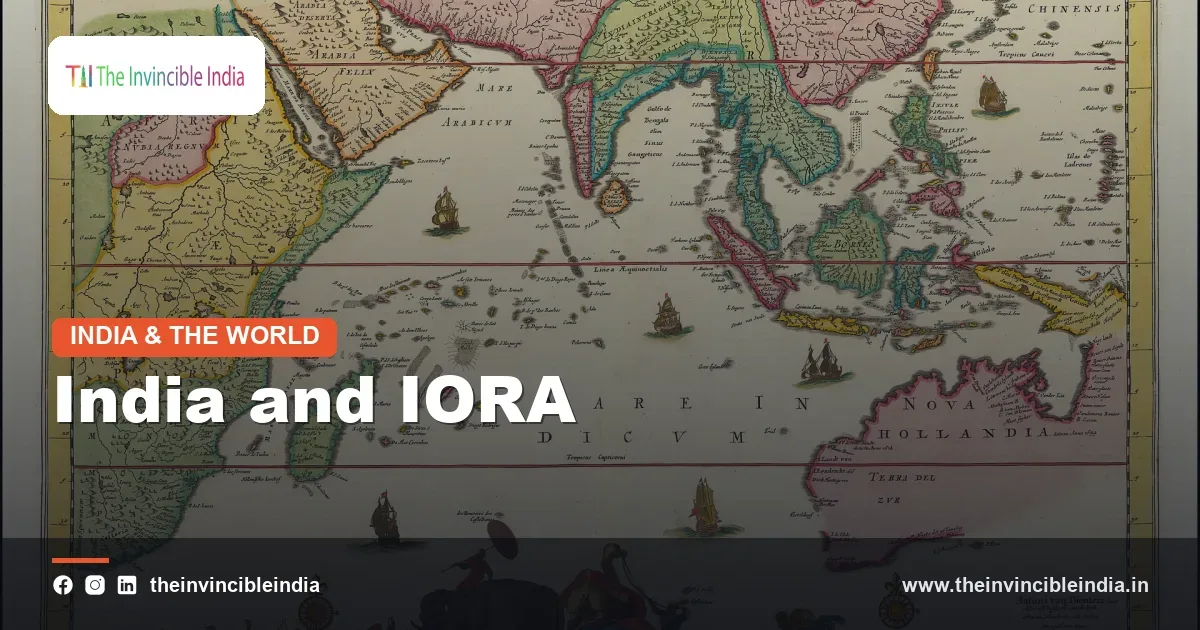
The Indian Ocean Rim Association (IORA) is an intergovernmental organisation of 23 Indian Ocean littoral and island states, founded in 1997 and headquartered in Ebene, Mauritius, that promotes regional cooperation, sustainable growth and balanced development around the Indian Ocean. India is one of its founding members and treats the Indian Ocean Rim Association as an important forum for its maritime diplomacy, economic outreach and vision of cooperative security in the region.
The association began as the Indian Ocean Rim Initiative and was formally launched in 1997 as the Indian Ocean Rim Association for Regional Cooperation (IOR-ARC). It was renamed the Indian Ocean Rim Association (IORA) in 2013. This explainer covers its origins, membership, priority areas, working method, India’s role and the challenges that shape what it can deliver.
| Attribute | Detail |
|---|---|
| Full name | Indian Ocean Rim Association (IORA), earlier the Indian Ocean Rim Association for Regional Cooperation (IOR-ARC) |
| Founded | 1997, following the Indian Ocean Rim Initiative begun in 1995 |
| Renamed IORA | 2013 |
| Headquarters | Ebene, Mauritius |
| Member States | 23 |
| Decision-making | Consensus-based; chairmanship rotates among members |
| Priority areas | Six: maritime safety and security, trade and investment facilitation, fisheries management, disaster risk management, tourism and cultural exchanges, academic, science and technology cooperation |
| Cross-cutting themes | Blue economy; women’s economic empowerment |
| India’s status | Founding member |
Key Takeaways
- The Indian Ocean Rim Association (IORA) was established in 1997 as the Indian Ocean Rim Association for Regional Cooperation and adopted its present name in 2013.
- IORA has 23 Member States spread across Africa, West Asia, South Asia, Southeast Asia and Oceania, and its secretariat is located in Ebene, Mauritius.
- IORA works on six priority areas, which are maritime safety and security, trade and investment facilitation, fisheries management, disaster risk management, tourism and cultural exchanges, and academic, science and technology cooperation.
- The blue economy and women’s economic empowerment are cross-cutting themes that run through all IORA priority areas.
- IORA takes decisions by consensus, and its cooperation is voluntary and project-based rather than treaty-binding.
- India is a founding member of IORA, and its Indian Ocean policy, including the SAGAR vision announced in 2015, aligns closely with the association’s emphasis on maritime security and sustainable growth.
What is the Indian Ocean Rim Association?
The Indian Ocean Rim Association is a regional organisation that brings together states bordering the Indian Ocean to cooperate on maritime, economic and development questions. It is an open, pragmatic forum rather than a bloc with a binding legal treaty, a customs union or a defence commitment.
The Indian Ocean is the third-largest ocean and carries a large share of the world’s seaborne trade, including most of the oil moved by sea between the Persian Gulf and the economies of Asia. Its rim spans the east coast of Africa, the Arabian Peninsula, South Asia, mainland and island Southeast Asia and the western coast of Australia. The countries involved differ widely in size, income and political systems, and IORA gives them a shared platform where such differences do not block practical work.
The organisation’s stated purpose is to build common understanding and mutually beneficial cooperation through a consensus-based, evolutionary and non-intrusive approach. It was designed to complement, rather than replace, other regional bodies such as the Association of Southeast Asian Nations (ASEAN), the South Asian Association for Regional Cooperation (SAARC), the Bay of Bengal Initiative for Multi-Sectoral Technical and Economic Cooperation (BIMSTEC), the African Union and the Gulf Cooperation Council.
How and when was IORA founded?
IORA was founded in March 1997 at a meeting in Mauritius, following an initiative that grew out of discussions between Mauritius, India and several other Indian Ocean states in the mid-1990s. The idea was strongly supported by South Africa after the end of apartheid, as the country returned to regional and international forums.
The initial group, the Indian Ocean Rim Initiative, was set up in 1995 and was converted into the Indian Ocean Rim Association for Regional Cooperation (IOR-ARC) in 1997. India was among the founding members, along with countries such as Australia, Kenya, Mauritius, Oman, Singapore, South Africa and Tanzania. In the early years, the organisation had a modest agenda and limited resources, and its activity was relatively low-key.
In the 2010s, the grouping was restructured. A Secretariat was strengthened in Mauritius, priority areas were defined, and the name was shortened to the Indian Ocean Rim Association (IORA) in 2013. A leaders’ summit held in Jakarta in 2017 produced the IORA Concord, a document that set out the organisation’s vision and recommitted the members to its priority areas. Later documents recognised the growing importance of the broader Indo-Pacific region for IORA’s membership and partners.
Which countries are members of IORA?
IORA has 23 Member States, drawn from across the Indian Ocean littoral and from island nations in the ocean itself. The member list covers a wide geographic and economic range, from large economies to small island states.
| Sub-region | Member States |
|---|---|
| Africa and western Indian Ocean | Comoros, Kenya, Madagascar, Mauritius, Mozambique, Seychelles, Somalia, South Africa, Tanzania |
| West Asia | Iran, Oman, United Arab Emirates, Yemen |
| South Asia | Bangladesh, India, Maldives, Sri Lanka |
| Southeast Asia | Indonesia, Malaysia, Singapore, Thailand |
| Oceania and Europe (overseas territories) | Australia; France (through its Indian Ocean territory of Réunion) |
Pakistan is not a member of IORA. The association also has Dialogue Partners, which include countries such as China, Japan, the United States, the United Kingdom, Germany, Italy, Egypt, South Korea and Turkey, as well as observers such as regional bodies. These partners can participate in discussions and projects but do not make decisions.
What are the priority areas of IORA?
IORA has six priority areas that guide its work programmes, and each of them is led or supported by working groups, expert bodies or coordinating Member States. These were set out in the early 2010s and have been refined since.
Maritime safety and security
Maritime safety and security covers piracy, illegal fishing, search and rescue, maritime domain awareness, shipping safety and the protection of sea lanes. This is the area that most directly connects to India’s security interests in the ocean.
Trade and investment facilitation
Trade and investment facilitation seeks to reduce non-tariff barriers, promote business contacts and share best practice in customs and trade. The Indian Ocean Rim Business Forum, a platform linking businesses in member countries, supports this work.
Fisheries management
Fisheries management aims at sustainable fishing and aquaculture, and the fight against illegal, unreported and unregulated fishing. A fisheries support unit has been set up under IORA to support information-sharing and capacity-building.
Disaster risk management
Disaster risk management responds to the region’s exposure to cyclones, tsunamis, floods and earthquakes. The 2004 Indian Ocean tsunami remains a defining memory, and early warning systems and relief coordination are central themes.
Tourism and cultural exchanges
Tourism and cultural exchanges promote sustainable tourism, people-to-people contact and cultural links across the rim, including heritage routes and festivals.
Academic, science and technology cooperation
Academic, science and technology cooperation encourages exchanges among universities and research institutions, ocean science, and technology transfer. The Indian Ocean Rim Academic Group (IORAG) is the main platform for this work.
What are the cross-cutting themes of IORA?
The two cross-cutting themes of IORA are the blue economy and women’s economic empowerment, and both apply across the six priority areas. They were highlighted because they connect economic growth with sustainability and inclusion.
The blue economy refers to the sustainable use of ocean resources for growth, jobs and livelihoods while protecting marine ecosystems. In the IORA context it covers fisheries and aquaculture, ports and shipping, renewable ocean energy, marine biotechnology, coastal tourism and seabed minerals. Ministerial declarations adopted by members in the mid-2010s gave the theme high political weight.
Women’s economic empowerment focuses on raising women’s participation in trade, entrepreneurship, fisheries, tourism and decision-making in the region. IORA has run programmes and dialogues on this subject, which have drawn on the experience of members from across the ocean.
How does IORA make decisions and who runs it?
IORA makes decisions by consensus among all Member States, and the organisation is led by a rotating chair, a Council of Ministers and a Secretariat in Mauritius. No member can be compelled to accept an outcome it does not agree to, and the organisation’s documents are mostly declarations and work plans rather than legally binding treaties.
- Council of Ministers (COM): the main decision-making body, usually composed of foreign ministers, which meets once a year.
- Committee of Senior Officials (CSO): prepares the work of the Council and reviews the implementation of decisions.
- Chair and Vice-Chair: Member States take the chair for a fixed term of about two years on a rotating basis, and the Vice-Chair succeeds in due course.
- Secretariat: based in Ebene, Mauritius, led by a Secretary-General and responsible for coordination, projects and communications.
- Working groups and support bodies: including those on trade and investment, the business forum, the academic group and sector-specific units.
The organisation depends largely on voluntary contributions and on member-led projects. The Special Fund, to which members contribute, finances selected activities. The budget and staff of the Secretariat are small relative to the organisation’s ambitions, a limitation that matters for the pace of delivery.
What is India’s role in the Indian Ocean Rim Association?
India is a founding member of IORA and plays an active role as a large economy, a major naval power in the region and a provider of training and technical assistance. It has also held the chairmanship of the association in the early 2010s, a period that coincided with the adoption of the present name.
India’s participation reflects the importance of the Indian Ocean to its trade, energy security and coastline of thousands of kilometres. The vast majority of India’s foreign trade by volume travels by sea, and its islands in the Bay of Bengal and the Arabian Sea sit along major shipping routes. For India, IORA is a way of engaging all the major littoral states, including partners in Africa and West Asia, through a single multilateral platform.
How does the SAGAR vision link to IORA?
The SAGAR vision, short for Security and Growth for All in the Region, is India’s policy approach to the Indian Ocean, announced by the Indian Prime Minister in Mauritius in 2015. It puts forward cooperation on maritime security, capacity-building, sustainable development and collective action, which fits closely with IORA’s own priorities.
India has since used the idea of SAGAR in its dealings with island states and coastal partners, and in 2025 it announced a broader vision named MAHASAGAR, which stands for Mutual and Holistic Advancement for Security and Growth Across Regions. Both frameworks emphasise a cooperative, inclusive approach to security, and they are often discussed in conjunction with the Indo-Pacific Oceans Initiative and India’s other maritime outreach efforts.
Why does the Indian Ocean Rim Association matter?
The Indian Ocean Rim Association matters because the Indian Ocean is a major corridor for global trade and energy, and because many of its coastal states face shared challenges that no single country can solve alone. The region contains critical choke points, rich fisheries, vulnerable island states and fast-growing economies.
The strategic relevance has increased in recent years as global attention shifts to the Indo-Pacific. Naval presence, port investments and infrastructure projects by several major powers have increased the stakes of ocean governance. IORA provides an inclusive setting in which smaller and middle-income countries can voice their priorities alongside larger ones, and it offers a path for rule-based, cooperative responses to common problems such as illegal fishing, plastic pollution, climate impacts and natural disasters.
The organisation is also notable for its diversity. Its membership brings together states from the Global South with a few advanced economies, so it can serve as a bridge between development priorities and technology and capital from larger partners.
What are the challenges facing IORA?
The main challenges facing IORA are its limited resources, the weight of consensus-based decision-making, the diversity of members’ interests and the overlap with other regional organisations. These factors explain why its achievements have been more incremental than dramatic.
- Limited funding and capacity: the Secretariat is small, and projects rely on voluntary funding and the goodwill of members.
- Consensus constraints: the need for agreement can slow decisions or dilute outcomes, particularly where members disagree on sensitive political or security matters.
- Diverse interests: members range from large economies to small island states, and their priorities, capacities and alignments differ.
- Institutional overlap: ASEAN, BIMSTEC, SAARC, the African Union and other bodies work on similar issues, which can lead to duplication.
- Great-power competition: strategic rivalry in the Indian Ocean can make it harder to build common positions on security.
- Political sensitivities: some regional states are not members, and the approach to security issues has to remain cautious.
Despite these limits, supporters argue that IORA’s non-intrusive approach is also its strength, because it allows cooperation to continue where more ambitious institutions might stall. The challenge for members, including India, is to turn declarations into funded projects and to give the association a clearer role in the Indo-Pacific architecture.
Timeline of the Indian Ocean Rim Association
| Year | Milestone |
|---|---|
| 1995 | Indian Ocean Rim Initiative begins, led by Mauritius with support from India, South Africa and others |
| 1997 | IOR-ARC formally launched in Mauritius |
| 2011 | Priority areas set out and the grouping is restructured around them |
| 2013 | Name changed to the Indian Ocean Rim Association (IORA) |
| 2015 | India announces the SAGAR vision in Mauritius |
| 2017 | Leaders’ summit in Jakarta; IORA Concord adopted |
| Mid-2010s | Blue economy given prominence through ministerial declarations |
| 2025 | India announces the MAHASAGAR vision for regional maritime cooperation |
Bottom Line
The Indian Ocean Rim Association is the broadest multilateral forum for Indian Ocean states, built on consensus and voluntary cooperation across six priority areas and two cross-cutting themes. For India, IORA complements bilateral maritime diplomacy and the SAGAR approach, though its influence depends on stronger resources and a clearer focus on delivery.
Frequently Asked Questions
What is the Indian Ocean Rim Association and when was it founded?
The Indian Ocean Rim Association (IORA) is an intergovernmental organisation of Indian Ocean littoral and island states, founded in 1997 and headquartered in Ebene, Mauritius. It started as the Indian Ocean Rim Association for Regional Cooperation (IOR-ARC) and was renamed IORA in 2013.
How many members does IORA have?
IORA has 23 Member States from Africa, West Asia, South Asia, Southeast Asia and Oceania, including India, Australia, Indonesia, Iran, Kenya, South Africa and the United Arab Emirates. It also has Dialogue Partners, such as China, Japan, the United States and the United Kingdom, which take part in discussions without voting.
What are the priority areas of IORA?
IORA has six priority areas: maritime safety and security, trade and investment facilitation, fisheries management, disaster risk management, tourism and cultural exchanges, and academic, science and technology cooperation. The blue economy and women’s economic empowerment are treated as cross-cutting themes across all six.
Is India a founding member of IORA?
Yes, India is a founding member of IORA and has been involved since the Indian Ocean Rim Initiative of the mid-1990s. India has also chaired the association and uses it as one of the platforms for its Indian Ocean policy, including the SAGAR vision announced in 2015.
How does IORA take decisions?
IORA takes decisions by consensus among its Member States, with a Council of Ministers meeting annually and a Committee of Senior Officials preparing its work. The chair rotates among members, and the Secretariat in Mauritius coordinates activities, which are mostly voluntary and project-based.
What are the main challenges facing IORA?
The main challenges are limited funding and staff, the slow pace of consensus-based decisions, the diversity of members’ interests and overlap with other regional organisations. Great-power competition in the Indian Ocean also complicates efforts to build common positions on security.
{“@context”:”https://schema.org”,”@graph”:[{“@type”:”FAQPage”,”mainEntity”:[{“@type”:”Question”,”name”:”What is the Indian Ocean Rim Association and when was it founded?”,”acceptedAnswer”:{“@type”:”Answer”,”text”:”The Indian Ocean Rim Association (IORA) is an intergovernmental organisation of Indian Ocean littoral and island states, founded in 1997 and headquartered in Ebene, Mauritius. It started as the Indian Ocean Rim Association for Regional Cooperation (IOR-ARC) and was renamed IORA in 2013.”}},{“@type”:”Question”,”name”:”How many members does IORA have?”,”acceptedAnswer”:{“@type”:”Answer”,”text”:”IORA has 23 Member States from Africa, West Asia, South Asia, Southeast Asia and Oceania, including India, Australia, Indonesia, Iran, Kenya, South Africa and the United Arab Emirates. It also has Dialogue Partners, such as China, Japan, the United States and the United Kingdom, which take part in discussions without voting.”}},{“@type”:”Question”,”name”:”What are the priority areas of IORA?”,”acceptedAnswer”:{“@type”:”Answer”,”text”:”IORA has six priority areas: maritime safety and security, trade and investment facilitation, fisheries management, disaster risk management, tourism and cultural exchanges, and academic, science and technology cooperation. The blue economy and women’s economic empowerment are treated as cross-cutting themes across all six.”}},{“@type”:”Question”,”name”:”Is India a founding member of IORA?”,”acceptedAnswer”:{“@type”:”Answer”,”text”:”Yes, India is a founding member of IORA and has been involved since the Indian Ocean Rim Initiative of the mid-1990s. India has also chaired the association and uses it as one of the platforms for its Indian Ocean policy, including the SAGAR vision announced in 2015.”}},{“@type”:”Question”,”name”:”How does IORA take decisions?”,”acceptedAnswer”:{“@type”:”Answer”,”text”:”IORA takes decisions by consensus among its Member States, with a Council of Ministers meeting annually and a Committee of Senior Officials preparing its work. The chair rotates among members, and the Secretariat in Mauritius coordinates activities, which are mostly voluntary and project-based.”}},{“@type”:”Question”,”name”:”What are the main challenges facing IORA?”,”acceptedAnswer”:{“@type”:”Answer”,”text”:”The main challenges are limited funding and staff, the slow pace of consensus-based decisions, the diversity of members’ interests and overlap with other regional organisations. Great-power competition in the Indian Ocean also complicates efforts to build common positions on security.”}}]}]}


