

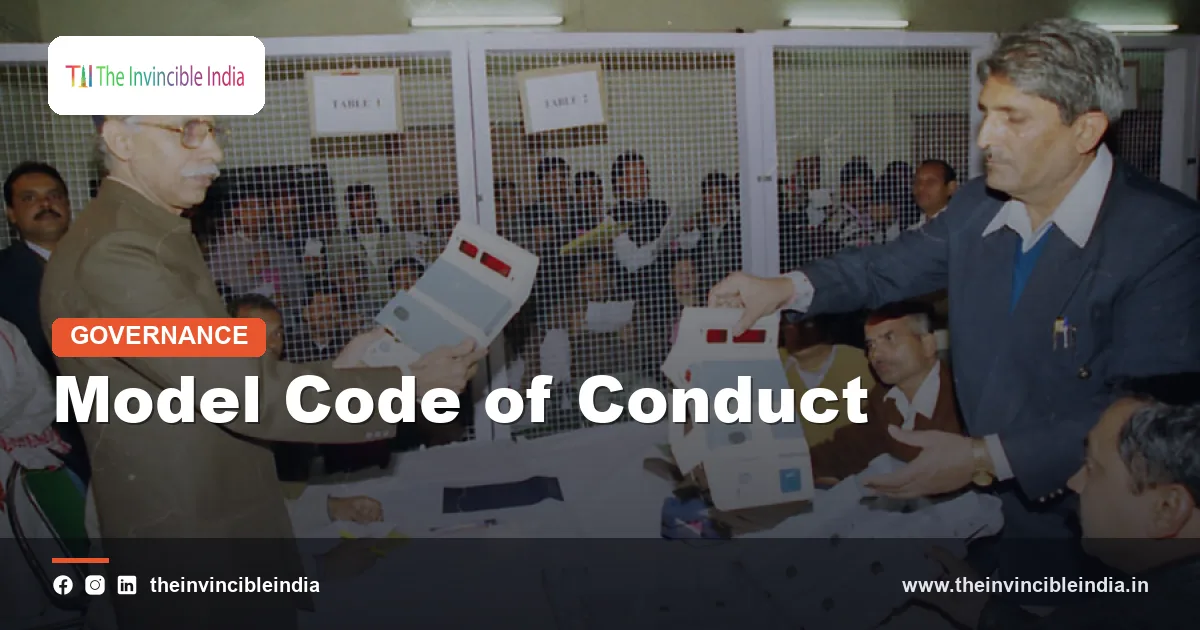
The Model Code of Conduct (MCC) is a set of norms issued by the Election Commission of India (ECI) that political parties, candidates and governments are expected to follow from the announcement of an election schedule until the results are declared. The Model Code of Conduct aims to keep campaigning fair, stop the ruling party from misusing official power, and preserve a level playing field between contestants.
The Model Code of Conduct has no dedicated Act of Parliament behind it. It grew out of voluntary agreement among parties and is enforced by the Election Commission under the powers given to it by Article 324 of the Constitution. This explainer covers how the Model Code of Conduct began, what it says, when it applies, how it is enforced and where it is debated. Last updated: 12 October 2026.
| Attribute | Detail |
|---|---|
| Full name | Model Code of Conduct for the Guidance of Political Parties and Candidates |
| Issued and enforced by | Election Commission of India (ECI) |
| Constitutional basis of ECI powers | Article 324 (superintendence, direction and control of elections) |
| Legal status | Not a statute; a consensus-based code enforced through the ECI’s constitutional authority |
| First experiment | Kerala Assembly elections, 1960 |
| Comes into force | On the announcement of the election schedule by the ECI |
| Ends | When the election process is completed and results are declared |
| Applies to | Political parties, candidates, and the central and state governments in the election area |
| Part on the “party in power” | Added in 1979 |
Key Takeaways
- The Model Code of Conduct is a set of election-time norms issued by the Election Commission of India for political parties, candidates and governments.
- The Model Code of Conduct comes into force the moment the Election Commission announces the election schedule and stays in force until the election process is completed.
- The Model Code of Conduct originated in the 1960 Kerala Assembly elections and was developed through consultation with political parties rather than imposed by law.
- The Model Code of Conduct is not a statute, but many of its prohibitions overlap with corrupt practices and offences defined in the Representation of the People Act, 1951 and criminal law.
- The Model Code of Conduct includes a special set of rules for the party in power, restricting new schemes, official-machinery use and advertising at public expense during elections.
- The Election Commission enforces the Model Code of Conduct through notices, warnings, censure and temporary bans on campaigning, rather than by imposing criminal punishment directly.
What is the Model Code of Conduct?
The Model Code of Conduct is a written set of guidelines, drawn up by the Election Commission of India with the agreement of political parties, that governs how parties and candidates behave during an election. It covers speeches, meetings, processions, polling-day conduct, the use of official resources and, since the 2010s, election manifestos.
The word “model” signals that the code is meant as a standard of good practice for all participants, not as a penal law. Parties accepted its principles voluntarily, and the ECI turned that acceptance into a working discipline. The code applies to every election the ECI conducts, including Lok Sabha, State Legislative Assembly, and by-elections, so it covers both national and state-level contests.
The purpose of the Model Code of Conduct can be summed up in three aims: keeping campaign speech civil, preventing bribery and intimidation of voters, and ensuring that governments in office do not use public power or money to tilt the contest.
How did the Model Code of Conduct originate and evolve?
The Model Code of Conduct began in Kerala in 1960, when the state administration prepared a code of conduct for the Assembly elections to be followed by parties and candidates on a voluntary basis. The experiment is widely regarded as the origin of the present code, and it worked because parties were consulted and agreed to abide by it.
The Election Commission circulated the idea more widely during the Lok Sabha elections of 1962, when it shared a code with recognised parties and obtained their cooperation. In 1967, ahead of the general elections and State Assembly elections, the Commission again appealed to parties and state governments to follow a common code, and the practice slowly became expected rather than exceptional.
Several later steps shaped the code into its present form:
- 1960: Kerala’s administration frames the first code for Assembly elections.
- 1962 and 1967: The ECI circulates the code ahead of general elections and seeks the support of parties and state governments.
- 1979: After consultation with parties, the ECI adds provisions about the party in power, in response to concerns about governments using their position during elections.
- 1991: The ECI consolidates and reissues the code, and it begins to be enforced with much greater visibility in the following years.
- 2013 onwards: After a Supreme Court direction in a case about election promises, guidelines on election manifestos are added to the code.
The code has continued to evolve through ECI instructions that respond to new campaign methods, including paid news, social media and electronic advertising.
When does the Model Code of Conduct come into force and when does it end?
The Model Code of Conduct comes into force as soon as the Election Commission announces the schedule of an election, usually through a press note, and it remains in force until the election process is completed. The code therefore does not wait for the date of notification or nomination; it begins when the schedule is made public.
For a general election to the Lok Sabha, the code applies across the entire country. For a State Assembly election, the code applies in the whole state going to the polls. For a by-election, the code applies in the district or districts in which the constituency lies. The central government is also bound where the election affects the area covered, which is why Union ministers face restrictions during state elections in that state.
The code lapses when the ECI announces that the election process is complete, which typically happens once the results are declared and the relevant House or Assembly is constituted. This means the MCC period can last several weeks, and in multi-phase elections it covers every phase.
What does the general conduct section say?
The general conduct section of the Model Code of Conduct tells parties and candidates to avoid activities that are corrupt practices or electoral offences and to criticise rivals only on their policies, programmes and public record. Criticism based on unverified allegations, and attacks on private life that are not connected to public activity, are prohibited.
The main rules in this section are:
- No appeal to caste or communal feelings to secure votes.
- No use of places of worship, such as temples, mosques, churches or gurdwaras, as a forum for election propaganda.
- No bribing of voters, no intimidation of voters, and no impersonation.
- No activity that aggravates existing differences or creates tension between different castes, communities, religions or languages.
- No use of a person’s land, building or wall for flags, banners or slogans without that person’s permission.
Some of these prohibitions mirror offences listed in the Representation of the People Act, 1951 (RP Act) and in the Indian Penal Code and its successor criminal law, so a violation may also lead to a legal case in addition to ECI action.
What rules apply to meetings and processions?
The Model Code of Conduct requires parties and candidates to inform the local police authorities in advance of the venue and time of any meeting so that law and order arrangements can be made. Organisers must also check that no prohibitory orders are in force at the place and must obtain permission for loudspeakers and similar facilities.
Processions are subject to additional checks. Organisers should decide the route and time of a procession in advance, ensure it does not obstruct traffic, and inform the police. If two parties plan processions along the same route at the same time, the organisers must coordinate with the police to avoid clashes. Carrying and burning effigies representing opponents is not allowed.
These rules are designed to make campaign events predictable for local officials, so that rival rallies do not collide and the ordinary public is not disrupted.
What are the rules on polling day and at the polling booth?
On polling day, the Model Code of Conduct requires parties and candidates to cooperate with election officials, and it bans campaigning within the polling area during the period fixed by law. Section 126 of the Representation of the People Act, 1951 bars public election meetings and propaganda in a constituency for 48 hours before the close of polling, commonly called the silence period.
The main polling-day norms include the following:
- Party workers should wear identity badges, and the slips given to voters should be plain paper without symbol, candidate name or party name.
- No distribution of liquor on the polling day and during the 48 hours before polling in the area.
- No canvassing within 100 metres of a polling station.
- No vehicle should be used to carry voters to and from the polling station in an organised way where this amounts to a corrupt practice.
- Only voters and persons with a valid pass from the Election Commission are allowed inside the polling booth.
The code also lets duly authorised observers, appointed by the ECI, report complaints directly. Candidates may bring a complaint about conduct at a polling station to the observer, who will take it up with the Commission.
What special rules apply to the party in power?
The Model Code of Conduct places special restrictions on the party in power, meaning the ruling party at the Centre or in a State, so that it cannot use its position to gain an unfair advantage. This section was added in 1979 after parties raised concerns about governments using official machinery during elections.
The key restrictions on the party in power are:
- Ministers must not combine official visits with election work or use official machinery or personnel for election work.
- Government vehicles, aircraft and guest houses must not be used for campaigning, and public premises must not be monopolised for rallies.
- Public funds must not be spent on advertisements in newspapers or other media that publicise the achievements of the government for election purposes.
- No new grants, projects or schemes may be announced, and no foundation stones for projects may be laid, once the code is in force.
- No promises of construction of roads, supply of drinking water or similar facilities that could influence voters.
- No ad hoc appointments in government and public sector bodies that could influence voters.
Ongoing works and schemes that have already begun may continue, but new benefits cannot be announced. Where a government wants to proceed with a project that appears to violate these limits, it must seek the Commission’s clearance.
What does the Model Code of Conduct say about election manifestos?
The Model Code of Conduct says that election manifestos must not contain anything that goes against the ideals and principles of the Constitution, must reflect the Directive Principles of State Policy, and must not induce voters through promises that undermine free and fair elections. These provisions were added after the Supreme Court in 2013 directed the ECI to frame guidelines on manifestos in consultation with parties.
The manifesto guidelines have three main strands:
- Parties should explain the rationale for promises and indicate, in broad terms, the means of meeting their financial requirements.
- Promises should be reasonable and should not exploit voters’ trust.
- Manifestos should not be released during the prohibitory period of the last phase’s silence period in a multi-phase election, so that no party gains an advantage.
Debate continues about where welfare promises end and inducements begin. The Supreme Court has said that such promises are not by themselves a corrupt practice, while the Commission has asked parties to be more transparent about costs and funding.
Is the Model Code of Conduct legally binding, and how is it enforced?
The Model Code of Conduct is not a statute and is not directly enforceable in court as a law, but it is enforced by the Election Commission through its powers under Article 324 and through the Representation of the People Act, 1951. In practice, governments, officials and parties treat it as binding, and courts have generally supported the Commission’s authority to enforce it.
Parliamentary committees and legal commissions have, at various times, discussed whether the code should be given statutory backing. The Election Commission has often argued that elections must be completed within a short time and that legal proceedings would be slower than the Commission’s own immediate action. Supporters of a statute say that clear penalties would deter violations. The question remains a standing topic of electoral reform debate.
How the Election Commission enforces the code
The Election Commission enforces the Model Code of Conduct through a network of district election officers, returning officers, observers, flying squads and static surveillance teams that monitor campaigning and spending. Complaints can be lodged with these officers, and since 2018 the ECI’s cVIGIL mobile application has allowed citizens to report violations with photographs and videos.
The Commission’s usual range of responses to a violation, from mildest to strongest, includes:
| Response | What it involves |
|---|---|
| Notice | The ECI asks the party or candidate to explain the alleged violation. |
| Advisory or warning | The Commission advises the person to avoid similar conduct and cautions about future action. |
| Censure | The ECI formally criticises the conduct in a written order. |
| Temporary campaign ban | The person is barred from addressing public meetings, rallies, roadshows or interviews for a fixed period. |
| Criminal complaint | The ECI directs registration of a case where the act amounts to an offence under law. |
The Commission may also order the transfer of officials, ban election-time advertisements or cancel or countermand a poll in extreme cases of bribery or violence.
What are some notable Model Code of Conduct actions?
The Model Code of Conduct became far more visible in the 1990s, when the then Chief Election Commissioner T. N. Seshan used it strictly to curb spending, bribery and misuse of official machinery. His tenure is often cited as the point at which the code became a serious working discipline rather than a polite request.
Later examples show the range of ECI action:
- The Commission has temporarily barred leaders of several parties from campaigning for fixed periods after speeches judged to violate the code, including in the 2019 general election.
- The ECI has cancelled or countermanded polls in constituencies where money power was seen to compromise the process.
- The Commission has directed governments to withdraw or defer announcements of schemes and has ordered the removal of political advertisements and portraits from public property.
- In 2017, a seven-judge Supreme Court bench in Abhiram Singh v. C. D. Commachen held that seeking votes on the basis of the religion, caste, community or language of a candidate or voter is a corrupt practice under the RP Act.
What criticisms and reform proposals surround the Model Code of Conduct?
Criticism of the Model Code of Conduct falls into two broad groups: that it is too weak because it lacks statutory penalties, and that its long duration in multi-phase elections can delay governance and welfare delivery. Some critics also say that action is inconsistent across parties and across cases, while the Commission responds that each case turns on its facts.
Reform ideas that have been discussed include giving the code statutory backing, shortening the election calendar so that restrictions last for less time, creating clearer definitions of hate speech and inducements, and bringing new media and online advertising more firmly within the code. Others argue that voluntary compliance backed by quick Commission action is more suitable for the short window of an election than a slower legal route.
Bottom Line
The Model Code of Conduct is India’s main framework of election-time discipline: a consensus-built code that began in Kerala in 1960 and is now enforced nationwide by the Election Commission from the announcement of the schedule to the end of the election process. It is not a law, yet it constrains speech, spending and government announcements in ways that shape every campaign.
Frequently Asked Questions
What is the Model Code of Conduct in simple words?
The Model Code of Conduct is a set of election-time rules issued by the Election Commission of India for parties, candidates and governments. It tells them how to campaign, hold meetings and behave on polling day. Its goal is to ensure that elections are free, fair and conducted on a level playing field.
When does the Model Code of Conduct start and end?
The Model Code of Conduct starts when the Election Commission announces the election schedule. It remains in force until the election process is completed and results are declared. In multi-phase elections, it applies for the whole period across all phases.
Is the Model Code of Conduct a law?
The Model Code of Conduct is not a law passed by Parliament. It is a consensus-based code enforced by the Election Commission under Article 324 of the Constitution. However, some of its prohibitions overlap with offences under the Representation of the People Act, 1951 and criminal law, so violations can also lead to legal action.
Who must follow the Model Code of Conduct?
Political parties, candidates and their supporters must follow the Model Code of Conduct. The party in power in the Centre or State must also follow additional rules on announcements, official machinery and public funds. Government officials deployed on election duty are also expected to act neutrally.
What can the Election Commission do if the Model Code of Conduct is violated?
The Election Commission can issue a notice, warn, censure or temporarily bar a person from campaigning. It can also direct registration of a criminal complaint if an offence is involved, and in serious cases it can cancel or countermand a poll. The Commission does not itself impose jail terms, which are matters for the courts.
Where did the Model Code of Conduct come from?
The Model Code of Conduct originated in Kerala in 1960, when the administration prepared a voluntary code for the Assembly elections. The Election Commission extended it to wider use in 1962 and 1967 and added a section on the party in power in 1979. Manifesto guidelines were added after a Supreme Court direction in 2013.
{“@context”:”https://schema.org”,”@graph”:[{“@type”:”FAQPage”,”mainEntity”:[{“@type”:”Question”,”name”:”What is the Model Code of Conduct in simple words?”,”acceptedAnswer”:{“@type”:”Answer”,”text”:”The Model Code of Conduct is a set of election-time rules issued by the Election Commission of India for parties, candidates and governments. It tells them how to campaign, hold meetings and behave on polling day. Its goal is to ensure that elections are free, fair and conducted on a level playing field.”}},{“@type”:”Question”,”name”:”When does the Model Code of Conduct start and end?”,”acceptedAnswer”:{“@type”:”Answer”,”text”:”The Model Code of Conduct starts when the Election Commission announces the election schedule. It remains in force until the election process is completed and results are declared. In multi-phase elections, it applies for the whole period across all phases.”}},{“@type”:”Question”,”name”:”Is the Model Code of Conduct a law?”,”acceptedAnswer”:{“@type”:”Answer”,”text”:”The Model Code of Conduct is not a law passed by Parliament. It is a consensus-based code enforced by the Election Commission under Article 324 of the Constitution. However, some of its prohibitions overlap with offences under the Representation of the People Act, 1951 and criminal law, so violations can also lead to legal action.”}},{“@type”:”Question”,”name”:”Who must follow the Model Code of Conduct?”,”acceptedAnswer”:{“@type”:”Answer”,”text”:”Political parties, candidates and their supporters must follow the Model Code of Conduct. The party in power in the Centre or State must also follow additional rules on announcements, official machinery and public funds. Government officials deployed on election duty are also expected to act neutrally.”}},{“@type”:”Question”,”name”:”What can the Election Commission do if the Model Code of Conduct is violated?”,”acceptedAnswer”:{“@type”:”Answer”,”text”:”The Election Commission can issue a notice, warn, censure or temporarily bar a person from campaigning. It can also direct registration of a criminal complaint if an offence is involved, and in serious cases it can cancel or countermand a poll. The Commission does not itself impose jail terms, which are matters for the courts.”}},{“@type”:”Question”,”name”:”Where did the Model Code of Conduct come from?”,”acceptedAnswer”:{“@type”:”Answer”,”text”:”The Model Code of Conduct originated in Kerala in 1960, when the administration prepared a voluntary code for the Assembly elections. The Election Commission extended it to wider use in 1962 and 1967 and added a section on the party in power in 1979. Manifesto guidelines were added after a Supreme Court direction in 2013.”}}]}]}


