

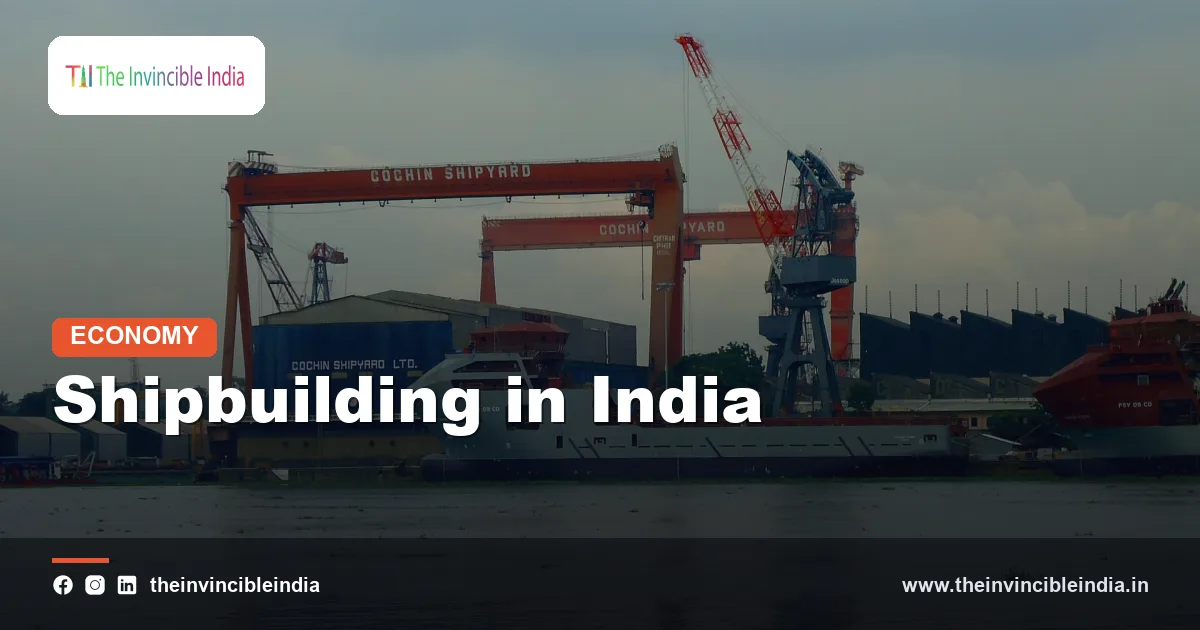
The shipbuilding industry in India is the sector that designs, builds and repairs vessels ranging from naval warships and submarines to cargo ships, tugs, dredgers and offshore support vessels, and it is dominated by a small group of public-sector shipyards under the Ministries of Defence and Ports, Shipping and Waterways. India is a very small player in global commercial shipbuilding, but it has strong capability in naval construction and a long coastline that gives it strategic reasons to expand.
The shipbuilding industry in India includes yards such as Cochin Shipyard Limited, Mazagon Dock Shipbuilders, Garden Reach Shipbuilders & Engineers, Hindustan Shipyard and Goa Shipyard, as well as private firms such as Larsen & Toubro and Swan Defence and Heavy Industries. This explainer covers the major yards, the split between warships and commercial ships, government policy, ship repair and ship-breaking, and the main challenges. Last updated: 12 October 2026.
| Attribute | Detail |
|---|---|
| Sector | Building, repair and refit of ships and marine structures |
| Main public-sector yards | Cochin Shipyard, Mazagon Dock, GRSE, Hindustan Shipyard, Goa Shipyard |
| Prominent private yards | Larsen & Toubro (Kattupalli and Hazira), Swan Defence and Heavy Industries |
| Largest customer for complex vessels | The Indian Navy and other defence services |
| Indigenous aircraft carrier | INS Vikrant, built at Cochin Shipyard and commissioned in 2022 |
| Key policy instruments | Shipbuilding Financial Assistance Policy (2016), Sagarmala, Maritime India Vision 2030 |
| Ship-breaking hub | Alang, Gujarat |
| Share of world commercial shipbuilding | Very small, well under one per cent of global output |
Key Takeaways
- The shipbuilding industry in India is concentrated in a handful of public-sector yards, with Cochin Shipyard, Mazagon Dock, GRSE, Hindustan Shipyard and Goa Shipyard as the best-known names.
- India has built complex warships domestically, including destroyers, frigates, corvettes, submarines under licence, and the aircraft carrier INS Vikrant, which was commissioned in 2022.
- India accounts for only a very small share of global commercial shipbuilding, which is led by China, South Korea and Japan.
- The Shipbuilding Financial Assistance Policy, introduced in 2016, offers financial support to Indian yards for contracts won from Indian and, in some cases, foreign owners.
- Alang in Gujarat is one of the world’s largest ship-breaking yards, and India regulates ship recycling through the Recycling of Ships Act, 2019.
- High cost of finance, dependence on imported equipment and engines, a thin ancillary industry and limited scale are the main reasons India lags in commercial shipbuilding.
What is the shipbuilding industry in India?
The shipbuilding industry in India is the set of shipyards, design agencies, equipment suppliers and repair facilities that produce and maintain ships for the Indian Navy, the Coast Guard, commercial shipping lines, ports and offshore operators. It includes new construction, repair, refit and conversion of vessels.
Shipbuilding is a heavy-engineering activity that depends on steel, machinery, electronics, skilled labour and design capability. A single ship may involve thousands of suppliers, so the industry is considered a “mother industry” that supports steel, engineering, electrical, electronics and shipping services.
India’s maritime sector is old: Indian shipwrights built seagoing vessels for centuries, and the Bombay Dockyard in the eighteenth century built warships for the British. The modern industry took shape after Independence, when the government set up or took over yards to support both naval needs and the shipping fleet.
Which are the major public-sector shipyards in India?
India’s major public-sector shipyards are Cochin Shipyard Limited, Mazagon Dock Shipbuilders Limited, Garden Reach Shipbuilders & Engineers Limited, Hindustan Shipyard Limited and Goa Shipyard Limited. Each has a distinct role and location, and together they have built most of India’s large vessels.
| Shipyard | Location | Administrative ministry | Known for |
|---|---|---|---|
| Cochin Shipyard Limited (CSL) | Kochi, Kerala | Ports, Shipping and Waterways | Largest shipyard in India by size; commercial ships; INS Vikrant; ship repair |
| Mazagon Dock Shipbuilders Limited (MDL) | Mumbai, Maharashtra | Defence | Destroyers, frigates, Scorpene-class submarines |
| Garden Reach Shipbuilders & Engineers (GRSE) | Kolkata, West Bengal | Defence | Corvettes, fast attack craft, patrol vessels |
| Hindustan Shipyard Limited (HSL) | Visakhapatnam, Andhra Pradesh | Defence | Commercial and naval vessels, submarine refits |
| Goa Shipyard Limited (GSL) | Vasco da Gama, Goa | Defence | Offshore patrol vessels, fast patrol vessels |
Cochin Shipyard Limited
Cochin Shipyard Limited, based in Kochi, is the biggest shipyard in the country and began operations in the 1970s. The yard builds and repairs commercial vessels and has the capacity to handle large ships. Cochin Shipyard built INS Vikrant, India’s first indigenously designed and built aircraft carrier.
Mazagon Dock Shipbuilders Limited
Mazagon Dock Shipbuilders Limited, in Mumbai, is among the oldest and most important builders of warships in India. The yard has built guided-missile destroyers and stealth frigates, and it built submarines of the Kalvari class under a technology-transfer arrangement with a French shipbuilder.
Garden Reach Shipbuilders & Engineers
Garden Reach Shipbuilders & Engineers, or GRSE, in Kolkata traces its history to the nineteenth century and is one of the oldest naval builders. GRSE builds anti-submarine corvettes, patrol vessels and also exports vessels to other countries.
Hindustan Shipyard and Goa Shipyard
Hindustan Shipyard Limited, in Visakhapatnam, began as a private yard before the government took it over, and it launched India’s first oceangoing steel ship built in an Indian yard. Goa Shipyard Limited, in Vasco da Gama, has specialised in patrol vessels and other small and medium naval and Coast Guard craft.
Which private companies build ships in India?
Private-sector shipbuilding in India is led by Larsen & Toubro, which operates shipyards at Kattupalli near Chennai and at Hazira near Surat, and by Swan Defence and Heavy Industries, which took over the Pipavav yard in Gujarat. These yards build naval vessels, offshore platforms and commercial ships.
Private yards have won contracts for naval patrol vessels, fleet support ships and offshore vessels. Several private yards, however, have faced financial stress and insolvency over the years, partly because shipbuilding is capital-intensive and prone to demand cycles. Smaller private yards in states such as Goa, Gujarat, Kerala and West Bengal build tugs, barges, fishing boats, inland vessels and workboats.
What is the difference between warship and commercial shipbuilding in India?
Warship shipbuilding in India is driven by government orders, long project timelines and a focus on technology, while commercial shipbuilding depends on competing for orders from ship owners on price, delivery time and financing. India has been strong in the first category and weak in the second.
| Feature | Warship building | Commercial shipbuilding |
|---|---|---|
| Main customer | Indian Navy, Coast Guard | Shipping lines, ports, offshore firms |
| Orders awarded by | Government procurement, usually restricted to Indian yards | Global tenders and competition |
| Competitive pressure | Lower; focus on capability and security | High; price and delivery time decide |
| Typical vessels | Destroyers, frigates, corvettes, submarines, carriers | Bulk carriers, tankers, container ships, tugs, dredgers |
| India’s strength | Significant and growing | Limited |
Naval work has helped India develop design capability through the Navy’s own design organisation and has built a large base of workers and suppliers. Commercial orders, on the other hand, usually go to the large yards of East Asia, which benefit from scale, mature supply chains and cheaper finance.
How big is the shipbuilding industry in India compared with the world?
The shipbuilding industry in India is very small compared with the global industry, with a share of world commercial shipbuilding that is well below one per cent. China, South Korea and Japan together build the great majority of the world’s ships by tonnage.
That small share contrasts with India’s position as a large trading nation. A large proportion of India’s foreign trade by volume moves by sea, yet most of the ships that carry it are foreign-built and foreign-owned. This gap is why successive governments have called shipbuilding a priority sector for self-reliance, jobs and strategic autonomy.
India’s strengths include a strong engineering talent pool, experience in naval work and lower labour costs than some advanced economies. Its weaknesses include higher financing costs, smaller yards and gaps in domestic production of key components.
What government policies support shipbuilding in India?
The main government policies supporting shipbuilding in India are the Shipbuilding Financial Assistance Policy, the Sagarmala programme and the Maritime India Vision 2030, along with defence procurement policies that favour Indian yards. These measures aim to make Indian yards more competitive and to build the supporting ecosystem.
- Shipbuilding Financial Assistance Policy (SBFAP), 2016: Offers financial assistance to Indian shipyards on the contract value of ships they build, and it was later extended with modifications.
- Sagarmala (2015): A port-led development programme intended to modernise ports and support maritime industries, including shipbuilding clusters.
- Maritime India Vision 2030: A strategy document released by the Ministry of Ports, Shipping and Waterways that sets out goals for ports, shipping, inland waterways and shipbuilding, followed by a longer-term vision to 2047.
- Infrastructure status for large ships: Larger vessels have been brought within the framework of infrastructure assets to ease access to long-term finance.
- Defence procurement preference: Under policies such as Make in India, naval projects increasingly use Indian yards and indigenous content.
Further steps have included proposals for shipbuilding clusters, greater support for ship financing and measures to develop domestic suppliers.
What is the role of ship repair in the Indian shipbuilding industry?
Ship repair is a significant part of the shipbuilding industry in India because it needs less capital than new construction and brings steady, high-skill work. Cochin Shipyard, Hindustan Shipyard and several smaller yards offer dry-docking, hull repairs, conversion and refit services for Indian and foreign vessels.
Repair work is easier to win because it depends on location, speed and price. India’s position on major east-west shipping lanes makes its ports convenient for ships needing maintenance. Naval refits, including mid-life upgrades and submarine refits, also keep public-sector yards busy.
What is ship-breaking and why is Alang important?
Ship-breaking is the process of dismantling end-of-life ships to recover steel and other materials, and Alang in Gujarat’s Bhavnagar district is one of the largest ship-breaking yards in the world. Alang began operating in the 1980s and grew quickly because of its tidal beach, large workforce and strong demand for recycled steel.
Alang’s importance is both economic and environmental. The yards supply re-rollable steel and other materials to Indian industry and support many jobs. At the same time, ship-breaking has raised concerns about worker safety and pollution, particularly from hazardous material such as asbestos and oils.
India has responded by regulating the activity, including through the Recycling of Ships Act, 2019 and by joining the Hong Kong International Convention on the safe and environmentally sound recycling of ships. Supreme Court directions earlier set standards for hazardous waste handling in ship-breaking. Many yards have upgraded facilities to meet international standards.
What are the main challenges facing the shipbuilding industry in India?
The main challenges facing the shipbuilding industry in India are high financing costs, a weak ancillary and component base, limited scale, long delivery times and competition from heavily supported foreign yards. Together, these factors make Indian yards less competitive on price and delivery schedules for commercial orders.
- Cost of finance: Ship owners look for low-cost, long-term credit and guarantees, which Indian yards often struggle to offer.
- Ancillary industry: Many key items, including marine engines, propulsion systems and electronics, are imported, which raises cost and delays.
- Scale and productivity: East Asian yards are far larger and have sustained orderbooks, which allow standardisation and lower unit costs.
- Delays and cost overruns: Some naval and public-sector projects have run late, which affects credibility with customers.
- Skills and design: The industry needs more trained welders, designers and project managers.
- Land and clearances: Setting up large new yards needs coastal land, environmental approvals and port connectivity.
Improvement efforts therefore focus on shipbuilding clusters, financing support, skilling and domestic manufacture of components.
Bottom Line
The shipbuilding industry in India is small in global terms but important strategically, with strong naval capability, a handful of established public-sector yards and a growing private presence. Its future depends on solving finance, supply-chain and scale problems so that Indian yards can win more commercial orders.
Frequently Asked Questions
What is the shipbuilding industry in India?
The shipbuilding industry in India is the sector that builds, repairs and refits ships, from warships and submarines to cargo vessels, tugs and offshore support ships. It is led by public-sector yards such as Cochin Shipyard and Mazagon Dock and includes private yards like Larsen & Toubro. The industry supports the Navy, the Coast Guard and commercial shipping.
Which are the biggest shipyards in India?
The biggest and best-known shipyards in India are Cochin Shipyard Limited, Mazagon Dock Shipbuilders Limited, Garden Reach Shipbuilders & Engineers, Hindustan Shipyard Limited and Goa Shipyard Limited. Larsen & Toubro and Swan Defence and Heavy Industries are prominent private yards. Cochin Shipyard is generally regarded as the largest in the country.
Which ship was the first aircraft carrier built in India?
INS Vikrant is the first aircraft carrier designed and built in India. It was built at Cochin Shipyard Limited and commissioned into the Indian Navy in 2022. The ship marked a major step in India’s warship-building capability.
Why is India’s share in global shipbuilding so small?
India’s share in global shipbuilding is small because its yards face higher financing costs, smaller scale and a limited domestic base of marine equipment makers. East Asian countries such as China, South Korea and Japan have larger yards and mature supply chains. India has therefore focused on naval and niche commercial vessels.
What is the Shipbuilding Financial Assistance Policy?
The Shipbuilding Financial Assistance Policy is a government scheme introduced in 2016 to give financial support to Indian shipyards for ships they build. The aim is to help yards compete with foreign builders who receive support in their own countries. The policy has been extended and revised since its introduction.
What is Alang known for?
Alang, in Gujarat, is known as one of the world’s largest ship-breaking yards, where old ships are dismantled for steel and other materials. It began operations in the 1980s and supplies recycled steel to Indian industry. The activity is regulated by the Recycling of Ships Act, 2019 and related environmental and safety rules.
{“@context”:”https://schema.org”,”@graph”:[{“@type”:”FAQPage”,”mainEntity”:[{“@type”:”Question”,”name”:”What is the shipbuilding industry in India?”,”acceptedAnswer”:{“@type”:”Answer”,”text”:”The shipbuilding industry in India is the sector that builds, repairs and refits ships, from warships and submarines to cargo vessels, tugs and offshore support ships. It is led by public-sector yards such as Cochin Shipyard and Mazagon Dock and includes private yards like Larsen & Toubro. The industry supports the Navy, the Coast Guard and commercial shipping.”}},{“@type”:”Question”,”name”:”Which are the biggest shipyards in India?”,”acceptedAnswer”:{“@type”:”Answer”,”text”:”The biggest and best-known shipyards in India are Cochin Shipyard Limited, Mazagon Dock Shipbuilders Limited, Garden Reach Shipbuilders & Engineers, Hindustan Shipyard Limited and Goa Shipyard Limited. Larsen & Toubro and Swan Defence and Heavy Industries are prominent private yards. Cochin Shipyard is generally regarded as the largest in the country.”}},{“@type”:”Question”,”name”:”Which ship was the first aircraft carrier built in India?”,”acceptedAnswer”:{“@type”:”Answer”,”text”:”INS Vikrant is the first aircraft carrier designed and built in India. It was built at Cochin Shipyard Limited and commissioned into the Indian Navy in 2022. The ship marked a major step in India’s warship-building capability.”}},{“@type”:”Question”,”name”:”Why is India’s share in global shipbuilding so small?”,”acceptedAnswer”:{“@type”:”Answer”,”text”:”India’s share in global shipbuilding is small because its yards face higher financing costs, smaller scale and a limited domestic base of marine equipment makers. East Asian countries such as China, South Korea and Japan have larger yards and mature supply chains. India has therefore focused on naval and niche commercial vessels.”}},{“@type”:”Question”,”name”:”What is the Shipbuilding Financial Assistance Policy?”,”acceptedAnswer”:{“@type”:”Answer”,”text”:”The Shipbuilding Financial Assistance Policy is a government scheme introduced in 2016 to give financial support to Indian shipyards for ships they build. The aim is to help yards compete with foreign builders who receive support in their own countries. The policy has been extended and revised since its introduction.”}},{“@type”:”Question”,”name”:”What is Alang known for?”,”acceptedAnswer”:{“@type”:”Answer”,”text”:”Alang, in Gujarat, is known as one of the world’s largest ship-breaking yards, where old ships are dismantled for steel and other materials. It began operations in the 1980s and supplies recycled steel to Indian industry. The activity is regulated by the Recycling of Ships Act, 2019 and related environmental and safety rules.”}}]}]}


