

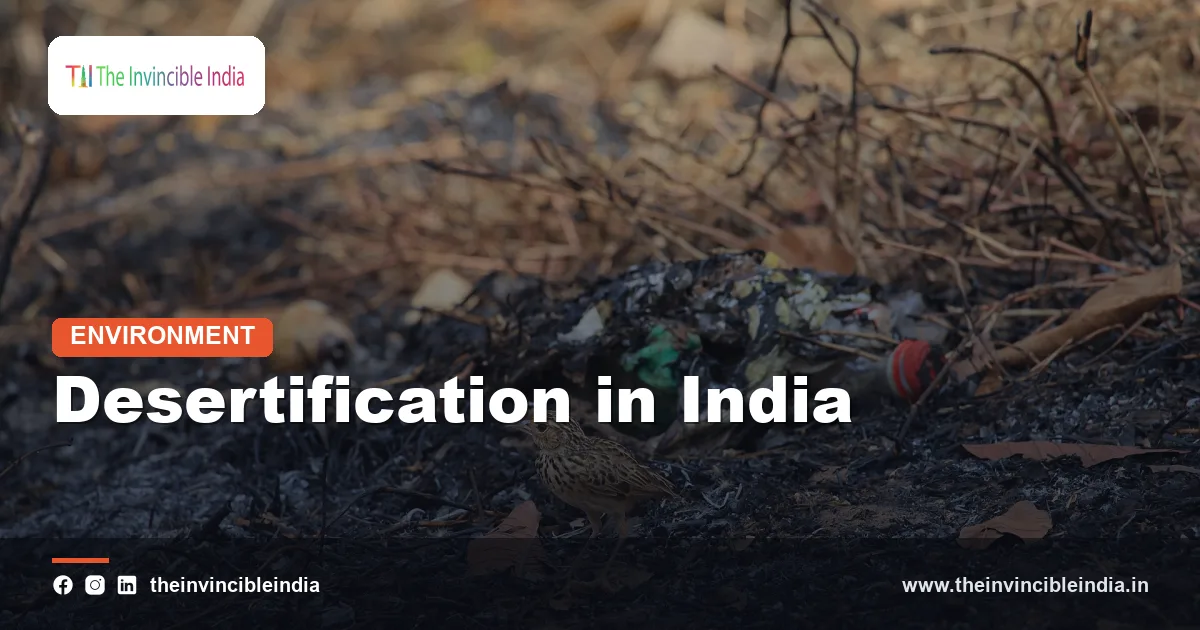
In India, desertification is the process by which productive land in arid, semi-arid and dry sub-humid regions loses its biological and economic productivity, and it forms one part of the wider problem of land degradation, which affects close to a third of the country’s total geographical area. The causes combine natural factors such as low rainfall and strong winds with human pressures such as overgrazing, deforestation, unsustainable farming and poor water management.
India is a party to the United Nations Convention to Combat Desertification (UNCCD) and hosted its 14th Conference of the Parties (COP14) in 2019. This explainer sets out what land degradation means in India, which processes drive it, where it is worst, what the national atlas shows and what the country is doing to restore land.
| Attribute | Detail |
|---|---|
| Definition (UNCCD) | Land degradation in arid, semi-arid and dry sub-humid areas caused by climatic variation and human activities |
| Share of India’s land degraded | Close to 30 per cent of total geographical area (ISRO/SAC atlas, 2018-19 assessment) |
| Main national assessment | Desertification and Land Degradation Atlas of India, by the Space Applications Centre (SAC), ISRO |
| Largest process | Water erosion, followed by vegetation degradation and wind erosion |
| International treaty | UNCCD, adopted in 1994 and in force since 1996; secretariat in Bonn, Germany |
| India’s COP | COP14 hosted at Greater Noida, September 2019; Delhi Declaration |
| Restoration pledge | 26 million hectares of degraded land by 2030 |
| Nodal ministry | Ministry of Environment, Forest and Climate Change (MoEFCC) |
Key Takeaways
- Close to 30 per cent of India’s total geographical area is classified as degraded, according to the ISRO Space Applications Centre’s Desertification and Land Degradation Atlas.
- Water erosion is the largest single process of land degradation in India, ahead of vegetation degradation and wind erosion.
- Desertification, in UNCCD terms, refers specifically to degradation in dryland regions and is not the same as the spread of existing deserts such as the Thar.
- India hosted the 14th Conference of the Parties to the UNCCD at Greater Noida in September 2019, which ended with the Delhi Declaration.
- India has pledged to restore 26 million hectares of degraded land by 2030, a target announced at UNCCD COP14.
- Responses to land degradation in India include watershed development, afforestation, soil health programmes, sustainable irrigation and community-based restoration.
What is desertification and how does it differ from land degradation?
Desertification is land degradation in arid, semi-arid and dry sub-humid areas, and it does not mean that deserts are literally expanding into green land. The United Nations Convention to Combat Desertification defines it as degradation resulting from various factors, including climatic variations and human activities, which reduces the land’s ability to support crops, grazing or forest.
Land degradation is the broader term. It covers any decline in the biological or economic productivity of land, in drylands or in wetter regions, including erosion in the hills, salt build-up in irrigated plains and loss of soil fertility on farms. Desertification is therefore a subset of land degradation that is confined to drylands.
In everyday Indian usage the two terms are often combined, and official reports speak of “desertification and land degradation” together. The distinction matters mainly in international treaties and in technical assessments.
How much of India’s land is degraded?
Close to 30 per cent of India’s total geographical area, roughly 97 million hectares, was classified as degraded in the national atlas based on satellite data for 2018-19. The share has changed only modestly between successive assessments, which suggests that new degradation in some regions has been offset by improvement in others.
The Desertification and Land Degradation Atlas of India is produced by the Space Applications Centre (SAC) in Ahmedabad, an institution of the Indian Space Research Organisation (ISRO), with support from the environment ministry. It maps land degradation across the whole country using multi-season satellite imagery and has been published in several editions since the early 2000s, each covering a different assessment period.
Because the atlas uses a consistent method over time, it allows researchers to see not only the extent of degradation but also whether specific states are gaining or losing healthy land. Readers should note that exact figures vary slightly between editions and that the atlas should be consulted directly for current numbers.
What are the main processes that degrade land in India?
The main processes that degrade land in India are water erosion, wind erosion, vegetation degradation, salinity and alkalinity, waterlogging and loss of soil organic carbon. The atlas classifies degraded land by these processes, and in most states one or two of them dominate.
| Process | What happens | Typical regions |
|---|---|---|
| Water erosion | Rain and runoff carry away topsoil, creating gullies and rills | Hilly and rolling terrain; Deccan plateau; ravines of central India |
| Wind erosion | Strong winds lift and move loose, dry soil and form sand dunes | Thar desert region of Rajasthan and Gujarat |
| Vegetation degradation | Forests and grasslands thin out through felling, grazing and fire | Forest belts in eastern and central India; Himalayan slopes |
| Salinity and alkalinity | Salts accumulate in the soil, harming crops | Irrigated plains and coastal areas |
| Waterlogging | Poor drainage keeps soil saturated and kills roots | Canal-irrigated regions |
| Soil organic carbon loss | Fertility and soil structure decline as organic matter falls | Intensively cultivated croplands |
How does water erosion degrade land in India?
Water erosion degrades land in India by washing away fertile topsoil during intense monsoon rainfall, and it is the biggest single contributor to degraded land in the country. Bare slopes, sparse vegetation and heavy seasonal rain make the Indian subcontinent especially vulnerable.
The loss of topsoil reduces crop yields, because the upper layer holds most of the nutrients and organic matter. The eroded soil also ends up in rivers and reservoirs, where it reduces storage capacity and clogs irrigation canals. In some parts of central and northern India, the repeated flow of water has carved deep ravines that take land out of cultivation altogether.
Because the underlying causes are removal of ground cover and unmanaged runoff, solutions typically involve contour bunding, check dams, terracing and planting of vegetation on slopes.
What role does wind erosion play, and where does it occur?
Wind erosion plays its main role in the arid western part of India, where strong, dry winds move loose sand and soil over large distances. The Thar desert, which spreads across western Rajasthan and into Gujarat, Punjab and Haryana, is the main affected region, and shifting dunes can bury farmland, roads and settlements.
The Thar is a natural desert, and its existence does not by itself count as desertification. The concern is that the surrounding semi-arid margins can be pushed towards desert-like conditions when vegetation is stripped by overgrazing and fuelwood collection. Protective measures include shelterbelts, sand-dune stabilisation using grasses and shrubs, and the planting of drought-tolerant trees.
The Indira Gandhi Canal, which brings river water to parts of the Thar, has transformed agriculture in some districts but has also brought waterlogging and salinity problems where drainage is poor.
How do salinity, waterlogging and falling soil carbon harm land?
Salinity, waterlogging and falling soil organic carbon harm land by reducing the soil’s fertility and its ability to hold water and support roots. These problems are especially linked to irrigated and intensively farmed regions rather than to wild landscapes.
- Salinity and alkalinity: salts rise to the surface when irrigation water evaporates, leaving crusts that stunt or kill crops.
- Waterlogging: canal seepage and inadequate drainage raise the water table until it saturates the root zone.
- Soil organic carbon loss: continuous cropping, residue burning and heavy chemical use reduce organic matter, which weakens soil structure and microbial life.
Soil organic carbon is also important for climate, because healthy soils store carbon and degraded soils release it. Improving soil carbon is therefore both an agricultural and a climate-mitigation goal.
Which Indian states are most affected by desertification and land degradation?
Rajasthan, Maharashtra, Gujarat, Karnataka, Jharkhand, Odisha, Madhya Pradesh and Telangana are among the states with the largest degraded areas in the national atlas, though the proportion of degraded land in a state varies by assessment. The states differ in their dominant processes, so the nature of the problem changes from region to region.
- Rajasthan and Gujarat: wind erosion, salinity and vegetation loss in arid and semi-arid zones.
- Maharashtra, Karnataka and Telangana: water erosion and vegetation degradation across the Deccan plateau, where rainfall is uncertain.
- Jharkhand and Odisha: loss of forest and vegetation, mining impacts and water erosion in hilly terrain.
- Madhya Pradesh: ravines, water erosion and agricultural land degradation.
- Himalayan and north-eastern states: erosion, landslides and vegetation degradation linked to steep slopes and shifting cultivation.
Rankings change with each atlas edition, so state-level comparisons should always cite the assessment year.
What are the causes of land degradation in India?
Land degradation in India is caused by a mix of natural conditions and human activity, with unsustainable land use usually the deciding factor. Natural drivers include erratic monsoon rainfall, steep slopes and drought, but these become damaging when land is mismanaged.
Human drivers
- Deforestation and the conversion of forest and grassland to farmland or settlements.
- Overgrazing by livestock on limited common pastures.
- Over-extraction of groundwater and faulty irrigation practices.
- Excessive use of chemical fertilisers and loss of organic matter.
- Mining, quarrying and infrastructure construction.
- Rapid urban expansion on fertile land.
Natural and climatic drivers
Droughts, floods, heavy downpours and rising temperatures stress soils and vegetation. Climate change is expected to intensify extreme rainfall and dry spells, which can accelerate erosion and make recovery harder.
What is the UN Convention to Combat Desertification and India’s role in it?
The United Nations Convention to Combat Desertification (UNCCD) is the international treaty adopted in 1994 to address land degradation in drylands, and India is a party to it. The convention came into force in 1996, and its secretariat is located in Bonn, Germany. Its governing body, the Conference of the Parties, meets regularly to review progress and set priorities.
India hosted the 14th session, COP14, at Greater Noida in September 2019, with the Ministry of Environment, Forest and Climate Change leading the arrangements. The session concluded with the Delhi Declaration, which called for greater action on land restoration, drought resilience and the principle of land degradation neutrality. India then held the COP presidency until the next session.
The Convention connects to Sustainable Development Goal 15.3, which calls for a land degradation-neutral world by 2030. Each year, 17 June is observed as the World Day to Combat Desertification and Drought.
What is India’s land restoration pledge and the Bonn Challenge?
India has pledged to restore 26 million hectares of degraded land by 2030, a goal announced at COP14 in 2019 that raised an earlier target of 21 million hectares. The pledge links with the Bonn Challenge, a global effort launched in 2011 by Germany and the International Union for Conservation of Nature (IUCN) to restore 150 million hectares of degraded and deforested land by 2020 and 350 million hectares by 2030.
India joined the Bonn Challenge with a voluntary restoration commitment, and the larger 2030 figure reflects the country’s intention to combine afforestation, agroforestry, watershed work and recovery of degraded farmland. Restoration here means improving the productivity and ecological function of land, not only planting trees.
| Year | Milestone |
|---|---|
| 1994 | UNCCD adopted |
| 1996 | UNCCD enters into force |
| 2011 | Bonn Challenge launched |
| 2019 | India hosts UNCCD COP14; restoration target raised to 26 million hectares by 2030 |
What measures is India taking to fight land degradation?
India fights land degradation through a combination of national missions, watershed programmes, afforestation, soil management schemes and scientific research. No single scheme covers the whole problem, so the response is spread across ministries.
- Watershed development: programmes under the Pradhan Mantri Krishi Sinchayee Yojana (PMKSY) and its predecessors treat catchments with check dams, trenches, bunds and vegetation to conserve soil and water.
- Afforestation: the National Mission for a Green India, a part of the National Action Plan on Climate Change, aims to increase and improve forest and tree cover.
- Soil health management: the Soil Health Card scheme, launched in 2015, advises farmers on balanced nutrient use.
- Employment-linked works: the Mahatma Gandhi National Rural Employment Guarantee Act (MGNREGA) funds water-conservation and land-development works.
- Research: institutions such as the Central Arid Zone Research Institute (CAZRI) in Jodhpur, set up in 1952, study dryland farming and sand-dune stabilisation.
- Green wall initiatives: the Aravalli landscape restoration effort aims to slow desert expansion towards the north.
Community participation is considered essential. Village committees and farmer groups often manage grazing, planting and water structures, and sustained local ownership is a major factor in whether restored land stays productive.
Bottom Line
Desertification and land degradation affect close to a third of India’s land and threaten farm incomes, water security and rural livelihoods. The country’s international commitments, particularly the 26 million hectare restoration pledge, give a clear target, but success depends on soil and water management at the level of the village and the farm.
Frequently Asked Questions
What is desertification in simple terms?
Desertification is the degradation of land in dry regions so that it can no longer support crops, grazing or forest. It is caused by climatic variation and human activities such as overgrazing and deforestation, and it does not mean that natural deserts are simply spreading.
How much of India is affected by land degradation?
Close to 30 per cent of India’s total geographical area is degraded, according to the ISRO Space Applications Centre’s atlas based on 2018-19 satellite data. That is roughly 97 million hectares, and the figure has shifted only slightly between assessments.
Which state in India is most affected by desertification?
Rajasthan is the state most closely associated with desertification because it contains most of the Thar desert and its dryland margins. Maharashtra, Gujarat, Karnataka, Jharkhand and Odisha also have large degraded areas, though rankings vary with the assessment year.
What was India’s role at UNCCD COP14?
India hosted the 14th Conference of the Parties to the UNCCD at Greater Noida in September 2019. The meeting adopted the Delhi Declaration, and India announced that it would restore 26 million hectares of degraded land by 2030.
What is the Bonn Challenge?
The Bonn Challenge is a global effort launched in 2011 by Germany and the IUCN to restore 150 million hectares of degraded and deforested land by 2020 and 350 million hectares by 2030. India has made a voluntary pledge under it, which was expanded at COP14.
What can be done to stop land degradation in India?
Land degradation can be reduced through watershed development, afforestation, sustainable grazing, efficient irrigation and better soil management. Programmes such as the Soil Health Card scheme, the National Mission for a Green India and community-led restoration all contribute.
{“@context”:”https://schema.org”,”@graph”:[{“@type”:”FAQPage”,”mainEntity”:[{“@type”:”Question”,”name”:”What is desertification in simple terms?”,”acceptedAnswer”:{“@type”:”Answer”,”text”:”Desertification is the degradation of land in dry regions so that it can no longer support crops, grazing or forest. It is caused by climatic variation and human activities such as overgrazing and deforestation, and it does not mean that natural deserts are simply spreading.”}},{“@type”:”Question”,”name”:”How much of India is affected by land degradation?”,”acceptedAnswer”:{“@type”:”Answer”,”text”:”Close to 30 per cent of India’s total geographical area is degraded, according to the ISRO Space Applications Centre’s atlas based on 2018-19 satellite data. That is roughly 97 million hectares, and the figure has shifted only slightly between assessments.”}},{“@type”:”Question”,”name”:”Which state in India is most affected by desertification?”,”acceptedAnswer”:{“@type”:”Answer”,”text”:”Rajasthan is the state most closely associated with desertification because it contains most of the Thar desert and its dryland margins. Maharashtra, Gujarat, Karnataka, Jharkhand and Odisha also have large degraded areas, though rankings vary with the assessment year.”}},{“@type”:”Question”,”name”:”What was India’s role at UNCCD COP14?”,”acceptedAnswer”:{“@type”:”Answer”,”text”:”India hosted the 14th Conference of the Parties to the UNCCD at Greater Noida in September 2019. The meeting adopted the Delhi Declaration, and India announced that it would restore 26 million hectares of degraded land by 2030.”}},{“@type”:”Question”,”name”:”What is the Bonn Challenge?”,”acceptedAnswer”:{“@type”:”Answer”,”text”:”The Bonn Challenge is a global effort launched in 2011 by Germany and the IUCN to restore 150 million hectares of degraded and deforested land by 2020 and 350 million hectares by 2030. India has made a voluntary pledge under it, which was expanded at COP14.”}},{“@type”:”Question”,”name”:”What can be done to stop land degradation in India?”,”acceptedAnswer”:{“@type”:”Answer”,”text”:”Land degradation can be reduced through watershed development, afforestation, sustainable grazing, efficient irrigation and better soil management. Programmes such as the Soil Health Card scheme, the National Mission for a Green India and community-led restoration all contribute.”}}]}]}


