

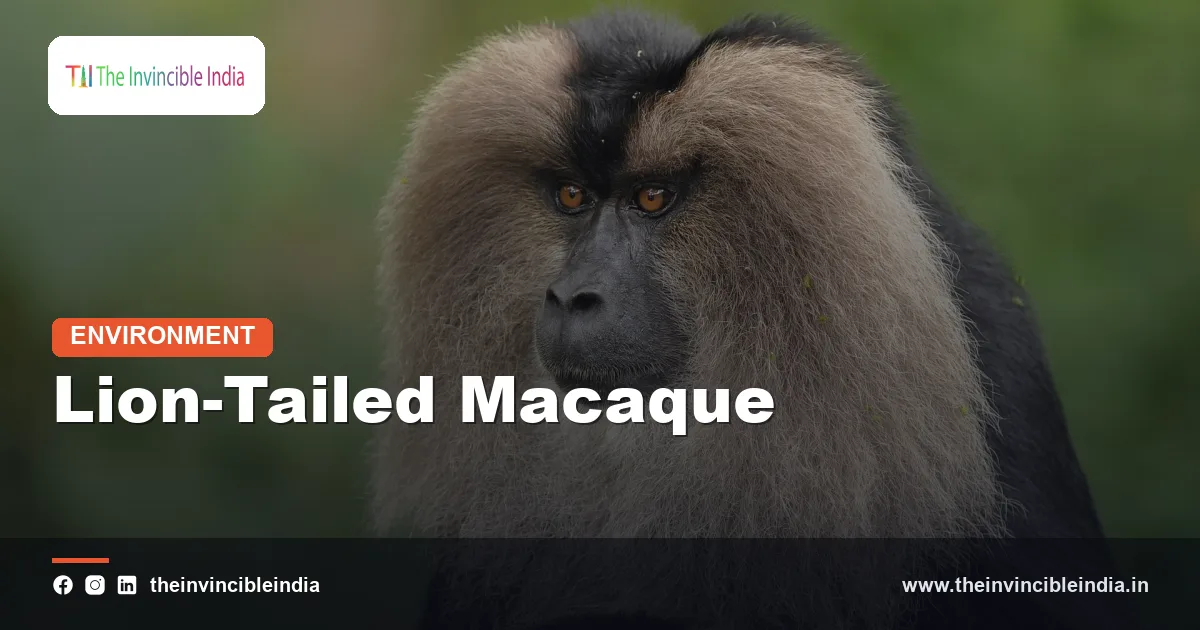
The lion-tailed macaque (Macaca silenus) is an endangered Old World monkey found only in the rainforests of the Western Ghats in southern India, recognisable by its black body, silver-grey mane and tufted, lion-like tail. Because the species lives almost entirely in the canopy of evergreen forest and depends on fruit, it is highly sensitive to forest loss, and its surviving population is split into small, isolated groups across Karnataka, Kerala and Tamil Nadu.
This explainer covers what the lion-tailed macaque looks like, where it lives, what it eats, how it behaves, why it is threatened and what is being done to save it. It is written as a stable reference, so population figures are given only as broad, dated estimates.
| Attribute | Detail |
|---|---|
| Scientific name | Macaca silenus |
| Group | Old World monkey (family Cercopithecidae), genus Macaca |
| Range | Endemic to the Western Ghats of Karnataka, Kerala and Tamil Nadu |
| Habitat | Mature evergreen and semi-evergreen tropical rainforest, including shola forest margins |
| Conservation status | Endangered on the IUCN Red List |
| Legal protection in India | Schedule I of the Wildlife (Protection) Act, 1972; CITES Appendix I |
| Wild population | Estimated at only a few thousand individuals in total |
| Key stronghold | Silent Valley National Park, Kerala, along with Anamalai, Periyar and Agasthyamalai landscapes |
Key Takeaways
- The lion-tailed macaque is endemic to the Western Ghats, meaning it occurs naturally nowhere else in the world.
- The lion-tailed macaque is classed as Endangered by the IUCN, and its wild population is estimated at only a few thousand animals.
- The lion-tailed macaque is a canopy specialist that depends on fruiting rainforest trees, so breaks in the forest canopy directly threaten its survival.
- Habitat fragmentation from plantations, roads, dams and settlements has divided the lion-tailed macaque into many small, isolated subpopulations.
- The lion-tailed macaque is protected under Schedule I of India’s Wildlife (Protection) Act, 1972, the highest level of legal protection.
- Conservation of the lion-tailed macaque combines protected areas, canopy bridges, community work in plantation landscapes and captive breeding.
What is the lion-tailed macaque?
The lion-tailed macaque is a medium-sized monkey of the genus Macaca, native to the rainforests of the Western Ghats, and it is one of the rarest and most threatened primates in India. Its scientific name is Macaca silenus, and it is sometimes called the wanderoo, a name that was historically applied to it in colonial-era writing.
The species belongs to the Old World monkeys, the group that includes langurs, baboons and other macaques. It is the only macaque of the Indian peninsula’s wet rainforest, and its closest relatives live in Southeast Asia. Other macaques in India, such as the rhesus macaque and the bonnet macaque, are far more widespread and tolerate human-modified landscapes much better.
Because the lion-tailed macaque is restricted to a narrow mountain range and to one forest type, conservation biologists treat it as a flagship species. Protecting its habitat also protects a wide range of other rainforest plants and animals of the Western Ghats.
What does a lion-tailed macaque look like?
A lion-tailed macaque has glossy black fur, a striking silver-grey to whitish mane that frames the face like a ruff, and a slender tail ending in a tuft, which gives the species its name. The face itself is black and hairless, which makes the pale mane stand out clearly against the dark forest.
Adults are stocky, with males noticeably larger than females. A typical adult male weighs several kilograms more than a female, and the body is built for moving along thick branches rather than running on the ground. The tail is held in a gentle curve and is not prehensile, so it does not grasp branches the way some New World monkey tails do.
The distinctive mane and tail tuft are the easiest field marks. They separate this species from the bonnet macaque and from the Nilgiri langur, a leaf-eating monkey with which it often shares forest space.
Where does the lion-tailed macaque live?
The lion-tailed macaque lives only in the southern Western Ghats, in scattered patches of rainforest across Karnataka, Kerala and Tamil Nadu. The range stretches from the forests of Uttara Kannada in Karnataka southwards through the hills of Kerala to the southern tip of the Ghats in Tamil Nadu.
The species prefers mature, tall, evergreen forest at middle elevations, and it is rarely found in dry or deciduous woodland. Its range has been broken into many separate blocks, and the largest and best-known populations occur in a handful of protected landscapes.
Major strongholds
- Silent Valley National Park, Kerala: a largely undisturbed rainforest block and one of the best-protected habitats for the species.
- Anamalai hills (Kerala and Tamil Nadu): including the Anamalai Tiger Reserve and the Valparai plateau, where forest is interspersed with tea and coffee estates.
- Periyar and neighbouring forests, Kerala: part of a large contiguous rainforest region in the central Western Ghats.
- Agasthyamalai and Kalakad-Mundanthurai landscape: in the far south, spanning Kerala and Tamil Nadu.
- Parts of Karnataka’s Western Ghats: including the Sharavathi valley and forests around Sirsi in Uttara Kannada, which hold the northernmost populations.
Why is Silent Valley important for the lion-tailed macaque?
Silent Valley is important because it protects a large, relatively intact rainforest where the lion-tailed macaque has lived with little disturbance. The valley lies in the Palakkad district of Kerala, in the Nilgiri hills, and it was declared a national park in 1984.
The area became a national symbol of conservation in the 1970s and early 1980s, when a proposed hydroelectric project on the Kunthipuzha river threatened to flood a part of the forest. Scientists, writers and citizens argued that the project would destroy a unique rainforest and the macaque habitat inside it, and the proposal was eventually abandoned. The episode is widely cited in India as an early example of a public environmental movement succeeding in protecting an ecosystem.
Today Silent Valley, together with neighbouring protected areas, forms part of a larger forested landscape in the Nilgiri Biosphere Reserve. It remains a reference habitat for studying the species in a natural setting.
What does the lion-tailed macaque eat?
The lion-tailed macaque eats mainly fruit, supplemented with seeds, leaves, buds, flowers, insects and occasionally small animals. Fruit forms the largest part of the diet whenever it is available, and the animals travel through their home range to follow fruiting trees through the seasons.
The diet makes the macaque an important seed disperser. By eating fruit and moving on, the monkeys carry seeds away from parent trees and help rainforest plants regenerate. When fruit is scarce, the group may rely more on insects, young leaves and other foods, but a reliable supply of rainforest fruit remains central to its survival.
This dependence on a varied, seasonal food supply is one reason the species struggles in plantations. A tea or coffee estate may offer a few food plants, but it rarely provides the year-round diversity that mature forest does.
How does the lion-tailed macaque live and behave?
The lion-tailed macaque is arboreal and lives in social groups, typically of around ten to twenty animals, with several females and their young and one or a few adult males. It spends nearly all of its time in the middle and upper layers of the forest canopy and comes to the ground only rarely, usually to cross gaps between forest patches.
Group life is organised around related females, and young females generally remain in the group where they were born while males move between groups. Adults communicate with a range of calls, and the loud call used to keep contact over long distances across the forest is a notable feature of the species.
Reproduction is slow. Females usually give birth to a single infant after a gestation of about six months, and they typically have an infant only once every couple of years. This slow breeding rate means that a small population recovers from losses very slowly.
Why is the lion-tailed macaque endangered?
The lion-tailed macaque is endangered mainly because its rainforest habitat has been cleared, fragmented and degraded across the Western Ghats. A species that depends on connected canopy cannot easily cross open ground, so every gap in the forest isolates groups from one another.
Main threats
- Habitat loss and fragmentation: conversion of forest to tea, coffee, cardamom and other plantations, as well as to agriculture and settlements.
- Roads and linear infrastructure: highways, power lines and railway lines that cut through forest, creating barriers and causing road deaths when monkeys cross on the ground.
- Dams and reservoirs: hydroelectric and irrigation projects that flood valley forest.
- Hunting and capture: historic hunting for meat and capture of animals for the pet trade, which have declined under legal protection but have not disappeared everywhere.
- Human-wildlife conflict: encounters near plantations and villages can lead to harassment, retaliation or injury.
- Small population risks: isolated groups face inbreeding and are more exposed to disease and chance events.
Climate change is an added long-term concern, because the species is tied to a specific forest type in a mountain range where suitable habitat can shift or shrink as temperature and rainfall patterns change.
How does habitat fragmentation affect the lion-tailed macaque?
Habitat fragmentation affects the lion-tailed macaque by splitting a once continuous population into many small groups that cannot easily meet, mate or move to new feeding areas. Smaller groups in smaller forest patches have less food, face a higher risk of local extinction and lose genetic variation over time.
Plantation landscapes illustrate the problem well. In the Anamalai region, for example, fragments of rainforest sit among tea and coffee estates and roads, and macaques sometimes have to cross open ground or move along estate roads to reach the next patch. Such crossings expose them to traffic, dogs and conflict with people.
Maintaining or restoring connections between forest patches, known as corridors, is therefore one of the most practical conservation priorities. Even narrow strips of canopy can help groups move between larger blocks of habitat.
How is the lion-tailed macaque protected in India?
The lion-tailed macaque is protected in India under Schedule I of the Wildlife (Protection) Act, 1972, which prohibits hunting and trade and carries the strongest penalties of any schedule. The species is also listed in Appendix I of CITES, the international convention that bans commercial trade in the most endangered species.
Much of its range falls inside national parks, wildlife sanctuaries and tiger reserves, which give legal and practical protection to the forest as well as to the animals. The Western Ghats were also inscribed as a UNESCO World Heritage Site in 2012, recognising their global biodiversity value.
| Level | Protection or measure |
|---|---|
| National law | Schedule I, Wildlife (Protection) Act, 1972 |
| International trade | CITES Appendix I |
| Global assessment | IUCN Red List: Endangered |
| Protected areas | National parks, sanctuaries and tiger reserves across the Western Ghats |
| Landscape recognition | Western Ghats UNESCO World Heritage Site (2012) |
| Ex-situ effort | Coordinated captive breeding in Indian zoos |
What conservation measures are helping the lion-tailed macaque?
Conservation measures for the lion-tailed macaque combine protecting core rainforest, reconnecting broken habitat, working with plantation owners and local communities, and maintaining a managed captive population. No single measure is enough, and the most effective programmes use several together.
- Protected areas: safeguarding large blocks of rainforest such as Silent Valley and Anamalai.
- Canopy bridges and crossings: rope and other aerial bridges installed over roads in plantation areas so that monkeys can cross without descending to the ground.
- Habitat restoration: replanting native rainforest trees, particularly fruit-bearing species, in degraded patches and along corridors.
- Community engagement: working with local residents and estate workers to reduce conflict, discourage feeding of wild monkeys and report road incidents.
- Research and monitoring: long-term field studies by universities and conservation organisations that track group size, movements and health.
- Captive breeding: a coordinated programme in Indian zoos, supported by the Central Zoo Authority, that maintains a back-up population.
Public awareness also matters. Because the species is not as widely known as the tiger or the elephant, conservation groups often use it to explain why intact rainforest matters for the whole Western Ghats ecosystem.
Why does the lion-tailed macaque matter for the Western Ghats?
The lion-tailed macaque matters because it is an indicator of healthy, connected rainforest, and its presence signals that the forest still has the fruiting trees and canopy structure that many other species also need. If the macaque disappears from a forest patch, it usually means the forest has lost quality as a whole.
The Western Ghats are one of the world’s recognised biodiversity hotspots, rich in species found nowhere else, and they supply water to millions of people in peninsular India through the rivers that rise there. Protecting the species therefore supports forest cover, water security and the many other plants and animals that share its habitat.
The macaque is also culturally and scientifically valuable. It offers researchers an opportunity to study primate ecology in a rainforest and gives India a distinctive species that represents the country’s southern forests in the same way that other flagship animals represent other regions.
Bottom Line
The lion-tailed macaque is a rainforest specialist of the Western Ghats whose future depends on keeping forest patches large, healthy and connected. Legal protection, canopy bridges, restoration and community cooperation have all helped, but with only a few thousand animals left in scattered groups, continued vigilance is essential.
Frequently Asked Questions
Where is the lion-tailed macaque found?
The lion-tailed macaque is found only in the rainforests of the Western Ghats in Karnataka, Kerala and Tamil Nadu. It lives in scattered forest patches, with important populations in Silent Valley, the Anamalai hills, Periyar and the Agasthyamalai region.
Why is it called the lion-tailed macaque?
The lion-tailed macaque is named for its tail, which is slender and ends in a tuft of hair like the tail of a lion. The silver-grey mane around its face adds to the lion-like appearance.
Is the lion-tailed macaque endangered?
Yes, the lion-tailed macaque is listed as Endangered on the IUCN Red List. Its wild population is estimated at only a few thousand animals, split into many isolated groups.
What does the lion-tailed macaque eat?
The lion-tailed macaque eats mainly fruit, along with seeds, leaves, flowers, insects and occasionally small animals. It follows fruiting rainforest trees through the seasons and helps to disperse their seeds.
What are the main threats to the lion-tailed macaque?
The main threats to the lion-tailed macaque are habitat loss and fragmentation from plantations, roads, dams and settlements. Hunting, capture for the pet trade, human-wildlife conflict and the risks of very small populations add to the pressure.
How is the lion-tailed macaque being conserved?
The lion-tailed macaque is conserved through legal protection under Schedule I of the Wildlife (Protection) Act, 1972, and through national parks, sanctuaries and tiger reserves. Canopy bridges over roads, forest restoration, community engagement and a coordinated captive breeding programme support these efforts.
{“@context”:”https://schema.org”,”@graph”:[{“@type”:”FAQPage”,”mainEntity”:[{“@type”:”Question”,”name”:”Where is the lion-tailed macaque found?”,”acceptedAnswer”:{“@type”:”Answer”,”text”:”The lion-tailed macaque is found only in the rainforests of the Western Ghats in Karnataka, Kerala and Tamil Nadu. It lives in scattered forest patches, with important populations in Silent Valley, the Anamalai hills, Periyar and the Agasthyamalai region.”}},{“@type”:”Question”,”name”:”Why is it called the lion-tailed macaque?”,”acceptedAnswer”:{“@type”:”Answer”,”text”:”The lion-tailed macaque is named for its tail, which is slender and ends in a tuft of hair like the tail of a lion. The silver-grey mane around its face adds to the lion-like appearance.”}},{“@type”:”Question”,”name”:”Is the lion-tailed macaque endangered?”,”acceptedAnswer”:{“@type”:”Answer”,”text”:”Yes, the lion-tailed macaque is listed as Endangered on the IUCN Red List. Its wild population is estimated at only a few thousand animals, split into many isolated groups.”}},{“@type”:”Question”,”name”:”What does the lion-tailed macaque eat?”,”acceptedAnswer”:{“@type”:”Answer”,”text”:”The lion-tailed macaque eats mainly fruit, along with seeds, leaves, flowers, insects and occasionally small animals. It follows fruiting rainforest trees through the seasons and helps to disperse their seeds.”}},{“@type”:”Question”,”name”:”What are the main threats to the lion-tailed macaque?”,”acceptedAnswer”:{“@type”:”Answer”,”text”:”The main threats to the lion-tailed macaque are habitat loss and fragmentation from plantations, roads, dams and settlements. Hunting, capture for the pet trade, human-wildlife conflict and the risks of very small populations add to the pressure.”}},{“@type”:”Question”,”name”:”How is the lion-tailed macaque being conserved?”,”acceptedAnswer”:{“@type”:”Answer”,”text”:”The lion-tailed macaque is conserved through legal protection under Schedule I of the Wildlife (Protection) Act, 1972, and through national parks, sanctuaries and tiger reserves. Canopy bridges over roads, forest restoration, community engagement and a coordinated captive breeding programme support these efforts.”}}]}]}


