

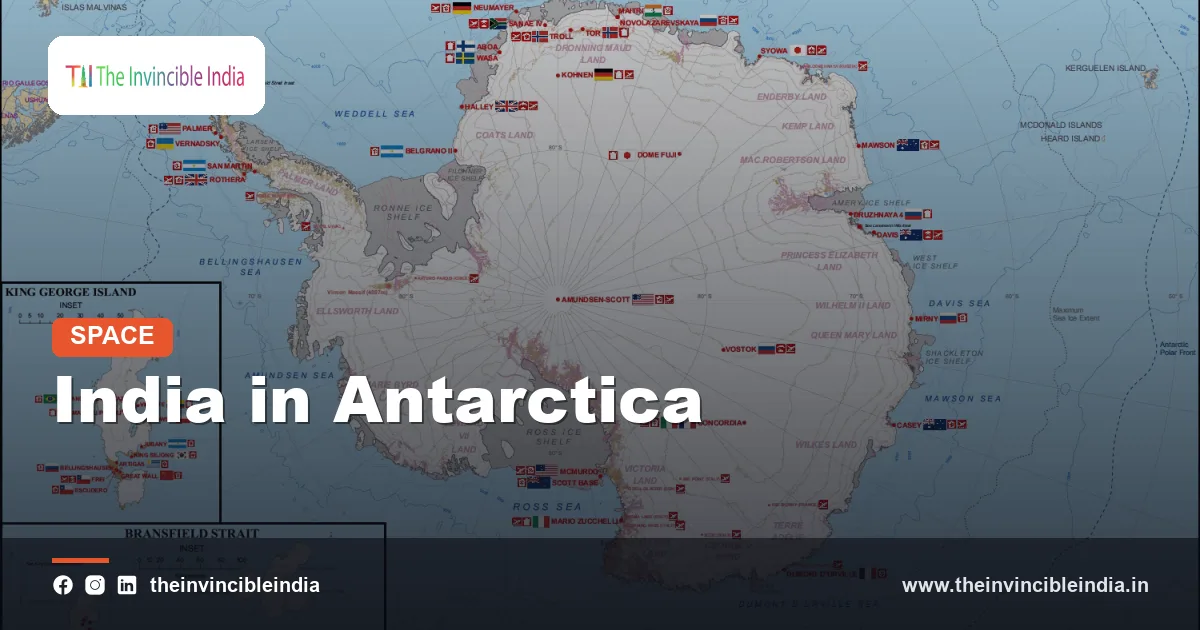
India’s Antarctic research programme is the country’s long-running scientific effort in Antarctica, begun with the first Indian expedition in 1981 and now run through the National Centre for Polar and Ocean Research (NCPOR) in Goa under the Ministry of Earth Sciences. India’s Antarctic research programme operates two year-round research stations, Maitri (commissioned in 1989) and Bharati (operational since 2012), and India has been a Consultative Party to the Antarctic Treaty since 1983.
The programme studies climate, glaciers and ice, the atmosphere, geology and polar life, and it contributes to global understanding of how the southern polar region shapes the Earth’s climate and oceans. In 2022 India passed the Indian Antarctic Act, giving its Antarctic activities a domestic legal framework.
| Attribute | Detail |
|---|---|
| Programme name | Indian Antarctic Programme |
| First expedition | 1981 (the first Indian Scientific Expedition to Antarctica) |
| Research stations | Dakshin Gangotri (1983, now decommissioned), Maitri (1989), Bharati (2012) |
| Nodal ministry | Ministry of Earth Sciences (MoES), Government of India |
| Implementing institution | National Centre for Polar and Ocean Research (NCPOR), Goa |
| Treaty status | Acceded to the Antarctic Treaty in 1983 and became a Consultative Party the same year |
| Domestic law | Indian Antarctic Act, 2022 |
| Station locations | Maitri at Schirmacher Oasis; Bharati at Larsemann Hills, East Antarctica |
Key Takeaways
- India sent its first scientific expedition to Antarctica in 1981, and the Indian Antarctic Programme has continued with regular expeditions since then.
- India has established three research stations in Antarctica: Dakshin Gangotri in 1983, Maitri in 1989 and Bharati in 2012.
- Dakshin Gangotri was gradually buried by snow and ice and was decommissioned, so Maitri and Bharati are the stations currently used for Indian research.
- The National Centre for Polar and Ocean Research (NCPOR) in Goa, an institution of the Ministry of Earth Sciences, plans and runs India’s Antarctic expeditions.
- India became a Consultative Party to the Antarctic Treaty in 1983, which gives it a voice in decisions on Antarctic governance.
- The Indian Antarctic Act, 2022 is India’s domestic law for Antarctic activities and aligns Indian conduct with the Antarctic Treaty system and its environmental rules.
What is India’s Antarctic research programme?
India’s Antarctic research programme, officially the Indian Antarctic Programme, is a government-funded scientific programme that sends researchers every year to the Antarctic continent to study its ice, atmosphere, geology and ecosystems. The programme is managed by the Ministry of Earth Sciences (MoES) and implemented by the National Centre for Polar and Ocean Research (NCPOR).
The programme operates mainly in East Antarctica, in the region south of the Indian Ocean. Each expedition usually includes scientists, engineers, doctors, support staff and logistics teams. Summer teams travel during the austral summer, when conditions allow ship and aircraft access, while smaller wintering teams stay at the stations through the dark, extreme winter months.
India’s work in Antarctica is purely scientific. Under the Antarctic Treaty, the continent is reserved for peaceful purposes, and India’s programme reflects that principle by focusing on research, environmental monitoring and international cooperation.
When did India’s first Antarctic expedition take place?
India’s first scientific expedition to Antarctica took place in 1981, when a team of researchers sailed from Goa on a chartered vessel and reached the continent in early 1982. The expedition was led by Dr S. Z. Qasim, a marine scientist who later held senior positions in Indian science administration.
The first expedition was a statement of scientific ambition for a country that had no previous polar presence. It collected initial data and tested equipment, logistics and the capacity of Indian scientists to work in extreme cold. Subsequent expeditions in the following years built on it, and India decided to establish a permanent base.
The early expeditions were followed by the building of the first station in 1983 and by India’s formal entry into the Antarctic Treaty system in the same year. Expeditions have since been conducted almost every year, and the numbering of expeditions has passed forty.
What are India’s research stations in Antarctica?
India has built three research stations in Antarctica: Dakshin Gangotri in 1983, Maitri in 1989 and Bharati in 2012. Of these, Maitri and Bharati are the active stations, while Dakshin Gangotri has been decommissioned.
| Station | Year | Location | Status |
|---|---|---|---|
| Dakshin Gangotri | 1983 | Ice shelf region of Dronning Maud Land, East Antarctica | Decommissioned; gradually buried in ice and later used only as a supply base |
| Maitri | 1989 | Schirmacher Oasis, Dronning Maud Land, East Antarctica | Active, year-round research station |
| Bharati | 2012 | Larsemann Hills, near Prydz Bay, East Antarctica | Active, year-round research station |
Dakshin Gangotri
Dakshin Gangotri was India’s first Antarctic station, set up in 1983 on the ice shelf. Because it was built on a moving ice shelf, snow accumulation gradually buried it and made it unsafe, and it was decommissioned in 1990 after being used for a time as a supply base. Its experience led India to choose a rocky, ice-free site for the next station.
Maitri
Maitri, whose name means friendship, was commissioned in 1989 on the Schirmacher Oasis, a small ice-free area of rock and lakes. It has hosted year-round research and is located close to the stations of other countries, which has encouraged cooperation. The station has been renovated and upgraded over time.
Bharati
Bharati became operational in 2012 at the Larsemann Hills, an ice-free coastal area of East Antarctica. It was built using prefabricated modules suited to harsh conditions, and its design emphasises energy efficiency, safety and a smaller environmental footprint. Bharati and Maitri are separated by a very long distance of roughly three thousand kilometres, which allows India to study different parts of East Antarctica.
Who runs India’s Antarctic research programme?
The National Centre for Polar and Ocean Research (NCPOR), located in Vasco da Gama, Goa, runs India’s Antarctic research programme on behalf of the Ministry of Earth Sciences (MoES). NCPOR was established in 1998 as an autonomous institution, initially under the name National Centre for Antarctic and Ocean Research (NCAOR), and was renamed to reflect its wider polar role.
NCPOR’s responsibilities include:
- Planning each year’s expedition, including the selection of scientific projects, personnel and equipment.
- Arranging logistics such as chartered ships, aircraft support, fuel, food and medical supplies.
- Operating and maintaining the Indian stations, Maitri and Bharati.
- Managing India’s Arctic station Himadri and Himalayan research at the Himansh station.
- Coordinating with universities, research institutions and international partners.
Participants come from many Indian institutions, including the National Institute of Oceanography, the Geological Survey of India, the India Meteorological Department, universities, and defence and technical organisations. The programme also depends on the expertise of the Indian Armed Forces and trained medical and engineering staff to keep the stations running safely.
What is India’s status in the Antarctic Treaty System?
India is a Consultative Party to the Antarctic Treaty, a status it obtained in 1983 soon after acceding to the Treaty, and it takes part in decisions on how Antarctica is managed. The Antarctic Treaty was signed in 1959 and entered into force in 1961, and it sets aside Antarctica for peaceful purposes and scientific cooperation.
Key principles of the Antarctic Treaty
- Antarctica is to be used for peaceful purposes only, with no military bases or manoeuvres.
- Freedom of scientific investigation and cooperation among nations is guaranteed.
- Nuclear explosions and the disposal of radioactive waste are prohibited.
- Existing territorial claims are neither recognised nor expanded while the Treaty is in force.
A country becomes a Consultative Party by demonstrating substantial scientific activity in Antarctica, such as building a station or sending an expedition, which India did. Consultative Parties vote at the Antarctic Treaty Consultative Meeting (ATCM), the annual meeting where rules are adopted by consensus. India hosted the 46th ATCM in Kochi in 2024, a notable diplomatic moment for the programme.
India is also a party to the Protocol on Environmental Protection to the Antarctic Treaty, known as the Madrid Protocol, which bans mineral resource activities and sets strict environmental standards. India also participates in related bodies, including the Scientific Committee on Antarctic Research (SCAR) and the Commission for the Conservation of Antarctic Marine Living Resources (CCAMLR).
What is the Indian Antarctic Act, 2022?
The Indian Antarctic Act, 2022 is a law passed by the Parliament of India to regulate Indian activities in Antarctica and to give effect to India’s obligations under the Antarctic Treaty system. It was enacted in 2022 and replaced the earlier practice of operating Indian expeditions without a dedicated statute.
Main provisions
- It applies to Indian citizens and to Indian expeditions in Antarctica, and to certain vessels and persons associated with them.
- It requires permits for expeditions and other activities, and sets rules for environmental protection, waste management and the protection of Antarctic wildlife.
- It prohibits nuclear explosions and the disposal of radioactive waste, and bans mineral resource activities other than scientific research.
- It creates a body, the Committee on Antarctic Governance and Environmental Protection, to oversee implementation, under the Ministry of Earth Sciences.
- It provides penalties for violations and provides for resolving disputes within the Indian legal system.
The law is meant to ensure that Indian conduct in Antarctica is consistent with the Treaty, the Madrid Protocol and CCAMLR. Supporters say it strengthens India’s credibility and helps protect the continent, while it also gives India a clear legal basis for supervising its nationals.
What science does India do in Antarctica?
India does science in Antarctica across climate, glaciology, geology, atmospheric science, oceanography and biology, using its stations as bases for long-term observations and field campaigns. Antarctica is useful for such research because its ice holds long climatic records and its environment is relatively undisturbed.
Climate and glaciology
Indian scientists study the thickness, flow and melting of ice, and they collect ice cores that preserve ancient air and snow. These records help reconstruct past climate and temperatures. Researchers also study sea ice and how the Antarctic ice sheet responds to warming, because its melt would affect global sea level and therefore India’s coastline.
Atmosphere and space science
Instruments at the stations measure weather, greenhouse gases, aerosols, ozone and the upper atmosphere. Antarctic observations help in monitoring the ozone layer and in studying how the polar atmosphere connects with global circulation, including links to the Indian monsoon. The polar location also suits studies of the Earth’s magnetic field and space weather.
Geology
India was once part of the ancient supercontinent Gondwana, along with Antarctica, Africa, Australia and South America. Geological studies in the Antarctic help reconstruct how these landmasses were joined and later separated, adding to understanding of India’s own geological history.
Biology and ecosystems
Researchers study microbes in lakes and soil, lichens, mosses and marine life, to understand how living things survive in extreme cold. These studies provide data on biodiversity and on how polar ecosystems respond to environmental change.
Why does India’s presence in Antarctica matter?
India’s presence in Antarctica matters because it provides scientific data on global climate, secures India a voice in decisions on a continent governed by international agreement, and builds national expertise in extreme-environment science and logistics. Polar regions regulate ocean currents and climate, which directly affect weather and sea level in India.
- Science and climate: long-term observations improve knowledge of the climate system and of changes in sea level.
- Governance: Consultative Party status gives India a say in Antarctic rules, including environmental protection and the future of the Treaty system.
- Capability: expeditions train scientists, engineers and support staff, and strengthen skills in remote logistics, polar shipping and cold-region engineering.
- International cooperation: India shares facilities and data with other countries, in keeping with the spirit of the Treaty.
What challenges does the programme face?
The Indian Antarctic Programme faces challenges that include the extreme climate, high logistics costs, dependence on chartered ships and the need to limit environmental impact. Operating in Antarctica requires careful planning, as supplies must be shipped across the Southern Ocean and every item brought in must be managed.
- Logistics: India has relied on chartered ice-class vessels, while a dedicated polar research vessel has long been discussed.
- Station modernisation: older infrastructure at Maitri needs periodic upgrades, and the construction of a replacement facility has been planned.
- Environment: minimising waste, fuel use and disturbance to wildlife is required by the Madrid Protocol and the 2022 Act.
- Competition and cooperation: many countries are expanding their Antarctic presence, so sustained funding and scientific output are important for maintaining influence.
Timeline of India’s Antarctic programme
| Year | Milestone |
|---|---|
| 1959 | Antarctic Treaty signed (in force from 1961) |
| 1981 | First Indian scientific expedition to Antarctica |
| 1983 | Dakshin Gangotri station set up; India accedes to the Antarctic Treaty and becomes a Consultative Party |
| 1989 | Maitri station commissioned at Schirmacher Oasis |
| 1998 | National Centre for Antarctic and Ocean Research (now NCPOR) established in Goa |
| 2012 | Bharati station becomes operational at Larsemann Hills |
| 2022 | Indian Antarctic Act enacted |
| 2024 | India hosts the 46th Antarctic Treaty Consultative Meeting in Kochi |
Bottom Line
India’s Antarctic research programme has grown from a single expedition in 1981 into a permanent scientific presence with two active stations, Maitri and Bharati, run by NCPOR in Goa. Backed by Consultative Party status and the Indian Antarctic Act, 2022, the programme combines climate and polar science with responsible participation in the Antarctic Treaty system.
Frequently Asked Questions
When did India start its Antarctic research programme?
India started its Antarctic research programme with its first scientific expedition in 1981. A permanent station, Dakshin Gangotri, followed in 1983. Expeditions have continued almost every year since then.
What are India’s research stations in Antarctica?
India has built three stations in Antarctica: Dakshin Gangotri (1983), Maitri (1989) and Bharati (2012). Maitri and Bharati are the active year-round stations. Dakshin Gangotri has been decommissioned because snow and ice gradually buried it.
Which organisation runs India’s Antarctic programme?
The National Centre for Polar and Ocean Research (NCPOR) in Goa runs India’s Antarctic programme on behalf of the Ministry of Earth Sciences. It plans expeditions, manages logistics and maintains the stations. NCPOR also manages India’s Arctic and Himalayan polar research.
Is India a member of the Antarctic Treaty?
Yes, India is a party to the Antarctic Treaty and has been a Consultative Party since 1983. This status allows India to take part in decisions at the Antarctic Treaty Consultative Meeting. India achieved it by showing substantial scientific activity on the continent.
What is the Indian Antarctic Act, 2022?
The Indian Antarctic Act, 2022 is a domestic law that regulates Indian activities in Antarctica and implements India’s obligations under the Antarctic Treaty system. It requires permits for expeditions, protects the environment and prohibits activities such as nuclear explosions and mineral resource extraction. It also sets up a committee under the Ministry of Earth Sciences to oversee its application.
What kind of research does India carry out in Antarctica?
India carries out research on climate, glaciers and ice, the atmosphere, geology and biology in Antarctica. Examples include ice core studies, ozone and weather observations, geological reconstruction of the ancient Gondwana supercontinent and surveys of polar microbes and wildlife. The results help scientists understand global climate and sea-level change.
{“@context”:”https://schema.org”,”@graph”:[{“@type”:”FAQPage”,”mainEntity”:[{“@type”:”Question”,”name”:”When did India start its Antarctic research programme?”,”acceptedAnswer”:{“@type”:”Answer”,”text”:”India started its Antarctic research programme with its first scientific expedition in 1981. A permanent station, Dakshin Gangotri, followed in 1983. Expeditions have continued almost every year since then.”}},{“@type”:”Question”,”name”:”What are India’s research stations in Antarctica?”,”acceptedAnswer”:{“@type”:”Answer”,”text”:”India has built three stations in Antarctica: Dakshin Gangotri (1983), Maitri (1989) and Bharati (2012). Maitri and Bharati are the active year-round stations. Dakshin Gangotri has been decommissioned because snow and ice gradually buried it.”}},{“@type”:”Question”,”name”:”Which organisation runs India’s Antarctic programme?”,”acceptedAnswer”:{“@type”:”Answer”,”text”:”The National Centre for Polar and Ocean Research (NCPOR) in Goa runs India’s Antarctic programme on behalf of the Ministry of Earth Sciences. It plans expeditions, manages logistics and maintains the stations. NCPOR also manages India’s Arctic and Himalayan polar research.”}},{“@type”:”Question”,”name”:”Is India a member of the Antarctic Treaty?”,”acceptedAnswer”:{“@type”:”Answer”,”text”:”Yes, India is a party to the Antarctic Treaty and has been a Consultative Party since 1983. This status allows India to take part in decisions at the Antarctic Treaty Consultative Meeting. India achieved it by showing substantial scientific activity on the continent.”}},{“@type”:”Question”,”name”:”What is the Indian Antarctic Act, 2022?”,”acceptedAnswer”:{“@type”:”Answer”,”text”:”The Indian Antarctic Act, 2022 is a domestic law that regulates Indian activities in Antarctica and implements India’s obligations under the Antarctic Treaty system. It requires permits for expeditions, protects the environment and prohibits activities such as nuclear explosions and mineral resource extraction. It also sets up a committee under the Ministry of Earth Sciences to oversee its application.”}},{“@type”:”Question”,”name”:”What kind of research does India carry out in Antarctica?”,”acceptedAnswer”:{“@type”:”Answer”,”text”:”India carries out research on climate, glaciers and ice, the atmosphere, geology and biology in Antarctica. Examples include ice core studies, ozone and weather observations, geological reconstruction of the ancient Gondwana supercontinent and surveys of polar microbes and wildlife. The results help scientists understand global climate and sea-level change.”}}]}]}


