

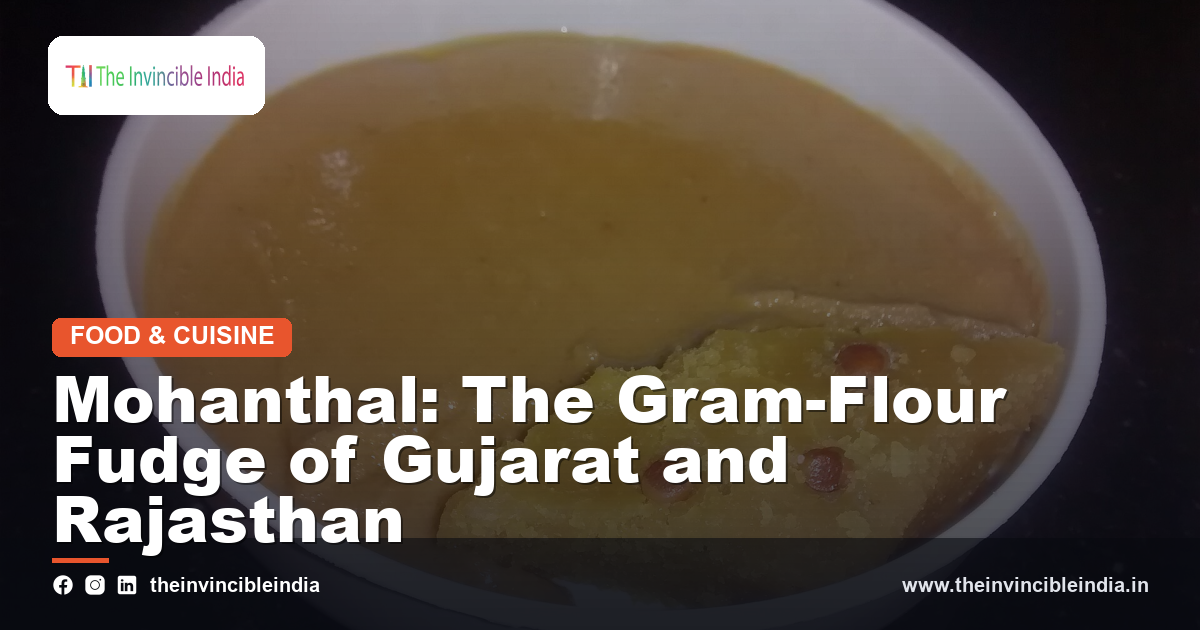
Mohanthal, also spelled mohan thal, mohanthaal or mohan thaal and often described as besan fudge or gram-flour fudge, is a dense, fragrant sweet made from coarse roasted gram flour, ghee and sugar syrup. It is closely associated with the western Indian states of Gujarat and Rajasthan, where it appears at festivals, weddings and temple offerings. Cut into neat squares or diamonds and scattered with sliced nuts, it has a grainy, melt-in-the-mouth texture that sets it apart from smoother fudges. Among the many famous sweets of India, it stands out for its simple ingredients and rich, nutty aroma. This guide explains what mohanthal is, how it is made and why it remains so loved.
Quick answer: Mohanthal is a traditional Indian sweet, a fudge made by roasting coarse gram flour (besan) in ghee, then binding it with sugar syrup and setting it in a tray. It is a speciality of Gujarat and Rajasthan and is also called mohan thal. The sweet is flavoured with cardamom and often saffron, topped with nuts, and is made for festivals such as Diwali and for weddings and religious offerings.
Key Takeaways
- Mohanthal is a gram-flour (besan) fudge from the western Indian states of Gujarat and Rajasthan.
- It is also written mohan thal or mohanthaal, and the word thal refers to the tray in which the fudge is set.
- The sweet is made from coarse besan, ghee, sugar syrup and often milk or khoya, flavoured with cardamom and saffron.
- Its texture is dense and slightly grainy, quite different from the smooth texture of a milk-based barfi.
- Mohanthal is a common festive sweet and is offered as prasad (temple food offering) in many Vaishnav traditions.
- Properly made mohanthal keeps well for a couple of weeks, which makes it suitable for gifting and travel.
Read on for the ingredients, method, serving customs, and cultural role in detail.
Quick Facts
| Detail | Information |
|---|---|
| Dish | Mohanthal (mohan thal, besan fudge) |
| Region | Gujarat and Rajasthan, western India |
| Type | Traditional sweet (mithai), fudge |
| Main ingredient | Coarse roasted gram flour (besan) |
| Key flavourings | Ghee, sugar syrup, cardamom, saffron, nuts |
| Texture | Dense, grainy, melt-in-the-mouth |
| Usually served | At room temperature, cut into squares or diamonds |
| Cultural role | Festival, wedding and temple-offering sweet |
What is mohanthal?
Mohanthal is a traditional fudge-like Indian sweet made from coarse gram flour roasted slowly in ghee and bound with sugar syrup. The word thal refers to a plate or tray, since the mixture is spread and set in a tray before being cut into pieces. The finished sweet is golden-brown, dense and slightly grainy, with the nutty aroma of roasted besan and the perfume of cardamom. It is not as smooth as a milk-based barfi, because the coarse flour keeps a delicate granular bite. A small square is usually enough, as the sweet is rich with ghee. Mohanthal is therefore best understood as a festive treat, one that turns a humble pulse flour into a sweet worthy of weddings, offerings and celebrations.
What are the other names and spellings of mohanthal?
Mohanthal is also written as mohan thal, mohanthaal or mohan thaal, and in English-language menus it is often described as besan fudge or gram-flour fudge. Because the transliteration of Gujarati and Hindi words varies, shops and cookbooks print several spellings of the same sweet. In some places the name is shortened to simply mohan, though this can cause confusion with other uses of the word. The sweet should not be mistaken for besan ladoo, besan barfi or Mysore pak, which are related but different preparations. Knowing these alternative names helps readers recognise the sweet across sweet-shop labels, festival menus and family recipes. Whichever spelling is used, the name points to the same grainy, ghee-rich gram-flour fudge of western India.
Where does mohanthal come from?
Mohanthal comes from western India, and it is most closely linked with Gujarat and Rajasthan, where gram flour and ghee are everyday kitchen staples. The sweet is a regional speciality rather than a dish with a single documented inventor, and its exact origin is not firmly recorded. Food writers generally place it within the broader Gujarati and Rajasthani tradition of besan sweets, which developed in kitchens that relied on pulses, milk products and sugar. It is also made in neighbouring regions and by communities from Gujarat settled elsewhere in India and abroad. Mohanthal therefore belongs to a shared western Indian sweet-making culture, one in which careful roasting and patient stirring turn simple pantry ingredients into a celebratory dessert.
Mohanthal in the Setting of Gujarati and Rajasthani Sweets
Mohanthal sits among the richest sweets of western India, alongside ladoos, barfis, halwas and syrup-soaked preparations. Gujarati meals often end with a sweet served with the main thali, while Rajasthani cooking is known for its generous use of ghee and gram flour in dishes both savoury and sweet. Within this tradition, mohanthal is the sweet that most clearly showcases besan, as almost nothing else competes with its nutty flavour. It is typically sold in sweet shops by weight and is a standard item in festive gift boxes. The Indian thali tradition, with its mix of savoury and sweet courses, provides a natural home for it. In this setting, mohanthal represents the celebratory end of a regional meal.
What ingredients go into mohanthal?
Mohanthal is made from coarse gram flour, ghee, sugar, a little milk and a few simple flavourings. The flour is usually the coarse variety known as ladoo besan, rather than the fine flour used for batters, because it gives the sweet its characteristic grain. Ghee is used generously, both to roast the flour and to moisten it, and sugar is cooked into a syrup. Cardamom powder is the standard fragrance, and saffron strands soaked in warm milk add colour and aroma. Chopped almonds and pistachios are used as topping, and some families add khoya (reduced milk solids) for a richer, creamier texture. The short ingredient list shows that the quality of the flour, the ghee and the roasting matter more than any elaborate addition.
Why Does Mohanthal Use Coarse Gram Flour?
Mohanthal uses coarse gram flour because the grainy texture of the flour is what gives the sweet its distinctive bite and keeps it from turning pasty. Gram flour, or besan, is made by grinding chickpeas or split chickpeas, and it is sold in fine and coarse grades. The coarse grade absorbs ghee and syrup more slowly and holds its granular shape through cooking, so the finished fudge crumbles gently instead of sticking together like dough. Fine flour tends to form lumps and gives a denser, heavier result. Many cooks buy or prepare the coarse flour specially for festive sweets. Choosing the right grade is therefore the first and most important decision in making a good mohanthal.
What does the word mohan mean in mohanthal?
The word mohan in mohanthal is generally explained in two ways, and neither is certain. One common explanation connects it to Mohan, a name of Lord Krishna meaning the enchanting one, and tradition holds that the sweet is a favourite offering to him. Another explanation points to a cooking term: in Gujarati and related kitchens, the fat rubbed into flour to make it crumbly is called mohan or moyan, and the first step of mohanthal does involve rubbing ghee and a little milk into the flour. Both readings fit the sweet, and both circulate in popular accounts. Because the etymology is debated, it is safest to say that the name may refer to either the divine name or the kitchen technique.
How is mohanthal made?
Mohanthal is made by rubbing ghee and milk into coarse gram flour, roasting the crumbs slowly, and then folding in hot sugar syrup. First the flour is mixed with ghee and a little milk until it forms moist granules, which are then sieved so they are even. The granules are roasted in more ghee on low heat, stirring constantly, until they turn golden and release a rich, nutty smell. Separately, sugar is cooked in water to a syrup of the right consistency and flavoured with cardamom and saffron. The syrup is added to the roasted flour and stirred quickly, and the mixture is spread in a greased tray. After cooling slightly, it is topped with nuts and cut into pieces.
The Importance of Slow Roasting
Slow roasting is the most important step in mohanthal, because it develops the flavour and removes the raw taste of gram flour. The roasting is done over low heat with constant stirring, so the granules colour evenly without scorching. A properly roasted mixture turns from pale yellow to a deeper golden shade and releases a distinctive nutty aroma, which cooks use as a signal that it is ready. Under-roasted besan leaves a raw, slightly bitter taste, while over-roasted besan turns dark and acrid. The process can take a considerable time, which is why mohanthal is traditionally made with patience and a heavy-bottomed pan. Slow roasting is therefore the quiet craft at the heart of the sweet.
Sugar Syrup and Setting the Fudge
The sugar syrup binds the roasted flour and decides whether the finished mohanthal is soft, firm or crumbly. Cooks traditionally cook the syrup only to a light stage, often described as one-string or a little less, because a syrup that is too thick makes the fudge hard and one that is too thin leaves it sticky. The warm syrup is poured over the hot roasted flour and mixed quickly, and the mixture is pressed into a greased tray while still warm. As it cools, the sugar sets and the granules lock together into a fudge that can be cut cleanly. Judging the syrup by sight and touch is a skill passed down in families, and it remains the main reason two batches of mohanthal can differ.
Flavourings, Nuts and Garnishes
Mohanthal is flavoured mainly with cardamom and saffron, and it is garnished with sliced almonds and pistachios. Cardamom provides the familiar sweet fragrance of Indian desserts, while saffron adds a golden tinge and a subtle floral note. Some cooks add a pinch of nutmeg or a little rose water, though these are less common. The nuts are spread over the top while the fudge is still warm so they stick, and some versions mix finely chopped nuts into the fudge itself. A few families add khoya, which makes the sweet creamier and slightly softer. These flavourings are used lightly, so that the toasty taste of besan and ghee remains the leading note.
Why Is Mohanthal Associated with Festivals?
Mohanthal is associated with festivals because it is rich, long-lasting and easy to share, which suits occasions of celebration and gifting. It is widely made for Diwali, the festival of lights, and for weddings and other family events across Gujarat and Rajasthan. Its keeping quality means it can be prepared ahead and packed into boxes for relatives and neighbours. The sweet also appears in religious settings, where it is offered to deities and then distributed as prasad. In sweet shops, mohanthal is among the best-selling festive items and is displayed prominently in the weeks before major holidays. Its place at celebrations reflects how the sweet has come to stand for generosity and the joy of shared eating.
Mohanthal as an Offering to the Divine
Mohanthal is offered as a sweet to deities in several Vaishnav traditions, especially in households and temples that honour Lord Krishna. Offering food to the deity and then sharing it as blessed food, known as prasad, is a central practice in Indian devotional life. In this context, the sweet’s association with the name Mohan makes it a fitting offering, although practices differ by temple and community. The ingredients are vegetarian and made with ghee, which fits the purity expected of an offering. Devotees often receive a small piece of mohanthal as part of the blessed food. The sweet therefore links everyday cooking to devotion, and the same recipe serves both the festive table and the shrine.
How Does Mohanthal Differ from Other Besan Sweets?
Mohanthal differs from other besan sweets mainly in its coarse, grainy texture and its method of binding with syrup. Besan ladoo is shaped into balls and is often softer and more crumbly, while besan barfi tends to be smoother and firmer. Mysore pak, the famous sweet of Karnataka, also uses gram flour, ghee and sugar, but it has a porous, melt-away texture quite unlike the dense grain of mohanthal. Each sweet reflects its region and its sweet-making habits, and the differences are real even though the starting ingredient is shared. This comparison shows how a single pulse flour can lead to many distinct sweets across India, with mohanthal as the western Indian expression.
How Should Mohanthal Be Stored and Served?
Mohanthal should be stored in an airtight container at room temperature and served in small squares or diamonds. Because it is made with ghee and sugar and contains little moisture, it keeps well for around two weeks in a cool place, though freshness is best in the first days. It is usually served at room temperature, as chilling can harden it, and a small piece is typically offered with tea or at the end of a meal. For gifting, the pieces are layered between sheets of paper in a box. Keeping it away from damp and heat protects its texture. Proper storage allows mohanthal to travel and to be enjoyed across several days of festivity.
Tips for a Well-Textured Mohanthal
A well-textured mohanthal depends on the right flour, even granules, patient roasting and a syrup of the correct consistency. Cooks recommend sieving the moistened flour so the granules are uniform, roasting on low heat, and removing the pan from the fire at the right moment, when the colour is golden and the aroma is nutty. Adding the syrup gradually and mixing quickly prevents lumps and keeps the grain. Pressing the mixture gently into the tray, rather than packing it hard, helps retain a soft bite. Cutting the pieces while the fudge is still slightly warm gives clean edges. These small habits explain why experienced cooks produce an even, melting mohanthal batch after batch.
Mohanthal Today
Mohanthal today remains one of the most recognisable sweets of Gujarat and Rajasthan, sold in sweet shops, prepared at home and shipped as gifts to families around the world. Modern shops produce it in large trays and offer variations with extra nuts, khoya or different flavours, while home cooks continue to follow family recipes. The sweet is a regular presence at Diwali, weddings and temple festivals, and it has found a place on dessert menus beyond western India. Its enduring popularity shows how a simple combination of gram flour, ghee and sugar can carry cultural meaning across generations. Mohanthal continues to represent the generous, festive spirit of western Indian sweet making.
Sources & Further Reading
- Ministry of Culture, Government of India (indiaculture.gov.in).
- Ministry of Tourism, Government of India (tourism.gov.in).
Frequently Asked Questions
What is mohanthal?
Mohanthal is a traditional Indian fudge made from coarse roasted gram flour, ghee and sugar syrup, flavoured with cardamom and saffron. It is a speciality of Gujarat and Rajasthan and is often topped with sliced nuts.
What does mohanthal taste like?
Mohanthal tastes sweet, nutty and buttery, with the toasty flavour of roasted gram flour and a light fragrance of cardamom. Its texture is dense and slightly grainy, and it melts gently in the mouth.
Is mohanthal the same as besan barfi?
No, mohanthal is not the same as besan barfi, although both use gram flour. Mohanthal is made from coarse flour and has a grainy fudge texture, while besan barfi is usually smoother and firmer.
Why is it called mohanthal?
The name mohanthal is explained in two ways, and the origin is debated. Mohan may refer to Lord Krishna, to whom the sweet is traditionally offered, or to the technique of rubbing ghee into flour, and thal means tray.
How long does mohanthal last?
Mohanthal keeps for about two weeks when stored in an airtight container in a cool, dry place. It is best eaten within the first several days for the freshest flavour and texture.
When is mohanthal eaten?
Mohanthal is eaten mainly at festivals such as Diwali, at weddings and as a temple offering, though it is also enjoyed as an everyday sweet. It is commonly served in small squares with tea or after a meal.


