

Ajaigarh Fort, also spelled Ajaygarh Fort and sometimes called the fort of Ajaigarh in Bundelkhand, is a hill fort in the Panna district of northern Madhya Pradesh. It crowns a rocky plateau of the Vindhyan hill country and is traditionally linked with the Chandela dynasty, the same royal house that raised the temples of Khajuraho. Later the fort served as the seat of a small princely state of Bundelkhand. Among the great forts of India it is a quiet and lesser-known site, yet its gateways, tanks and ruined temples tell a layered story. This guide explains where the fort stands, who held it and what visitors can still see.
Quick answer: Ajaigarh Fort is a hill fort in Panna district, Madhya Pradesh, India, built on a rocky plateau in the Bundelkhand region. It is traditionally associated with the Chandela dynasty and later became the capital of the princely state of Ajaigarh. Its defensive walls, rock-cut gateways, ponds and ruined Hindu and Jain temples make it a valuable but little-visited heritage site.
Key Takeaways
- Ajaigarh Fort is a hill fort in Panna district, in the Bundelkhand region of northern Madhya Pradesh.
- The fort is traditionally linked with the Chandela dynasty, which also built the temples of Khajuraho.
- Ajaigarh later served as the capital of a small Bundelkhand princely state until the middle of the twentieth century.
- The fort is entered through gateways cut into the hill, and the interior holds ponds, ruined palaces and temple remains.
- Sculptures and temple fragments inside the fort belong to both Hindu and Jain traditions.
- The nearby fort of Kalinjar, in Uttar Pradesh, is its famous neighbour and is often compared with it.
The sections below describe the setting of the fort, its history, its architecture and the practical side of a visit.
Quick Facts
| Detail | Information |
|---|---|
| Location | Ajaigarh town, Panna district, Madhya Pradesh |
| Region | Bundelkhand, on the Vindhyan plateau |
| Type | Hill fort with rock-cut gateways |
| Associated dynasty | Chandelas (traditional attribution); later Bundela rulers |
| Later role | Capital of the princely state of Ajaigarh |
| Main features | Gateways, ponds, ruined palaces and temples |
| Nearby sites | Khajuraho, Panna, Kalinjar |
| Also spelled | Ajaygarh Fort |
What Is Ajaigarh Fort?
Ajaigarh Fort is a medieval hill fort occupying a flat-topped rocky plateau above the small town of Ajaigarh in Panna district, Madhya Pradesh. It belongs to the family of Bundelkhand hill forts that guarded the passes and plateaus between the Gangetic plain and central India. The fort is enclosed by stone walls built along the edge of the plateau, with bastions placed where the slope is gentler and with gateways cut into the living rock. Inside the walls lie a plateau of scrub and boulders, several tanks, the ruins of palaces and a number of old temples. Unlike the great fortress-palaces of Rajasthan, Ajaigarh has never been heavily restored, so it keeps the look of a working hill fort that was gradually abandoned. The fort therefore offers a clear picture of defensive life in the Bundelkhand country.
Where Is Ajaigarh Fort Located?
Ajaigarh Fort is located in the Panna district of northern Madhya Pradesh, in the Bundelkhand region that spreads across the borders of Madhya Pradesh and Uttar Pradesh. The town of Ajaigarh lies at the foot of the plateau, and the fort rises directly above it. The wider area is part of the Vindhyan hill country, a landscape of low ranges, deciduous forest, small rivers and rocky outcrops. Panna, known for its diamond mines and its tiger reserve, lies to the south, while Khajuraho, famous for its medieval temples, lies within a manageable distance to the west. To the north, across the state border in Uttar Pradesh, stands the fort of Kalinjar. The position of Ajaigarh between these better-known places makes it a natural addition to a heritage journey through the region.
What Does the Name Ajaigarh Mean?
The name Ajaigarh is generally understood to mean the invincible fort, from the Sanskrit and Hindi words ajaya, meaning unconquerable, and garh, meaning fort. Local tradition connects the name with a Chandela ruler or with the idea of an impregnable stronghold, though the precise origin of the name is not firmly settled in the historical record. Spellings vary, and the place appears as Ajaigarh, Ajaygarh and Ajaigadh in different writings. The meaning, however, fits the character of the site, because the steep sides of the plateau and the rock-cut approaches made the fort difficult to storm. Names of this kind were common in Indian military architecture, where a fort was often called by a word promising strength. The name Ajaigarh thus expresses both a hope and a reputation.
How Is Ajaigarh Fort Linked to the Chandelas?
Ajaigarh Fort is traditionally linked with the Chandela dynasty, the ruling house of Bundelkhand, then called Jejakabhukti, that flourished in the early medieval centuries and is best remembered for the Khajuraho temples. The Chandelas controlled a chain of hill forts, among which Kalinjar was the most celebrated, and Ajaigarh is generally counted as one of the strongholds of that network. Architectural fragments and temple remains inside the fort show the sculptural style of the Chandela period. At the same time, historians treat the exact date of the fortification as uncertain, since forts of this kind were built up and repaired over many centuries. The safe statement is that the site has Chandela-era roots and that later rulers strengthened it. The fort therefore preserves a trace of one of central India’s great medieval dynasties.
Why Was This Hill Chosen for a Fort?
The hill was chosen because it offers a natural stronghold: a plateau with steep rocky sides, a commanding view of the plain and a supply of water on the summit. A hill fort needed three things, which were height for observation, difficult approaches for defence and tanks or springs to survive a siege, and Ajaigarh provides all three. From the walls, watchers could see movement along the roads below and signal to other posts in the chain of forts. The surrounding forest supplied timber and game, while the nearby plain supplied grain. Such sites were also symbols of authority, because a ruler seated on a high rock could be seen from far around. The choice of the plateau shows careful reading of the land by those who built the fort.
What Are the Gateways of Ajaigarh Fort?
The fort is entered through gateways cut into the hillside, two of which are commonly named as the Kalinjar Gate and the Tarhaoni Gate, the latter reached by a stone stairway. These approaches are narrow and winding, so that an attacking force would have to climb in single file under the eyes of defenders on the walls. Gateways in hill forts were designed as the weakest point made strong, with turns, thick doors and guard chambers close to the entrance. At Ajaigarh the stone of the hill itself forms part of the passage, which gives the entrance a rugged and dramatic character. Visitors who approach on foot still feel how forbidding the climb must have been to an enemy. The gateways therefore reveal the military logic of the whole fort in a single view.
What Water Sources Are Found Inside the Fort?
Several tanks and ponds are found on the plateau, and a pair of rock-cut ponds known as the Ganga and Jamuna kunds are among the best-known features. Water was the most important resource for a fort under siege, so Indian hill forts typically gathered rainwater in tanks cut into the rock or enclosed by stone steps. At Ajaigarh the monsoon fills these basins, and the water sustained the garrison, the palace households and the temple worship through the dry months. The ponds are often connected by tradition with sacred rivers, which gave them a religious as well as a practical meaning. Stone steps and carved edges can still be seen around some of the basins. The water system shows how engineering and devotion were woven together in the life of the fort.
What Temples and Sculptures Are Inside the Fort?
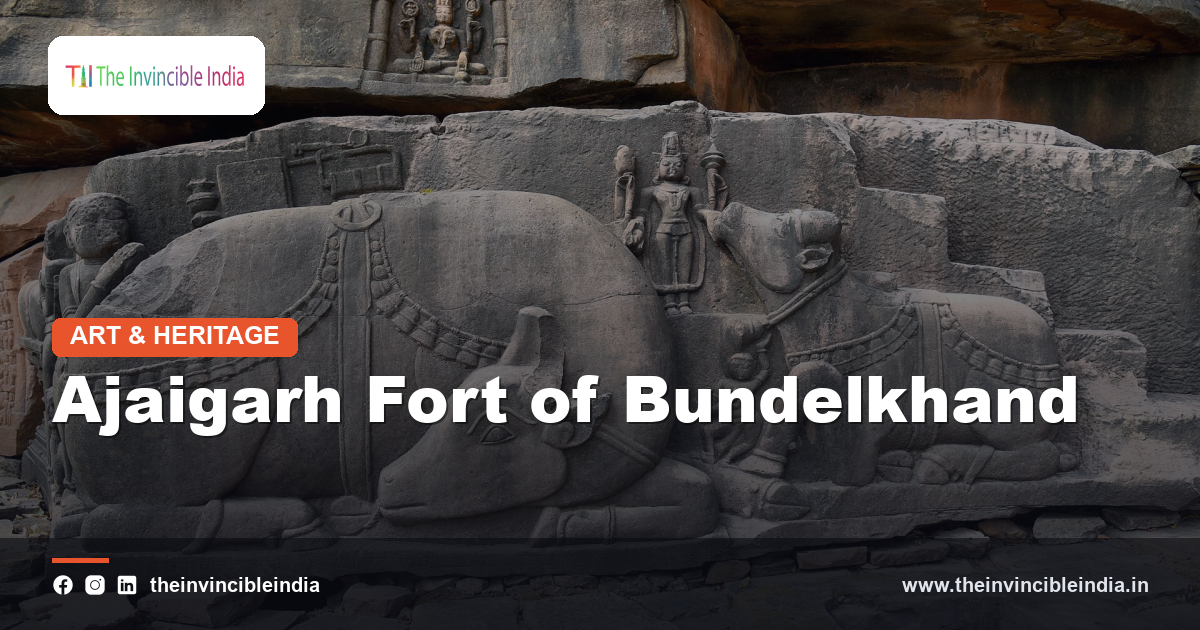
Ruined temples and scattered sculptures inside the fort represent both Hindu and Jain traditions, reflecting the mixed religious world of medieval Bundelkhand. Fragments include carved doorways, pillars and images that follow the sculptural idiom of the Chandela period, with its graceful figures, ornamental bands and layered mouldings. Among the carvings are figures of Shaiva and Vaishnava deities as well as Jain Tirthankaras, some of them cut into the rock face or set within niches. Many of the buildings are now roofless or partly collapsed, but their plans and decorated stones remain legible. Studying them offers a way into the wider story told in the guide to Indian temple architecture. The temple remains of Ajaigarh prove that a fort could also be a place of worship and artistic patronage.
How Does Ajaigarh Compare With Kalinjar?
Ajaigarh is smaller and quieter than Kalinjar, the larger and more famous Chandela fort that stands across the state border in Uttar Pradesh, though the two share a similar setting and military purpose. Kalinjar is celebrated in history for repeated sieges and for its association with Shiva as Nilkantha, and it is usually the first Bundelkhand fort that travellers hear of. Ajaigarh played a different part, serving first as a satellite stronghold and later as the seat of its own small state. Both forts sit on rocky plateaus, use rock-cut approaches and hold temples and tanks inside their walls. Seeing them together helps a visitor understand how a dynasty or a region protected itself through a network of linked strongpoints. The comparison also shows that fame is not always a measure of historical interest.
How Did Ajaigarh Become a Princely State?
Ajaigarh became the capital of a princely state in the Bundelkhand region after the weakening of older powers, when local Bundela chiefs and their relatives established small kingdoms in the hill country. The rulers of Ajaigarh held the fort and the surrounding territory and later entered into agreements with the British East India Company, as most princely houses did in the early nineteenth century. Under these arrangements the state kept internal authority while accepting British overall control. The rulers built or repaired structures in and around the town, and the fort continued to serve as a symbol of the state. After independence the small states of the region were merged, and Ajaigarh was folded into the new administrative structure of central India. Its princely chapter thus links the fort to the wider story of Indian political change.
How Does the Fort Fit Into Indian Military Architecture?
The fort belongs to the hill-fort tradition, in which natural features were combined with walls, bastions and controlled gateways to create a defensible stronghold. Indian military architecture includes several types, such as the desert fort, the water fort, the forest fort and the hill fort, and Ajaigarh is a clear example of the last. Its builders used the edge of the plateau as the first line of defence and added masonry only where nature left a weakness. Features such as bastions, loopholed parapets, guard rooms and water tanks all follow a long inherited pattern. Compared with the grand Mughal and Rajput fortress-palaces, Ajaigarh is modest in scale and plain in ornament. That plainness is itself instructive, since it shows how ordinary regional strongholds worked beyond the famous showpieces.
What Is the Condition of the Fort Today?
Much of the fort is in a ruined or semi-ruined state, with fallen walls, overgrown paths and roofless buildings, although the major gateways, ponds and several temple remains are still recognisable. The site has not been developed for mass tourism, so there are few facilities, and the experience is closer to exploring an old ruin than visiting a museum. Heritage protection in India is shared between the Archaeological Survey of India and state archaeology departments, and visitors who want to know the exact protection status of a monument should consult those official bodies. The slow decay of unattended hill forts is a familiar problem across Bundelkhand, caused by monsoon rain, vegetation and neglect. Even so, the fort retains an atmosphere that restored sites sometimes lose. Its condition invites careful and respectful visiting.
How Can Visitors Explore Ajaigarh Fort?
Visitors usually reach Ajaigarh by road from Panna or from Khajuraho, and the climb to the fort is made on foot along the old stairways and paths. The cooler months, from roughly October to March, are the most comfortable for exploring, because the plateau is exposed and can become very hot in summer. Sturdy shoes, drinking water and a hat are sensible, and it is wise to go in daylight, since the paths are uneven and some structures are unstable. A local guide can point out the gateways, ponds and carvings that are easy to miss. Because the site is quiet, visitors should keep to marked paths and avoid disturbing carvings or loose stones. Planned with care, a visit to Ajaigarh can be combined with Khajuraho and the Panna forests in a rewarding circuit.
What Is Bundelkhand and Why Does It Matter?
Bundelkhand is a historic region of central India spread across parts of Madhya Pradesh and Uttar Pradesh, named after the Bundela Rajputs who ruled much of it from the late medieval period. It is a land of rocky plateaus, ravines, tanks and forts, and it has a strong tradition of heroism, folk song and architecture. The Chandelas ruled here earlier, leaving the temples of Khajuraho and the great fort of Kalinjar, and the Bundelas later raised palaces, cenotaphs and forts at places such as Orchha and Datia. Ajaigarh belongs to this long sequence and helps explain the regional culture that produced it. Understanding Bundelkhand turns a scattered list of monuments into a connected story. The region matters because it preserves a distinct strand of Indian heritage between the Gangetic and Deccan worlds.
Why Does Ajaigarh Fort Matter for Indian Heritage?
Ajaigarh Fort matters because it preserves, in a relatively unspoilt state, the character of a regional hill fort that was both a military post and a religious and political centre. Famous monuments often draw all the attention, yet the story of a region is also written in its smaller sites, where the layers of dynasties, faiths and technologies can be read more freely. The fort connects the Chandela artistic legacy with the later Bundela and princely periods, and it shows how Hindu and Jain traditions lived side by side. For students of fortification, art and local history it offers rich material. It also reminds readers that heritage is not only monumental. The fort stands as a modest but meaningful witness to the long history of Bundelkhand.
Ajaigarh Fort Today
Ajaigarh Fort today is a quiet heritage site where weathered walls, rock-cut gateways, still ponds and fallen temple stones rest under open sky. The town below carries on as a small administrative and market centre, and the fort remains part of its identity. Interest in lesser-known heritage has grown in recent years, and travellers who follow the trail from Khajuraho to Panna increasingly add Ajaigarh to their plans. The challenge, as with many such places, is to welcome visitors while protecting fragile carvings and unstable walls. Careful documentation, community pride and thoughtful visiting all help to secure the future of the fort. In its present silence Ajaigarh still speaks of the Chandelas, the Bundelas and the many people who lived within its walls.
Sources & Further Reading
- Archaeological Survey of India (asi.nic.in).
- Ministry of Culture, Government of India (indiaculture.gov.in).
Frequently Asked Questions
Where is Ajaigarh Fort located?
Ajaigarh Fort is located in Ajaigarh town in Panna district of northern Madhya Pradesh, in the Bundelkhand region. It stands on a rocky plateau of the Vindhyan hills. Khajuraho and Panna are the nearest well-known places.
Who built Ajaigarh Fort?
Ajaigarh Fort is traditionally associated with the Chandela dynasty, though the exact builder and date are not firmly established. Later rulers, including Bundela chiefs, strengthened and used the fort. Historians therefore describe it as a site with Chandela-era roots and several later phases.
What does Ajaigarh mean?
Ajaigarh is generally understood to mean the invincible or unconquerable fort. The name combines ajaya, meaning unconquered, with garh, meaning fort. Its spelling varies, and it is also written Ajaygarh.
What can be seen inside Ajaigarh Fort?
Inside the fort visitors can see rock-cut gateways, ponds known as the Ganga and Jamuna kunds, ruined palace buildings and remains of Hindu and Jain temples. Carved pillars, doorways and sculptures are scattered across the plateau. The views over the surrounding plain are also a highlight.
How is Ajaigarh different from Kalinjar Fort?
Ajaigarh is smaller, quieter and less documented than Kalinjar, which lies across the border in Uttar Pradesh. Both are Bundelkhand hill forts with Chandela links, but Ajaigarh later became the capital of its own princely state. Kalinjar is better known for sieges and its Shiva temple.
What is the best time to visit Ajaigarh Fort?
The best time to visit is the cooler season from about October to March. The plateau is exposed, so summer afternoons are very hot, and the monsoon makes the paths slippery. Visitors should go in daylight with sturdy shoes and water.


