

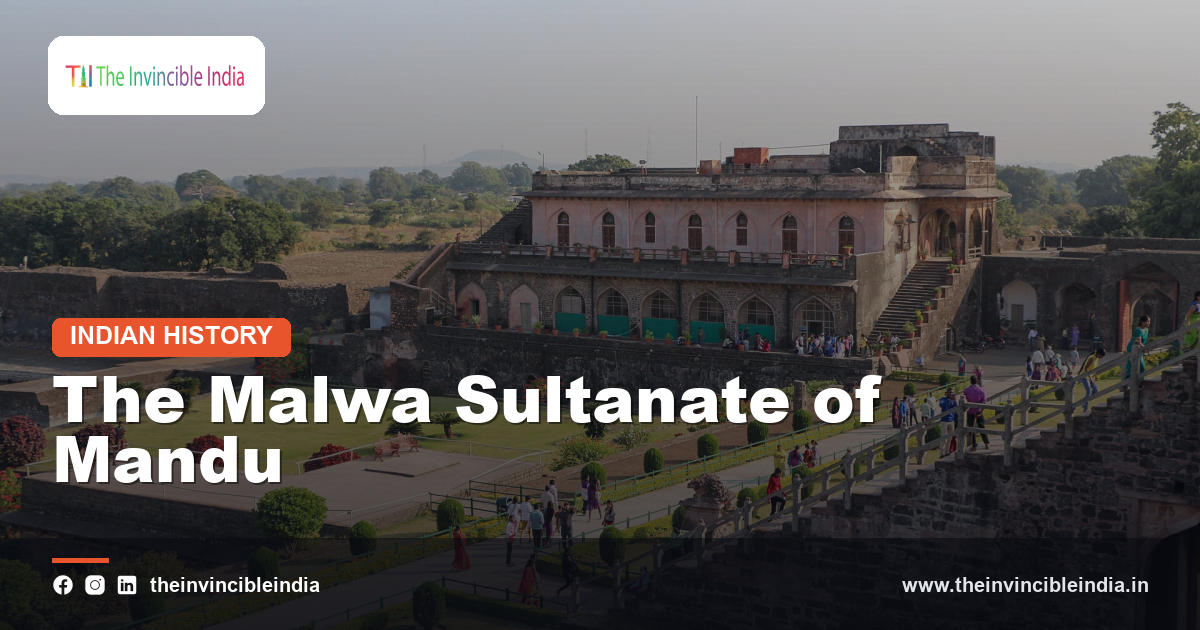
The Malwa Sultanate, also called the Sultanate of Malwa or the Mandu Sultanate, was a regional Muslim kingdom that ruled the Malwa plateau in present-day Madhya Pradesh from the end of the fourteenth century until the mid-sixteenth century. It began when a governor of the Delhi Sultanate declared independence in the turmoil that followed the invasion of Timur, and its rulers later shifted the capital to the hill fortress of Mandu. The sultanate is remembered for the elegant architecture of Mandu, including the Jahaz Mahal and the tomb of Hoshang Shah, and for its long rivalry with Gujarat and Mewar. It stands beside the Rajput kingdoms as a key part of medieval central India.
Quick answer: The Malwa Sultanate is a medieval Muslim kingdom that ruled the Malwa plateau of present-day Madhya Pradesh from Dhar and then the fortress of Mandu, from the early fifteenth century to the mid-sixteenth century. Founded by Dilawar Khan Ghuri after the decline of Delhi’s authority, it was later ruled by the Khalji dynasty. It is remembered for monuments such as the Jahaz Mahal and Hoshang Shah’s Tomb and for the legend of Baz Bahadur and Rupmati.
Key Takeaways
- The Malwa Sultanate was a regional kingdom of central India that grew out of the Delhi Sultanate’s loss of control after Timur’s invasion.
- Hoshang Shah moved the capital from Dhar to the plateau fortress of Mandu, which was also called Shadiabad.
- The Jahaz Mahal, or Ship Palace, was built between two lakes at Mandu and is the sultanate’s best-known building.
- Hoshang Shah’s Tomb is one of the earliest large marble mausoleums in India.
- The Khalji line, beginning with Mahmud Khalji, expanded Malwa and fought long wars with Gujarat, Mewar and the Deccan states.
- Baz Bahadur, the last independent sultan, lost Malwa to Mughal forces in the mid-sixteenth century.
Quick Facts
| Detail | Information |
|---|---|
| Dynasty | Ghurid and Khalji rulers of Malwa |
| Capital | Dhar, then Mandu (Shadiabad), Madhya Pradesh |
| Region | Malwa plateau, central India |
| Founder | Dilawar Khan Ghuri |
| Famous monuments | Jahaz Mahal, Hindola Mahal, Hoshang Shah’s Tomb, Jami Masjid |
| End of rule | Annexed by the Mughal Empire in the mid-sixteenth century |
What was the Malwa Sultanate?
The Malwa Sultanate was an independent Muslim kingdom that governed the Malwa region of central India for roughly a century and a half. It emerged from the weakening of the Delhi Sultanate and survived through a combination of strong fortifications, shifting alliances and local support. Two ruling houses are associated with it, the earlier Ghurid line and the later Khalji line. Its territory covered fertile plateau land, important trade routes between Gujarat, the Deccan and the north, and several well-known forts. Although smaller than the empires around it, Malwa was a significant cultural centre that produced remarkable buildings and a lively court life. Its story is essential for understanding how regional states shaped the political map of medieval India.
How did the Malwa Sultanate begin?
The Malwa Sultanate began when the governor of Malwa under the Delhi Sultanate, Dilawar Khan, became effectively independent after Timur’s invasion shattered imperial control in the north. Delhi’s authority was greatly reduced at that time, and provincial governors in Gujarat, Jaunpur and Malwa asserted autonomy. Dilawar Khan ruled from the town of Dhar, and the formal assumption of royal titles is generally placed in the early years of the fifteenth century, though the exact steps are described differently in different sources. The family is commonly referred to as Ghurid, a name linked to its claimed origins. The sultanate therefore grew out of a moment of political fragmentation, when capable governors with local power could build lasting states.
Who was Hoshang Shah?
Hoshang Shah was the second ruler of the Ghurid line and the monarch who transformed Malwa into a prominent regional power. He moved the capital from Dhar to the hill fortress of Mandu, which he strengthened and beautified, and he campaigned against neighbouring states. His reign saw conflict with Gujarat, and he is also remembered for supporting trade and building. Accounts of his life include dramatic episodes, such as stories of travel in disguise and captivity, and some of these tales are better regarded as popular narrative than as verified history. What is well established is his role as a builder and organiser, whose choices created the setting for the most famous monuments of Mandu and for the later reputation of the sultanate.
Why was Mandu chosen as the capital?
Mandu was chosen as the capital because its location on a high Vindhya plateau made it an exceptionally defensible stronghold. The fort rests on a rocky tableland surrounded by deep ravines, with a long perimeter wall and gateways that controlled access. Inside, there was enough open land, water and shade to support a large royal town. The site is located in the present Dhar district of Madhya Pradesh. Its elevation brought cooler air in the hot season and a beautiful setting during the monsoon, when lakes and gardens filled. For the Malwa sultans, Mandu was both a refuge in times of war and a showcase for royal power. The rulers renamed the city Shadiabad, meaning the city of joy, reflecting its pleasant reputation.
What is the Jahaz Mahal?
The Jahaz Mahal, or Ship Palace, is a long, narrow palace built between two artificial lakes at Mandu, so that it appears to float like a ship on water. It is generally associated with the later Khalji period and is often linked to Ghiyath Shah, though the exact patron is a matter of traditional attribution. The building has open terraces, pavilions, arched halls and a rooftop pool, all arranged to enjoy breezes and views across the water. It is often described as a pleasure palace, and popular tales connect it with large royal households, though such stories are partly legend. As architecture, the Jahaz Mahal demonstrates a sophisticated approach to climate, water and leisure in medieval Indian palace design.
What is the Hindola Mahal?
The Hindola Mahal, or Swinging Palace, is a distinctive hall at Mandu whose side walls slope inward, giving the impression of a swing in motion. It is thought to have served as an audience hall or royal assembly space. The slanting buttress-like walls are supported by arches, and the interior has a large open space suitable for court gatherings. The building is simple in decoration but dramatic in form, and it shows the experimental quality of Malwa architecture. Its precise date and purpose are not certain, and scholars discuss whether it was part of a larger palace complex. Together with the Jahaz Mahal, it remains one of the most recognisable structures of Mandu and an important example of early Indo-Islamic design in central India.
What is special about Hoshang Shah’s Tomb?
Hoshang Shah’s Tomb at Mandu is special because it is among the earliest large marble mausoleums in India. The structure stands on a raised platform within a courtyard and is topped by a broad dome with small corner domes. Its perforated stone screens filter light into the interior, and its restrained decoration emphasises clean lines and harmony of proportion. Later traditions say that architects of the Mughal emperor Shah Jahan visited the tomb while preparing for major commissions, though this account is difficult to verify. Even without that claim, the tomb is treated as a milestone in the development of Indian funerary architecture, showing how Malwa builders combined local masonry traditions with imported ideas and a refined sense of form.
What is the Jami Masjid at Mandu?
The Jami Masjid at Mandu is a large congregational mosque built on a high platform with a grand entrance porch. It has a broad courtyard surrounded by colonnades and a prayer hall crowned by domes. Local tradition sometimes compares its design with famous mosques elsewhere in the Islamic world, but such comparisons are impressions rather than documented facts. The building was completed in stages across the reigns of different rulers, and its sober grandeur shows the confidence of the sultanate. Near it stand a number of related structures, including the Ashrafi Mahal, once a school and tomb complex. The mosque shows the religious and educational life of the court and complements the secular palaces that dominate the popular image of Mandu.
Who were the Khalji rulers of Malwa?
The Khalji rulers of Malwa were the dynasty that took power after the Ghurid line, beginning with Mahmud Khalji in the middle of the fifteenth century. Mahmud Khalji was an energetic ruler who expanded the sultanate, fought wars against Gujarat, the Bahmanis and Mewar, and strengthened the army. His successors, including Ghiyath Shah, continued to rule from Mandu, and the dynasty presided over much of the monumental building for which the city is known. The Khalji period saw the height of Malwa’s territorial reach and also its growing strain from rivals on every side. Although these rulers are sometimes confused with the Khalji dynasty of Delhi, the two were separate families from different periods and regions.
How did Malwa relate to Mewar and the Rajputs?
Malwa had a long and competitive relationship with Mewar and other Rajput states, marked by war, diplomacy and occasional cooperation. The Rajput ruler Rana Kumbha of Mewar fought against Malwa, and the rivalry gave rise to monuments of commemoration on both sides. Mahmud Khalji is traditionally credited with a tower of victory at Mandu, while Mewar built its own tower at Chittorgarh, although the connection between these structures is debated. Rajput chiefs also served in Malwa’s armies and administration, and in the later period Rajput nobles held significant power at court. The relationship was therefore not simply one of religious opposition but a shifting contest over land, trade and prestige in a region where many powers overlapped.
How did Malwa deal with Gujarat and the Deccan?
Malwa dealt with its powerful neighbours Gujarat and the Deccan sultanates through repeated wars, treaties and marriage-based diplomacy. Gujarat, to the west, was the most persistent rival and interfered in Malwa’s succession on several occasions. To the south, Malwa clashed with the Bahmani Sultanate and later with its successor states over border districts. These pressures forced Malwa’s rulers to maintain a strong military and to seek allies, including regional chiefs. Over time the sultanate lost ground to Gujarat, which at one stage dominated it politically. The pattern shows how medieval India was a system of interacting states, where a small kingdom could survive for generations by balancing larger powers.
Who were Baz Bahadur and Rupmati?
Baz Bahadur was the last independent ruler of the Malwa Sultanate, and Rupmati is the beloved figure of a famous legend associated with him. The story presents Baz Bahadur as a ruler devoted to music and Rupmati as a singer whose voice charmed him. Popular accounts connect Rupmati with a pavilion on the edge of the Mandu plateau and tell of a tragic end following the arrival of Mughal forces. Historians treat the romance with caution, since much of it comes from later literary and folk retellings. The legend has nonetheless been highly influential, appearing in poetry, painting and song, and it has become part of the cultural memory of Mandu and of central Indian regional storytelling.
How did the Malwa Sultanate end?
The Malwa Sultanate ended in the mid-sixteenth century, when Mughal forces under Akbar’s commanders took control of the region from Baz Bahadur. Before that, the kingdom had suffered a period of instability, including interference from Gujarat and a brief interval of dominance by Sher Shah Suri’s administration. Baz Bahadur recovered the throne for a time, but his military strength was limited, and he could not withstand the expanding Mughal Empire. Malwa then became a province of the empire. The fall of the sultanate ended a distinct chapter of regional rule, yet the buildings, stories and administrative traditions it created continued to influence the culture of central India for centuries.
What was everyday life and engineering like at Mandu?
Everyday life and engineering at Mandu centred on water management, gardens and the combination of defence with comfort. Because the plateau is high and rocky, the rulers built reservoirs, step-wells and channels to store the monsoon rain and supply the palaces and households. Structures such as the Champa Baodi, a stepped well with cool underground chambers, show how builders adapted to climate. Markets, mosques, rest houses and gardens filled the town, and travellers from different regions passed through. The sultans enjoyed hunting, poetry, music and cultivated leisure, reflected in the open pavilions of their palaces. These practical and artistic achievements make Mandu an important case study of medieval Indian urban living.
What is the architectural legacy of the sultanate?
The architectural legacy of the Malwa Sultanate is its blend of strong forms, restrained ornament and a lively use of local stone, tile and open space. Builders combined arches, domes and colonnades with elements drawn from regional traditions, creating buildings suited to the landscape. Surviving structures include palaces, mosques, tombs, gateways and water works, with traces of glazed tile and carved screens. The influence of Malwa style is sometimes traced in later buildings, although specific claims should be treated carefully. What can be said confidently is that Mandu forms one of the most coherent medieval architectural ensembles in central India, and that it demonstrates how a mid-sized sultanate could develop a recognisable and elegant visual language.
Malwa Sultanate Today
The Malwa Sultanate today survives mainly through the monuments of Mandu, which lie in the Dhar district of Madhya Pradesh and are protected as heritage sites. Visitors come to see the Jahaz Mahal, the Hindola Mahal, Hoshang Shah’s Tomb, the Jami Masjid and the pavilions associated with Baz Bahadur and Rupmati. The surrounding landscape, especially in the monsoon season, adds to the appeal. Local traditions, folk songs and stories continue to keep the sultanate’s memory alive, while historians and conservation bodies study its inscriptions and buildings. As an example of how regional kingdoms contributed to India’s architectural heritage, the Malwa Sultanate remains a valuable subject for anyone exploring the medieval history of central India.
Sources & Further Reading
- Archaeological Survey of India (asi.nic.in).
- Ministry of Culture, Government of India (indiaculture.gov.in).
Frequently Asked Questions
What was the Malwa Sultanate?
The Malwa Sultanate was a medieval Muslim kingdom that ruled the Malwa plateau in central India, mainly from Dhar and Mandu, from the early fifteenth century until the mid-sixteenth century. It was ruled first by the Ghurid line and then by the Khalji line.
Who founded the Malwa Sultanate?
Dilawar Khan Ghuri founded the Malwa Sultanate. He was a governor under the Delhi Sultanate who became effectively independent after the disorder following Timur’s invasion.
Where is Mandu located?
Mandu is located in the Dhar district of Madhya Pradesh, central India, on a high plateau of the Vindhya range. It was the capital of the Malwa Sultanate and is known for its palaces, mosques and tombs.
What is the Jahaz Mahal?
The Jahaz Mahal is a long palace at Mandu built between two lakes so that it resembles a ship. It is associated with the later Khalji rulers of Malwa and is one of the best-known monuments of the sultanate.
Who were Baz Bahadur and Rupmati?
Baz Bahadur was the last independent sultan of Malwa, and Rupmati is the heroine of a popular legend about his love of music. The romance is a well-known part of local tradition, although historians regard many details as later embellishment.
How did the Malwa Sultanate end?
The Malwa Sultanate ended when Mughal forces took Malwa from Baz Bahadur in the mid-sixteenth century. The region then became a province of the Mughal Empire.


