

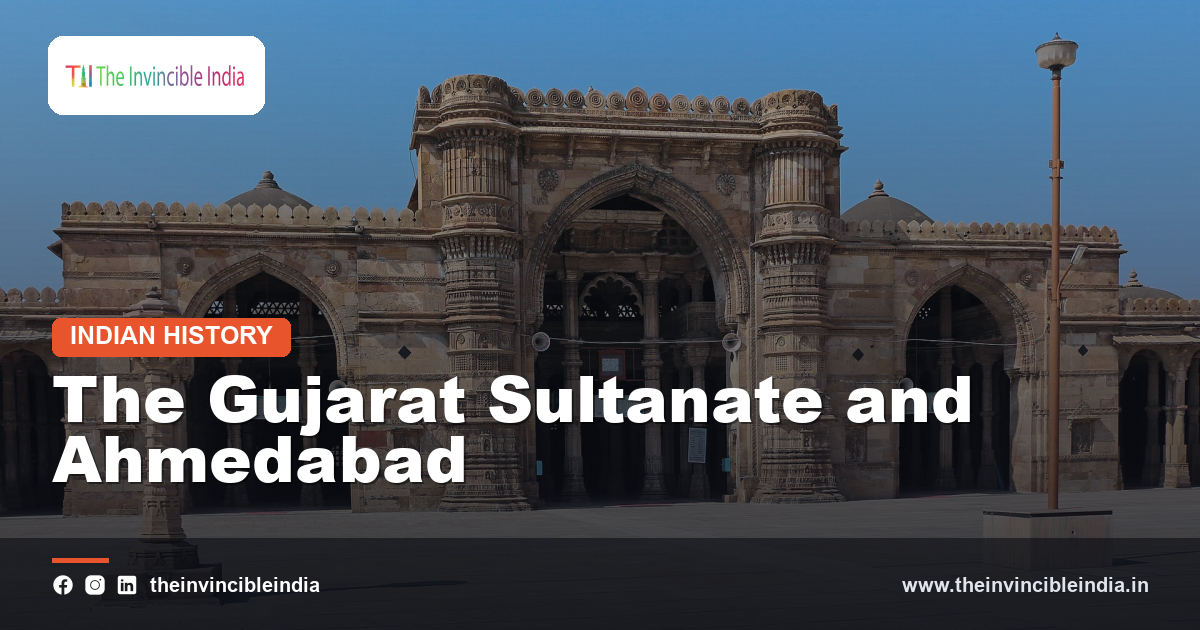
The Gujarat Sultanate, also known as the Sultanate of Gujarat or the Ahmad Shahi dynasty after its early rulers, was an independent kingdom that governed Gujarat and nearby regions of western India from the turn of the fifteenth century until the later sixteenth century. It began when a governor of the Delhi Sultanate asserted independence, and it grew into one of the wealthiest states of its age thanks to its ports, textiles and fertile land. The sultans founded Ahmedabad and filled it with mosques, tombs and stepwells that blend Islamic design with the carving traditions of the region. The story connects naturally with that of the Rajput states that bordered it.
Quick answer: The Gujarat Sultanate is a medieval Muslim kingdom that ruled Gujarat in western India from the early fifteenth century to the later sixteenth century. Founded by Zafar Khan (Muzaffar Shah I) after Delhi’s authority weakened, it established Ahmedabad as its capital under Ahmad Shah I. It is known for its Arabian Sea trade and for Indo-Islamic monuments such as the Jama Masjid, Sidi Saiyyed Mosque and Sarkhej Roza, before Akbar annexed it to the Mughal Empire.
Key Takeaways
- The Gujarat Sultanate was an independent kingdom of western India that emerged from the Delhi Sultanate’s Gujarat province around the turn of the fifteenth century.
- Ahmad Shah I founded Ahmedabad on the banks of the Sabarmati River and made it the capital.
- Mahmud Begada, the most famous sultan, captured Girnar and Champaner-Pavagadh and expanded trade and building.
- Sultanate architecture blends Islamic forms with Gujarat’s carving traditions, as seen in the Jama Masjid and the Sidi Saiyyed jali.
- Ports such as Cambay linked Gujarat to the Indian Ocean trade in textiles, indigo and luxury goods.
- Akbar annexed Gujarat to the Mughal Empire in the later sixteenth century, ending the sultanate.
Quick Facts
| Detail | Information |
|---|---|
| Dynasty | Muzaffarid (Ahmad Shahi) sultans of Gujarat |
| Capitals | Patan, then Ahmedabad, Gujarat |
| Founder | Zafar Khan (Muzaffar Shah I) |
| City founded | Ahmedabad, by Ahmad Shah I |
| Famous monuments | Jama Masjid, Teen Darwaza, Sidi Saiyyed Mosque, Sarkhej Roza |
| End of rule | Annexed by the Mughal Empire under Akbar in the later sixteenth century |
What was the Gujarat Sultanate?
The Gujarat Sultanate was an independent Muslim kingdom that ruled Gujarat and adjoining areas for roughly a century and three quarters. It emerged from the provincial government of the Delhi Sultanate and rapidly became one of the most prosperous states in medieval India. Its wealth came from agriculture, textile manufacture and above all from the busy ports of the Arabian Sea, which linked India to Arabia, Africa and Southeast Asia. The sultans maintained a strong army, a refined court and an energetic building programme. Their capital moved from the old city of Patan to the newly founded city of Ahmedabad. The Gujarat Sultanate is often studied as a model of how regional states shaped commerce, culture and architecture in the post-Delhi world.
How did the Gujarat Sultanate begin?
The Gujarat Sultanate began when Zafar Khan, the governor of Gujarat under the Tughluq rulers of Delhi, asserted independence after the disruption caused by Timur’s invasion. Zafar Khan was the son of a convert from a local community, according to the traditional account, and he rose to high office through ability. He formally took the title Muzaffar Shah and established the dynasty around the turn of the fifteenth century. The exact sequence of events, including the date of his formal assumption of kingship, is described in slightly different ways by different chroniclers, so historians generally speak in broad terms. What is clear is that the sultanate came into being in a moment of imperial weakness and quickly consolidated under strong early rulers.
Who founded Ahmedabad?
Ahmedabad was founded by Ahmad Shah I, the grandson of Muzaffar Shah and the ruler who shaped the early sultanate into a stable kingdom. He established the city on the banks of the Sabarmati River, near the older settlement of Asaval, and named it after himself. Traditional stories say that the site was chosen after the sultan saw a hare turn upon a pursuing dog, taken as a sign of a spirited land, and another legend links the founding with a saint named Manek Baba. These tales are folk traditions, not verified history. The city soon became the capital and the commercial heart of the kingdom, and it grew into a major centre of textiles, trade and craft.
Why was Ahmedabad made the capital?
Ahmedabad was made the capital because it offered a central position within Gujarat, access to river water, and proximity to the trading routes that led to the ports of the Gulf of Khambhat. Moving the court from Patan to a new city allowed the sultan to design a royal centre of his own, with a fortified citadel known as Bhadra, broad avenues, markets and a series of grand mosques. The new capital also reduced dependence on older local elites and signalled the arrival of a fresh political order. Merchants, artisans and scholars were drawn to the city, which quickly became one of the largest urban centres in western India. Its planning reflected both royal ambition and practical commercial sense.
What is the Bhadra Fort and Teen Darwaza?
The Bhadra Fort is the royal citadel built by Ahmad Shah I in the original core of Ahmedabad, and the Teen Darwaza is the triple gateway that once formed a ceremonial entrance to the royal square. The fort enclosed palaces, a mosque and administrative buildings, and its walls and gates controlled access to the heart of the city. The Teen Darwaza, with its three arched openings and richly carved surfaces, shows the decorative skill of Gujarat’s stonecutters. Together they formed the stage on which the court appeared to the public. Today the area around Bhadra is a lively market and a major historic precinct, and it preserves the memory of the sultanate’s early capital.
What is the Jama Masjid of Ahmedabad?
The Jama Masjid of Ahmedabad is the grand congregational mosque built by Ahmad Shah I and counted among the finest examples of Gujarat Sultanate architecture. It has a vast courtyard, a prayer hall supported by a forest of carved pillars, and a façade of arched openings with minarets. A distinctive feature is its use of trabeate construction, in which pillars and beams carry the roof, along with pointed arches, a combination that reflects the region’s earlier building traditions. Jain and Hindu architectural motifs, such as lotus carvings and bell-and-chain patterns, appear in the stonework. This fusion shows how local craftsmen contributed to the sultanate’s religious architecture, producing a style that is recognisably Islamic yet clearly rooted in Gujarat.
What makes the Sidi Saiyyed Mosque famous?
The Sidi Saiyyed Mosque is famous for its intricate stone lattice windows, or jalis, especially the one carved with an intertwining tree design. The mosque was built in the later period of the sultanate and is named after a nobleman of African origin who served at court. Its arches are filled with finely worked stone screens that filter light and air, creating a delicate interplay of pattern and shadow. The tree-and-palm motif has become an emblem of Ahmedabad and appears in civic symbols and design. The mosque has no large dome or minaret, which gives it a distinctive, open appearance, and it is widely celebrated as a masterpiece of Indo-Islamic craft in India.
Who was Mahmud Begada?
Mahmud Begada, also called Mahmud Shah I, was the most celebrated sultan of Gujarat and ruled for a long period in the later fifteenth and early sixteenth centuries. He is known for expanding the kingdom, strengthening the navy and coast, and promoting trade and architecture. The nickname Begada is traditionally explained as meaning conqueror of two forts, referring to his capture of Girnar and Champaner-Pavagadh, although other explanations have been proposed. His reign saw the creation of new towns, gardens and monuments, and the court was admired by visiting travellers. He also faced the early arrival of Portuguese power in the Arabian Sea. Many consider his reign the high point of the sultanate.
What is the Sarkhej Roza?
The Sarkhej Roza is a complex of tombs, a mosque, palaces and a large tank near Ahmedabad, built around the shrine of the Sufi saint Shaikh Ahmad Khattu Ganj Baksh. Mahmud Begada developed the complex into a royal retreat, and members of the ruling family were buried there. The buildings are arranged around a large water tank, and the designs combine domes, pillars and screens in a harmonious composition. The complex is notable for its calm atmosphere and its synthesis of religious devotion, royal patronage and landscape design. It is often described as one of the finest groups of Gujarat Sultanate monuments and gives a sense of the sultanate’s interest in gardens and water.
What are Champaner-Pavagadh and the Gujarat stepwells?
Champaner-Pavagadh and the stepwells are two of the most significant heritage legacies of the Gujarat Sultanate. After capturing the hill fortress of Pavagadh, Mahmud Begada developed the nearby town of Champaner as a new capital, adding mosques, gateways and a walled city. The archaeological park that includes these remains has been recognised as a UNESCO World Heritage Site. Stepwells, known locally as vavs, were built across Gujarat for water storage and community gathering, and the sultanate period saw elaborate examples such as the stepwell at Adalaj near Ahmedabad. These structures served practical and social purposes in a dry region and display the carving skill of Gujarat’s stonemasons.
How did the Arabian Sea trade shape Gujarat?
The Arabian Sea trade shaped Gujarat by making its ports gateways to a vast commercial network. Cambay, known today as Khambhat, and other ports exported cotton cloth, indigo and other goods to the Middle East, East Africa and Southeast Asia, and imported horses, metals and luxury items. Merchant communities of many faiths, including Muslims, Hindus, Jains and Parsis, took part in this commerce. The sultans levied customs and protected trade, which provided much of the kingdom’s revenue. Gujarat’s textiles were valued across the Indian Ocean world. This prosperity funded monumental building and gave Ahmedabad a cosmopolitan character, and it also attracted the attention of European powers, especially the Portuguese.
How did the Gujarat Sultanate deal with Mewar, Malwa and the Deccan?
The Gujarat Sultanate dealt with its neighbours through a mixture of war, alliance and diplomacy. It competed with the Malwa Sultanate for influence in central India, and at times Gujarat dominated its rival. It also clashed with the Rajput state of Mewar, whose rulers resisted the sultans’ expansion. Relations with the Deccan sultanates were generally less hostile and included marriage ties and exchanges of envoys. Through these contacts Gujarat became part of a wider network of Persianate courts across India. The balance of power shifted from one generation to another, and success depended on the skills of individual rulers and the loyalty of their nobles, but the sultanate remained one of the strongest regional states for many decades.
How diverse was Gujarat Sultanate society?
Gujarat Sultanate society was diverse, with Muslims, Hindus, Jains, Parsis and other communities living and trading side by side. Muslim merchants and religious figures, including Sufi saints, were influential, and Hindu and Jain merchant families controlled much of the commerce and finance. Persian was the language of the court, while Gujarati remained the language of daily life and trade. Communities of African descent, including the Sidis, served as soldiers and nobles. The state relied on cooperation with local elites to run its economy and revenue system. While relations were not free of tension, the overall picture is one of a pluralistic society whose commercial prosperity depended on coexistence and exchange among many groups.
How did the Gujarat Sultanate end?
The Gujarat Sultanate ended in the later sixteenth century, when Akbar annexed Gujarat to the Mughal Empire. Its decline began earlier, after the death of Bahadur Shah, who faced pressure from the Mughal emperor Humayun and from the Portuguese. Bahadur Shah died in a confrontation with the Portuguese near Diu, and his successors were weaker, with powerful nobles dominating the court. The kingdom drifted into factional conflict, and Akbar took advantage of the instability to bring the region under imperial control. The annexation gave the Mughals access to Gujarat’s ports and wealth, and Surat later grew into a major Mughal port as Cambay declined.
What is the architectural legacy of the sultanate?
The architectural legacy of the Gujarat Sultanate is a distinctive regional style that fuses Islamic forms with Gujarat’s native stone-carving. Characteristic features include large courtyards, slender minarets, carved pillars, elaborate jalis, and ornamental motifs borrowed from local temple and Jain traditions. Mosques, tombs, stepwells and gardens show a consistent aesthetic of lightness and fine detail. Scholars often cite Ahmedabad as a rare example of a medieval Indian city where the sultanate-period monuments survive in significant numbers within a living urban fabric. The style influenced later architecture in western India, and its motifs continue to inspire designers. This blend of religious traditions in stone is one of the sultanate’s most lasting contributions to Indian heritage.
Gujarat Sultanate Today
The Gujarat Sultanate today survives in the monuments, street plans and living traditions of Ahmedabad, Champaner and other towns across Gujarat. The historic walled city of Ahmedabad was recognised by UNESCO as India’s first World Heritage City, in part because of its concentration of sultanate-period buildings and its intact traditional neighbourhoods called pols. Visitors can see the Jama Masjid, the Sidi Saiyyed jali, the Teen Darwaza and the Sarkhej Roza, and heritage walks introduce the city’s layered history. Scholars continue to study the inscriptions, chronicles and monuments of the period. As an example of how a regional sultanate created a lasting urban and architectural identity, the Gujarat Sultanate remains central to the cultural story of western India.
Sources & Further Reading
- Archaeological Survey of India (asi.nic.in).
- UNESCO World Heritage Centre (whc.unesco.org).
Frequently Asked Questions
What was the Gujarat Sultanate?
The Gujarat Sultanate was an independent Muslim kingdom that ruled Gujarat and nearby regions from the early fifteenth century until the later sixteenth century. It grew rich through textiles and Arabian Sea trade and built Ahmedabad as its capital.
Who founded Ahmedabad?
Ahmad Shah I of the Gujarat Sultanate founded Ahmedabad on the banks of the Sabarmati River and named it after himself. Popular legends about the choice of site are traditional stories rather than documented history.
Why is the Sidi Saiyyed Mosque famous?
The Sidi Saiyyed Mosque is famous for its stone lattice windows, especially the jali carved with an intertwining tree motif. This design has become a well-known symbol of Ahmedabad.
Who was Mahmud Begada?
Mahmud Begada was the most celebrated sultan of Gujarat, ruling for a long period around the turn of the sixteenth century. He expanded the kingdom, captured Girnar and Champaner-Pavagadh and promoted trade and building.
What is the Sarkhej Roza?
The Sarkhej Roza is a complex of tombs, a mosque, palaces and a large tank near Ahmedabad, built around a Sufi saint’s shrine. It was developed by Mahmud Begada and is one of the finest Gujarat Sultanate monuments.
How did the Gujarat Sultanate end?
The Gujarat Sultanate ended when Akbar annexed Gujarat to the Mughal Empire in the later sixteenth century. Earlier pressure from Humayun and the Portuguese, and the rise of factional nobles, had weakened it.


