

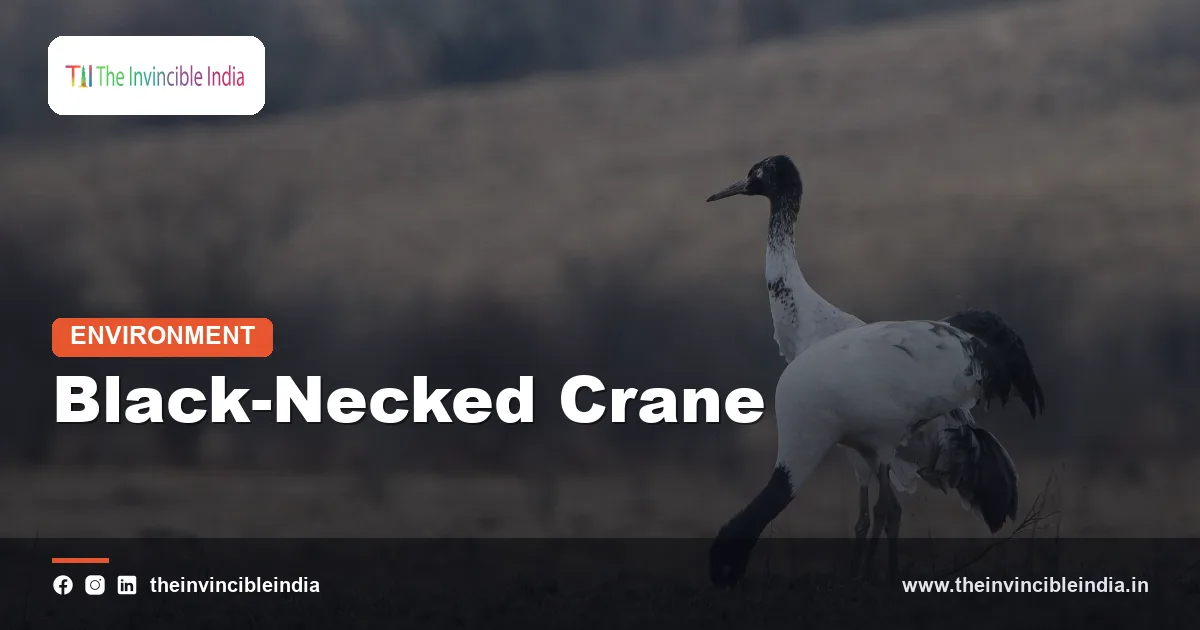
The black-necked crane (Grus nigricollis) is the only crane in the world that lives and breeds at high altitude, and in India it is a rare summer visitor to the high wetlands of Ladakh and a winter visitor to the valleys of Arunachal Pradesh. A tall grey-white bird with a black head and neck and a red crown patch, the black-necked crane is revered in Buddhist communities across the Himalaya and the Tibetan Plateau, and it is protected under Schedule I of the Wildlife (Protection) Act, 1972.
Black-necked crane conservation in India concerns a very small population, only a few hundred birds at most, that depends on remote marshes in Changthang and a handful of wintering valleys in the eastern Himalaya. The bird was the state bird of the former state of Jammu and Kashmir. This explainer sets out its biology, range, cultural role, threats and protection. Information was last reviewed on 14 October 2026.
| Attribute | Details |
|---|---|
| Scientific name | Grus nigricollis |
| Family | Gruidae (cranes) |
| Distinction | The only alpine (high-altitude) crane species |
| Height | About 1.1 to 1.4 metres, wingspan over two metres |
| Breeding in India | High-altitude wetlands of Ladakh (Changthang), roughly April to September |
| Wintering in India | Valleys of western Arunachal Pradesh, such as Sangti and Zemithang |
| Indian legal status | Schedule I, Wildlife (Protection) Act, 1972 |
| International listing | CITES Appendix I; Convention on Migratory Species Appendix I |
| State bird | Former state of Jammu and Kashmir |
Key Takeaways
- The black-necked crane (Grus nigricollis) is the only crane species adapted to life at high altitude and breeds on the Tibetan Plateau and neighbouring Himalayan plateaus.
- In India, the black-necked crane breeds in the high-altitude wetlands of Ladakh, mainly in the Changthang region, and winters in the valleys of Arunachal Pradesh.
- India holds only a small share of the global black-necked crane population, most of which lives in China, and the Indian breeding population is thought to number about a hundred or a few hundred birds.
- The black-necked crane is protected under Schedule I of the Wildlife (Protection) Act, 1972, and is listed in Appendix I of CITES.
- Habitat change, feral dogs, infrastructure development and climate-driven wetland shifts are the main threats to the black-necked crane in India.
- The black-necked crane is regarded as sacred in Buddhist culture and was the state bird of the former state of Jammu and Kashmir.
What is the black-necked crane?
The black-necked crane is a large crane species with a pale grey body, a black head and upper neck, a bright red patch on the crown and a small white spot behind the eye. It stands about 1.1 to 1.4 metres tall, has a wingspan of more than two metres and has black legs and black wing tips that show clearly in flight.
The black-necked crane belongs to the crane family, Gruidae, and it was the last of the world’s fifteen crane species to be scientifically described. The Russian explorer Nikolai Przhevalsky described it in 1876 from specimens collected on the Tibetan Plateau, which gives an idea of how remote its home is. Male and female look alike, and pairs form long bonds, often for life.
Why is it called the only alpine crane?
Every other crane species lives in wetlands, grasslands or farmland at low to moderate elevations. The black-necked crane breeds at roughly 3,000 to 5,000 metres above sea level, in cold marshes, lake edges and river valleys of the Tibetan Plateau. Its dense plumage, strong lungs and tolerance of thin air allow it to nest where temperatures drop below freezing even in summer.
Where does the black-necked crane live in India?
In India, the black-necked crane breeds in the high-altitude wetlands of Ladakh and winters in the valleys of western Arunachal Pradesh. These two regions form the only parts of India where the species is regularly recorded, and the number of birds in each is small.
Breeding grounds in Ladakh
The cranes arrive in Ladakh’s Changthang plateau in spring, usually around March and April, and breed in marshes and lakeshores such as Tso Kar, Tso Moriri, the Hanle plains, Chushul and the Pangong Tso basin. Changthang is a cold desert with wide, flat valleys, saline lakes and sedge meadows, and the cranes choose wet patches where they can build a nest of reeds and grass on small mounds or islets. The Changthang Cold Desert Wildlife Sanctuary covers much of this habitat. In Ladakhi, the bird is known as the Thrung Thrung Karmo.
Wintering grounds in Arunachal Pradesh
In winter a small number of black-necked cranes come down to river valleys in Arunachal Pradesh, mainly the Sangti Valley in West Kameng district and the Zemithang valley in Tawang district. These valleys are used by the Monpa community, who consider the bird sacred, and the cranes feed on harvested paddy fields, roots and wetland vegetation. Some cranes from Tibet and Bhutan use the same corridor, so the valleys form part of a wider migration route across the eastern Himalaya.
How big is the black-necked crane population in India?
The black-necked crane population in India is very small, with the breeding population in Ladakh usually put at roughly one hundred birds or somewhat more, and the wintering group in Arunachal Pradesh at a few dozen. Exact counts change from year to year, and figures should be read as approximate.
Globally the species numbers more than ten thousand individuals, and most of them breed in China, mainly on the Qinghai-Tibet Plateau, with other birds in Bhutan and a few in India. The global trend has been described as stable or slowly increasing in recent assessments, and the International Union for Conservation of Nature (IUCN) has categorised the species as Vulnerable and, in more recent assessments, as Near Threatened. India’s share is small, which means that a local loss would be significant for the country even though the global species is not facing imminent extinction.
How does the black-necked crane breed and feed?
The black-necked crane breeds by forming a monogamous pair that builds a large nest of grasses and sedges in a marsh and lays usually two eggs, which both parents guard. Incubation lasts about a month, and chicks hatch in early summer and fledge after roughly three months, in time to leave before the harsh winter sets in.
- Courtship: Pairs perform dances with bowing, leaping and wing-flapping, along with loud, trumpeting duet calls.
- Nesting: Nests are placed in shallow water or on small islands to reduce predator access.
- Diet in summer: Roots and tubers, aquatic plants, insects, frogs, small fish and small rodents.
- Diet in winter: Waste grain in harvested fields, tubers, roots and invertebrates.
- Chick survival: Often only one chick survives to fledging because of competition, predation and cold.
Why is the black-necked crane sacred in Buddhist culture?
The black-necked crane is sacred in Buddhist culture because Tibetan, Ladakhi, Bhutanese and Monpa communities regard it as a bird of good fortune and a symbol of longevity and peace. In many Himalayan villages, people believe the cranes circle sacred sites, and the arrival or departure of the birds is marked with rituals and festivals.
Poems traditionally linked to the Sixth Dalai Lama, Tsangyang Gyatso, invoke cranes and the longing for return, and the bird appears in folk songs and art across the plateau. In Bhutan, the annual Black-Necked Crane Festival in the Phobjikha Valley celebrates the winter arrival of the birds. In Ladakh, local people have a long tradition of tolerating the birds on their pastures. This respect has been one of the most important reasons that the species has survived in places where hunting was once possible.
The bird also holds an official status in India: it was designated the state bird of the former state of Jammu and Kashmir, which highlights its place in the region’s identity. Since the reorganisation of 2019, its Indian breeding range lies within the Union Territory of Ladakh.
What are the threats to the black-necked crane in India?
The main threats to the black-necked crane in India are habitat change in breeding and wintering wetlands, predation and disturbance by feral and free-ranging dogs, infrastructure development and the effects of climate change on high-altitude marshes. Because the population is so small, even modest pressures can have a large effect.
| Threat | How it affects the crane |
|---|---|
| Wetland degradation and drying | Reduces nesting sites and feeding marshes in Changthang and wintering valleys |
| Feral dogs | Dogs disturb nesting pairs, take eggs and chicks and spread disease |
| Infrastructure and tourism | Roads, buildings, vehicle traffic and crowds near lakes disturb nesting; power lines cause collisions |
| Livestock grazing pressure | Overgrazing of sedge meadows near lakes lowers cover and food |
| Climate change | Shifting glacier melt, rainfall and temperature change wetland water levels and food supply |
| Changes at wintering sites | Altered farming, hydropower and road projects in valleys such as Zemithang can reduce feeding areas |
Why feral dogs are a particular problem
Feral and village dogs have increased around settlements and military and tourist camps in Changthang, partly because of waste food. Dogs can chase adults off nests, and eggs and chicks are easy prey. Managing garbage and dog populations near wetlands is therefore an important, low-cost conservation measure.
How is the black-necked crane protected in India?
The black-necked crane is protected in India by listing in Schedule I of the Wildlife (Protection) Act, 1972, by the designation of key wetlands as protected areas and Ramsar sites, and by international treaties. Schedule I status prohibits hunting, capture and trade and carries the strongest penalties in the Act.
- National law: Schedule I protection under the Wildlife (Protection) Act, 1972.
- International trade: Appendix I of CITES, which bans commercial trade.
- Migratory species: Appendix I of the Convention on Migratory Species, which calls on range states to protect the species and its habitat.
- Protected habitats: The Changthang Cold Desert Wildlife Sanctuary in Ladakh and wetlands such as Tso Kar and Tso Moriri, both Ramsar sites, cover important breeding areas.
- Community role: Local herders in Ladakh and Monpa villagers in Arunachal Pradesh have long protected the birds on their land.
What does black-necked crane conservation involve on the ground?
Black-necked crane conservation on the ground involves annual counts at breeding and wintering sites, protection of nesting marshes, control of dogs and rubbish, regulation of tourism and work with local communities. Because the birds use both Indian and neighbouring habitats, cooperation across borders also matters.
Wildlife departments, the Wildlife Institute of India, research bodies and conservation organisations conduct counts of adults and chicks at Ladakh’s lakes and at Sangti and Zemithang. These surveys help track whether the population is rising or falling. Visitors are asked to keep a distance from nests, and some wetlands are protected by seasonal restrictions on grazing and vehicles. In Arunachal Pradesh, community groups have helped guard roosting sites and organise awareness events.
Planning also matters. Roads, hydropower projects, tourist camps and power lines near cranes need environmental assessment to avoid nesting and roosting areas. In the long term, protecting water catchments, glaciers and high-altitude peatlands is part of keeping the habitat of the black-necked crane intact in a warming climate.
Bottom Line
The black-necked crane is a rare, culturally revered bird that breeds in Ladakh and winters in Arunachal Pradesh. India’s small population is protected by law and tradition, but it depends on undisturbed high-altitude wetlands, control of feral dogs and careful planning of roads and development.
Frequently Asked Questions
Why is the black-necked crane special?
The black-necked crane is special because it is the only crane species that lives and breeds at high altitude. It nests on the Tibetan Plateau and neighbouring Himalayan plateaus at roughly 3,000 to 5,000 metres. It is also revered in Buddhist culture across the region.
Where can the black-necked crane be seen in India?
The black-necked crane can be seen in summer in the high wetlands of Ladakh, including Tso Kar, Tso Moriri, Hanle and the Pangong area. In winter it can be seen in the Sangti and Zemithang valleys of Arunachal Pradesh. Sightings depend on season and are usually from a respectful distance.
How many black-necked cranes are there in India?
India has a very small population, with the Ladakh breeding group usually estimated at about a hundred birds or a little more and a few dozen wintering in Arunachal Pradesh. Numbers vary yearly and are approximate. Most of the world’s black-necked cranes live in China.
Is the black-necked crane protected in India?
The black-necked crane is fully protected in India under Schedule I of the Wildlife (Protection) Act, 1972. It is also listed in CITES Appendix I and in Appendix I of the Convention on Migratory Species. Several of its key wetlands are protected areas or Ramsar sites.
What threatens the black-necked crane in India?
The biggest threats are changes to wetlands, disturbance and predation by feral dogs, roads and other infrastructure, and climate change. Because the Indian population is small, even limited disturbance at a few nesting sites can reduce breeding success.
Which state bird is the black-necked crane?
The black-necked crane was the state bird of the former state of Jammu and Kashmir. Its main Indian breeding range is now in the Union Territory of Ladakh. The bird remains a symbol of the high-altitude Himalayan region.
{“@context”:”https://schema.org”,”@graph”:[{“@type”:”FAQPage”,”mainEntity”:[{“@type”:”Question”,”name”:”Why is the black-necked crane special?”,”acceptedAnswer”:{“@type”:”Answer”,”text”:”The black-necked crane is special because it is the only crane species that lives and breeds at high altitude. It nests on the Tibetan Plateau and neighbouring Himalayan plateaus at roughly 3,000 to 5,000 metres. It is also revered in Buddhist culture across the region.”}},{“@type”:”Question”,”name”:”Where can the black-necked crane be seen in India?”,”acceptedAnswer”:{“@type”:”Answer”,”text”:”The black-necked crane can be seen in summer in the high wetlands of Ladakh, including Tso Kar, Tso Moriri, Hanle and the Pangong area. In winter it can be seen in the Sangti and Zemithang valleys of Arunachal Pradesh. Sightings depend on season and are usually from a respectful distance.”}},{“@type”:”Question”,”name”:”How many black-necked cranes are there in India?”,”acceptedAnswer”:{“@type”:”Answer”,”text”:”India has a very small population, with the Ladakh breeding group usually estimated at about a hundred birds or a little more and a few dozen wintering in Arunachal Pradesh. Numbers vary yearly and are approximate. Most of the world’s black-necked cranes live in China.”}},{“@type”:”Question”,”name”:”Is the black-necked crane protected in India?”,”acceptedAnswer”:{“@type”:”Answer”,”text”:”The black-necked crane is fully protected in India under Schedule I of the Wildlife (Protection) Act, 1972. It is also listed in CITES Appendix I and in Appendix I of the Convention on Migratory Species. Several of its key wetlands are protected areas or Ramsar sites.”}},{“@type”:”Question”,”name”:”What threatens the black-necked crane in India?”,”acceptedAnswer”:{“@type”:”Answer”,”text”:”The biggest threats are changes to wetlands, disturbance and predation by feral dogs, roads and other infrastructure, and climate change. Because the Indian population is small, even limited disturbance at a few nesting sites can reduce breeding success.”}},{“@type”:”Question”,”name”:”Which state bird is the black-necked crane?”,”acceptedAnswer”:{“@type”:”Answer”,”text”:”The black-necked crane was the state bird of the former state of Jammu and Kashmir. Its main Indian breeding range is now in the Union Territory of Ladakh. The bird remains a symbol of the high-altitude Himalayan region.”}}]}]}


