

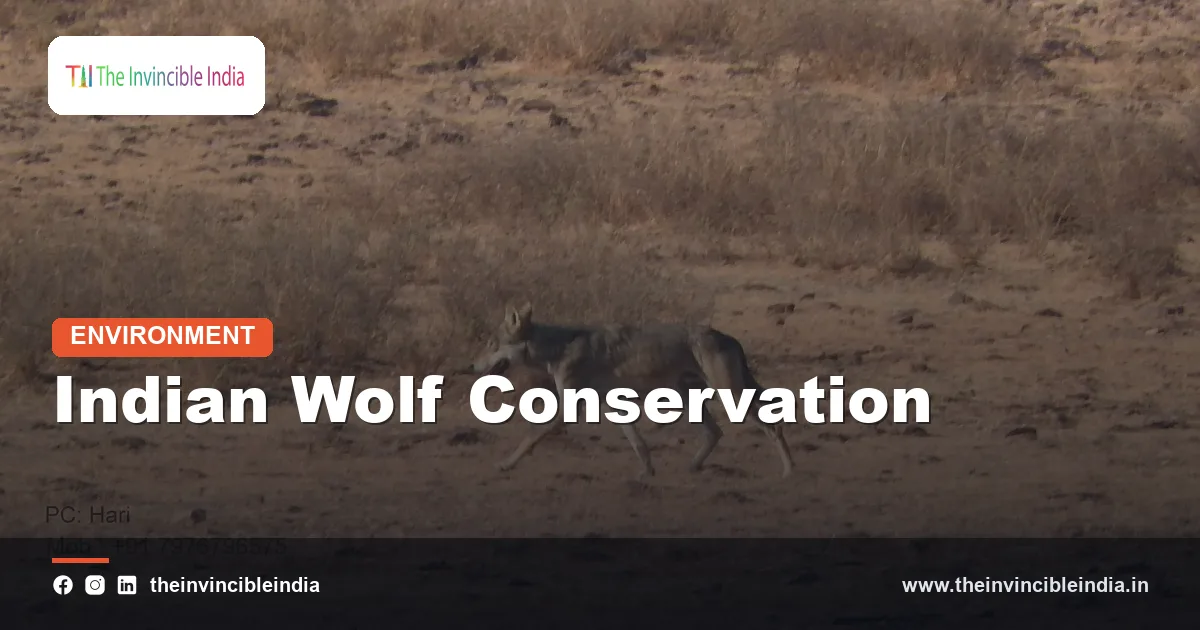
The Indian wolf (Canis lupus pallipes) is a medium-sized subspecies of the grey wolf that lives in the scrub, grassland and semi-arid plains of peninsular and western India, and it is one of the oldest surviving wolf lineages in the world. Unlike the wolves of northern forests and tundra, the Indian wolf is a specialist of open, dry country, where it hunts blackbuck, chinkara, hares and livestock, and shelters in burrows dug into ravines and earthen banks.
Indian wolf conservation is difficult because the animal lives mostly outside forests, in village commons, pasture and farmland that are officially classed as “wasteland”. The species is protected under Schedule I of the Wildlife (Protection) Act, 1972, yet loss of grassland, persecution, hybridisation with free-ranging dogs and road kills continue to thin its numbers. This explainer covers its biology, range, cultural presence, threats, legal status and strongholds. Information was last reviewed on 14 October 2026.
| Attribute | Details |
|---|---|
| Scientific name | Canis lupus pallipes (Indian grey wolf) |
| Family | Canidae (the dog family) |
| Typical habitat | Scrub, grassland, semi-arid plains, agro-pastoral landscapes |
| Body size | Roughly 18 to 25 kg; shorter, thinner coat than northern wolves |
| Typical pack size | Small, usually two to eight animals |
| Main prey | Blackbuck, chinkara, hares, rodents, goats, sheep, poultry |
| Indian legal status | Schedule I, Wildlife (Protection) Act, 1972 |
| International listing | CITES Appendix I for the Indian population |
| Only dedicated wolf sanctuary | Mahuadanr Wolf Sanctuary, Latehar district, Jharkhand |
Key Takeaways
- The Indian wolf (Canis lupus pallipes) is a drought-adapted subspecies of grey wolf that lives in scrub, grassland and semi-arid plains rather than in dense forest.
- Genetic studies indicate that the Indian wolf belongs to one of the most ancient wolf lineages, which separated from other grey wolves hundreds of thousands of years ago.
- The Indian wolf is listed in Schedule I of the Wildlife (Protection) Act, 1972, which gives it the highest level of legal protection in India.
- Grassland conversion, shrinking prey, hybridisation with free-ranging dogs, persecution after livestock losses and road kills are the major threats to the Indian wolf.
- Most Indian wolves live outside protected areas, on village commons and open “wastelands”, so their survival depends heavily on how this land is managed.
- Velavadar in Gujarat, Mahuadanr in Jharkhand and grassland belts of Maharashtra, Karnataka, Rajasthan and Andhra Pradesh are among the best-known strongholds of the Indian wolf.
What is the Indian wolf?
The Indian wolf is the subspecies of grey wolf (Canis lupus) native to the Indian subcontinent, scientifically named Canis lupus pallipes, meaning “pale-footed wolf”. It is a lean, long-legged canid with a short, tan to reddish-grey coat, often with a darker saddle along the back and paler underparts. Adults generally weigh in the region of 18 to 25 kg, which makes the Indian wolf noticeably smaller than the heavy-furred wolves of Siberia, Canada or the Tibetan Plateau.
The subspecies has a thin coat because it has evolved for heat rather than for snow. Its large ears, narrow muzzle and slender build help it shed warmth and cover long distances at a steady trot. A wolf can travel many kilometres in a night across open ground in search of prey, and it can go without water for periods that would stress a forest-dwelling predator.
An ancient lineage
Molecular studies of the Indian wolf, based mainly on mitochondrial DNA, have repeatedly placed it on a deep and distinct branch of the wolf family tree. Researchers estimate that the lineage separated from other grey wolves hundreds of thousands of years ago, long before the last Ice Age. Some scientists have argued that the Indian wolf, together with the wolves of the Himalaya, may deserve recognition as separate species or at least as evolutionarily significant units, although taxonomic opinion is not settled.
Where does the Indian wolf live in India?
The Indian wolf lives across the dry plains of peninsular and western India, from Gujarat and Rajasthan through Maharashtra, Madhya Pradesh, Karnataka, Andhra Pradesh and Telangana, with scattered populations in Uttar Pradesh, Haryana and Jharkhand. It is a species of the open country, found in semi-arid grassland, thorn scrub, fallow farmland, rocky outcrops and the margins of cultivated fields.
The Indian wolf is largely absent from dense moist forest and from the high mountains, where other canids and other wolf lineages take over. Outside India, the same subspecies is reported from parts of Pakistan, southern Iran and adjoining areas of West and South Asia, although numbers there are also uncertain. Within India, no reliable nationwide census of wolves exists, and published estimates are broad and should be treated with caution; most authorities describe the population as small, fragmented and probably declining.
Wolves of the Himalaya are different
The Indian wolf should not be confused with the Himalayan wolf, a separate high-altitude lineage found in Ladakh, Lahaul and Spiti and parts of Uttarakhand. The Himalayan wolf is thicker-coated, paler and adapted to cold, thin air and wild mountain ungulates. The two lineages occupy different habitats and are treated by many researchers as distinct, though both are protected under Indian law.
How do Indian wolves live and hunt?
Indian wolves live in small family packs, usually made up of a breeding pair and their offspring from one or two seasons, and they hunt together on open ground. A typical pack numbers two to eight animals, which is smaller than the large packs of northern wolves because prey in dry Indian plains is smaller and more scattered.
Diet and hunting
The diet of the Indian wolf is varied and opportunistic. In grassland reserves it preys on blackbuck and chinkara, and it takes hares, rodents, ground-nesting birds, reptiles and carrion. In farming country, where wild prey has thinned, wolves often depend on goats, sheep and poultry. Wolves test herds, single out weak, young or isolated animals and rely on endurance rather than on a short sprint. Their role as a top predator helps keep herbivore populations healthy and removes sick animals.
Breeding and dens
Indian wolves usually breed in the cooler months, with pups born around winter after a gestation of about two months. The female digs or enlarges a den in a ravine, riverbank, rocky crevice or sandy mound, and the pack brings food back for the pups. Dens are often reused for years. Pups emerge in a few weeks, and by the time the monsoon arrives they are old enough to move between rendezvous sites. Because dens sit in raised, broken ground at the edges of fields, they are easily disturbed by quarrying, ploughing and construction.
Why is the Indian wolf important in Indian folklore and culture?
The Indian wolf is deeply embedded in Indian folklore, pastoral tradition and literature, where it appears as both a feared predator and a figure of foster care. The best-known literary example is Rudyard Kipling’s The Jungle Book, in which the human child Mowgli is raised by a wolf pack in the Seoni hills of central India, and the wolves, including Akela, are drawn from the Indian wolf.
In the nineteenth century, British administrators in northern India recorded accounts of children said to have been raised by wolves, notably in the area of Awadh. Such reports are difficult to verify, and modern scholars treat many of them cautiously, but they show how closely wolves figured in the rural imagination. Pastoral communities such as the Dhangars of Maharashtra and the Rabaris of Gujarat and Rajasthan have lived alongside wolves for generations, and some herding traditions treat the wolf as a hazard that must be tolerated rather than as an enemy to be eliminated.
Folk stories, proverbs and nursery tales across regions use the wolf as a symbol of cunning and danger. This long cultural familiarity matters for conservation, because acceptance of the animal by local people is the single strongest safeguard for a species that lives on shared land.
What are the main threats to the Indian wolf?
The main threats to the Indian wolf are the loss and conversion of grassland, declining wild prey, persecution after livestock attacks, hybridisation and disease transmission from free-ranging dogs, and deaths on roads and railways. These pressures act together and make the Indian wolf one of the most vulnerable large carnivores of the Indian plains.
- Grassland loss: Open natural ecosystems have long been labelled “wastelands” in land records and policy, which has encouraged their conversion to farms, plantations, industrial estates, solar and wind installations and housing. Each conversion removes den sites, hunting grounds and prey.
- Prey decline: Poaching and habitat loss have reduced blackbuck, chinkara and hare numbers outside reserves, pushing wolves towards livestock.
- Persecution: Wolves are killed by poisoning, trapping, shooting and den destruction after real or perceived livestock losses. Pups are sometimes killed in their dens.
- Dogs: Free-ranging dogs compete with wolves for food, spread diseases such as rabies and canine distemper, and can interbreed with wolves, which dilutes the genetic identity of the Indian wolf.
- Roads and railways: Highways and rail lines cutting through wolf country cause collisions and fragment territories.
- Human conflict: Rare episodes of attacks on children, such as those reported in parts of Uttar Pradesh in the mid-1990s and again in later decades, trigger retaliatory killing and public fear.
Why hybridisation matters
Hybridisation between wolves and dogs is a quiet but serious conservation problem. Where wolf numbers are low and dog numbers are high, a lone wolf may mate with a dog, and the offspring can spread dog genes through the population. Over generations this blurs the distinct Indian wolf lineage, which scientists value precisely because it is old and unique. Managing dog populations through sterilisation and vaccination near wolf habitat is therefore a conservation tool, not only a public health measure.
How is the Indian wolf legally protected?
The Indian wolf is legally protected in India under Schedule I of the Wildlife (Protection) Act, 1972, which places it in the strictest category and prohibits hunting, capture and trade. Killing a Schedule I animal attracts the heaviest penalties in the Act, including imprisonment and fines, and such cases are treated as serious offences.
Internationally, the Indian population of the wolf is listed in Appendix I of the Convention on International Trade in Endangered Species of Wild Fauna and Flora (CITES), which bans commercial international trade in the animal and its parts. Wolves elsewhere in the world are generally listed in Appendix II. Globally, the grey wolf as a species is assessed as Least Concern by the International Union for Conservation of Nature (IUCN), but this broad assessment masks the much smaller and more threatened status of regional populations like the Indian wolf.
Protection outside forests
A key limitation is that the law protects the animal but not always the ground it stands on. Because most wolves live outside notified national parks and sanctuaries, protection of dens and grazing commons depends on state revenue departments, panchayats and local communities. Conservationists have argued for recognising grasslands as an ecosystem in their own right in land-use planning, instead of treating them as unproductive land to be reclaimed.
Where are the strongholds of the Indian wolf?
The strongholds of the Indian wolf are grassland and scrub landscapes in western and peninsular India, including Velavadar in Gujarat, Mahuadanr in Jharkhand, parts of Maharashtra’s Deccan plateau, and dry belts of Karnataka, Rajasthan and Andhra Pradesh. The table below lists well-documented wolf areas and what makes each one important.
| Landscape | State | Why it matters |
|---|---|---|
| Velavadar Blackbuck National Park and surrounding grassland | Gujarat | Dense blackbuck prey base and one of the best-known wolf sites for research and sightings |
| Mahuadanr Wolf Sanctuary, Latehar | Jharkhand | The only sanctuary in India set up primarily for wolves, established in the 1970s |
| Solapur, Ahmednagar and surrounding Deccan grasslands | Maharashtra | Open scrub where wolves share land with shepherd communities |
| Ranebennur and Jayamangali grasslands | Karnataka | Blackbuck reserves with scrub and grass habitat |
| Rollapadu Wildlife Sanctuary | Andhra Pradesh | Dry grassland sanctuary with wolves and other grassland species |
| Kutch and Thar fringes | Gujarat and Rajasthan | Semi-arid ranges with a traditional pastoral economy |
This list is illustrative rather than exhaustive. Many wolf families live on private farmland and village pasture that do not appear on any protected-area map, which is why local surveys are important.
How does the Indian wolf help grassland ecosystems?
The Indian wolf helps grassland ecosystems by acting as a top predator that regulates herbivore numbers, removes weak animals and keeps populations of small mammals in check. As a result, wolves contribute to balanced grazing pressure and to the health of the prey species that share their habitat, including the blackbuck and the chinkara.
Grasslands are among India’s most neglected ecosystems, even though they hold unique species such as the Great Indian Bustard, the lesser florican, the Indian fox, the striped hyena and the desert cat. The Indian wolf is often described as an indicator or umbrella species of this community. Protecting a wolf population means keeping large, connected tracts of open land, and those same tracts support dozens of other species and sustain the grazing livelihoods of pastoral communities.
What can be done to conserve the Indian wolf?
Effective conservation of the Indian wolf depends on protecting grasslands, compensating herders quickly for livestock losses, managing free-ranging dogs and monitoring populations scientifically. Because wolves live mainly on shared land, conservation succeeds when local people see a benefit from tolerating them.
- Recognise grasslands: Reclassify open natural ecosystems in land records so that they are no longer treated as wasteland available for conversion.
- Compensate losses: Offer prompt, fair compensation for livestock killed by wolves, which reduces the motive for poisoning and den destruction.
- Secure dens: Identify and protect breeding dens, and limit quarrying, ploughing and construction near them in the breeding season.
- Manage dogs: Run sterilisation and vaccination programmes in villages near wolf habitat to reduce hybridisation and disease.
- Mitigate roads: Fit crossings and warning measures where roads and railways cut through wolf ranges.
- Survey and research: Use camera traps, scat DNA and village surveys to estimate numbers and map dens, since reliable population data are scarce.
- Raise awareness: Use schools, shepherd groups and local media to replace fear and myth with accurate information.
Bottom Line
The Indian wolf is an ancient, drought-adapted predator that survives mainly on the open land of India’s dry plains rather than inside forests. It is legally protected under Schedule I of the Wildlife (Protection) Act, 1972, but its future depends on grassland protection, tolerance among herders and control of free-ranging dogs.
Frequently Asked Questions
What is the scientific name of the Indian wolf?
The scientific name of the Indian wolf is Canis lupus pallipes, a subspecies of the grey wolf. The name pallipes means “pale-footed”. Some scientists suggest the Indian wolf lineage is distinct enough to be treated as a separate species, though this is still debated.
Where do Indian wolves live?
Indian wolves live in the scrub, grassland and semi-arid plains of peninsular and western India. They are found in states such as Gujarat, Rajasthan, Maharashtra, Madhya Pradesh, Karnataka, Andhra Pradesh and Telangana, with smaller pockets elsewhere. They generally avoid dense forests and high mountains.
What do Indian wolves eat?
Indian wolves eat a mix of wild and domestic prey depending on what is available. They hunt blackbuck, chinkara, hares and rodents, and they often take goats, sheep and poultry in farming areas. They also eat carrion when it is available.
Is the Indian wolf endangered and protected by law?
The Indian wolf is a threatened, declining species and is protected under Schedule I of the Wildlife (Protection) Act, 1972. It is also listed in CITES Appendix I for the Indian population. Grassland loss, persecution, dog hybridisation and road kills are the main reasons for concern.
How is the Indian wolf different from the Himalayan wolf?
The Indian wolf is a small, thin-coated wolf of dry plains, while the Himalayan wolf is a thicker-coated, high-altitude lineage found in Ladakh, Spiti and nearby mountains. The two live in very different habitats and have separate evolutionary histories. Both are protected under Indian law.
Where is India’s wolf sanctuary?
India’s dedicated wolf sanctuary is the Mahuadanr Wolf Sanctuary in Latehar district, Jharkhand, set up in the 1970s. Most Indian wolves, however, live outside protected areas, including well-known grassland sites such as Velavadar in Gujarat.
{“@context”:”https://schema.org”,”@graph”:[{“@type”:”FAQPage”,”mainEntity”:[{“@type”:”Question”,”name”:”What is the scientific name of the Indian wolf?”,”acceptedAnswer”:{“@type”:”Answer”,”text”:”The scientific name of the Indian wolf is Canis lupus pallipes, a subspecies of the grey wolf. The name pallipes means “pale-footed”. Some scientists suggest the Indian wolf lineage is distinct enough to be treated as a separate species, though this is still debated.”}},{“@type”:”Question”,”name”:”Where do Indian wolves live?”,”acceptedAnswer”:{“@type”:”Answer”,”text”:”Indian wolves live in the scrub, grassland and semi-arid plains of peninsular and western India. They are found in states such as Gujarat, Rajasthan, Maharashtra, Madhya Pradesh, Karnataka, Andhra Pradesh and Telangana, with smaller pockets elsewhere. They generally avoid dense forests and high mountains.”}},{“@type”:”Question”,”name”:”What do Indian wolves eat?”,”acceptedAnswer”:{“@type”:”Answer”,”text”:”Indian wolves eat a mix of wild and domestic prey depending on what is available. They hunt blackbuck, chinkara, hares and rodents, and they often take goats, sheep and poultry in farming areas. They also eat carrion when it is available.”}},{“@type”:”Question”,”name”:”Is the Indian wolf endangered and protected by law?”,”acceptedAnswer”:{“@type”:”Answer”,”text”:”The Indian wolf is a threatened, declining species and is protected under Schedule I of the Wildlife (Protection) Act, 1972. It is also listed in CITES Appendix I for the Indian population. Grassland loss, persecution, dog hybridisation and road kills are the main reasons for concern.”}},{“@type”:”Question”,”name”:”How is the Indian wolf different from the Himalayan wolf?”,”acceptedAnswer”:{“@type”:”Answer”,”text”:”The Indian wolf is a small, thin-coated wolf of dry plains, while the Himalayan wolf is a thicker-coated, high-altitude lineage found in Ladakh, Spiti and nearby mountains. The two live in very different habitats and have separate evolutionary histories. Both are protected under Indian law.”}},{“@type”:”Question”,”name”:”Where is India’s wolf sanctuary?”,”acceptedAnswer”:{“@type”:”Answer”,”text”:”India’s dedicated wolf sanctuary is the Mahuadanr Wolf Sanctuary in Latehar district, Jharkhand, set up in the 1970s. Most Indian wolves, however, live outside protected areas, including well-known grassland sites such as Velavadar in Gujarat.”}}]}]}


