

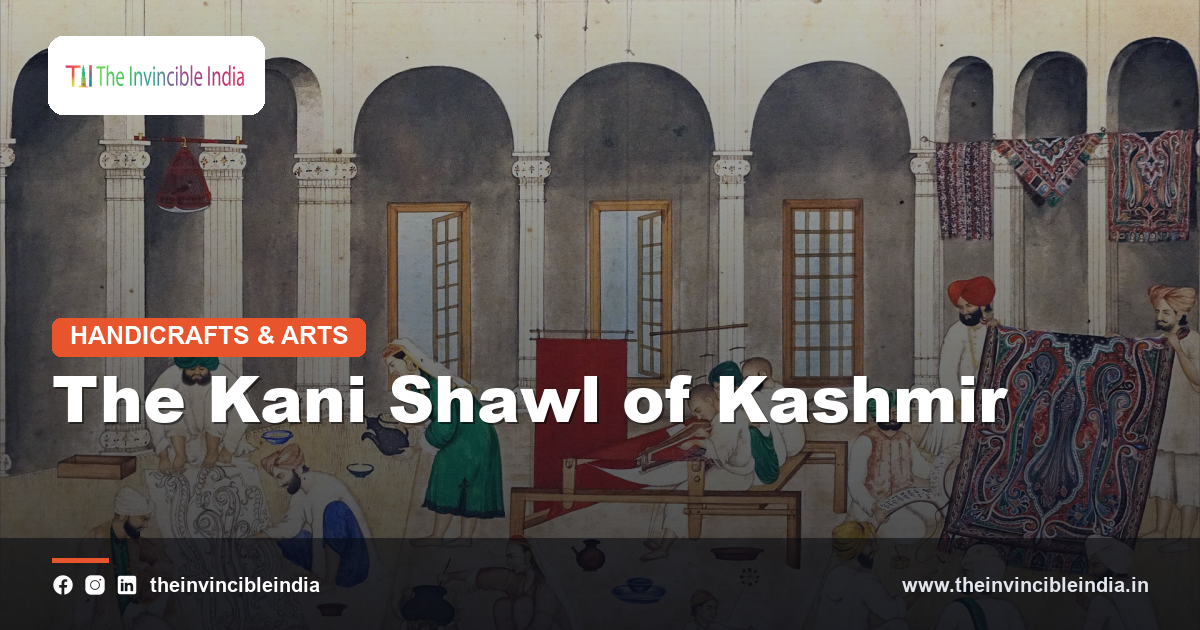
The Kani shawl is the hand-woven pashmina shawl of Kashmir, produced in a slow twill-tapestry technique in which every coloured thread is laid in by a small wooden bobbin known as a kani. The textile is also called the Kanihama shawl, after the village of Kanihama in the Budgam district, and it is sometimes spelled Kanni or Kaani in trade listings. It belongs to the same family of Kashmiri woollens as the plain-woven shawls in the Pashmina guide, but its woven pictures set it apart as a separate and far more demanding craft. This guide explains how the shawl is made, what its patterns mean and why it is treasured.
Quick answer: The Kani shawl is a traditional hand-woven pashmina shawl from Kashmir, India, made by weaving coloured weft threads around small wooden bobbins called kanis so that patterns form inside the fabric itself. It is associated especially with Kanihama village in Budgam district and is valued for its detailed motifs, its softness and the very long hours each piece takes to complete. It holds Geographical Indication status as a distinctive craft of Kashmir.
Key Takeaways
- The Kani shawl is woven, not embroidered, so its patterns are part of the cloth rather than stitched on top of it.
- Each shawl is made on a handloom using many small wooden bobbins called kanis, one for each block of colour in the design.
- The weaving follows a coded pattern script called talim, which a master reads aloud to the weaver.
- The finest Kani shawls use pashmina yarn, the soft undercoat fibre of the Changthangi goat of the Himalayan plateau.
- Kanihama village in Budgam district is the best-known home of the craft, and the shawl is protected as a Geographical Indication product.
Understanding the Kani shawl starts with its method, because the technique explains almost every quality of the finished piece, from its price to its patience-testing pace.
Quick Facts
| Detail | Information |
|---|---|
| Craft | Hand-woven Kani shawl |
| Region | Kashmir Valley, India |
| Best-known village | Kanihama, Budgam district |
| Technique | Twill-tapestry weaving with wooden bobbins (kanis) |
| Main material | Pashmina (Changthangi goat undercoat) |
| Pattern guide | Talim, a coded weaving script |
| Typical motifs | Boteh (paisley), chinar leaf, flowers, vines |
| Status | Geographical Indication product |
What Is a Kani Shawl?
A Kani shawl is a hand-woven Kashmiri shawl in which the design is built into the fabric during weaving. The name comes from the kani, a small pointed wooden stick or bobbin that carries a single colour of weft yarn. Instead of passing one shuttle across the whole width of the loom, the weaver uses dozens or even hundreds of kanis, each laying a short stretch of colour exactly where the pattern calls for it. The result is a cloth whose image looks painted yet is entirely woven, and whose back is as tidy as its front. Because the technique is so slow, the Kani shawl has long been regarded as a luxury textile and a mark of refined taste. In essence, a Kani shawl is a woven picture made from the finest wool, and it differs from every shawl whose pattern is added afterwards.
Where Does the Kani Shawl Come From?
The Kani shawl comes from the Kashmir Valley, where shawl weaving has been practised for many centuries. Kanihama, a village in the Budgam district, is the place most closely tied to the craft, and its name has become shorthand for this style of weaving. Kashmir’s cool climate, its tradition of fine spinning and its network of skilled artisans created the conditions in which such an exacting textile could develop. Historical accounts describe Kashmiri shawls being prized at royal courts, and the patronage of rulers helped the weavers refine their art. Although similar tapestry weaving traditions exist elsewhere in the world, the Kashmiri version has a character of its own in its colours, its motifs and its use of pashmina. The craft is therefore best understood as a product of the Valley’s landscape, climate and long artisan memory.
How Did the Kani Weaving Tradition Develop?
The Kani weaving tradition developed over centuries of court patronage and trade, and it is generally traced to the broad flowering of Kashmiri textiles under successive rulers. Under Mughal taste, floral and vegetal designs became highly fashionable, and these continue to shape the Kani repertoire. Later, Kashmiri shawls travelled widely to markets abroad, where they were so admired that European weavers produced imitations, and the paisley pattern took its name from a Scottish town that wove such copies. Details of early dates and individual innovators are debated, so the tradition is best described in general terms rather than by exact years. What is clear is that Kani weaving survived political change, shifting fashions and competition by adapting while keeping its method intact. The history of the Kani shawl is thus a story of continuity carried by families of weavers.
What Materials Are Used in a Kani Shawl?
A Kani shawl is traditionally made from pashmina, the very soft undercoat fibre combed from the Changthangi goat that lives on the high, cold plateau of Ladakh. The raw fibre is cleaned by hand, spun into extremely fine thread and then dyed in the colours the design requires. Warp threads, which run the length of the loom, are usually kept plain and strong, while the coloured weft threads form the pattern. Some modern Kani shawls use blends or finer-gauge wool to lower the cost, although the most prized pieces remain pure pashmina. The thread must be even, because any irregularity would show in the delicate tapestry weave. The choice of material is therefore central to the shawl, since only a fibre this fine can hold the detail that the technique allows.
What Are the Kanis and How Do They Work?
The kanis are the small wooden bobbins that give the shawl its name, and each one carries a single colour of weft thread. They are slim, pointed sticks that the weaver passes through a small group of warp threads, then beats down so that the colour locks into the fabric. A complex design may need a very large number of kanis hanging at once from the loom, each waiting for the point in the pattern where its colour is needed. Handling them requires patience, memory and a steady rhythm, because a single misplaced bobbin would disturb the picture. The kani is simple in form, yet it is what makes the whole technique possible. By separating colour into individual threads, the kani lets a loom behave like a canvas on which the pattern is slowly drawn.
What Is Talim and Why Does It Matter?
Talim is the coded pattern script that guides Kani weaving, and it is one of the most distinctive features of the craft. Instead of a drawn picture, the weaver works from a written notation that records the sequence of colours and the number of warp threads each should cover, row after row. A master known as the talim guru reads the code aloud, and the weaver translates each instruction into a movement of the kanis. This oral and written system allows complex designs to be repeated accurately and passed from one generation to the next. It also means the same pattern can be woven by different hands with consistent results. Talim therefore acts as both a design drawing and a memory device, preserving the grammar of Kashmiri motifs within the workshop itself.
How Is a Kani Shawl Woven Step by Step?
A Kani shawl is woven in a sequence that begins with preparing yarn and ends with careful finishing. The thread is first spun and dyed, and the loom is set up with the warp stretched evenly across it. The talim is then prepared and read, and the weaver begins laying in coloured wefts with the kanis, one narrow band after another. After each row the weft is pressed down firmly so the pattern stays crisp. Large shawls are often woven in separate pieces or panels by several weavers, and these are later joined so skilfully that the seam is almost invisible. The cloth is then washed, checked and finished by hand. Every stage depends on the one before it, so the process is slow by nature, and the pace of the work is a defining characteristic of the final shawl.
How Long Does a Kani Shawl Take to Make?
A Kani shawl takes a very long time to make, often many months for an elaborate piece and sometimes far longer, because the design grows only a small distance each working day. The exact duration depends on the size of the shawl, the number of colours, the fineness of the yarn and the number of weavers working together. A simple pattern with large colour blocks moves faster than a dense field of tiny flowers and vines. Because so much time is invested in every piece, the labour is a large part of the shawl’s value. This also explains why a handmade Kani shawl cannot be hurried or mass produced without losing its character. The time embedded in the cloth is, in a real sense, what the buyer is purchasing along with the wool.
What Patterns and Motifs Appear on Kani Shawls?
Kani shawls are known for dense, flowing motifs drawn from Kashmir’s gardens and landscape. The most famous is the boteh, the curved teardrop shape known in the West as paisley, which is often filled with tiny flowers and repeated across the field or along the border. Other common motifs include the chinar leaf, floral sprays, climbing vines, almond shapes and scenes with birds and trees. Borders, known as hashiya, usually frame the shawl with bands of repeating patterns, while the central field may be plain, scattered or filled with a full allover design. Colours are chosen to be harmonious rather than loud, giving the cloth a jewel-like depth. Taken together, these motifs form a visual language that connects the shawl to the gardens, seasons and craft heritage of Kashmir.
How Does Kani Weaving Differ from Sozni Embroidery?
Kani weaving differs from sozni embroidery mainly in how the pattern is made, since Kani designs are woven into the cloth while sozni designs are stitched on afterwards. In sozni work, an artisan decorates a finished plain shawl with fine needlework, often in close, delicate stitches that can cover the field or the borders. In Kani work, the pattern is formed during the weaving itself, so the design and the fabric are one object. Both crafts belong to the wider Kashmiri shawl tradition, and both use pashmina, but they require different skills and different tools. A Kani shawl is a woven textile with a tapestry structure, whereas a sozni shawl is an embroidered one. Understanding this contrast helps buyers recognise what they are looking at and appreciate the particular skill behind each type.
Who Are the Artisans Behind the Kani Shawl?
The artisans behind the Kani shawl are a community of weavers, pattern readers, dyers and finishers whose skills are mostly learned inside families and workshops. The talim guru reads the design, the weavers work the kanis, and rafoogars, the skilled darners, repair and join the pieces at the end. Many of these artisans learned as children by watching elders and gradually taking on more complex tasks. Their craft is demanding on the eyes and the hands, and the earnings from such work have not always reflected its difficulty. Younger people are sometimes drawn to other careers, which makes the transmission of skill a concern. Recognising the artisan’s role, and the shared nature of the work, is essential to appreciating why every authentic Kani shawl reflects collective knowledge more than individual genius.
What Is the Cultural Significance of the Kani Shawl?
The Kani shawl carries deep cultural significance as a symbol of Kashmiri artistry, hospitality and identity. For centuries it has been a gift of honour, a bridal treasure and an heirloom passed from one generation to the next. Its motifs echo Kashmir’s gardens and its colours recall the seasons of the Valley, so wearing one is also a way of carrying a piece of that landscape. The shawl has been displayed in exhibitions and collections as an example of India’s finest textile heritage. Beyond its beauty, it stands for patience, collective skill and a refusal to hurry quality. The cultural value of the Kani shawl therefore lies as much in the knowledge woven into it as in the finished garment itself.
What Does the Geographical Indication Status Mean?
Geographical Indication status means that the Kani shawl is legally recognised as a product with a specific Kashmiri origin and a defined method of making. In India, the GI system is designed to protect traditional products whose qualities come from a particular place and tradition, and it helps prevent imitations from being sold under the same name. For the Kani shawl, the status supports artisans by giving buyers a way to distinguish genuine hand-woven pieces from machine-made copies. It does not by itself solve every market difficulty, but it provides a framework for labelling, authentication and promotion. Buyers are encouraged to look for official marks and reliable sellers. The GI recognition is therefore a form of protection that attaches the shawl’s name to its true home and its true craft.
How Can You Identify an Authentic Kani Shawl?
An authentic Kani shawl can be identified by examining its weave, its reverse side and its overall finish. Look closely at the pattern, because in a genuine piece the colours are woven into the cloth, and the back shows neat, short thread ends rather than a flat printed surface. The fabric should feel soft yet dense, and the motifs should be crisp at their edges. Machine-made imitations often have a repeated, uniform look and a stiffer texture. A reliable seller will provide a GI label, a clear description of the fibre and some account of where the shawl was made. Price is also a clue, since genuine hand-woven pieces represent months of labour. Careful inspection and trusted sourcing are the best protection for anyone buying a Kani shawl.
How Should a Kani Shawl Be Cared For?
A Kani shawl should be cared for gently, because its fine pashmina fibres are delicate and easily damaged by rough handling. Dry cleaning by a specialist is generally the safest option, although some owners hand wash very carefully in cool water with a mild soap and never wring or twist the cloth. The shawl should be dried flat away from direct sun and heat. For storage, it should be folded loosely in a breathable cotton or muslin cover, with natural repellents used to keep moths away rather than harsh chemicals. Hanging it for long periods can stretch the weave, so folding is preferred. Treated with this kind of attention, a Kani shawl can last for generations. Good care is therefore part of owning one, since the shawl is meant to be preserved and passed on.
What Challenges Does the Kani Shawl Craft Face?
The Kani shawl craft faces challenges that include competition from machine-made copies, rising costs of raw material and the difficulty of attracting young apprentices. Power-loom imitations can be produced faster and sold at lower prices, and they sometimes carry misleading labels. The long hours required for genuine work make it hard for weavers to earn what the effort deserves, which discourages new entrants. Eye strain and the physical demands of the loom are additional concerns. Efforts to respond include GI protection, training programmes, exhibitions and direct marketing that reaches buyers more fairly. Such measures aim to keep the skills alive and to reward artisans properly. The survival of the Kani shawl will depend on whether its value is recognised in the market as well as in the museum.
The Kani Shawl Today
The Kani shawl today remains one of India’s most admired hand-woven textiles, treasured by collectors, designers and families alike. Contemporary weavers continue to use the kani and the talim, while also experimenting with new colour palettes, lighter shawls and modern uses such as stoles and wraps. Exhibitions, craft fairs and online platforms have widened its audience, and GI recognition has strengthened its identity. At the same time, the craft depends on a small circle of experienced artisans, so training and fair pay are still pressing needs. For a traveller or buyer, learning how a Kani shawl is made changes how it is seen, because the cloth becomes a record of countless hours of skill. In this way the Kani shawl continues to link Kashmir’s past, present and future in a single woven object.
Sources & Further Reading
- Ministry of Culture, Government of India (indiaculture.gov.in).
- Development Commissioner (Handicrafts), Ministry of Textiles, Government of India (handicrafts.nic.in).
Frequently Asked Questions
What is a Kani shawl?
A Kani shawl is a hand-woven pashmina shawl from Kashmir in which the pattern is woven into the fabric using small wooden bobbins called kanis. It is named after these bobbins and is closely associated with Kanihama village in Budgam district.
Why is the Kani shawl so expensive?
The Kani shawl is expensive because it is woven slowly by hand, often over many months, using very fine pashmina yarn. The cost reflects the skilled labour of weavers, pattern readers and finishers as well as the rarity of the raw fibre.
What is the difference between a Kani shawl and a pashmina shawl?
A pashmina shawl is defined by its fibre, while a Kani shawl is defined by its weaving technique. A Kani shawl is usually made from pashmina, but its coloured pattern is woven in with kanis, whereas a plain pashmina shawl may be undecorated or embroidered afterwards.
What is talim in Kani weaving?
Talim is the coded pattern script that tells a Kani weaver which colour to lay in and how many warp threads to cover in each row. A master reads the code aloud while the weaver works the kanis, which lets complex designs be repeated accurately.
How can I tell if a Kani shawl is genuine?
A genuine Kani shawl has its pattern woven into the cloth, a neat reverse side and a soft, dense feel, and it usually carries a GI label from a reliable seller. Printed or power-loom imitations tend to look uniform and flat when examined closely.
How should I wash a Kani shawl?
A Kani shawl is best dry cleaned by a specialist, because pashmina is delicate. If washed by hand, use cool water and mild soap, avoid wringing, and dry the shawl flat in the shade.


