

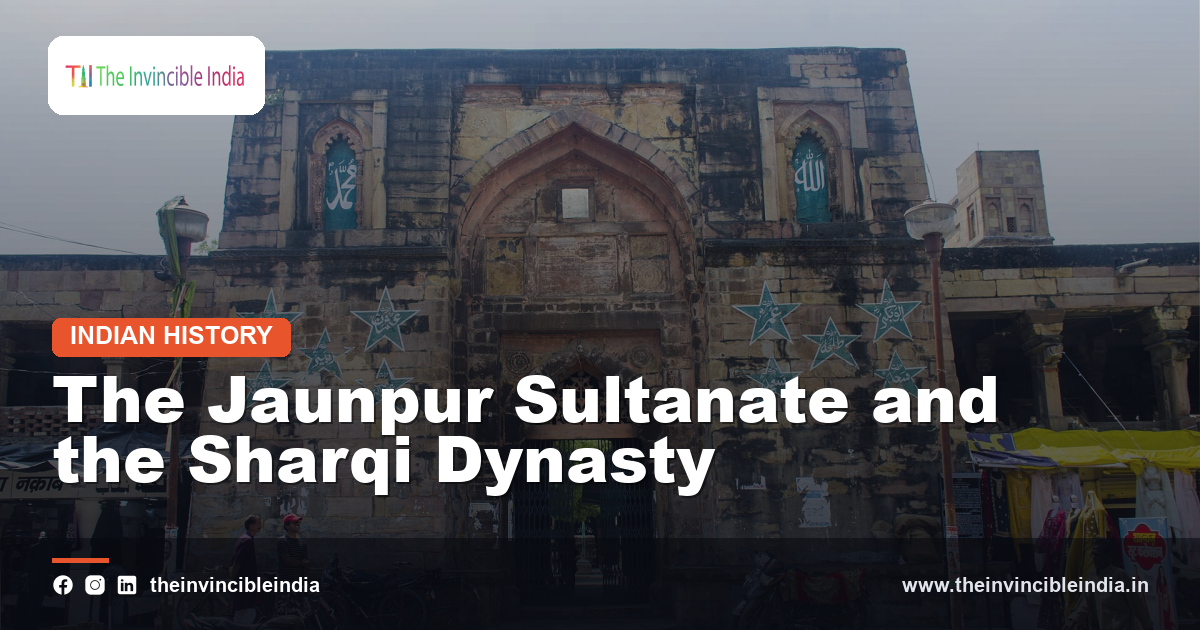
The Jaunpur Sultanate, also known as the Sharqi Sultanate or the Sharqi dynasty of Jaunpur, was an independent kingdom that ruled much of the eastern Gangetic plain in the fifteenth century. Its capital, Jaunpur, stands on the Gomti river in eastern Uttar Pradesh, not far from Varanasi. Established when the authority of the Delhi Sultanate faltered, the state became a famous centre of learning, music and architecture, so admired that it was called the Shiraz of India. Its rulers built mosques with a unique monumental style and tangled repeatedly with their neighbours in Delhi, including the Lodis who eventually ended the kingdom. The story of Jaunpur is also part of the wider history of regional powers such as the Rajputs and other medieval kingdoms of northern India.
Quick answer: The Jaunpur Sultanate was an independent kingdom ruled by the Sharqi dynasty from Jaunpur in eastern Uttar Pradesh during the fifteenth century. Founded when governors broke away from a weakened Delhi Sultanate, it became famous as the Shiraz of India for its scholars, music and the monumental Atala Masjid. The Lodi dynasty of Delhi conquered it in the later fifteenth century.
Key Takeaways
- The Jaunpur Sultanate, also called the Sharqi Sultanate, was a fifteenth-century kingdom on the Gomti river in eastern Uttar Pradesh.
- The Sharqi dynasty was founded by Malik Sarwar, whose title Malik-us-Sharq, meaning lord of the east, gave the dynasty its name.
- Jaunpur earned the title Shiraz of India because scholars, Sufis and artists found patronage there during the disorder at Delhi.
- The Atala Masjid, completed under Ibrahim Shah, is the best-known example of Sharqi architecture, with its giant gateway screen and absence of minarets.
- Tradition links Sultan Husain Shah Sharqi with ragas including Jaunpuri, though musicologists debate individual attributions.
- The Lodi dynasty of Delhi conquered Jaunpur in the later fifteenth century, ending Sharqi independence.
Quick Facts
| Detail | Information |
|---|---|
| Name | Jaunpur Sultanate (Sharqi Sultanate) |
| Capital | Jaunpur, on the Gomti river, Uttar Pradesh |
| Dynasty | Sharqi, founded by Malik Sarwar |
| Era | Mainly the fifteenth century |
| Famous monuments | Atala Masjid, Jama Masjid, Jhanjhri Masjid, Lal Darwaza Masjid |
| End of rule | Conquered by the Lodi dynasty of Delhi in the later fifteenth century |
What was the Jaunpur Sultanate?
The Jaunpur Sultanate was an independent Muslim kingdom in the eastern Gangetic plain that flourished in the fifteenth century under the Sharqi dynasty. It covered a belt of fertile territory around the middle Ganges and Gomti, including parts of what are now eastern Uttar Pradesh and neighbouring regions. The state arose when provincial governors, taking advantage of weakened rule at Delhi, declared their autonomy. Although it lasted only about a century, Jaunpur developed a strong political and cultural identity, and its rulers behaved as full sovereigns who struck coins and held court. The sultanate is remembered more for its monuments, scholars and artistic taste than for conquests. Its brief independence made it a kind of cultural beacon for the whole eastern plains.
Where is Jaunpur located and why does it matter?
Jaunpur is located on the banks of the Gomti river in eastern Uttar Pradesh, within reach of Varanasi, Prayagraj and Lucknow. Its position on river and land routes made it a natural centre for trade and administration in the eastern plains. The city had earlier been strengthened under the Tughlaq rulers of Delhi, who built a fort there and gave it importance as a provincial base. Local tradition about the exact origin of its name is debated, with various stories linking it to Tughlaq-era figures. What is clear is that the city’s location, close to the holy centres of the Ganges and surrounded by productive farmland, helped it grow into a prosperous capital once the Sharqi dynasty chose it as their seat.
How did the Sharqi dynasty come to power?
The Sharqi dynasty came to power when a senior Tughlaq official at Jaunpur took advantage of the confusion that followed the Delhi Sultanate’s decline at the end of the fourteenth century. The invasion of Timur and the resulting disorder left Delhi unable to supervise its provinces, so governors in places such as Gujarat, Malwa and Jaunpur began to rule independently. The ruler of Jaunpur governed the eastern territories with firm authority and gradually dropped any formal dependence on Delhi. His successors continued this policy, adopting royal titles and keeping their own court. The change was less a sudden rebellion than a slow shift in practical power. In this way a provincial governorship became a sultanate with its own ruling house.
Who was Malik Sarwar?
Malik Sarwar was the founder of the Sharqi line and the first great governor of Jaunpur who laid the groundwork for independence. He served the Tughlaq court as a high official and was given the title Malik-us-Sharq, meaning lord of the east, which became the source of the dynasty’s name Sharqi. Sources describe him as a capable administrator who restored order in the eastern provinces and secured the loyalty of local nobles. He is usually described as having risen from a palace background, though details of his early life are limited and sometimes disputed. His title, and the base he built at Jaunpur, gave his successors a strong political foundation. For this reason he is remembered as the true architect of the sultanate.
Who were the main Sharqi rulers?
The main Sharqi rulers were a short line of sultans who followed Malik Sarwar and took Jaunpur to the height of its influence. Mubarak Shah, who succeeded after the founder, continued the policy of independence. Ibrahim Shah is the best known of all, ruling for a long period and gaining a reputation as a scholar and patron of learning. Mahmud Shah expanded the kingdom’s military ambitions, and Husain Shah, the last sultan, was a skilled soldier and patron of music who fought a long contest with the Lodis. The reigns differ in length and the chronology of campaigns is sometimes debated, but the overall pattern is consistent. Each ruler added to the city’s buildings and reputation.
Why was Jaunpur called the Shiraz of India?
Jaunpur was called the Shiraz of India because it became a famous centre of scholarship, poetry and refined culture, compared to the Persian city of Shiraz. When Delhi suffered disorder, scholars, theologians and artists sought shelter in Jaunpur, where Sharqi rulers offered patronage and security. Madrasas, libraries and mosques multiplied, and the city drew students from many regions. The nickname Shiraz-e-Hind captured the sense that Jaunpur had inherited the learned atmosphere of a great Persian city. It also reflects the value that medieval rulers placed on being seen as protectors of knowledge. The label remains in popular memory and underlines how important the sultanate was for the intellectual history of northern India.
What is Sharqi architecture?
Sharqi architecture is the distinctive regional style of mosques and tombs built in Jaunpur and nearby towns during the fifteenth century. Its most recognisable feature is the propylon, a huge sloping gateway screen that rises in front of the prayer hall and hides the dome behind it. The style joins the straight beams and columns of older Indian building with the arch and dome of Islamic tradition, creating a bold and austere look. Minarets are absent, which makes the monuments stand out among other medieval mosques. The result is monumental, balanced and unmistakable. Sharqi architecture is regarded as one of the most original regional styles of medieval India and is studied for the way it blended building traditions.
What is the Atala Masjid?
The Atala Masjid is the finest and most famous mosque of Jaunpur, completed in the early fifteenth century during the reign of Ibrahim Shah. Its central feature is a lofty gateway screen leading into a courtyard surrounded by arcades, with a prayer hall to the west that is crowned by domes. The mosque’s name comes from the earlier Atala Devi temple, whose site and some of whose materials are traditionally said to have been used, a point that historians describe in neutral terms as evidence of reuse common in many regions. Carved stone, tall arches and the huge entrance create a powerful effect. The Atala Masjid is the defining monument of the Sharqi style and a leading attraction for visitors.
What other Sharqi monuments survive in Jaunpur?
Several other Sharqi mosques survive in Jaunpur and share the monumental gateway style of the Atala Masjid. The Jhanjhri Masjid, with its lattice work, the Khalis Mukhlis Masjid and the Lal Darwaza Masjid, whose name is linked to a royal queen’s palace, show variations on the same theme. The Jama Masjid, begun by Husain Shah and set on a high platform, is the largest of them. The Shahi Bridge across the Gomti, a later Mughal work, also forms part of the city’s historic scene, and the old Tughlaq-era fort overlooks the river. Together these buildings give Jaunpur an architectural character found nowhere else. Their survival allows visitors to trace the sultanate through its stonework.
How did Jaunpur support music and the arts?
The Sharqi court supported music and the arts by sponsoring musicians, theorists and poets, and Jaunpur became closely linked with the history of Hindustani music. Traditional accounts credit Sultan Husain Shah Sharqi with creating or popularising several ragas, such as Jaunpuri, and with encouraging the khayal style, although specific attributions are debated by musicologists. A treatise on music written under court patronage is also associated with this period. The city’s musical reputation outlived the dynasty and continued into later centuries. Raga Jaunpuri remains a popular raga in classical performance today. Whether or not every attribution is exact, the strong connection between the Sharqi court and musical creativity is widely accepted and forms a lasting part of the sultanate’s heritage.
How did Sufis and scholars shape Jaunpur?
Sufis and scholars shaped Jaunpur by making it a centre of devotion, teaching and debate in the eastern plains. Sufi teachers established hospices that drew followers from many communities, and their shrines became places of pilgrimage. Learned men from Delhi and further afield found positions in madrasas and at court, and their presence enriched the intellectual life of the city. Jaunpur was also a place where Persian, Arabic and local languages met, which encouraged exchange among poets and writers. The sultans valued these figures as sources of moral authority and cultural prestige. Their support for religious learning gave the sultanate a reputation that went beyond politics and helped it survive in memory after its collapse.
How did Jaunpur's society and economy function?
Jaunpur’s society and economy depended on rich farmland, river trade and a mixed population of cultivators, artisans, merchants and officials. The Gangetic plain produced grain, sugarcane and other crops that supported the army and court. Artisans worked in stone, textiles and other crafts, and urban markets grew around the mosques and palaces. Local Hindu landholders and officials held important roles in administration alongside Muslim nobles, which allowed the state to function across a diverse countryside. The sultans taxed trade, issued coins and maintained a standing military force. This balance between local elites and the royal court gave the state stability for several generations and helped finance the building projects that still define the city.
How did the Sharqis deal with Delhi?
The Sharqis dealt with Delhi through a long mixture of rivalry, war and negotiation that shaped the politics of the fifteenth century. Their sultans saw themselves as equal to the rulers of Delhi, and several attempted to extend their authority westward. The Sayyid rulers of Delhi, who were weak in this period, struggled to hold back Jaunpur, and the border regions often changed hands. When the Lodi dynasty rose at Delhi, the balance shifted, and Bahlol Lodi pursued a long campaign against Jaunpur. Marriage alliances and diplomatic exchanges sometimes eased tension, but conflict returned repeatedly. This persistent struggle explains why Jaunpur’s rulers spent so much energy on defence and why the kingdom’s end came through direct confrontation with Delhi.
How did the Jaunpur Sultanate end?
The Jaunpur Sultanate ended when the Lodi rulers of Delhi conquered it in the later fifteenth century. Husain Shah, the last Sharqi sultan, fought a prolonged war with Bahlol Lodi and then with his son, but he was gradually driven from his capital and lost his kingdom. He is said to have spent his last years in exile, though the details of his final years vary in the sources. Under Lodi rule, Jaunpur became a governed province rather than a capital, and some of its fine mosques suffered damage in the fighting. Even so, the cultural life of the city continued under later rulers. The end of the sultanate marked the end of independence, but not of the city’s importance.
What happened to Jaunpur after the Sharqis?
After the Sharqis, Jaunpur remained an important provincial city under the Lodis, the Sur dynasty and the Mughal Empire. The Mughals appointed governors to the region and left their own marks, notably the stone bridge over the Gomti built in the sixteenth century. The city continued as a centre of Islamic learning, and its monuments were preserved by local communities and later by state authorities. Jaunpur also played a role in later regional politics and in the wider transitions of the Gangetic plain. Although it never regained the independence of the Sharqi age, its heritage continued to attract admiration. The older monuments provided a link between the sultanate’s brilliant century and the long centuries that followed.
Why is the Jaunpur Sultanate important?
The Jaunpur Sultanate is important because it produced a regional culture and architecture of lasting originality in an age of political change. Its mosques demonstrate how Indian and Islamic building traditions could be combined in confident new forms, and its court sheltered scholars and musicians when other centres were in turmoil. The sultanate also illustrates the pattern of regional states that emerged as the Delhi Sultanate weakened, a pattern that shaped the political map of medieval India. Historians study Jaunpur as an example of cultural patronage without imperial scale. Its contribution to Hindustani music, to religious learning and to architecture makes it a significant chapter in the history of northern India.
The Jaunpur Sultanate Today
The Jaunpur Sultanate survives today in the great mosques of the city, which remain places of worship and objects of study. The Atala Masjid, the Jama Masjid and the Lal Darwaza Masjid are protected by the Archaeological Survey of India and attract visitors interested in medieval architecture. Jaunpur still carries the memory of its Sharqi past in local tradition, in the raga that bears its name and in the continued role of the city as an educational centre. Scholars use the monuments, coins and chronicles to refine the story of the dynasty, and heritage walks introduce new generations to its legacy. The sultanate is remembered as a brief but brilliant episode in the cultural history of the Gangetic plain.
Sources & Further Reading
- Ministry of Culture, Government of India (indiaculture.gov.in).
- Archaeological Survey of India (asi.nic.in).
Frequently Asked Questions
What was the Jaunpur Sultanate?
The Jaunpur Sultanate was an independent kingdom ruled by the Sharqi dynasty in the fifteenth century from Jaunpur in eastern Uttar Pradesh. It broke away from the Delhi Sultanate and became known for learning, music and monumental mosques.
Who founded the Sharqi dynasty?
Malik Sarwar founded the Sharqi dynasty. He was a Tughlaq official who received the title Malik-us-Sharq, meaning lord of the east, which gave the dynasty its name.
Why is Jaunpur called the Shiraz of India?
Jaunpur is called the Shiraz of India because it became a major centre of scholarship, poetry and refined culture under the Sharqi rulers. Scholars and artists from Delhi and elsewhere sought patronage there.
What is the Atala Masjid in Jaunpur?
The Atala Masjid is the most famous mosque of Jaunpur, built in the early fifteenth century under Ibrahim Shah. It is known for its huge gateway screen and is the defining monument of the Sharqi architectural style.
How did the Jaunpur Sultanate end?
The Jaunpur Sultanate ended when the Lodi dynasty of Delhi conquered it in the later fifteenth century. Husain Shah Sharqi, the last sultan, lost his capital after a long struggle with Bahlol Lodi.
Is raga Jaunpuri linked to the Sharqi sultans?
Yes, tradition links raga Jaunpuri with Sultan Husain Shah Sharqi, although musicologists debate exact attributions. The raga remains popular in Hindustani classical music today.


