

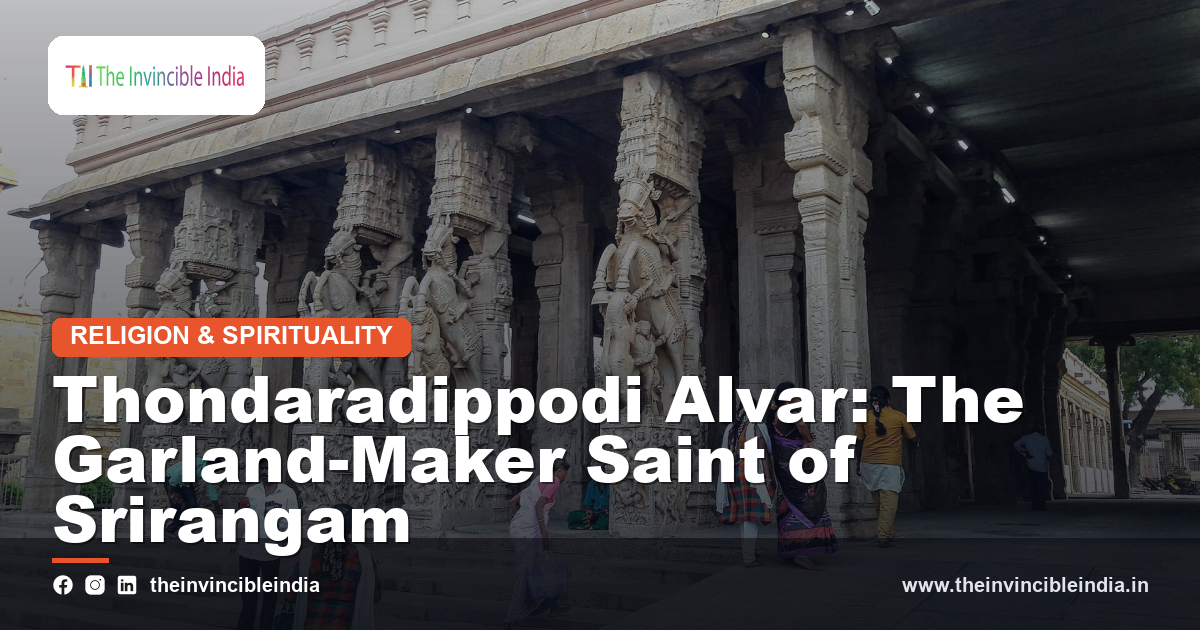
Thondaradippodi Alvar, also spelled Tondaradippodi Azhwar or Thondaradippodi Azhvar and known in tradition by his earlier name Vipranarayana, is one of the twelve Alvars, the Tamil saint-poets of Vaishnava devotion, and is remembered as the garland-maker saint of Srirangam. Tradition says that he tended a flower garden and offered tulasi garlands to Lord Ranganatha, and he composed two hymns in the Divya Prabandham, Tirumalai and Tirupalliyezhuchi. His story is a loved part of temple culture, and it shows how simple service can become sacred, as described in the guide to Hindu temple worship.
Quick answer: Thondaradippodi Alvar is one of the twelve Alvars of Sri Vaishnavism, traditionally a garland-maker who served Lord Ranganatha at the Srirangam temple in Tamil Nadu with flowers and tulasi. He composed two Tamil hymns, Tirumalai and Tirupalliyezhuchi, the second of which is the dawn hymn that awakens the Lord. His name means the dust of the feet of the devotees, and it expresses the humility for which he is remembered.
Key Takeaways
- Thondaradippodi Alvar is one of the twelve Alvars, the Tamil saint-poets of Vaishnava devotion, also known by his earlier name Vipranarayana.
- His name means the dust of the feet of the devotees, a phrase that expresses complete humility before other worshippers of the Lord.
- Tradition says that he made garlands and kept a flower garden for Lord Ranganatha at Srirangam, in the Kaveri delta of Tamil Nadu.
- His two hymns in the Divya Prabandham are Tirumalai, with forty-five verses, and Tirupalliyezhuchi, with ten verses.
- Tirupalliyezhuchi is a dawn hymn that wakes the Lord and is recited in the early hours at Srirangam, especially in the month of Margazhi.
- The stories of his early life and his return to devotion are tradition and not documented history.
The sections below explain the life, works, teachings and continuing legacy in more detail.
Quick Facts
| Detail | Information |
|---|---|
| Also known as | Tondaradippodi Azhwar, Vipranarayana |
| Tradition | Sri Vaishnavism (Alvars) |
| Traditional birthplace | Thirumandangudi near Kumbakonam, Tamil Nadu |
| Place of service | Sri Ranganathaswamy Temple, Srirangam |
| Hymns | Tirumalai (45 verses) and Tirupalliyezhuchi (10 verses) |
| Language | Tamil |
| Occupation in tradition | Garland-maker and keeper of a flower garden |
| Era | Alvar period (traditional account, dates debated) |
Who Was Thondaradippodi Alvar?
Thondaradippodi Alvar was a Tamil saint-poet and one of the twelve Alvars, remembered as a humble servant of Lord Ranganatha who made garlands for the deity at Srirangam. He is honoured in Sri Vaishnavism as a model of selfless service and of respect for fellow devotees. His two hymns are recited in temples across South India.
The accounts of his life come from Sri Vaishnava tradition and devotional biography, and respectful readers treat them as sacred narrative. Scholars debate his dates and many details. What is consistent is the picture of a man who found holiness in the plain work of tending flowers and weaving them into offerings for the Lord.
What Does the Name Thondaradippodi Mean?
The name Thondaradippodi means the dust of the feet of the servants or devotees, and it expresses the greatest humility before other worshippers of Vishnu. In Tamil, thondar means a servant or devotee, adi means feet and podi means dust. The saint is said to have taken this name after he came to see the high value of serving those who love the Lord.
His earlier name, according to tradition, was Vipranarayana, which suggests a learned Brahmin birth. The change of name is told as a sign of inner change. It teaches that spiritual maturity shows itself in modesty and in honour for others, and the name has stayed with the saint as a short statement of his whole outlook.
Where Was He Born?
Tradition places the birth of Thondaradippodi Alvar in Thirumandangudi, a village in the Kaveri delta near Kumbakonam in Tamil Nadu. The region is rich in temples and in farming, and it has produced many saints and scholars. The village is honoured in local tradition as the home of the Alvar in his early years.
From this village the saint is said to have travelled to Srirangam, where he gave his life to the service of the Lord. The accounts vary in detail and are told as tradition. The connection between the village and the great temple town shows how the saints of the Kaveri country moved between small places and large centres of worship.
What Is Srirangam and Why Is It Important?
Srirangam is a temple island on the Kaveri river near Tiruchirappalli in Tamil Nadu and is home to the Sri Ranganathaswamy Temple, one of the most important Vaishnava temples in India. The deity, Ranganatha, is Vishnu reclining on the serpent Adishesha. The vast temple complex has many courtyards and towers and receives pilgrims throughout the year.
For the Alvars, Srirangam is the foremost of the Divya Desams, the sacred shrines praised in their hymns. It is also the place most closely linked with Thondaradippodi Alvar. The temple is a living centre of worship, music and festival life, and it gives the saint’s story a vivid and tangible setting in the heart of Tamil Nadu.
Why Is He Called the Garland-Maker Saint?
Thondaradippodi Alvar is called the garland-maker saint because tradition says that he kept a garden at Srirangam and wove flowers and tulasi leaves into garlands for Lord Ranganatha each day. This work was his service and his prayer. He is said to have asked for nothing beyond the privilege of doing it well.
The image of a devotee turning a simple craft into worship is one of the most loved in Sri Vaishnava memory. It speaks to anyone who does ordinary work with care. The title honours the dignity of such work and reminds listeners that the Lord is pleased by sincerity and not by wealth or position.
What Is the Role of Garlands and Flowers in Temple Worship?
Flowers and garlands play a central role in Hindu temple worship, where they are offered to the deity as a sign of love, beauty and surrender. Garlands adorn the image each day and are carried in processions at festivals. The leaves of the tulasi plant hold a special place in the worship of Vishnu.
A whole community of gardeners and garland-makers has supported temples across India for many generations. Their work is an essential part of the beauty of worship. The story of Thondaradippodi Alvar gives this craft a spiritual meaning, since it shows that the person who prepares the offering shares in the devotion as truly as the priest who presents it.
What Is the Story of Vipranarayana's Early Devotion?
Tradition says that Vipranarayana, the early name of the saint, was a devout and learned young man who gave up other pursuits to serve Ranganatha at Srirangam. He is described as living simply, tending his garden and offering garlands, with his mind fixed on the Lord. The picture is of a pure and single-minded devotee.
This account is part of the tradition and is told with respect. It sets the stage for the later episodes of the story and establishes the saint’s character as one of discipline and love. Respectful readers treat the narrative as sacred biography that expresses the ideal of service and not as a precise historical record.
What Does Tradition Say About His Test and Return to Devotion?
Tradition tells that Vipranarayana was once led astray from his strict devotion through attachment to a dancer named Devadevi, and that the Lord Ranganatha himself intervened through a sequence of events that brought him back to his service. The story ends with the saint’s repentance and a deeper humility, and it is the reason he took the name Thondaradippodi.
The account is told as tradition and is understood as a parable of grace. It teaches that even a person who has stumbled can be restored by the compassion of the Lord. Many devotees draw comfort from the story, and it is usually told with gentleness and without judgement of those involved.
Which Hymns Did Thondaradippodi Alvar Compose?
Thondaradippodi Alvar composed two hymns in the Divya Prabandham, Tirumalai and Tirupalliyezhuchi, which together contain fifty-five verses in Tamil. They are short but they carry great weight in the tradition. Both are addressed to Lord Ranganatha of Srirangam and reflect the saint’s humility and love.
The hymns are recited in temples and homes and are included in the daily and seasonal worship of Sri Vaishnavism. Their place in the collection of the Alvars shows that even a small body of verse can have a large effect. They give a lasting voice to a life of service and form a beloved part of Tamil devotional literature.
What Is Tirumalai?
Tirumalai is a hymn of forty-five Tamil verses by Thondaradippodi Alvar that praises Ranganatha and urges the listener to turn from worldly distractions toward the Lord. It speaks of the compassion of the deity and of the folly of wasted days. The tone is earnest and affectionate.
The hymn is valued for its direct and heartfelt language, and it is studied for its picture of the devotee’s attitude. It teaches that true wealth lies in devotion and that serving the Lord and his followers is the highest path. Tirumalai is often recited in Srirangam and is one of the most cherished works of the Alvar tradition.
What Is Tirupalliyezhuchi?
Tirupalliyezhuchi is a hymn of ten Tamil verses by Thondaradippodi Alvar that awakens Lord Ranganatha at dawn, much as a Suprabhatam does in other traditions. The title means the sacred rising from the couch. Each verse describes the morning scene at Srirangam and invites the Lord to rise and bless the waiting devotees.
The hymn is recited in the early hours at Srirangam and in many Vaishnava temples, and it is especially prominent in the month of Margazhi. Its gentle imagery of sunrise, flowers and the sound of worshippers has made it widely loved. The verses give a daily rhythm to the worship of the temple and are known to many who have never read the full Divya Prabandham.
What Is His Place Among the Twelve Alvars?
Thondaradippodi Alvar is counted among the twelve Alvars and is regarded in Sri Vaishnava tradition as a partial manifestation of Vanamala, the garland of Vishnu. This belief is part of the way the tradition honours each Alvar by linking him with an emblem or attendant of the Lord. It is a matter of faith.
Among the Alvars, who include Nammalvar, Andal and Tirumangai, he is known for the small size and the great influence of his work. His life is a counterpart to that of poets who composed vast hymns, and it shows that the Alvar family included a variety of voices. Each is seen as contributing a different colour to the whole.
How Is He Remembered in Worship at Srirangam?
Thondaradippodi Alvar is remembered at Srirangam through a shrine and through the recitation of his hymns, and his birth star, traditionally placed in the Tamil month of Margazhi, is celebrated by devotees. The dawn recitation of Tirupalliyezhuchi keeps his voice present in the daily life of the temple.
Garland-makers and flower workers of the temple town hold the saint in special affection and see him as a patron of their calling. Festivals and processions include his image, and the temple community gathers to honour him with song. These practices ensure that the garland-maker of Srirangam is not forgotten and is part of the living culture of the temple.
Why Is Thondaradippodi Alvar Important in Indian Culture?
Thondaradippodi Alvar is important in Indian culture because he gives spiritual dignity to humble service and contributes two beloved hymns to Tamil devotional literature. His life shows that the work of gardeners, florists and temple helpers is part of the sacred life of the temple. This message has deep social meaning.
The Alvars together shaped the music, the festivals and the learning of Tamil Nadu, and he is a respected part of that story. The dawn hymn he composed is among the most widely heard of all Tamil devotional verses. His legacy is a reminder that culture is carried by modest hands as much as by great scholars and kings.
What Lessons Does His Life Offer?
The life of Thondaradippodi Alvar offers the lesson that humble work done with devotion is a form of worship and that humility toward others is the mark of true holiness. His name itself is a lesson, since it places the saint at the feet of every sincere devotee. The message appeals to readers of every background.
The story of his return after a time of failure also teaches that grace is greater than error and that anyone can begin again. These lessons are practical and humane. They invite the reader to bring care to the small tasks of each day and to treat others with respect, in the spirit of the garland-maker of Srirangam.
Thondaradippodi Alvar Today
Thondaradippodi Alvar today is remembered as one of the most endearing saints of Sri Vaishnavism, honoured at Srirangam and in Vishnu temples across South India. His dawn hymn is recited in the early morning, his Tirumalai is studied and his story of humble service is told to young and old. Flower workers of the temples still look to him as a guide and a patron.
For students of Indian religion, he is a clear example of how devotion can find expression in the plainest work. The accounts of his life are traditional, and respectful readers treat them as sacred narrative with real meaning. His memory lives in the garland, the dawn song and the quiet service of the temple.
Sources & Further Reading
- Ministry of Culture, Government of India (indiaculture.gov.in).
- Archaeological Survey of India (asi.nic.in).
Frequently Asked Questions
Who was Thondaradippodi Alvar?
Thondaradippodi Alvar was one of the twelve Alvars, the Tamil saint-poets of Vaishnava devotion, and is traditionally remembered as the garland-maker of Lord Ranganatha at Srirangam. He composed two hymns in the Divya Prabandham, Tirumalai and Tirupalliyezhuchi.
What does Thondaradippodi mean?
Thondaradippodi means the dust of the feet of the devotees. It is a name of great humility, which tradition says the saint took after his earlier life as Vipranarayana.
What is Tirupalliyezhuchi?
Tirupalliyezhuchi is a ten-verse Tamil hymn by Thondaradippodi Alvar that awakens Lord Ranganatha at dawn. It is recited in the early hours at Srirangam and in many Vaishnava temples, especially in the month of Margazhi.
What is Tirumalai?
Tirumalai is a hymn of forty-five Tamil verses by Thondaradippodi Alvar in praise of Ranganatha. It urges listeners to turn from worldly distractions toward devotion to the Lord.
Why is he called the garland-maker saint?
He is called the garland-maker saint because tradition says that he kept a flower garden at Srirangam and made garlands of flowers and tulasi for Lord Ranganatha each day. This work was his form of worship.
Where is Srirangam?
Srirangam is a temple island on the Kaveri river near Tiruchirappalli in Tamil Nadu. It is home to the Sri Ranganathaswamy Temple, one of the most important Vaishnava temples in India.


