

The Nawabs of the Carnatic, also called the Nawabs of Arcot or the Carnatic Sultanate, were Muslim rulers who governed the southeastern coastal region of India from their capital at Arcot between the late seventeenth and the early nineteenth centuries. Appointed at first as Mughal governors under the Nizam of Hyderabad, they became regional sovereigns in practice and played a central part in the Carnatic Wars, the contest between the British and the French for influence in southern India. Their rule left lasting landmarks in Chennai, including the Chepauk Palace and the Walajah Mosque. The story of the Nawabs sits within the wider history of the Mughal Empire and the rise of European power in India.
Quick answer: The Nawabs of the Carnatic, also called the Nawabs of Arcot, were the hereditary Muslim rulers of the Carnatic region of southeastern India from the late seventeenth to the early nineteenth century. Appointed originally as Mughal governors under the Nizam of Hyderabad, they ruled from Arcot, shaped the Carnatic Wars with the British and French, and built landmarks in Madras such as the Chepauk Palace and the Walajah Mosque.
Key Takeaways
- The Nawabs of the Carnatic, also called the Nawabs of Arcot, ruled the Carnatic coastal region of southeastern India from Arcot from the late seventeenth century.
- They began as Mughal-appointed governors under the Nizam of Hyderabad and became practically independent regional rulers as Mughal power declined.
- The succession to the Arcot throne was at the heart of the Carnatic Wars, in which the British and French East India Companies fought for influence in the mid-eighteenth century.
- Muhammad Ali Khan Walajah, who won the throne with British support, founded the Walajah dynasty and built the Walajah Mosque in Triplicane, Chennai.
- The Chepauk Palace in Chennai, with its Kalas Mahal and Humayun Mahal, is an early landmark of Indo-Saracenic architecture built for the Nawabs.
- The East India Company took over the administration of the Carnatic in the early nineteenth century, and the family later held the ceremonial title Prince of Arcot.
Quick Facts
| Detail | Information |
|---|---|
| Title | Nawab of the Carnatic (Nawab of Arcot) |
| Capital | Arcot, later with a residence at Chepauk, Madras |
| Origin | Mughal-appointed governors of the Carnatic under the Nizam of Hyderabad |
| Main dynasties | Nawayath dynasty and Walajah dynasty |
| Famous monuments | Chepauk Palace, Walajah Mosque, Arcot Fort remains |
| End of rule | Administration taken over by the East India Company in the early nineteenth century |
Who were the Nawabs of the Carnatic?
The Nawabs of the Carnatic were the hereditary Muslim rulers of Arcot who governed the Carnatic region of southeastern India from the late seventeenth century. They began as Mughal-appointed governors and became practically independent as imperial authority declined, though they acknowledged the nominal overlordship of the Nizam of Hyderabad. Their territory included the coastal plain of present-day Tamil Nadu and parts of neighbouring Andhra Pradesh and Karnataka. They ruled during the years when French and British traders were turning into political players, and their decisions affected the course of that rivalry. The Nawabs are therefore best known as important intermediaries between the Mughal system and the European powers, and their story is central to the history of southern India in the eighteenth century.
What does Carnatic mean in this history?
Carnatic, in this history, refers to the low-lying plains of southeastern India between the Eastern Ghats and the Bay of Bengal, not to the modern state of Karnataka. The term derives from older Kannada words, and European writers applied it to the coastal region, which later became known by names such as the Coromandel coast. The region contained fertile river valleys, port towns and old temple cities, and was a prize for competing powers. The Nawab’s title took its name from this region. Understanding the old sense of the word helps avoid confusion today, because the Carnatic Nawabs ruled territory that is now largely in Tamil Nadu and southern Andhra Pradesh, and the same word survives in the name of Carnatic music.
How did the Nawabs of Arcot begin?
The Nawabs of Arcot began when Mughal emperors appointed a governor to administer the Carnatic after Mughal armies had extended their power into the south in the later seventeenth century. Zulfiqar Ali Khan, a leading Mughal commander, is regarded as the first to hold the office, and his successors continued as Nawabs with their seat at Arcot. The post was meant to govern the Carnatic under the supervision of the Mughal viceroy of the Deccan, who later became the independent Nizam of Hyderabad. As Mughal power weakened, the Nawabs began to act more independently and treated the office as hereditary. This evolution from imperial appointees to regional rulers is typical of eighteenth-century India.
Where is Arcot and why did it matter?
Arcot is a historic town on the Palar river in present-day Tamil Nadu, and it became the capital of the Nawabs because of its central position in the Carnatic. The town sat on routes connecting the coast with the interior and was close to the old centre of Vellore. Its fort, once an important defensive position, and its gates and mosques made it the symbolic centre of Nawabi power. The surrounding region produced grain and textiles, which supported the court and army. Though Arcot later declined in importance as Madras grew, its name remained attached to the Nawabs and gave rise to the term Arcot rupee and other local names. Its location made it a natural capital for the region.
Who were the Nawayath rulers?
The Nawayath rulers were the first hereditary line of Nawabs of the Carnatic, ruling from the early into the middle of the eighteenth century. Saadatullah Khan I and later Dost Ali Khan were prominent among them, and Saadatullah Khan is remembered for consolidating the state and giving the Nawabs a firmer political base. The dynasty was named after the Nawayath community, a group with roots on the western coast. Its later members faced difficulties from succession disputes, as well as raids by the Marathas and pressure from outside powers. The line came to an end in a period of crisis, when a disputed succession opened the way for new contenders and for external intervention, leading to the rise of the Walajah family, beginning with Anwaruddin Khan.
What were the Carnatic Wars?
The Carnatic Wars were a series of conflicts in the middle of the eighteenth century in which the British and French East India Companies fought for influence in southern India, using local rulers as allies. The wars grew out of the European rivalry of the time but took place largely in the Carnatic, where succession disputes among Indian rulers gave the companies an opening. Each company supported a rival candidate for the throne of Arcot, and battles and sieges followed. The conflict ended in a clear advantage for the British and reduced French power in India. Historians treat the wars as a turning point in Indian history, since they showed how European forces could shape the politics of the subcontinent.
How did the Nawabs shape the Carnatic Wars?
The Nawabs shaped the Carnatic Wars because the succession to the Arcot throne was the main issue over which the European companies chose sides. Anwaruddin Khan held the office when the contest began, and Chanda Sahib, supported by the French, challenged his claim and that of his house. After Anwaruddin’s death in battle, his son Muhammad Ali Khan Walajah, backed by the British, emerged as the final victor. The siege and defence of Arcot by Robert Clive, which came in the midst of this struggle, became a celebrated episode. The wars therefore were not simply colonial contests but involved Indian rulers who made their own calculations. The outcome affected the future of the Nawabs themselves.
Who was Muhammad Ali Khan Walajah?
Muhammad Ali Khan Walajah was a Nawab of the Carnatic who ruled for a long period in the second half of the eighteenth century and gave his name to the Walajah dynasty. He came to power with British support in the Carnatic Wars and remained closely tied to the East India Company for the rest of his life. He built mosques and palaces, supported scholars and religious figures, and shifted much of his court life to Madras. His reign saw invasions by Hyder Ali of Mysore, which devastated parts of the Carnatic, and growing financial dependence on British loans. Historians assess his rule with mixed judgements, but all agree that he was a central figure in the history of Madras and the Carnatic.
How did the Nawabs rule and finance the state?
The Nawabs ruled through a court of nobles, revenue officers and military commanders, and financed the state through land revenue, customs and loans. Persian was the language of administration, and Urdu and Tamil were widely used in everyday life. The state depended on a mix of local landholders, called poligars, and officials who collected taxes. As European power grew, the Nawabs came to rely on British troops for security, and they borrowed large sums from the company and from private creditors to pay for wars and administration. These debts later became a major political issue in Britain as well as India. The financial strains of the state limited the Nawabs’ independence and helped lead to the end of their rule.
What is the Chepauk Palace?
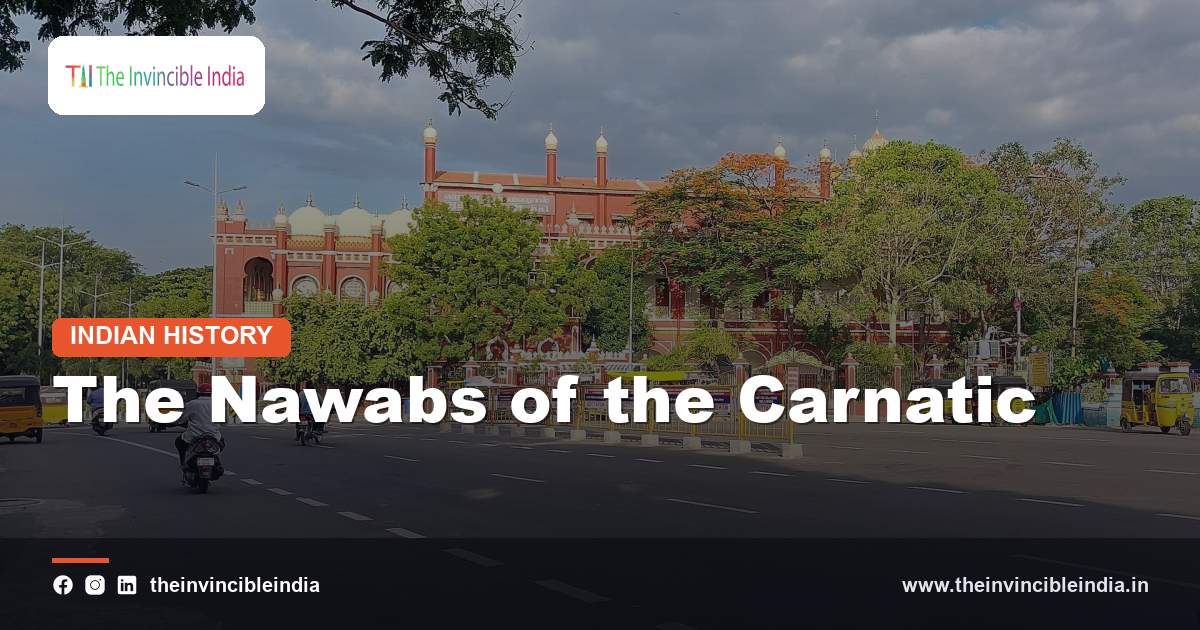
The Chepauk Palace is a large Indo-Saracenic building in Chennai that was built for the Nawabs of the Carnatic in the late eighteenth century and extended in the nineteenth. It consists of two main parts, the Kalas Mahal and the Humayun Mahal, which combine Indian, Islamic and European elements in a series of domes, arches and verandahs. It served as the Nawab’s residence in Madras, and after the end of the Nawabi administration, it passed to the government and housed public offices. The neighbouring cricket ground takes its name from the palace area. The Chepauk Palace is regarded as an important early example of Indo-Saracenic architecture in India, and it remains a recognised landmark of the city.
What is the Walajah Mosque?
The Walajah Mosque, also called the Big Mosque, is a large mosque in Triplicane, Chennai, built during the time of Muhammad Ali Khan Walajah in the eighteenth century. It forms part of a complex of buildings that includes a tomb, a school and residential structures, and its design shows a mix of local and Persianate styles. The mosque reflects the Nawab’s patronage of religion and learning and became a centre of Muslim life in the city. It remains in active use for prayer and community gatherings. The mosque is also a reminder that the Nawabs shaped the urban landscape of Madras, since many neighbourhoods, roads and buildings in the city carry names or memories connected with Walajah and his family.
How did the Nawabs shape culture in Madras and the Carnatic?
The Nawabs shaped culture in Madras and the Carnatic by supporting Persian and Urdu learning, religious institutions and a distinctive Muslim court tradition in the Tamil country. They endowed mosques, shrines and schools, and welcomed poets and scholars from the Deccan and beyond. Tamil Muslim literature flourished in this period, and the cuisine of the region, including dishes such as Arcot and Ambur biryani, is traditionally linked with Nawabi tables, though the exact origins are a matter of popular tradition. The blending of Persianate, Dakhni and Tamil influences produced a rich local culture. The Nawabs thus left a mark on language, food, architecture and social life that is still visible in the region today.
How did the Nawabs lose power?
The Nawabs lost power as a result of growing debt, dependence on British forces and suspicion of their dealings during the wars with Mysore. In the early nineteenth century, the East India Company took over the administration of the Carnatic after a succession dispute and allegations of secret communication with the enemy. The ruling Nawab became a pensioner, and his territories came under direct British control. The details of the agreement are described differently by Indian and British writers, and historians debate how far the Nawabs were wrongly treated. What is clear is that the shift ended Nawabi sovereignty, while the family kept its rank, titles and a stipend, reflecting the usual pattern of British dealings with princely houses.
What happened to the title after Nawabi rule ended?
After the Nawabi administration ended, the family retained a ceremonial title, and the line was later styled the Prince of Arcot, with the family living in Chennai. The Prince of Arcot title was recognised by the British government in the nineteenth century and continued to be used by the family in the republic of India as a social and cultural rank, though without any political authority. The family continues to take part in charitable and community work, and its residence at Amir Mahal in Chennai is a known historic building. The story of the title shows how princely houses continued as social and cultural institutions even after their sovereign power had ended.
Why are the Nawabs of the Carnatic important?
The Nawabs of the Carnatic are important because they stood at the point where the Mughal order, regional power and European expansion met in southern India. Their decisions and disputes shaped the Carnatic Wars and the early growth of the British presence in Madras and the south. They also left a built and cultural legacy that continues to define parts of Chennai. Historians study them to understand how regional rulers dealt with European trading companies and how debts, alliances and local politics shaped colonial expansion. The Nawabs therefore illustrate both the agency of Indian rulers and the pressures that limited it. Their history is essential to any account of eighteenth-century India.
The Nawabs of the Carnatic Today
The Nawabs of the Carnatic are remembered today through the Chepauk Palace, the Walajah Mosque, the ruins of Arcot Fort and the family that continues to bear the title Prince of Arcot. Visitors to Chennai can trace the Nawabs’ influence through its buildings, street names and cultural traditions, and the cuisine of Arcot and Ambur keeps their memory alive in daily life. Historians continue to study the period through records in Persian, Tamil and European languages, which give a fuller picture than any one source alone. The Nawabs remain an important chapter in the history of Tamil Nadu and southern India, and their story continues to attract scholars, students and visitors interested in the layered past of Madras.
Sources & Further Reading
- Ministry of Culture, Government of India (indiaculture.gov.in).
- Archaeological Survey of India (asi.nic.in).
Frequently Asked Questions
Who were the Nawabs of the Carnatic?
The Nawabs of the Carnatic were the hereditary Muslim rulers of Arcot who governed the Carnatic region of southeastern India from the late seventeenth century. They began as Mughal governors under the Nizam of Hyderabad and later became regional rulers allied with the British.
Where was the capital of the Nawabs of the Carnatic?
The capital of the Nawabs of the Carnatic was Arcot, a town on the Palar river in present-day Tamil Nadu. Later Nawabs also lived at the Chepauk Palace in Madras, now Chennai.
What were the Carnatic Wars?
The Carnatic Wars were conflicts in the mid-eighteenth century in which the British and French companies fought for influence in southern India. They were fought around disputed successions to the throne of Arcot and ended with a British advantage.
What is the Chepauk Palace?
The Chepauk Palace is an Indo-Saracenic building in Chennai built for the Nawabs of the Carnatic in the late eighteenth century. It has two main halls, the Kalas Mahal and the Humayun Mahal, and later served as government offices.
Who was Muhammad Ali Khan Walajah?
Muhammad Ali Khan Walajah was a Nawab of the Carnatic who ruled for much of the later eighteenth century with British support. He founded the Walajah dynasty and built the Walajah Mosque in Triplicane, Chennai.
Is there still a Prince of Arcot?
Yes, the title Prince of Arcot is still held by a descendant of the Nawabs, though it has no political power. The family lives in Chennai and takes part in cultural and charitable activities.


