

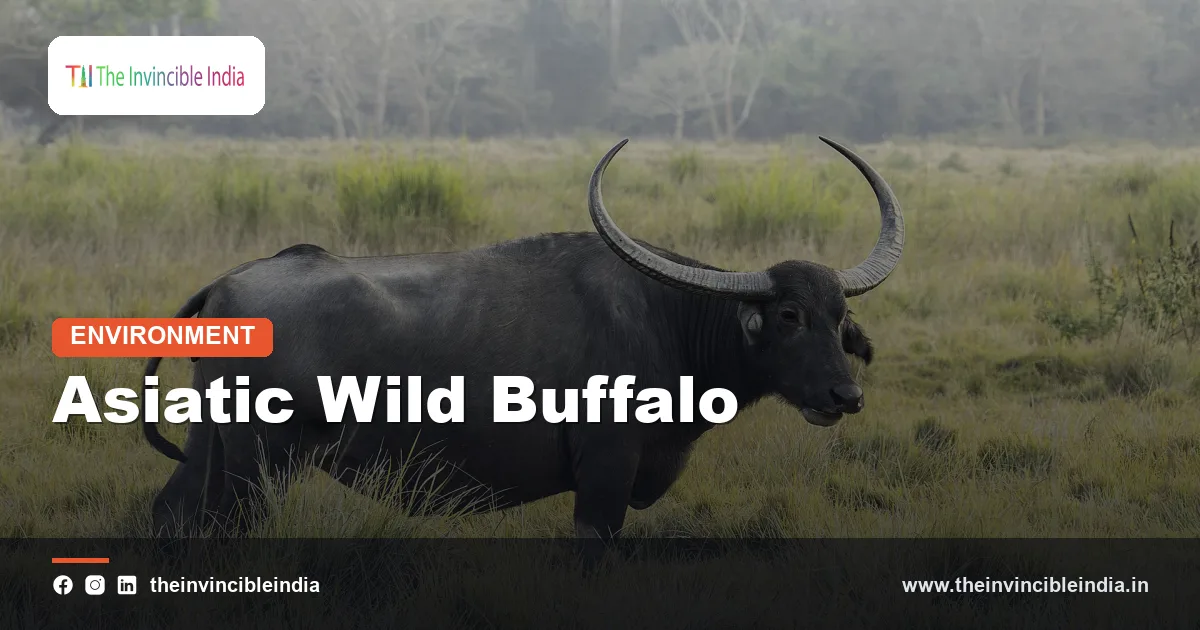
The wild buffalo, formally the Asiatic wild buffalo or wild water buffalo (Bubalus arnee), is a large, heavily built wild bovine of South and Southeast Asia that is the ancestor of the domestic water buffalo and is classed as Endangered on the IUCN Red List. India holds the great majority of the world’s remaining wild buffalo, most of them in the floodplain grasslands of Assam, with a handful of small, fragile populations in central India, where the animal is the state animal of Chhattisgarh.
The wild buffalo is protected under Schedule I of India’s Wildlife (Protection) Act, 1972, yet it faces serious pressure from shrinking wetlands and grasslands and from interbreeding and disease transmission from domestic buffalo. Its conservation is a race to keep genetically pure animals alive.
| Attribute | Detail |
|---|---|
| Common names | Asiatic wild buffalo, wild water buffalo, arna (Hindi/Assamese regional usage) |
| Scientific name | Bubalus arnee |
| IUCN status | Endangered |
| Indian legal status | Schedule I, Wildlife (Protection) Act, 1972 |
| Main Indian strongholds | Kaziranga and Manas (Assam); Indravati and Udanti-Sitanadi (Chhattisgarh) |
| State animal of | Chhattisgarh |
| Habitat | Tall wet grasslands, swamps, riverine forests and marshes |
| Relationship to livestock | Wild ancestor of the domestic water buffalo (Bubalus bubalis) |
| Conservation concern | Hybridisation and disease from domestic buffalo, habitat loss, hunting |
Key Takeaways
- The Asiatic wild buffalo (Bubalus arnee) is the wild ancestor of the domestic water buffalo and is listed as Endangered on the IUCN Red List.
- India is home to the great majority of the world’s wild buffalo, with the largest populations in Assam’s Kaziranga National Park and Manas National Park.
- Chhattisgarh has adopted the wild buffalo as its state animal, and the species survives in the state in tiny populations in Udanti-Sitanadi Tiger Reserve and the Indravati landscape.
- Wild buffalo carry some of the longest and widest-spreading horns of any living bovine, and both males and females have horns.
- Interbreeding with domestic buffalo and diseases passed on from livestock are major threats because they erode the genetic purity of the wild population.
- India’s wild buffalo is one of the species supported under the central government’s species recovery programme, with a focus on habitat protection and breeding of genetically pure animals.
What is the Asiatic wild buffalo?
The Asiatic wild buffalo is a massive wild member of the cattle family that lives in swampy grasslands and river floodplains and is the wild form from which the domestic river and swamp buffalo were derived. Scientists classify it as Bubalus arnee, and it is also called the wild water buffalo, to separate it from the African buffalo and from domesticated herds.
Adult wild buffalo are heavily built, with a broad muzzle, a slightly sloping back, and a sparse grey-black to dark-brown coat. Bulls can weigh around a tonne or more, and they are generally larger and heavier than most domestic buffalo. The animal has pale, sometimes whitish markings on the lower legs and a V-shaped pale chevron on the chest in many individuals.
Wild buffalo are strong, alert and capable of defending themselves against tigers, though calves and weaker animals can be taken by large predators. They are a keystone grazer of wetland grasslands.
Why are the horns of the wild buffalo so remarkable?
The wild buffalo has some of the longest horns of any living bovine, curving outward and backward in a broad crescent that can exceed a metre along the curve in large animals. Both sexes carry horns, which are heavy, ridged and triangular in cross-section, and trophy-hunting interest in these horns historically contributed to the species’ decline.
The horns serve as weapons in contests between bulls, as a deterrent against predators, and as a way to push through dense reed beds. Their size and shape are among the traits used to tell a genetically wild animal from a hybrid, since domestic buffalo generally have shorter, more tightly curved horns, though horn shape alone is not a reliable test.
Where does the wild buffalo live in India?
The wild buffalo lives in two main regions of India: the Brahmaputra floodplains of Assam, where most animals are found, and a few pockets of central India in Chhattisgarh. The species also survives in small numbers in neighbouring countries such as Nepal, Bhutan, Thailand and Cambodia, but its stronghold is Assam.
Assam: Kaziranga, Manas and other floodplain reserves
Kaziranga National Park is the single most important stronghold of the wild buffalo, and the tall elephant grass and wetlands of this UNESCO World Heritage Site suit the species well. Manas National Park, also a World Heritage Site and a tiger reserve, holds another significant population that has recovered after a period of unrest and poaching. Smaller populations survive in places such as Dibru-Saikhowa, Laokhowa and Pobitora.
Central India: Indravati and Udanti-Sitanadi
In Chhattisgarh, wild buffalo survive in the Indravati Tiger Reserve in Bastar and in the Udanti-Sitanadi Tiger Reserve. These populations are very small, and in Udanti-Sitanadi the number of confirmed animals has fallen to just a few individuals, which makes the central Indian wild buffalo one of the most precarious large mammal populations in the country.
Because of the long distance between Assam and central India, the two populations are isolated from one another and are not connected by any habitat corridor.
What is the conservation status of the wild buffalo?
The wild buffalo is classified as Endangered by the IUCN, with a global population believed to be below four thousand mature individuals and still declining in several countries. The listing reflects a severe long-term population drop over the past century, driven by habitat conversion, hunting and genetic swamping by domestic buffalo.
In India, the species is on Schedule I of the Wildlife (Protection) Act, 1972, the strictest category, which prohibits hunting and trade. The wild buffalo is also one of the species selected for focused recovery effort under the central government’s recovery programme for critically endangered species, which funds habitat work and breeding efforts.
The species is considered regionally extinct or nearly extinct in several parts of its former range, including large areas of the Indian peninsula, Bangladesh and Sri Lanka, where its range has shrunk to a few remnant sites.
How is the wild buffalo different from the domestic buffalo?
The wild buffalo differs from the domestic buffalo mainly in its larger body, longer and more widely spreading horns, wilder temperament and genetic makeup, even though the two can interbreed and produce fertile offspring. The domestic water buffalo (Bubalus bubalis), a mainstay of Indian dairy farming, is generally accepted to have descended from the wild buffalo after domestication thousands of years ago.
| Feature | Wild buffalo | Domestic buffalo |
|---|---|---|
| Scientific name | Bubalus arnee | Bubalus bubalis |
| Body size | Larger, heavier build | Generally smaller |
| Horns | Long, wide-spreading crescent | Shorter, often more tightly curved |
| Temperament | Wary and potentially aggressive | Docile, bred for work and milk |
| Habitat | Wild wet grasslands and swamps | Villages, farms and grazing lands |
| Conservation status | Endangered | Not applicable (domesticated) |
Domestic buffalo are among India’s most important livestock, and India is one of the world’s largest producers of buffalo milk. This large domestic population is both an asset to the economy and a conservation problem, since it lives near wild herds in many areas.
What are the main threats to the wild buffalo?
The main threats to the wild buffalo are loss and degradation of wetland grasslands, hybridisation and disease transmission from domestic buffalo, and hunting. Together, these threats have reduced the species to scattered remnant populations.
Habitat loss and degradation
Wild buffalo depend on tall, wet grasslands and swamps, which are among the most threatened habitats in Asia because they are readily converted to farmland, embankments and settlements. Invasive plants such as water hyacinth and mimosa also choke wetlands and reduce good forage. In Assam, annual floods are natural but can force animals out of parks onto roads and into settlements.
Hybridisation with domestic buffalo
Domestic buffalo are often grazed in and around protected areas, and wild buffalo, especially lone animals or small groups, may mate with them. The resulting hybrids dilute the wild gene pool over generations, and this “genetic swamping” can make a population of apparently wild-looking animals genetically impure. This is a particularly serious concern in central India, where the remaining herds are tiny.
Disease from livestock
Domestic buffalo and cattle can transmit infections such as foot-and-mouth disease, haemorrhagic septicaemia and anthrax to wild buffalo. Because the wild populations are small, an outbreak can cause outsized damage.
Hunting and retaliation
Wild buffalo have been hunted for meat and horns, and during periods of conflict in some regions, poaching increased sharply. Animals that stray onto farmland may also be killed in retaliation for crop damage.
What is being done to conserve the wild buffalo in India?
India conserves the wild buffalo through strict legal protection, management of core habitats in Assam’s national parks and Chhattisgarh’s tiger reserves, and a breeding and recovery effort focused on genetically pure animals. The Ministry of Environment, Forest and Climate Change includes the Asiatic wild buffalo in its list of species supported under the recovery programme, which provides funds for habitat improvement, monitoring and breeding.
- Habitat management: Grassland burning in controlled patterns, wetland restoration and removal of invasive plants help maintain the open, tall-grass habitat the species needs.
- Anti-poaching: Patrols in Kaziranga, Manas and the Chhattisgarh reserves guard against hunting.
- Livestock management: Moving domestic buffalo away from wild herds and vaccinating livestock reduces hybridisation and disease risk.
- Genetic assessment: Researchers, including those at the Wildlife Institute of India, have used genetic testing to identify pure animals and guide breeding choices.
- Captive breeding and translocation: Chhattisgarh has pursued a breeding programme for pure wild buffalo, including at the Barnawapara Wildlife Sanctuary, and has explored bringing animals from Assam to build a healthier breeding group.
- Monitoring: Camera traps and regular surveys track the numbers and movements of wild buffalo.
Why is the Chhattisgarh wild buffalo population special?
The Chhattisgarh wild buffalo population is special because it is the main remaining wild buffalo group in peninsular India and is cut off from the larger Assam populations by many hundreds of kilometres. The animal, locally known as the “van bhainsa”, is the state animal of Chhattisgarh and is a source of state pride, yet only a very small number of animals remain.
The state has tried to rebuild the population by breeding genetically pure animals in a protected setting and later releasing them into suitable habitat. These efforts have faced difficulties, including the tiny number of available pure individuals and the lack of breeding partners. The experience shows how difficult it is to recover a species once its numbers have become extremely low, and why early protection matters.
What is the future outlook for the wild buffalo?
The future of the wild buffalo is reasonably secure in the large Assam floodplain reserves, but it remains highly uncertain in central India, where the survival of the species depends on intensive management. The Assam populations are large enough to sustain themselves if habitat, anti-poaching and flood management continue to receive attention.
The priorities for the coming years include protecting wetland grasslands from conversion, keeping domestic buffalo away from wild herds, maintaining genetic records of pure animals, and building a reliable breeding and translocation programme. Expanding the number of protected sites where the species can live would also reduce the risk that a single disease outbreak or flood could wipe out a large share of the population.
Cross-border cooperation with Nepal, Bhutan and Southeast Asian countries could help share expertise on the species as well.
Bottom Line
The Asiatic wild buffalo is the wild ancestor of one of India’s most important farm animals, and the country holds most of the species that still survive. Protecting tall wetland grasslands, separating wild herds from domestic buffalo, and carefully breeding pure animals are the central tasks of wild buffalo conservation in India.
Frequently Asked Questions
Is the Asiatic wild buffalo endangered?
Yes, the Asiatic wild buffalo is classified as Endangered on the IUCN Red List. The global population is believed to be below four thousand mature individuals, and most of them live in India.
Where can I see wild buffalo in India?
The best places to see wild buffalo in India are Kaziranga National Park and Manas National Park in Assam. Small populations also survive in Chhattisgarh in the Indravati and Udanti-Sitanadi tiger reserves, but sightings there are rare.
Is the wild buffalo the same as the domestic water buffalo?
No, the wild buffalo (Bubalus arnee) is the wild ancestor of the domestic water buffalo (Bubalus bubalis) but is a different, larger animal with longer horns. The two can interbreed, which is a major conservation threat to the wild species.
Which Indian state has the wild buffalo as its state animal?
Chhattisgarh has the wild buffalo, known locally as the van bhainsa, as its state animal. The state still has a very small wild population in its tiger reserves.
Why is hybridisation with domestic buffalo a problem?
Hybridisation is a problem because it mixes domestic genes into the wild population, gradually eroding the genetic purity of the wild buffalo. When the remaining herd is tiny, even a few hybrid offspring can change the character of the whole group.
How is the wild buffalo protected by law in India?
The wild buffalo is listed on Schedule I of the Wildlife (Protection) Act, 1972, which gives it the highest level of protection and bans hunting and trade. It is also covered by the government’s recovery programme for critically endangered species, which funds habitat work and breeding.
{“@context”:”https://schema.org”,”@graph”:[{“@type”:”FAQPage”,”mainEntity”:[{“@type”:”Question”,”name”:”Is the Asiatic wild buffalo endangered?”,”acceptedAnswer”:{“@type”:”Answer”,”text”:”Yes, the Asiatic wild buffalo is classified as Endangered on the IUCN Red List. The global population is believed to be below four thousand mature individuals, and most of them live in India.”}},{“@type”:”Question”,”name”:”Where can I see wild buffalo in India?”,”acceptedAnswer”:{“@type”:”Answer”,”text”:”The best places to see wild buffalo in India are Kaziranga National Park and Manas National Park in Assam. Small populations also survive in Chhattisgarh in the Indravati and Udanti-Sitanadi tiger reserves, but sightings there are rare.”}},{“@type”:”Question”,”name”:”Is the wild buffalo the same as the domestic water buffalo?”,”acceptedAnswer”:{“@type”:”Answer”,”text”:”No, the wild buffalo (Bubalus arnee) is the wild ancestor of the domestic water buffalo (Bubalus bubalis) but is a different, larger animal with longer horns. The two can interbreed, which is a major conservation threat to the wild species.”}},{“@type”:”Question”,”name”:”Which Indian state has the wild buffalo as its state animal?”,”acceptedAnswer”:{“@type”:”Answer”,”text”:”Chhattisgarh has the wild buffalo, known locally as the van bhainsa, as its state animal. The state still has a very small wild population in its tiger reserves.”}},{“@type”:”Question”,”name”:”Why is hybridisation with domestic buffalo a problem?”,”acceptedAnswer”:{“@type”:”Answer”,”text”:”Hybridisation is a problem because it mixes domestic genes into the wild population, gradually eroding the genetic purity of the wild buffalo. When the remaining herd is tiny, even a few hybrid offspring can change the character of the whole group.”}},{“@type”:”Question”,”name”:”How is the wild buffalo protected by law in India?”,”acceptedAnswer”:{“@type”:”Answer”,”text”:”The wild buffalo is listed on Schedule I of the Wildlife (Protection) Act, 1972, which gives it the highest level of protection and bans hunting and trade. It is also covered by the government’s recovery programme for critically endangered species, which funds habitat work and breeding.”}}]}]}


