

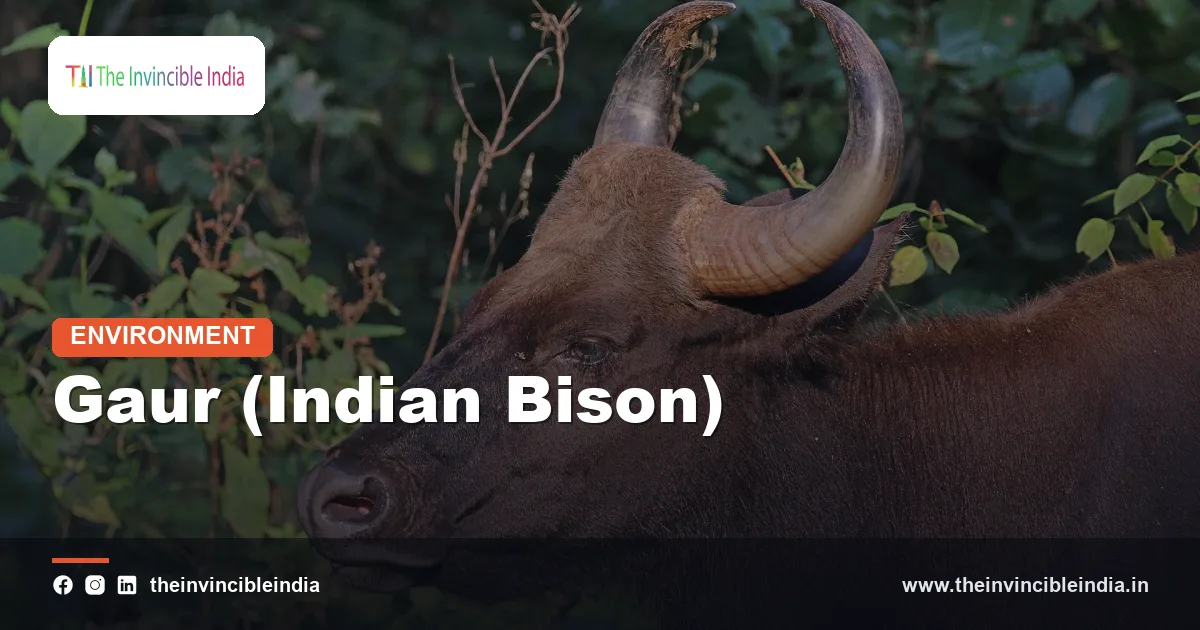
The gaur, often called the Indian bison, is the largest wild bovine in the world, a massive, dark-coated forest ox (Bos gaurus) that lives in hilly, forested country across peninsular India, central India, the Himalayan foothills and the Northeast. The gaur is classed as Vulnerable on the IUCN Red List and enjoys the highest legal protection in India, being listed on Schedule I of the Wildlife (Protection) Act, 1972.
Although the gaur is not an endangered flagship like the tiger, its numbers have fallen across much of Asia because of shrinking forests, disease spillover from domestic cattle and hunting. India still holds the largest share of the world population, which makes the country central to the gaur’s long-term survival.
| Attribute | Detail |
|---|---|
| Common names | Gaur, Indian bison, seladang (Malay Peninsula) |
| Scientific name | Bos gaurus |
| Distinction | Largest living wild bovine in the world |
| IUCN status | Vulnerable |
| Indian legal status | Schedule I, Wildlife (Protection) Act, 1972 |
| International trade status | CITES Appendix I |
| Main Indian strongholds | Western Ghats (Nilgiris, Nagarhole, Bandipur, Mudumalai), central India (Kanha, Pench, Satpura), Northeast India |
| State animal of | Goa and Bihar |
| Diet | Grasses, bamboo, leaves, shoots and fruits |
Key Takeaways
- The gaur (Bos gaurus) is the largest wild bovine on Earth, with adult bulls standing roughly 1.6 to 1.9 metres at the shoulder and weighing well over 800 kilograms.
- The IUCN Red List classifies the gaur as Vulnerable, and India protects the animal under Schedule I of the Wildlife (Protection) Act, 1972.
- Gaur live in matriarchal herds led by an experienced adult female, while mature bulls are often solitary or join herds mainly during the breeding season.
- Habitat loss and fragmentation, disease transmitted by domestic cattle, and poaching for meat are the three biggest threats to the gaur.
- The Nilgiri Biosphere Reserve landscape, covering protected areas such as Nagarhole, Bandipur and Mudumalai, is widely regarded as one of the most important gaur strongholds in the world.
- Gaur shape forest ecosystems as large grazers and browsers, and they form a key part of the prey base for tigers and dholes.
What is a gaur and why is it called the Indian bison?
The gaur is a wild ox of the family Bovidae that is commonly called the Indian bison, even though it is not a true bison and is more closely related to cattle and the banteng. The name “Indian bison” arose in colonial-era writing because the animal’s humped shoulders and heavy build resemble the American bison, but the gaur belongs to the genus Bos, the same genus as domestic cattle.
The gaur is easily recognised by its muscular build, a pronounced ridge along the shoulders and upper back, a pale forehead, and pale “stockings” on the lower legs that look like white or yellowish socks. Adult bulls are dark brown to nearly black, while cows and young animals tend to be lighter, and calves are golden-brown.
Both sexes carry horns that curve upward and inward from the sides of the head. The horns are pale yellowish-green at the base and darken to black at the tip, and they are used for display and for sparring rather than for hunting, since the gaur is a strict herbivore.
How big is the gaur compared with other wild cattle?
The gaur is larger than every other living wild bovine, including the Asiatic wild buffalo, the banteng, the wisent and the American bison in most measurements of overall bulk. Large bulls can exceed a tonne in weight, and their combination of shoulder height, body length and muscle mass gives them an unmistakable silhouette in the forest.
The animal’s massive frame has practical consequences. An adult gaur has few natural predators, since only tigers and, occasionally, packs of dholes can realistically take down a healthy adult, and the tiger is generally regarded as the main predator of adults. Calves and juveniles are much more vulnerable and can also fall prey to leopards.
The related gayal, or mithun (Bos frontalis), found in Arunachal Pradesh, Nagaland and neighbouring hill regions, is regarded by many researchers as a domesticated or semi-domesticated form linked to the gaur. The mithun is a separate subject and is the state animal of Nagaland and Arunachal Pradesh.
Where does the gaur live in India?
The gaur lives in evergreen, semi-evergreen and moist or dry deciduous forests across the Western Ghats, central India, the Eastern Ghats in patches, the sub-Himalayan belt and the hills of the Northeast. The animal prefers hilly terrain with a mix of forest cover, grassy clearings, bamboo thickets and reliable water, and it is usually found below about 1,500 metres, though it may use higher ground seasonally.
The Western Ghats and southern India
The Western Ghats and the Nilgiri hills hold some of the highest-density and most secure gaur populations anywhere. The contiguous protected areas of Nagarhole, Bandipur, Mudumalai and Wayanad, together with the Silent Valley, Periyar, Anamalai and Parambikulam tracts, provide continuous forest where gaur herds can move across state boundaries.
Central India
In the central Indian highlands, the gaur occurs in tiger reserves such as Kanha, Pench, Satpura, Bandhavgarh and Tadoba. Gaur once vanished from Bandhavgarh because of disease, and they were later reintroduced there from Kanha in a pioneering translocation exercise.
The Northeast and the Himalayan foothills
In Northeast India, gaur are found in parts of Assam, Arunachal Pradesh, Meghalaya, Mizoram and Nagaland, in areas such as Manas, Namdapha, Dampa and the hill forests of Karbi Anglong. Populations in these regions are often smaller, more fragmented and harder to monitor because of rugged terrain and hunting pressure.
Outside India, the species is found in Nepal, Bhutan, Myanmar, Thailand, Cambodia, Laos, Vietnam and the Malay Peninsula, and it has disappeared from Sri Lanka and from many former areas of Southeast Asia.
What is the conservation status of the gaur?
The gaur is listed as Vulnerable by the International Union for Conservation of Nature (IUCN), which means the species faces a high risk of extinction in the wild unless the threats driving its decline are reversed. The listing reflects an estimated population decline of well over thirty percent across the species’ range over several decades, driven mostly by habitat loss and hunting in Southeast Asia.
In India, the gaur is placed on Schedule I of the Wildlife (Protection) Act, 1972, which gives it the same top tier of legal protection as the tiger, the elephant and the rhinoceros. Hunting or trading in gaur is a serious offence, and the species is also on Appendix I of the Convention on International Trade in Endangered Species (CITES), which bans commercial international trade.
The global population is thought to number in the tens of thousands at most, and estimates vary with the survey method. India is believed to hold the majority of the world’s gaur, which is why Indian protected areas carry so much responsibility for the species.
How do gaur live in herds?
Gaur live in herds that are typically led by a mature, experienced female and usually number between eight and about thirty animals, though herd size changes with season, food and disturbance. Herds are made up mostly of cows, calves and younger animals, and they move together across a home range of several square kilometres in search of fodder and water.
Adult bulls tend to live alone or in small bachelor groups, and they join herds mainly during the breeding season to compete for access to receptive cows. Breeding is concentrated in the cooler, drier months, and calves are born after a gestation of roughly nine months.
Gaur are most active in the early morning, late afternoon and evening, and they rest in shade during the hottest part of the day. In areas with heavy human presence, gaur often shift to nocturnal activity to avoid contact with people.
- Herds follow established trails and visit regular water holes and salt licks.
- Alarm is signalled with a sharp whistling snort, and the whole herd may bolt or form a defensive group around calves.
- A single calf is the norm, and the calf stays close to its mother for many months.
What does the gaur eat and what role does it play in the ecosystem?
The gaur is a grazer and browser that eats grasses, bamboo shoots, tender leaves, fruits and bark, and it plays a significant role in shaping forest structure. By feeding in clearings and along forest edges, gaur keep grass at different heights, open up regrowth and disperse seeds through their dung.
The gaur also forms an important prey species in the forest food web. In the Western Ghats and central India, large herbivores such as the gaur, sambar and chital support tiger and dhole populations, so a healthy gaur population is a useful indicator of a healthy forest. When gaur numbers fall, predators are more likely to turn to livestock, which can raise human-wildlife conflict.
Gaur depend on seasonal food and water, and many herds make local movements between moist valleys and higher grassy slopes. Salt licks are especially important because forest vegetation is often low in minerals.
What are the main threats to the gaur?
The main threats to the gaur are habitat loss and fragmentation, disease passed on from domestic cattle, and poaching for meat, with additional pressure from invasive plants and road and rail traffic. These threats often act together, so a herd squeezed into a small forest patch becomes more exposed to every other risk.
Habitat loss and fragmentation
Forest conversion for plantations, agriculture, mining, roads and townships has broken once-continuous gaur habitat into isolated patches. Small populations in such patches face inbreeding, and they cannot easily recolonise areas where herds have been lost.
Disease from livestock
Gaur are highly susceptible to diseases of cattle, including foot-and-mouth disease, anthrax, haemorrhagic septicaemia and, historically, rinderpest. Grazing of cattle inside or near forest reserves allows diseases to spread to wild herds, and serious outbreaks have wiped out entire local populations in the past. Rinderpest was declared globally eradicated in 2011, but other livestock diseases remain a risk.
Poaching and conflict
Gaur are hunted for meat in several parts of their range, especially where forest-edge communities have limited access to other protein. Gaur are also sometimes killed in retaliation after crop damage, and strays entering towns, estates and highways cause accidents that harm both people and animals.
Invasive weeds and degraded grassland
Invasive plants such as lantana and Senna spectabilis can replace the native grasses and herbs on which gaur feed. This reduces the quality of forage and pushes herds toward farms and plantations.
Which protected areas are the gaur strongholds in India?
The strongest gaur strongholds in India are the tiger reserves, national parks and sanctuaries of the Western Ghats and central India, along with a few key protected areas in the Northeast. The Nilgiri Biosphere Reserve, India’s first biosphere reserve, notified in 1986, covers many of these forests and is regarded as a core gaur landscape.
| Region | Notable protected areas | Remarks |
|---|---|---|
| Western Ghats (Karnataka, Tamil Nadu, Kerala) | Nagarhole, Bandipur, Mudumalai, Wayanad, Periyar, Parambikulam | Large, connected forests with some of the highest densities of gaur in Asia |
| Central India | Kanha, Pench, Satpura, Bandhavgarh, Tadoba | Gaur coexist with tigers; Bandhavgarh herd restored by reintroduction |
| Northeast India | Manas, Namdapha, Dampa, Karbi Anglong hills | Smaller, fragmented populations under hunting pressure |
| Goa and Karnataka belt | Bhagwan Mahavir (Mollem), Mhadei and nearby sanctuaries | Gaur is the state animal of Goa |
The Nagarhole, Bandipur, Mudumalai and Wayanad forests together form one of the largest continuous protected stretches for Asian elephants, tigers and gaur in the world. Because these forests straddle three states, coordinated management across state boundaries is critical.
How is the gaur being conserved in India?
The gaur is conserved in India mainly through legal protection under the Wildlife (Protection) Act, 1972, safeguarding of its habitat in tiger reserves and sanctuaries, and targeted measures such as disease control, translocation and community engagement. Because many gaur live inside tiger reserves, Project Tiger indirectly shelters the species through patrolling, habitat management and relocation of villages from core areas.
- Protected area management: Anti-poaching patrols, water-hole creation and grassland improvement support gaur populations inside reserves.
- Livestock vaccination: Vaccination of cattle around reserves against foot-and-mouth disease and other infections lowers the risk of spillover.
- Reintroduction: Translocation of gaur from healthy source populations, such as Kanha to Bandhavgarh, has restored herds in areas where they had disappeared.
- Corridors: Protecting forest corridors lets herds move between reserves and keeps populations genetically healthy.
- Community participation: Compensation for crop loss and awareness programmes reduce retaliation and hunting.
- Monitoring: Camera traps, ungulate surveys and the all-India tiger monitoring exercise generate data on gaur numbers along with their prey base.
Conservation of the gaur also benefits from the many wild herbivores protected under broader habitat programmes, since the species shares forests with elephants, tigers, sambar and other wildlife.
What is the future outlook for the gaur?
The future of the gaur in India looks relatively stable in large, well-protected forests such as the Nilgiri landscape, but it remains uncertain for small, isolated populations. The species has shown that it can recover when forests are protected, diseases are controlled and poaching is checked, as the Bandhavgarh reintroduction demonstrates.
The key priorities for the coming decades include securing wildlife corridors, preventing diseases from cattle through sustained vaccination and grazing control, managing invasive weeds, and improving conflict management at forest edges. Regular population assessments are also needed because gaur numbers are less closely tracked than those of tigers.
Climate variability and changes in forest composition could affect fodder and water in the future, so adaptive habitat management will be important. For people living near gaur habitat, timely compensation and early-warning systems are central to coexistence.
Bottom Line
The gaur is the largest wild bovine in the world and a defining animal of Indian forests, with its strongest populations in the Western Ghats and central India. Strict legal protection, healthy tiger reserves, disease control and secure corridors are the foundations of gaur conservation, and sustained attention to these will decide whether the Indian bison remains common in the forests it has long inhabited.
Frequently Asked Questions
Is the gaur the same as the Indian bison?
Yes, the gaur and the Indian bison are the same animal, scientifically called Bos gaurus. The name “bison” is a colonial-era habit, since the gaur is actually a wild ox related to cattle and not a true bison.
Is the gaur endangered?
The gaur is not classed as endangered but as Vulnerable on the IUCN Red List, meaning it faces a high risk of extinction in the wild. In India, the animal is further protected under Schedule I of the Wildlife (Protection) Act, 1972.
Where can I see gaur in India?
Gaur are most reliably seen in protected areas of the Western Ghats and central India, such as Nagarhole, Bandipur, Mudumalai, Kanha, Pench and Bandhavgarh. Sightings are best in the early morning and late afternoon, often near open grassland and water holes.
Is the gaur dangerous to humans?
The gaur is generally shy and avoids people, but a large bull can be dangerous if surprised, wounded or cornered. Attacks are rare, and visitors are advised to keep a safe distance and stay inside vehicles in protected areas.
What are the biggest threats to the gaur?
The biggest threats are habitat loss and fragmentation, diseases such as foot-and-mouth disease passed on by domestic cattle, and poaching for meat. Invasive weeds and conflict at forest edges add further pressure.
Which Indian states have the gaur as their state animal?
The gaur is the state animal of Goa and Bihar. The related mithun, or gayal, is the state animal of Nagaland and Arunachal Pradesh.
{“@context”:”https://schema.org”,”@graph”:[{“@type”:”FAQPage”,”mainEntity”:[{“@type”:”Question”,”name”:”Is the gaur the same as the Indian bison?”,”acceptedAnswer”:{“@type”:”Answer”,”text”:”Yes, the gaur and the Indian bison are the same animal, scientifically called Bos gaurus. The name “bison” is a colonial-era habit, since the gaur is actually a wild ox related to cattle and not a true bison.”}},{“@type”:”Question”,”name”:”Is the gaur endangered?”,”acceptedAnswer”:{“@type”:”Answer”,”text”:”The gaur is not classed as endangered but as Vulnerable on the IUCN Red List, meaning it faces a high risk of extinction in the wild. In India, the animal is further protected under Schedule I of the Wildlife (Protection) Act, 1972.”}},{“@type”:”Question”,”name”:”Where can I see gaur in India?”,”acceptedAnswer”:{“@type”:”Answer”,”text”:”Gaur are most reliably seen in protected areas of the Western Ghats and central India, such as Nagarhole, Bandipur, Mudumalai, Kanha, Pench and Bandhavgarh. Sightings are best in the early morning and late afternoon, often near open grassland and water holes.”}},{“@type”:”Question”,”name”:”Is the gaur dangerous to humans?”,”acceptedAnswer”:{“@type”:”Answer”,”text”:”The gaur is generally shy and avoids people, but a large bull can be dangerous if surprised, wounded or cornered. Attacks are rare, and visitors are advised to keep a safe distance and stay inside vehicles in protected areas.”}},{“@type”:”Question”,”name”:”What are the biggest threats to the gaur?”,”acceptedAnswer”:{“@type”:”Answer”,”text”:”The biggest threats are habitat loss and fragmentation, diseases such as foot-and-mouth disease passed on by domestic cattle, and poaching for meat. Invasive weeds and conflict at forest edges add further pressure.”}},{“@type”:”Question”,”name”:”Which Indian states have the gaur as their state animal?”,”acceptedAnswer”:{“@type”:”Answer”,”text”:”The gaur is the state animal of Goa and Bihar. The related mithun, or gayal, is the state animal of Nagaland and Arunachal Pradesh.”}}]}]}


