

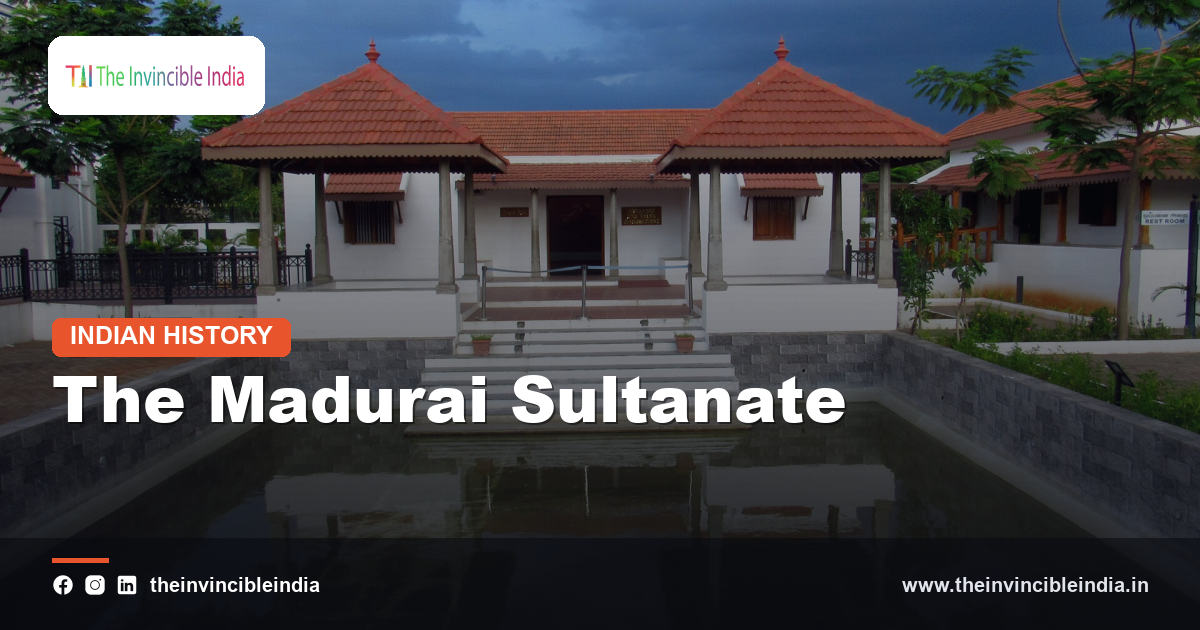
The Madurai Sultanate, also called the Ma’bar Sultanate or the Sultanate of Madurai, was a short-lived Muslim-ruled kingdom that controlled the southern Tamil country from its capital Madurai during the fourteenth century. It began when a governor sent by the Delhi Sultanate declared independence from his masters, and it ended when armies of the rising Vijayanagara Empire reclaimed the region. Though it lasted only a few decades, the sultanate left a strong mark on historical memory, partly because of the testimony of the traveller Ibn Battuta and partly because of the poem that celebrated its defeat. This guide treats the period neutrally and flags where sources disagree. The wider medieval background includes powers such as the Cholas, who had earlier shaped Tamil culture.
Quick answer: The Madurai Sultanate, also called the Ma’bar Sultanate or the Sultanate of Madurai, was a short-lived Muslim kingdom that ruled southern Tamil Nadu from Madurai for a few decades in the fourteenth century. It began when Jalaluddin Ahsan Khan, a governor of the Delhi Sultanate, declared independence, and it ended when the Vijayanagara prince Kumara Kampana conquered the region.
Key Takeaways
- The Madurai Sultanate, also called the Ma’bar Sultanate, ruled the southern Tamil country from Madurai for a few decades in the fourteenth century.
- It began when Jalaluddin Ahsan Khan, a governor sent by the Delhi Sultanate, declared independence from Delhi.
- The Pandya dynasty’s decline and the earlier raids by Delhi armies created the conditions for the sultanate’s rise.
- The traveller Ibn Battuta visited the court and left an eyewitness account that historians value but read critically.
- The Vijayanagara prince Kumara Kampana ended the sultanate, an event celebrated in the Sanskrit poem Madhura Vijayam.
- The order of the sultans and the exact dates of the sultanate are debated because the surviving evidence is limited.
Quick Facts
| Detail | Information |
|---|---|
| Name | Madurai Sultanate (Ma’bar Sultanate) |
| Region | Southern Tamil Nadu, around Madurai |
| Capital | Madurai |
| Period | A few decades in the fourteenth century |
| Founder | Jalaluddin Ahsan Khan, a former Delhi governor |
| Ended by | The Vijayanagara Empire under Kumara Kampana |
What was the Madurai Sultanate?
The Madurai Sultanate was a breakaway Muslim kingdom that ruled the southern Tamil country, centred on Madurai, for a short period in the fourteenth century. It arose from a provincial governorship of the Delhi Sultanate, and its rulers soon cut their ties with Delhi to govern in their own names. Persian and Arabic sources call the region Ma’bar, a term for the Coromandel coast and its hinterland, so the state is often called the Ma’bar Sultanate as well. The kingdom’s reach, though, was modest and often contested, and it never developed the stable institutions of larger sultanates. Because it lasted only a few decades and its records are sparse, much of what is known comes from coins, a few inscriptions and outside observers. It is therefore best seen as a brief and turbulent interlude between the Pandyas and Vijayanagara.
What was Ma'bar and why did it attract invaders?
Ma’bar was the name given by Persian and Arabic writers to the south-eastern coast of the peninsula, a rich region of ports, temples and trade that attracted ambitious invaders from the north. The Pandya kingdom controlled it, and its cities handled pearls, textiles, spices and horses brought from overseas. This wealth, together with the prestige of its large temples, made the area a tempting target for the Delhi Sultanate’s armies in the early fourteenth century. Contemporary writers describe it as a land of great prosperity, though their descriptions focus on what could be taken. The region’s attraction was therefore both economic and political, since control over such a rich coast gave a ruler wealth and standing. That explains why the south became involved in northern politics at this time.
How did the Delhi Sultanate reach Madurai?
The Delhi Sultanate reached Madurai through a series of long-distance military expeditions in the early fourteenth century, led by commanders such as Malik Kafur under Alauddin Khalji. These expeditions travelled across the Deccan and into the Tamil country, attacking cities and taking treasure. Traditional accounts say the campaign into Pandya lands was prompted by a dispute between rival Pandya princes, one of whom appealed for outside help, although the sources do not agree on the sequence. The raids did not set up permanent rule at once, but they weakened the Pandya state and showed that the distance between Delhi and the south could be crossed. Later, under the Tughlaq rulers, Delhi tried to administer the region directly through a governor stationed in Madurai, which created the conditions for the sultanate’s birth.
How did the Pandya dynasty decline before the sultanate?
The Pandya dynasty declined because of internal rivalry between royal brothers, pressure from neighbouring kingdoms and the shock of the northern raids. The Pandyas had been among the greatest powers of the far south, famed for their maritime trade and temple patronage, and they had risen again after the age of the Cholas. By the early fourteenth century, however, disputes over succession had divided the royal house, and rival claimants fought one another instead of defending the kingdom. When the Delhi armies arrived, the realm was in no condition to resist in the long term. The weakness of the Pandya order opened the way for a new power to occupy Madurai, and it explains why the region seemed ready for outside rule when the Delhi governors arrived.
Who founded the Madurai Sultanate?
The Madurai Sultanate was founded by Jalaluddin Ahsan Khan, a governor of Ma’bar who had been appointed under the Tughlaq administration of Delhi and then rebelled to rule independently. Sources suggest that he declared himself sultan during a period when Delhi was distracted by unrest in other provinces, and he began to issue coins in his own name. The exact year and circumstances are debated, since the surviving accounts disagree and some details were recorded decades later. His position was never fully secure, because he had to control rival nobles, a hostile population and the memory of the Pandya kings. His reign nevertheless created the political fact of an independent Madurai, and later sultans inherited the title. He is therefore treated as the first ruler of a line that lasted only a few decades.
Which sultans followed, and why are the dates uncertain?
Several sultans followed the founder in quick succession, and historians disagree about their order and exact reigns because the evidence is thin. Names that appear in the sources include Alauddin Udauji, Qutbuddin, Ghiyasuddin Muhammad Damghani, Nasiruddin and others, with some of them known mainly from coins and short chronicle notices. Palace murders, rebellions and sudden depositions seem to have been common, so reigns were often brief. Scholars rely on a mix of numismatic evidence, inscriptions in Persian and Tamil, and the account of Ibn Battuta to build a chronology, but each source has its own limits. Any precise list should therefore be treated as provisional. What can be said safely is that the sultanate saw rapid changes of ruler and was unstable from within for most of its existence.
What did Ibn Battuta report about Madurai?
Ibn Battuta, the Moroccan traveller who spent years in the Delhi Sultanate’s service, visited the Ma’bar court and left one of the best-known descriptions of the sultanate in its later years. He had a family connection through marriage to the ruling house and stayed for a time in the region. His narrative portrays the sultan of the day as harsh and describes a troubled realm in which war, hardship and disease caused suffering. Because Ibn Battuta wrote from memory long afterwards and had personal interests, historians read his account critically, though they value it as an eyewitness voice from the period. It remains one of the few outside sources on southern India at the time. His testimony is a reminder that the sultanate was already in difficulty before its final defeat.
What was life like in Madurai under the sultans?
Life in Madurai under the sultans was marked by insecurity, disrupted trade and uneven treatment of religious institutions, though the evidence is limited and sometimes one-sided. The great temple of Meenakshi and Sundareswarar was affected by the period’s conflicts, and later accounts describe interruptions in worship, damage and the movement of images for safety. Markets, craft guilds and farming communities carried on as best they could, and Muslim traders and Sufi teachers were part of the city’s life. The sultans introduced Persian-language administration, but they ruled a population that remained overwhelmingly Tamil in language and culture. The impression is of a society under strain rather than one of stable transformation, and this helps explain why the Vijayanagara conquest was later remembered as a restoration.
What is the link between Madurai and Vijayanagara?
The link between Madurai and Vijayanagara is that the Vijayanagara Empire, founded in the fourteenth century, grew in part as a response to the Delhi Sultanate’s reach into the south and later absorbed the Madurai region. The brothers Harihara and Bukka founded the new kingdom on the Tungabhadra, and its rulers soon turned their attention to the Tamil country. Control of Madurai gave them access to the Pandya heartland, its temples and its trade, and it helped them present themselves as defenders of older traditions. The relationship between the two states was one of direct competition, with the sultanate acting as a southern outpost of the Delhi world and Vijayanagara as the emerging local power. The outcome in Madurai shaped the political map of the south for centuries afterwards.
Who was Kumara Kampana?
Kumara Kampana, also called Kampana Udaiyar, was a Vijayanagara prince and military commander, a son of Bukka, who led the campaign that ended the Madurai Sultanate. He moved with an army through the Tamil country, defeating local opponents and bringing the region under Vijayanagara authority. Tradition holds that he restored worship at major temples and reopened sites that had fallen silent, and his achievements were celebrated by his court. The exact year of the final conquest is debated, but it is placed in the fourteenth century, in the later decades of the sultanate’s life. His career gave the new empire a firm foothold in the south and made him a symbol of Vijayanagara’s early expansion. Later governors known as Nayaks continued his work of administration and temple patronage.
What is the Madhura Vijayam?
The Madhura Vijayam, also called the Veerakamparaya Charitam, is a Sanskrit poem attributed to Gangadevi, a queen of Kampana, which celebrates his conquest of Madurai. It is an important source for the event, though it is a work of court literature rather than a neutral history. The poem narrates the campaign in elevated language and includes a famous story in which a divine sword is handed to Kampana to restore righteous rule. Historians read it carefully, separating its poetic elements from the likely facts, but they accept that it preserves a Vijayanagara perspective on the end of the sultanate. The poem also shows the cultural confidence of the new empire and its patronage of Sanskrit scholarship. It is a vivid example of how literature was used to record and justify political change.
What happened to the Meenakshi temple?
The Meenakshi temple at Madurai, one of the great Hindu temples of Tamil Nadu, was affected by the political upheavals of the fourteenth century, and its worship resumed more fully after Vijayanagara rule was established. The temple’s earlier structures were damaged or interrupted during the conflicts, and later accounts describe the temple as having fallen out of regular use for a period. After the Vijayanagara conquest, rulers and governors repaired and expanded the complex, and the Nayaks of Madurai in later centuries gave it much of its present grandeur, including the great gateway towers. The exact extent of damage in the sultanate years is difficult to measure, since sources conflict. What is clear is that the temple survived, regained its central place in Madurai and remains one of the most visited sacred sites in the south.
What is the Sikandar Dargah at Thirupparankundram?
The Sikandar Dargah is a Muslim shrine on the hill at Thirupparankundram near Madurai, popularly connected with a figure called Sikandar Badushah, sometimes identified in tradition as a late sultan of Madurai. The hill is also sacred to Hindus because of the ancient temple of Murugan, and the two shrines have long existed close together, making the site a symbol of shared sacred geography in Tamil Nadu. The identity of the saint or ruler honoured at the dargah is debated, and the stories told about him blend history and legend. Pilgrims of several communities visit the hill, and local festivals show a tradition of coexistence. The dargah is a reminder that the sultanate’s cultural legacy is not only of conflict but also of lasting devotional practices that continue in the region today.
How did the Madurai Sultanate end?
The Madurai Sultanate ended when Vijayanagara forces under Kumara Kampana defeated the last sultans and took control of the region in the fourteenth century. By that time the sultanate had been weakened by constant changes of ruler, quarrels among nobles, loss of income and the pressure of a hostile countryside. Without support from Delhi, which faced its own difficulties, the sultans could not hold off the new power in the north-west. Once Madurai fell, Vijayanagara governors took over the administration, and the Tamil country entered a long period of Vijayanagara and then Nayak rule. The sultanate left few lasting institutions, which explains why it is sometimes treated as a footnote, but its story shows how the political order of the south was reshaped during the fourteenth century.
Why do historians debate the Madurai Sultanate?
Historians debate the Madurai Sultanate because the sources are scarce, often late and written from sharply different viewpoints. The main materials are coins, short inscriptions, the memoir of Ibn Battuta, Persian chronicles written in the north and the Vijayanagara poem, each of which has its own purpose and bias. As a result there is disagreement about the number and order of sultans, the dates of the founding and the conquest, and the real extent of damage to temples and communities. Some writers emphasise destruction and others stress continuity in everyday life. A careful reader therefore avoids confident dates and absolute judgements, and accepts that the period is known only in outline. This uncertainty is a normal part of studying the medieval south, where records are uneven and interpretation depends on cross-checking sources.
The Madurai Sultanate Today
The Madurai Sultanate is remembered today as a brief but significant chapter that links the end of Pandya power with the rise of Vijayanagara and the Nayaks. Its traces survive in coins, a few inscriptions, the narrative of Ibn Battuta and the later memory preserved in the Madhura Vijayam. The city of Madurai itself, with its great temple, markets and shared shrines, carries the layers of all these eras. For students of history, the sultanate shows how far the politics of the north could reach into the south, and how quickly regional powers could rise and fall in the fourteenth century. Visitors to Madurai today see mostly the later temple city, yet the sultanate remains part of the long story that shaped it.
Sources & Further Reading
- Ministry of Culture, Government of India (indiaculture.gov.in).
- Archaeological Survey of India (asi.nic.in).
Frequently Asked Questions
What was the Madurai Sultanate?
The Madurai Sultanate was a short-lived Muslim kingdom that ruled the southern Tamil country from Madurai in the fourteenth century. It began when a governor of the Delhi Sultanate declared independence and ended when Vijayanagara conquered the region.
Who founded the Madurai Sultanate?
Jalaluddin Ahsan Khan founded the Madurai Sultanate after rebelling against his Delhi masters. The exact date of his declaration of independence is debated by historians.
Why is the Madurai Sultanate also called the Ma'bar Sultanate?
Persian and Arabic writers called the south-eastern coast of the peninsula and its hinterland Ma’bar. The sultanate is therefore known by this regional name as well as by the name of its capital.
Who ended the Madurai Sultanate?
The Vijayanagara prince Kumara Kampana, also called Kampana Udaiyar, ended the sultanate in the fourteenth century. The poem Madhura Vijayam by his queen Gangadevi celebrates the conquest.
What did Ibn Battuta say about the Madurai Sultanate?
Ibn Battuta visited the Ma’bar court and described a harsh ruler and a realm troubled by war and hardship. Historians treat his account as valuable but read it critically.
Why are the dates of the Madurai Sultans uncertain?
The dates are uncertain because the evidence is limited to coins, a few inscriptions and conflicting chronicles. Scholars therefore disagree about the order of the sultans and the exact years of their reigns.


