

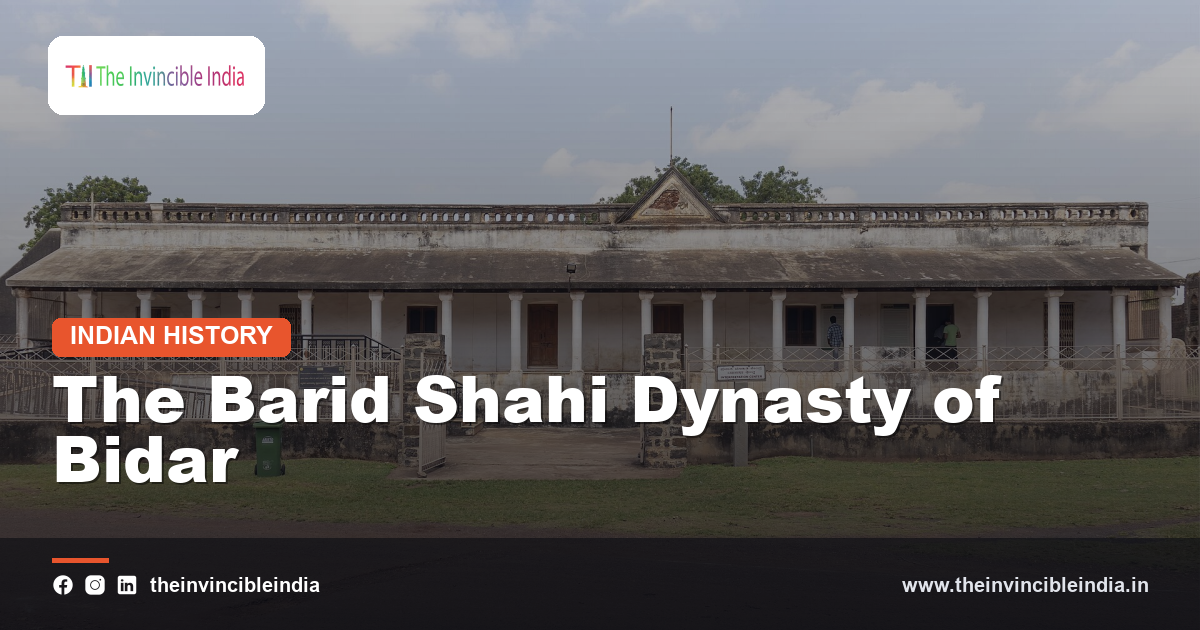
The Barid Shahi dynasty, also called the Barid Shahis or the Sultanate of Bidar, was a Deccan ruling house that governed the city of Bidar in the sixteenth and early seventeenth centuries. It arose from the breakup of the Bahmani Sultanate, whose capital had once stood at Bidar, and it is counted among the five successor Deccan sultanates, along with Bijapur, Golconda, Ahmednagar and Berar. Smaller and less wealthy than its neighbours, Bidar nonetheless kept a vivid courtly culture and left a fort, garden tombs and a celebrated metalwork tradition. Its story belongs to the same medieval world as the Vijayanagara Empire, with which the Deccan sultans alternately competed and cooperated.
Quick answer: The Barid Shahi dynasty, also called the Sultanate of Bidar, was a Deccan ruling house that governed Bidar in present Karnataka in the sixteenth and early seventeenth centuries. Founded by the Bahmani minister Qasim Barid, it was the smallest of the five successor Deccan sultanates and is remembered for Bidar Fort, the Rangin Mahal, its garden tombs and the link with Bidri metalwork.
Key Takeaways
- The Barid Shahi dynasty, also called the Sultanate of Bidar, ruled Bidar in northern Karnataka after the Bahmani Sultanate broke apart.
- Qasim Barid, a Bahmani minister, founded the family’s power, and Ali Barid is generally seen as the first to take the title of Shah.
- It was the smallest of the five successor Deccan sultanates and survived mainly through diplomacy and alliances with stronger neighbours.
- Bidar Fort, the decorated Rangin Mahal and the Barid Shahi garden tombs are the main monuments linked with the dynasty.
- Bidri ware, a silver-inlaid black metal craft named after Bidar, developed in the courtly culture of the Deccan sultanates.
- The Bijapur sultanate annexed Bidar in the early seventeenth century, ending the dynasty’s independent rule.
Quick Facts
| Detail | Information |
|---|---|
| Name | Barid Shahi dynasty (Sultanate of Bidar) |
| Region | Bidar, in present northern Karnataka |
| Founder | Qasim Barid, a minister of the Bahmani court |
| Parent state | The Bahmani Sultanate |
| Famous monuments | Bidar Fort, Rangin Mahal, Barid Shahi garden tombs |
| End of rule | Annexed by the neighbouring Bijapur sultanate in the early seventeenth century |
What was the Barid Shahi dynasty of Bidar?
The Barid Shahi dynasty was a Deccan sultanate centred on Bidar that emerged as the Bahmani kingdom fragmented in the late fifteenth and early sixteenth centuries. It was the smallest of the five successor states, with a modest territory around its capital and a long, tense border with stronger neighbours. Its rulers began as ministers who controlled the Bahmani court and only gradually took royal titles for themselves. The name Barid comes from the title of office held by the founder, which is usually explained as relating to the royal post or intelligence service. Despite its size, the state survived for about a century through shrewd alliances and careful diplomacy. Its record reminds readers that the Deccan was not dominated by a single power but by a shifting group of regional courts with their own cultures and ambitions.
Where is Bidar and why was it important?
Bidar is a historic city in the north-east of present Karnataka, set on a high plateau that gave it a strategic position in the northern Deccan. Its elevation, cooler climate and commanding views made it an attractive capital, and its location linked routes between the Deccan interior, the Godavari valley and the coast. Before the sultanates, the site already carried earlier fortifications and settlements. The city later became the Bahmani capital, and its walls, gateways and palaces reflect that long period of royal investment. Today it is known as a heritage town with a layered skyline of tombs, mosques and bastions. The geography of the plateau explains why successive rulers wanted Bidar and why its fort remained one of the most formidable defensive sites in the region.
How did the Bahmani Sultanate lead to the Barid Shahis?
The Bahmani Sultanate led to the Barid Shahis because its decline allowed powerful ministers to rule on behalf of weak sultans and eventually in their own right. The Bahmanis, founded in the fourteenth century, had governed much of the Deccan from Gulbarga and later from Bidar. Over time quarrels between long-settled Deccani nobles and newer arrivals from Persia and Central Asia, often called foreigners, divided the court. Provincial governors gradually claimed independence, creating the states of Bijapur, Golconda, Ahmednagar and Berar. At Bidar, the capital itself, the central government survived mostly as a shell controlled by court ministers. The Barid Shahis stepped into this space. They inherited the Bahmani capital, its institutions and its symbols, which gave them a legitimacy their small territory could not otherwise provide.
Who was Qasim Barid, the founder?
Qasim Barid was a powerful minister at the late Bahmani court who laid the foundations of the dynasty, though he never fully abandoned the fiction of serving the Bahmani sultan. His origins are described in the sources as Turkic or from the Caucasus region, and, as with many military and administrative elites of the time, he first rose in service before holding high office. His title, Barid-ul-Mamalik, gave the later house its name. Qasim managed the court, commanded troops and controlled access to the ruler, using the Bahmani throne as a source of authority while keeping real power for himself. The details of his early career vary among chroniclers, so historians treat them cautiously. His achievement was to turn a ministerial position into a family base that his son could convert into a ruling house.
How did Amir Barid and Ali Barid rule?
Amir Barid and Ali Barid rule marks the stage at which the family moved from controlling the Bahmani court to openly governing as kings. Amir Barid, the son of Qasim, dominated the last Bahmani sultans, moved them around as needed and managed the remaining Bahmani territory. His successor Ali Barid is generally seen as the first to take the title of Shah, formally ending the pretence that a Bahmani ruler still held power. Both men worked through diplomacy as much as war, aware that Bidar lay between larger sultanates and could be crushed by a united attack. They allied or quarrelled with their neighbours as circumstances required. This pragmatic politics kept the small state alive and gave the court time to develop its own cultural style.
What role did Bidar play in the Deccan alliance against Vijayanagara?
Bidar was one of several Deccan sultanates that joined forces against the Vijayanagara Empire in the mid-sixteenth century, culminating in the great battle fought near Talikota. For many years the sultans had been rivals, often allying with Vijayanagara against each other, so the combined action was unusual and marked a change in regional politics. Ali Barid is traditionally included among those who took part, and the alliance is widely regarded as a major turning point because it was followed by the decline of Vijayanagara’s capital city. Historians continue to discuss the causes, including trade, territory and religious or political resentment, and they caution against reading the war only in religious terms. For Bidar the episode confirmed its place among the Deccan powers, even though its own resources remained limited.
What is Bidar Fort and what does it contain?
Bidar Fort is a large medieval fortress on the edge of the plateau, built mainly in laterite stone and surrounded by deep rock-cut moats that made direct assault difficult. Its foundation is traditionally linked to the Bahmani period, when the capital moved to Bidar, but later dynasties, including the Barid Shahis, repaired and expanded it. Within the walls lie palaces, audience halls, mosques, gateways and water structures, together forming a small royal city. The gateways, such as the Gumbad Darwaza, use arches and domed chambers to impressive effect, and the long walls are punctuated by bastions that once held heavy guns. The fort is a record of continuous use across several dynasties and an important monument for understanding the military architecture of the Deccan. Many sections remain well preserved and open to visitors.
What is the Rangin Mahal?
The Rangin Mahal is a small palace within Bidar Fort celebrated for its decorated interior, whose name means the coloured palace. It is usually associated with the Barid Shahi period and is admired for its tilework, carved wooden elements and inlay in mother-of-pearl, which show Persian and local Deccan influences working together. Although modest in scale, the building gives a sense of the taste and refinement of the court, and its surfaces remind visitors that the fort was not only a military site but also a residence for rulers who cared about beauty. Parts of the original ornament have been lost to weather and age, so the present appearance is partly the result of conservation. The Rangin Mahal remains one of the finest surviving examples of courtly decoration in the Bidar region.
Which earlier monuments shape the Bidar skyline?
The Bidar skyline is shaped as much by Bahmani monuments as by those of the Barid Shahis, because the earlier dynasty made the city its capital and left several landmarks. The madrasa of Mahmud Gawan, a Persian-born Bahmani prime minister, stands in the old town with its tall minaret, coloured tile fragments and large courtyard, and it is one of the best-known educational buildings of the medieval Deccan. The Solah Khamba Mosque, the Takht Mahal and the Jami Masjid also belong to the Bahmani heritage within and near the fort. The Barid Shahis lived among these structures and inherited their prestige, then added their own tombs and palaces. Seeing the layers together helps explain why Bidar is considered one of the most important medieval cities of southern India.
What are the Barid Shahi tombs?
The Barid Shahi tombs are a group of royal mausoleums set in a landscaped area west of Bidar town, where members of the ruling family were buried. They use the Indo-Islamic tomb form of a square chamber under a dome, often raised on a platform with arched openings and surrounded by enclosure walls. The tomb of Ali Barid is a well-known example, and tradition says that he prepared it during his lifetime, which was a custom among rulers who wished to oversee their own memorials. The tombs are less richly carved than some imperial monuments, but their setting and proportions give them dignity. Together with the Bahmani tombs at Ashtur, they form a major open-air record of royal memory and are important for the study of Deccan funerary architecture.
What is Bidri ware and how is it linked to Bidar?
Bidri ware is a metal craft named after Bidar, in which a blackened alloy, mainly of zinc, is inlaid with silver or brass in fine patterns. Craftsmen cast the object, engrave the design, hammer in thin metal wire or sheet, and then treat the surface with a special soil that turns the base black while leaving the inlay bright. The result is a striking contrast used on vessels, boxes, hookah bases and decorative items. The craft developed under Persian and Central Asian influence in the Deccan court tradition, flourishing during the Bahmani and sultanate periods. The exact moment of origin is uncertain, but Bidar has remained its centre and the name is now protected as a regional craft heritage. Bidri is a living example of how courtly taste can create enduring local industries.
How was water managed in Bidar?
Water in Bidar was managed through an underground channel system known as the karez, an engineering method that originated in Persia and Central Asia and was adopted in the city to supply the fort and town. On a dry plateau with no large river nearby, this system mattered greatly, because it tapped groundwater and carried it by gravity through tunnels and open outlets. Reservoirs, wells and tanks supplemented it, and parts of the network are still visible to visitors who explore the old city. The karez shows the technical knowledge that the Bahmani and Barid Shahi courts drew from the Persian world and applied to local conditions. It is also a reminder that the success of a medieval capital depended on utilities as much as on walls and palaces, and Bidar’s water works remain an admired example.
How did the Barid Shahis relate to their neighbours?
The Barid Shahis related to their neighbours through careful diplomacy because Bidar was geographically squeezed between the stronger sultanates of Bijapur, Golconda and Ahmednagar. Rulers formed marriage alliances, offered tribute when necessary, joined coalitions and sometimes changed sides to avoid being swallowed by a single power. This policy of balance gave the small kingdom a long life but also made it vulnerable, since any serious change in the regional order could threaten its independence. The relations with Bijapur became especially important, and the Adil Shahi court eventually proved decisive for Bidar’s fate. Historians often describe the Deccan sultanates as a system of competing and cooperating states, and the Barid Shahis show that system at its smallest scale, where survival depended on political skill rather than military strength.
How did Barid Shahi rule end?
Barid Shahi rule ended when the Bijapur sultanate annexed Bidar in the early seventeenth century, absorbing its territory and taking control of the fort. By then the family had lost much of its strength through internal quarrels and the steady pressure of larger neighbours. The change was part of a wider pattern in which the remaining Deccan sultanates were drawn into conflict with one another and later with the expanding Mughal Empire. Bidar passed through several hands afterwards, including Mughal governance in the seventeenth century, and the city’s importance gradually declined as Hyderabad and other centres rose. The end of the dynasty was therefore not a single dramatic collapse but a gradual absorption of a small state into a larger political system, leaving the monuments as its most visible legacy.
What religious and cultural traditions mark Bidar?
Bidar is marked by a plural religious landscape that includes Sufi shrines, mosques, temples and a notable Sikh site, reflecting centuries of coexistence in a Deccan town. The Gurudwara Nanak Jhira Sahib, associated by tradition with a visit by Guru Nanak, draws pilgrims from across the country and is known for its sacred spring. Sufi dargahs and the tombs of saints attract visitors during annual observances, while temples in the old city show the continuity of earlier traditions. The Persian-influenced courts also supported poets and scholars writing in Persian and Dakhni, the Deccan form of Urdu. Together these strands give Bidar a layered culture that cannot be reduced to a single religion or period, and they form much of the town’s attraction today.
The Barid Shahi Dynasty Today
The Barid Shahi dynasty is remembered today through the monuments of Bidar, which are protected as heritage sites and attract students of history, architecture and craft. The fort, the Rangin Mahal, the madrasa of Mahmud Gawan and the Barid Shahi tombs are visited by travellers who want to see a less crowded corner of the Deccan. Bidri artisans keep the metalwork tradition alive, and the city’s karez and old gateways attract researchers of medieval engineering. Conservation work continues, as weather and growth in the modern town place pressure on old structures. The dynasty may have been small and short-lived, but it shows how the Deccan’s regional courts built distinctive cultures, and Bidar’s surviving buildings preserve their story for future readers.
Sources & Further Reading
- Ministry of Culture, Government of India (indiaculture.gov.in).
- Archaeological Survey of India (asi.nic.in).
Frequently Asked Questions
Who founded the Barid Shahi dynasty?
Qasim Barid, a minister at the Bahmani court, founded the family’s power in the late fifteenth century. His son Amir Barid expanded it, and Ali Barid is generally seen as the first to take the title of Shah.
Where is Bidar located?
Bidar is a historic city in north-eastern Karnataka, on a high plateau in the northern Deccan. It was once the capital of the Bahmani Sultanate and later of the Barid Shahis.
What are the Barid Shahis best known for?
The Barid Shahis are best known for ruling Bidar as the smallest Deccan sultanate and for the monuments they left, including the Rangin Mahal and garden tombs. The Bidri metalwork craft is also linked with their court’s cultural environment.
What is the Rangin Mahal in Bidar Fort?
The Rangin Mahal is a small palace in Bidar Fort known for its tilework, carved wood and mother-of-pearl inlay. It is generally associated with the Barid Shahi period.
How did the Barid Shahi dynasty end?
The Barid Shahi dynasty ended when the neighbouring Bijapur sultanate annexed Bidar in the early seventeenth century. The city later came under Mughal and other rule.
What is Bidri ware?
Bidri ware is a metal craft from Bidar in which silver or brass is inlaid on a blackened zinc-based alloy. It developed under Persian influence in the Deccan court tradition and is still made in Bidar.


