

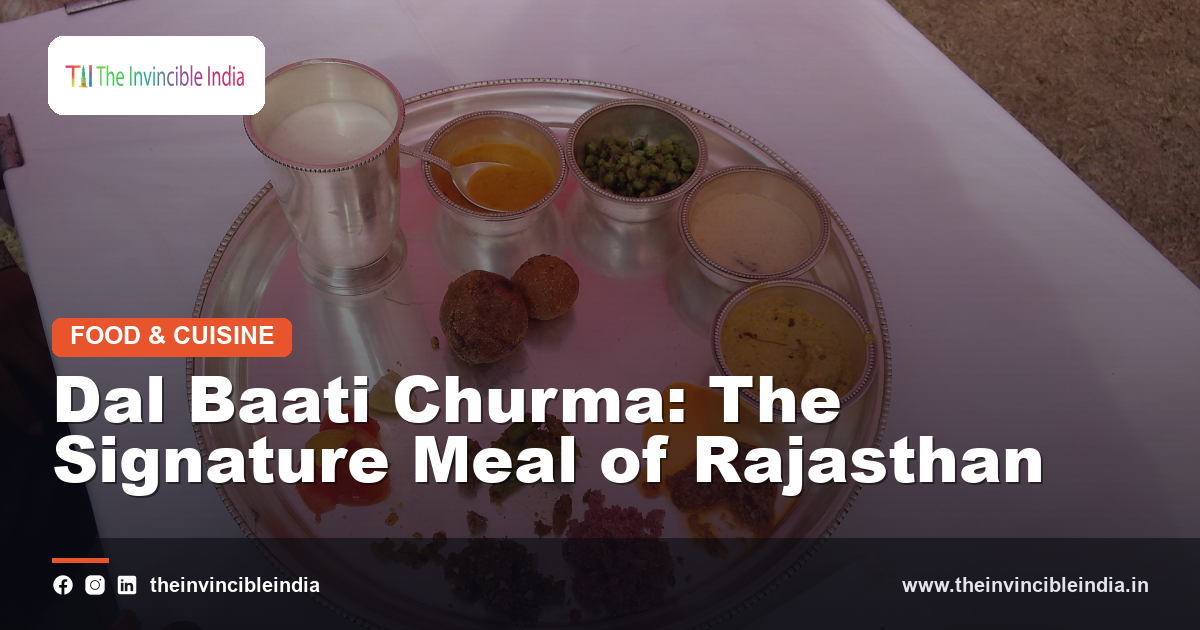
Dal baati churma, also written daal baati choorma or simply called dal baati, is the best-known traditional meal of Rajasthan and a fixture of the state’s feasts and festivals. It brings together three preparations on one plate: baati, a hard baked ball of wheat dough; dal, a spiced lentil stew; and churma, a sweet, crumbly mixture made from crushed baati, ghee and sugar or jaggery. The meal grew out of a desert culture that valued food that was filling, durable and easy to prepare in the open. Among the regional cuisines of India, it stands out for its simplicity of ingredients and its generous use of ghee. This guide explains what the meal is, where it comes from and how it is made and served.
Quick answer: Dal baati churma is a traditional Rajasthani meal made of baked wheat dough balls (baati), a spiced mixed-lentil dal and a sweet crumbled dish called churma. It is associated with the Mewar and Marwar regions of Rajasthan and is generously served with ghee. The meal is a staple of weddings, festivals and family gatherings and is often eaten with garlic chutney and kadhi.
Key Takeaways
- Dal baati churma is a three-part Rajasthani meal of baati, dal and churma, and it is usually served with plenty of ghee.
- Baati is a firm, round wheat dough ball that was traditionally baked over embers or in a pit rather than fried or steamed.
- The dal is commonly panchmel dal, a blend of five kinds of lentils cooked with a ghee tempering of cumin, garlic and red chilli.
- Churma is made by crushing baked baati and mixing it with ghee and sugar or jaggery, often scented with cardamom and nuts.
- Garlic chutney, kadhi, raw onion and boondi raita are among the usual accompaniments.
- Related regional dishes include dal bafla of Madhya Pradesh and litti chokha of Bihar and eastern Uttar Pradesh.
The sections below describe the meal, its origins, the way each part is prepared and the customs that surround it at the Rajasthani table.
Quick Facts
| Detail | Information |
|---|---|
| Dish type | Traditional vegetarian meal of three preparations |
| Region | Rajasthan, especially Mewar and Marwar |
| Main ingredient | Whole wheat flour, mixed lentils, ghee and sugar or jaggery |
| Signature element | Baati, a hard baked wheat dough ball dipped in ghee |
| Cooking style | Baked over embers or in an oven, with dal simmered and tempered |
| Usually served with | Garlic chutney, kadhi, raw onion and boondi raita |
What is dal baati churma?
Dal baati churma is a complete Rajasthani meal built from three related preparations that are eaten together. Baati is a firm ball of whole wheat dough baked until the outside is crusty and the inside is dense. Dal is a spiced lentil stew, most often a mix of several kinds of lentils tempered in ghee. Churma is a sweet, sandy mixture made by crushing baked baati and blending it with ghee and sugar or jaggery. The three are meant to be eaten as a sequence rather than as separate dishes, with the baati broken open and soaked in dal and ghee, and the churma served as the sweet finish or alongside. The meal is vegetarian, uses few ingredients and relies on ghee for richness and flavour. It is therefore best understood as a dish of the desert pantry, simple in its parts and generous in its serving.
Where does dal baati churma come from?
Dal baati churma comes from Rajasthan, where it is considered a signature dish of the state’s traditional cooking. It is most often linked with the Mewar region around Chittorgarh and Udaipur, and with the neighbouring Marwar region around Jodhpur, though it is now eaten across the whole state. Rajasthan’s dry climate and limited water shaped a cuisine that favoured wheat, millet, lentils, dried spices and ghee, all of which store well. Dal baati churma uses exactly these ingredients, which helps explain its long standing in the region. Precise dates and the names of the first cooks are not documented, so the origin is best described in general terms as an old desert and Rajput tradition. The dish later travelled with Rajasthani families and traders to other parts of India, where it became a recognised symbol of the state’s food.
Why is baati linked to warriors and desert life?
Baati is linked to warriors and desert life because a hard dough ball that bakes without a pan or a pot suits people who travel and camp. A widely repeated tradition says that the soldiers of Mewar rolled dough into balls, left them in the hot sand or near fires and returned to find them baked, then ate them with whatever dal or ghee was available. Such stories are part of local memory rather than documented history, so they are best treated as folk tradition. What is certain is that baati keeps well, needs little fuel and provides lasting energy, qualities that suit both soldiers and farmers working in a harsh landscape. The link between baati and Rajasthan’s martial past remains an important part of how the dish is described and celebrated.
What are the three parts of the meal?
The three parts of the meal are baati, dal and churma, and each plays a distinct role on the plate. Baati supplies the substance, a dense baked bread that absorbs ghee and dal. Dal supplies the savoury, spiced and slightly tangy flavour, and it moistens the baati so that it can be eaten easily. Churma supplies sweetness and a contrasting texture, and it is often served in a small mound at the side of the plate. In many households a fourth element appears in the form of garlic chutney, which adds sharp pungency. The parts are balanced against each other, with the plain baked wheat at the centre, the savoury dal on one side and the sweet churma on the other. Together they form a meal that covers carbohydrate, protein and fat in a form suited to hard physical work.
How is baati made?
Baati is made from a stiff dough of coarse whole wheat flour, ghee, salt and a little water, sometimes with a spoonful of semolina for crumbliness. The dough is deliberately firmer than that of a roti, because the balls must hold their shape and develop a crust during baking. Many cooks add ajwain (carom seeds) for flavour and digestion, and some add a pinch of baking soda to make the interior slightly lighter. The dough is divided into small portions and shaped into rounds, often with a shallow dent or a crack at the top so that heat can reach the middle and ghee can enter later. After resting, the balls are baked until they are golden to brown on the outside and cooked through. The stiffness of the dough and the generous ghee in it are what give a good baati its characteristic crumbly bite.
How is baati traditionally baked?
Baati is traditionally baked over embers, with cooks placing the dough balls in a bed of glowing cow dung cakes or charcoal and turning them until they are evenly cooked. In village settings the balls may be buried partly in hot ash or set in a shallow pit covered with embers, a method that gives a smoky aroma and a hard, dark crust. Home kitchens in towns later adopted the clay oven, the tandoor and the ordinary baking oven, and a special pan with round cavities, sometimes called a baati maker, is also used. Whatever the method, baking is slow and steady, so that the outside crisps without burning before the centre is done. Once baked, each baati is cracked open slightly and dipped or soaked in melted ghee. The embers give the finest flavour, but the modern oven reproduces the method well enough for everyday cooking.
What is panchmel dal?
Panchmel dal is a Rajasthani lentil preparation made from five kinds of lentils cooked together, and it is the most common dal served with baati. The word panchmel means a mixture of five, and the usual combination draws on lentils such as toor, chana, moong, urad and masoor, though cooks vary the exact mix by household. The lentils are boiled until soft and then finished with a tempering of ghee, cumin, asafoetida, garlic, dried red chilli and sometimes ginger. Turmeric and coriander give colour and fragrance, and a squeeze of lemon may add brightness at the end. Because several lentils are used, the dal has a layered texture and an earthy depth that a single lentil would not give. It is traditionally poured generously over broken baati, so that the hard wheat softens and carries the spiced flavour through every mouthful.
What is churma and how is it made?
Churma is a sweet, crumbly dish made by crushing baked baati into coarse crumbs and mixing it with ghee and a sweetener. The traditional sweeteners are powdered sugar or jaggery, and cooks often add cardamom for fragrance and chopped nuts or raisins for richness. Some households make churma from baati prepared specially for the purpose, while others use leftover baati from the main meal. A well-known folk tale says that churma was discovered by accident when baati fell into a pot of sweetened liquid, but this is a story rather than a documented fact. Churma is typically served warm or at room temperature, often in a mound beside the dal and baati. Its sandy, sweet texture offers a deliberate contrast to the salty and spiced dal, and it is regarded as an essential part of the full meal.
What role does ghee play in the meal?
Ghee plays a central role in dal baati churma, because it enriches every part of the meal and is served in generous quantity. It goes into the baati dough, it is poured over the baked baati while still hot, it is used to temper the dal and it binds the crumbs of churma. In Rajasthani hospitality, a host who serves plenty of ghee is expressing warmth and respect for the guest, and a plate with a visible pool of ghee is considered a sign of a proper meal. The use of ghee also has a practical logic, since it keeps well in a dry climate and provides concentrated energy. A light baati would not hold up to the dal, but a ghee-soaked one softens evenly and tastes rich. Ghee is therefore not an optional extra but the thread that ties the three dishes together.
What accompaniments are served with dal baati churma?
Dal baati churma is usually served with garlic chutney, kadhi, raw onion and a few other side dishes that add sharpness and moisture. Lasun ki chutney, a fiery paste of garlic and red chilli, is the classic partner, and its pungency cuts through the richness of the ghee. Kadhi, a tangy yogurt and gram flour curry, is a common companion and adds a cooling, sour note. Slices of raw onion, green chillies and wedges of lemon supply crunch and freshness. Boondi raita, besan gatte ki sabzi and ker sangri, a traditional dish of desert beans and berries, may also join the plate at festive meals. Jaggery and a glass of buttermilk sometimes close the meal. Each accompaniment answers a possible excess in the main dishes, so the full plate feels balanced rather than heavy.
How does dal baati churma compare with dal bafla and litti chokha?
Dal baati churma has close regional cousins in dal bafla of Madhya Pradesh and litti chokha of Bihar and eastern Uttar Pradesh. Dal bafla, popular in the Malwa region, uses a similar wheat dough, but the balls are usually boiled first and then baked or roasted, which gives a softer result than a Rajasthani baati. Litti chokha uses balls of dough filled with roasted gram flour and spices, served with a mashed vegetable preparation called chokha. All three belong to a wider north and central Indian tradition of baked wheat balls eaten with lentils, ghee and chutney, and they show how a simple method adapted to different local tastes. Rajasthan’s version is distinguished by the sweet churma and the panchmel dal. The resemblance among the three dishes is a reminder that food traditions often travel along the same roads as people do.
What are the common variations of dal baati churma?
Common variations of dal baati churma include stuffed baati, different dals and changes in the baking method. Masala baati has a filling of spiced peas, potatoes, gram flour or paneer tucked inside the dough before baking. Some households prepare baati with a bit of semolina, and others add dry fruit to the dough for festive occasions. The dal may be a single lentil such as toor or moong in homes where panchmel dal is not practical, and a rich version may be finished with a larger tempering of ghee and spices. Churma can be made with jaggery in winter, because jaggery is regarded as warming, or with sugar for a lighter taste. Restaurants and caterers sometimes add a vegetable curry or a chutney platter. These variations reflect household taste and season, while the core structure of baked wheat, dal and sweet crumbs stays constant.
When is dal baati churma served?
Dal baati churma is served at weddings, festivals, religious gatherings and family celebrations across Rajasthan. It is especially associated with communal meals, where large amounts can be prepared in advance and where the baking of baati over embers becomes a social event. It also appears at community picnics and on special days in the household calendar, when a family wishes to serve something more elaborate than an everyday meal. Because baati keeps for some time, it was historically a convenient food for journeys and for occasions when a large number of guests had to be fed. In towns and cities the meal has become a popular choice for festive lunches and hospitality, and many restaurants present it as a showpiece of the state’s cuisine. The occasion tells guests that they are being treated with the fullest hospitality.
Why is dal baati churma such a hearty meal?
Dal baati churma is a hearty meal because it combines wheat, lentils and ghee in one plate, giving sustained energy that suits physically demanding work. The baati supplies slow-burning carbohydrate, the lentils supply protein and fibre, and the ghee supplies concentrated fat. This pattern matches the needs of farmers, herders and travellers in a hot, dry region where meals were often few and had to last. It is also a dense and rich dish, and Rajasthani households typically eat it at a leisurely pace, often in winter or on festive days rather than as an everyday supper. Modern cooks sometimes lighten the meal by baking baati with less ghee or by serving more salad and buttermilk. Its heartiness is part of its identity, and it explains why the meal is associated with celebration, hospitality and a sense of abundance.
How is dal baati churma eaten?
Dal baati churma is eaten by breaking the baati open with the hands, pouring dal and ghee over the pieces and scooping up the softened bread with the fingers. The baati is first cracked in the middle so that ghee can seep in, and then crushed slightly into the dal in a shallow bowl or on a plate. Garlic chutney and kadhi are added according to taste, and a bite of raw onion or green chilli is taken between mouthfuls. The churma is eaten either after the savoury portion or alongside it, depending on the household. Hosts often keep serving ghee until guests say they have had enough, and refusing a second helping is sometimes politely resisted. Eating the meal this way is both practical and sociable, because the hands, the shared pot and the generous service are all part of the experience.
Dal Baati Churma Today
Dal baati churma today remains the most recognisable symbol of Rajasthani food and is served in homes, restaurants and festival kitchens across India and abroad. The meal has adapted to modern life through ovens, baati makers and pressure cookers, while the traditional method over embers is still kept alive at village feasts and in heritage hotels. Restaurant menus often present it as the centrepiece of a Rajasthani thali, and visitors to the state frequently list it among the dishes they most want to try. Younger cooks experiment with baked and air-fried baati, wholegrain flours and lighter dals, yet the three-part structure endures. Its continuing popularity shows how a desert meal built on a few pantry staples can become a cultural emblem. Dal baati churma continues to carry the warmth, generosity and resourcefulness of Rajasthan’s kitchens to new generations of eaters.
Sources & Further Reading
- Ministry of Culture, Government of India (indiaculture.gov.in).
- Rajasthan Tourism, Department of Tourism, Government of Rajasthan (rajasthantourism.gov.in).
Frequently Asked Questions
What is dal baati churma?
Dal baati churma is a traditional Rajasthani meal made of baked wheat balls (baati), a spiced lentil dal and a sweet crumbled dish called churma. The three are eaten together with plenty of ghee. It is a staple of festivals, weddings and family feasts in Rajasthan.
Which state is dal baati churma from?
Dal baati churma is from Rajasthan, in northwestern India. It is most closely associated with the Mewar and Marwar regions, although it is now eaten throughout the state and well beyond it.
What is baati made of?
Baati is made of a stiff dough of coarse whole wheat flour, ghee, salt and water, sometimes with a little semolina and ajwain. The dough is shaped into balls and baked until the outside is crusty. Each baati is then dipped in melted ghee.
What is churma made of?
Churma is made of crushed baked baati mixed with ghee and sugar or jaggery. Cooks often add cardamom, nuts and raisins for flavour and richness. It is served as a sweet side or finish to the meal.
What dal is served with baati?
Panchmel dal, a mixture of five lentils tempered in ghee with cumin, garlic and red chilli, is the dal most commonly served with baati. Households may vary the lentils or use a single lentil instead. The dal is poured over broken baati so the bread softens.
Is dal baati churma vegetarian?
Yes, dal baati churma is a vegetarian meal. It is made from wheat, lentils, ghee and sugar or jaggery, and its usual accompaniments such as chutney, kadhi and raita are also vegetarian.


