

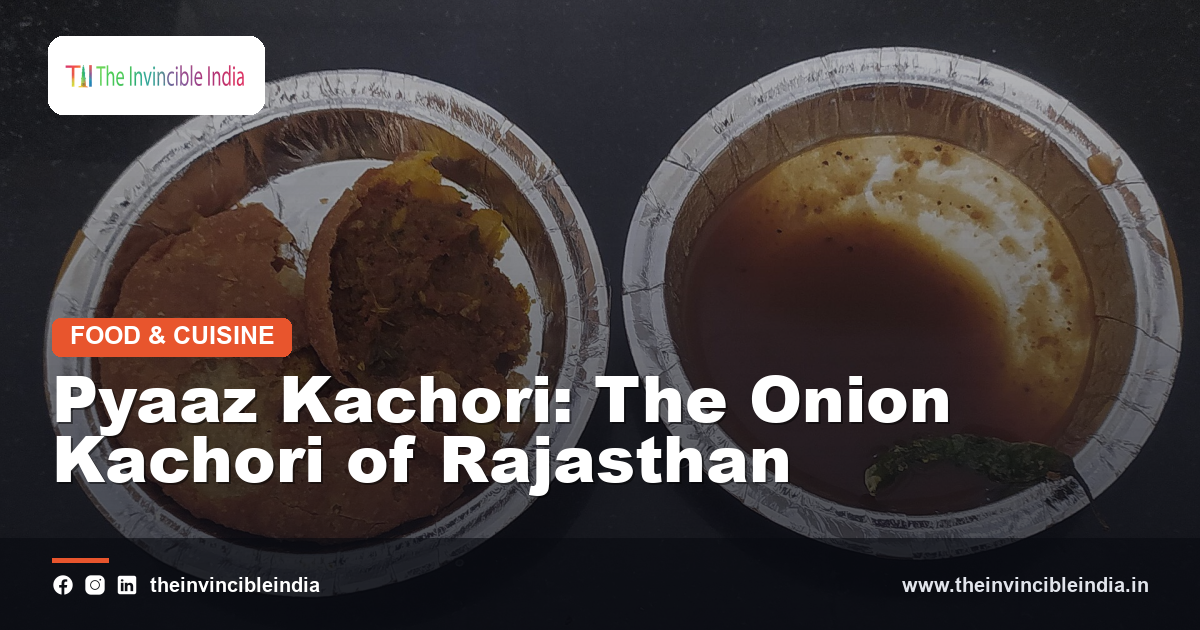
Pyaaz kachori, also spelled pyaz kachori or pyaj kachori and often called onion kachori in English, is a round, deep-fried pastry filled with a spiced onion mixture and is one of the most loved snacks of Rajasthan. The word pyaaz means onion in Hindi, and the filling of fried onion, fennel, coriander and chilli gives the kachori its fragrant, savoury character. The cities of Jodhpur and Jaipur are especially well known for it, and it is a common sight at sweet shops and breakfast stalls across the state. Within the wide world of Indian namkeen snacks, the pyaaz kachori holds a distinctive place because it is both humble and richly flavoured. This guide explains what it is, where it comes from and how it is made and enjoyed.
Quick answer: Pyaaz kachori is a deep-fried Rajasthani snack made of a flaky refined flour shell stuffed with a spiced onion filling. It is especially associated with Jodhpur and Jaipur and is traditionally eaten for breakfast or with tea, accompanied by tamarind or mint chutney. The filling usually combines onion with fennel, coriander seed, cumin, chilli and asafoetida.
Key Takeaways
- Pyaaz kachori is a crisp, round, deep-fried Rajasthani pastry stuffed with spiced onion.
- Jodhpur and Jaipur are the cities most closely associated with the snack, which is sold at sweet shops and street stalls.
- The outer shell is made from refined flour and fat, and it puffs into a flaky, layered crust when fried slowly.
- The filling typically combines onion with fennel, coriander seed, cumin, red chilli, asafoetida and sometimes gram flour.
- Tamarind chutney, mint-coriander chutney and green chillies are the usual accompaniments.
- Pyaaz kachori is a breakfast and tea-time snack and is also popular as a travel food because it keeps for a short while.
The sections below describe the snack, its origins, how it is made and the customs that surround it in Rajasthan.
Quick Facts
| Detail | Information |
|---|---|
| Dish type | Deep-fried savoury snack, vegetarian |
| Region | Rajasthan, especially Jodhpur and Jaipur |
| Main ingredient | Refined flour shell with a spiced onion filling |
| Signature flavour | Fennel, coriander, cumin, chilli and asafoetida |
| Cooking style | Deep fried slowly in oil until flaky and golden |
| Usually served with | Tamarind chutney, mint chutney and tea |
What is pyaaz kachori?
Pyaaz kachori is a Rajasthani snack in which a ball of flaky dough is stuffed with a spiced onion mixture, flattened and deep fried until it puffs and turns golden. The outer shell is crisp and layered, while the inside is soft, savoury and mildly sweet from cooked onion. It differs from other kachoris in its filling, since many popular versions use lentils, peas or potatoes, whereas this one relies on onion as the main ingredient. The seasoning is aromatic rather than merely hot, with fennel and coriander giving it a distinct fragrance. Pyaaz kachori is eaten warm, often straight from the pan, and is usually served with a sweet and sour chutney. It is regarded as a cornerstone of Rajasthani street food, a snack that appears at breakfast, at tea time and at the counters of famous sweet shops.
Where does pyaaz kachori come from?
Pyaaz kachori comes from Rajasthan, and it is most closely associated with the cities of Jodhpur and Jaipur. Both cities have long-established sweet and snack shops where the kachori is a daily speciality, and visitors to either place are routinely directed to try it. The kachori as a general type is found across northern and western India, and food historians trace its family of filled fried breads to older Indian traditions of stuffed pastries. The specific onion version is a regional adaptation that suits Rajasthan’s dry climate, where onions store well and dried spices are abundant. Exact dates and the identity of the first maker are not recorded, so the origin is best described as a long local tradition. Over time the snack has spread with Rajasthani communities to many other Indian cities.
Why is Jodhpur so famous for pyaaz kachori?
Jodhpur is famous for pyaaz kachori because its sweet shops and snack counters have made the kachori a daily specialty, and the city’s breakfast culture is built around it. Walking through the old city of Jodhpur in the morning, a visitor will find stalls frying kachoris in large pans and selling them hot to people on their way to work. The snack is commonly paired with other Jodhpur favourites such as mirchi bada, a stuffed and fried green chilli, and with sweet dishes like mawa kachori. Jodhpur’s reputation rests on this long-standing habit of eating fried snacks for breakfast with tea, rather than on any single shop. The city’s kachori has therefore become a point of local pride and a standard recommendation for travellers who want to taste Rajasthan’s everyday food.
What goes into the onion filling?
The onion filling is made from finely chopped onion cooked in oil with ground and whole spices until it is soft and dry enough to hold together. Typical seasonings include fennel seeds, coriander seeds, cumin, red chilli powder, turmeric, asafoetida, salt and often dried mango powder (amchur) for a slight tang. Many cooks add a spoonful of roasted gram flour (besan) to bind the filling and soak up the moisture released by the onions. Some households add mashed potato or a little crushed lentil to give it more body. The filling must be cooked until quite dry, because wet filling would make the dough soggy and could cause the kachori to burst in the oil. A well-balanced filling is aromatic, gently sweet from the onion and lightly spicy, and it should taste complete even without chutney.
How is the dough for pyaaz kachori prepared?
The dough for pyaaz kachori is prepared from refined flour (maida), salt, oil or ghee and water, and it is kneaded until firm but pliable. The fat is rubbed into the flour before the water is added, a step known as moyan, and it is the key to a flaky, crisp shell. If the moyan is too light the crust becomes hard, and if it is too heavy the kachori may absorb too much oil. Many cooks add a small spoonful of semolina for extra crispness. After kneading, the dough is rested under a damp cloth so that it relaxes and becomes easier to roll. The result should be smooth, elastic and not sticky. A properly made dough gives a shell that is thin enough to crisp but strong enough to enclose the filling without cracking while it is shaped and fried.
How is pyaaz kachori shaped and stuffed?
Pyaaz kachori is shaped by dividing the dough into small balls, flattening each into a cup, filling it with the onion mixture and sealing the edges. The cook pinches the dough over the filling, twists it closed and presses the ball gently flat between the palms or against a board. A small amount of dry flour may be used to prevent sticking. The kachori is then rolled lightly into a thick disc, thin enough to cook through but thick enough to puff. It is important that no air is trapped near the filling and that the seal is tight, otherwise the kachori can split or swell unevenly. The shaping is done quickly and by hand, and skilled makers in Jodhpur and Jaipur can fill and seal them in rapid succession. The care taken here determines the final crispness.
How is pyaaz kachori fried?
Pyaaz kachori is fried slowly in moderately hot oil so that the crust cooks through before it browns. The kachoris are lowered gently into the pan, and the cook keeps the heat steady, turning them often until the shell puffs, develops tiny bubbles and turns an even golden colour. Oil that is too hot makes the outside brown quickly while leaving the dough raw inside, whereas oil that is too cool makes the kachori greasy. Patience is the central skill, and many cooks fry in batches to keep the oil temperature even. Once cooked, the kachoris are lifted out and drained, and they are best eaten while still warm and crisp. The slow frying method is what produces the characteristic blistered, flaky texture that distinguishes a well-made pyaaz kachori from an ordinary fried snack.
What chutneys are served with pyaaz kachori?
Pyaaz kachori is usually served with tamarind chutney, mint and coriander chutney, and sometimes a hot green chilli or garlic chutney. The sweet and sour tamarind chutney, often sweetened with jaggery, balances the savoury onion filling and the richness of the fried crust. The mint and coriander chutney adds a fresh herbal sharpness and a cooling note. A spoonful of either is placed over a broken kachori or served in a small bowl for dipping. Some shops offer a thin potato or chickpea curry alongside, making the kachori into a more substantial plate. Raw onion rings and whole fried green chillies may appear on the side. The choice of chutney reflects local preference, but the principle is the same everywhere: the sweet, sour and fresh accompaniments bring out the aroma of the spiced onion.
How is pyaaz kachori different from other kachoris?
Pyaaz kachori differs from other kachoris mainly in its onion-based filling and in the particular spices that flavour it. The kachori family is wide and includes dal kachori made with moong or urad lentils, matar kachori with green peas, aloo kachori with potato, and mawa kachori, a sweet version of Jodhpur filled with milk solids and dipped in syrup. Kota kachori, from the city of Kota, is another famous Rajasthani variety with a lentil filling and a rather spicy character. Pyaaz kachori stands apart because the onion gives it a gentle sweetness, and because the fennel and coriander add a clean aromatic note. Each type of kachori suits a different taste and occasion, and the variety shows how a single pastry form can carry many regional personalities. The onion version is among the most widely recognised of them.
When is pyaaz kachori eaten?
Pyaaz kachori is eaten most often at breakfast and in the late afternoon, and it is usually taken with a glass or cup of hot tea. In Jodhpur and Jaipur it forms part of the morning routine of many people, who stop at a sweet shop on the way to work or school. The snack is also popular on cool winter mornings and on rainy days, when fried food is traditionally appreciated. It is a frequent choice for picnics, train journeys and road trips, because the fried shell keeps reasonably well for a short time and does not need to be eaten hot. Families also serve it to guests alongside sweets and other namkeen. The kachori is therefore a flexible snack that moves easily between a quick bite, a social treat and a portable meal.
Why does pyaaz kachori keep well for travel?
Pyaaz kachori keeps well for travel because the filling is cooked dry and the shell is fried to a firm, crisp finish, which reduces moisture and slows spoilage over a short period. This quality made it a practical food in a region where long journeys by road, rail and camel caravan were common, and it remains a favourite in tiffin boxes and travel bags today. Shops in Rajasthan often pack kachoris in paper or boxes for customers who plan to eat them later in the day. The snack is best fresh, and reheating on a pan or in an oven restores some of the crispness. Because the flavour of the spices deepens slightly after resting, many people feel that a kachori eaten a few hours later is still very pleasant. This durability has helped carry the snack beyond Rajasthan.
What role do onions play in Rajasthani cooking?
Onions play a major role in Rajasthani cooking because they store well, add natural sweetness and provide bulk and flavour to many dishes in a region where fresh vegetables can be scarce. They appear raw as a side with meals, fried as the base of curries, and as the central ingredient in snacks such as pyaaz kachori. Dried spices, pulses and grains form much of the traditional diet, and onions give moisture and sweetness that balance the dryness of these ingredients. The pyaaz kachori is perhaps the most visible celebration of this ingredient, turning an everyday vegetable into a festive snack. The preference for onion and garlic in many Rajasthani dishes also reflects a long local tradition of bold seasoning. The humble onion, treated with care, becomes the heart of the kachori.
What makes a good pyaaz kachori?
A good pyaaz kachori has a thin, crisp, blistered shell, a dry and aromatic filling and no excess oil. The surface should be golden and slightly bubbled, and the crust should shatter lightly when bitten, revealing a soft, fragrant layer of onion inside. The filling should taste of fennel and coriander without any raw onion sharpness, and it should be seasoned enough to stand up to the chutney. A heavy, doughy or oily kachori usually results from an overworked dough, a wet filling or oil that was not hot enough. Freshness matters greatly, and many people prefer to eat kachoris straight from the pan. The best examples are those made with patience, with attention to the dough, the filling and the frying temperature. These qualities are widely agreed among Rajasthani snack lovers.
What are the common variations of pyaaz kachori?
Common variations of pyaaz kachori include versions with a larger proportion of gram flour in the filling, versions with added potato or lentil, and baked or air-fried adaptations that use less oil. Some cooks add chopped green chilli, ginger or fresh coriander to the filling for more freshness and heat, while others emphasise fennel or roasted spices for a mellower profile. Wholewheat flour may replace part of the refined flour in health-minded households, although the crust is then less flaky. Miniature versions are sometimes made for parties and festive trays. In some places the kachori is split open and topped with chutney, yogurt and sev to make a chaat-style plate. Such variations show the snack’s adaptability, while the core idea of a spiced onion filling inside a crisp fried shell remains recognisable across all of them.
How is pyaaz kachori made at home?
Pyaaz kachori can be made at home by preparing a firm refined flour dough, cooking a dry spiced onion filling, stuffing and sealing small balls, and frying them slowly in oil. The work is easiest when the filling is prepared first and allowed to cool, so that it does not soften the dough. Home cooks keep the oil at a moderate temperature and fry in small batches so that each kachori has room to puff. It is helpful to roll the stuffed balls thick rather than thin, since thin kachoris tend to crack. Many families make a large batch for a festival or guests and serve it with homemade chutney and tea. The recipe rewards practice, and the first attempt may be uneven, but the method is well within the reach of a patient home cook who respects each step.
Pyaaz Kachori Today
Pyaaz kachori today remains one of the most recognisable snacks of Rajasthan and is sold not only in Jodhpur and Jaipur but in snack shops across India and in Indian communities abroad. Its popularity has been helped by travel, by food writing and by social media, which have brought the Jodhpur breakfast to a wider audience. Sweet shops continue to fry fresh batches every morning, and frozen or packaged kachoris now make the snack available in places far from Rajasthan. Chefs and home cooks also experiment with baked, air-fried and wholewheat versions that reduce oil. Yet the traditional method of slow frying a flaky shell around a fragrant onion filling is still valued above all. The pyaaz kachori endures as a small but significant emblem of Rajasthani hospitality, thrift and flavour, as relevant now as it ever was.
Sources & Further Reading
- Ministry of Culture, Government of India (indiaculture.gov.in).
- Rajasthan Tourism, Department of Tourism, Government of Rajasthan (rajasthantourism.gov.in).
Frequently Asked Questions
What is pyaaz kachori?
Pyaaz kachori is a deep-fried Rajasthani snack made of a flaky refined flour shell filled with a spiced onion mixture. It is eaten warm with chutney and tea. Jodhpur and Jaipur are the cities most associated with it.
Which city is famous for pyaaz kachori?
Jodhpur is the city most famous for pyaaz kachori, though Jaipur is also well known for it. Both cities have long-established sweet shops and snack stalls that fry fresh batches every morning.
What is in the filling of pyaaz kachori?
The filling of pyaaz kachori is made from cooked onion seasoned with fennel, coriander seed, cumin, red chilli, asafoetida and often dried mango powder. Many cooks add roasted gram flour to bind it. The mixture is cooked dry so that the shell stays crisp.
What is pyaaz kachori served with?
Pyaaz kachori is served with tamarind chutney and mint-coriander chutney, and sometimes with green chillies and a light curry. A hot cup of tea is the classic drink alongside it.
Is pyaaz kachori vegetarian?
Yes, pyaaz kachori is a vegetarian snack. It is made from refined flour, oil or ghee, onion and spices, and its usual chutneys are also vegetarian.
How is pyaaz kachori different from dal kachori?
Pyaaz kachori is filled with spiced onion, whereas dal kachori is filled with cooked and spiced lentils such as moong or urad. The onion version has a gentler sweetness and a fennel-forward fragrance, while the dal version is denser and more savoury.


