

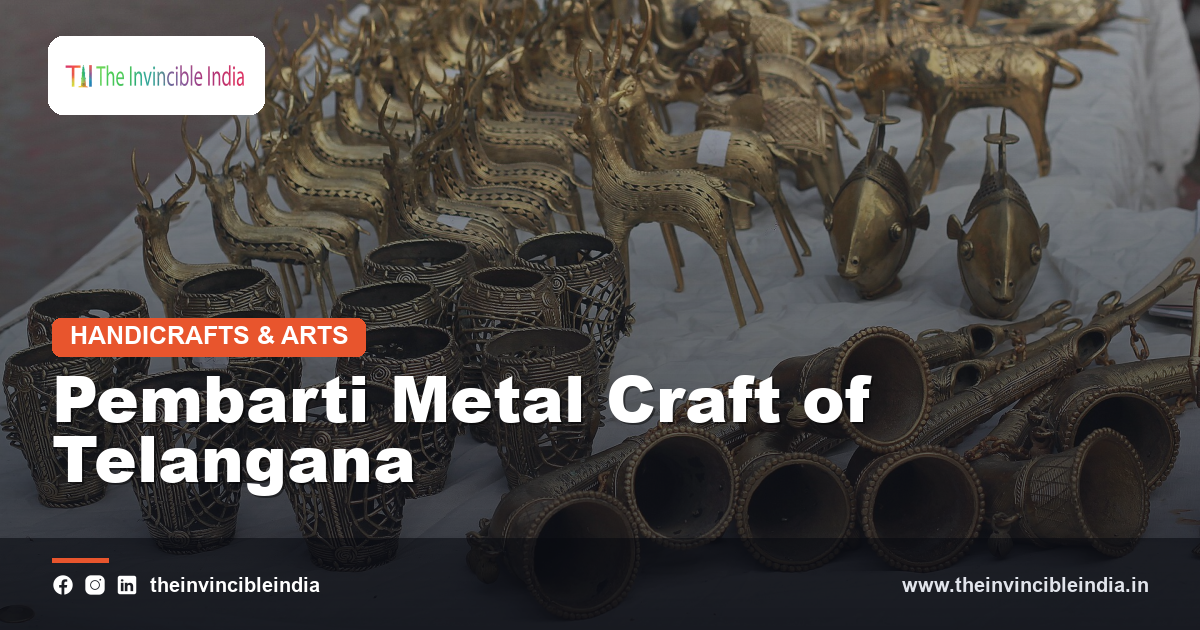
Pembarti metal craft, also spelled Pembarthi or Pembarthy metal craft, is the traditional art of hammering thin sheets of brass, copper and other metals into richly embossed designs, practised in and around the village of Pembarthi in the Jangaon district of Telangana. The craft turns flat metal into raised images of deities, flowers, animals and ornamental borders, and it has long been linked with temples, festivals and household ritual in the Deccan. Like the traditional handicrafts of Rajasthan, it shows how a regional skill can carry the identity of a whole community. This guide explains where the craft comes from, how an artisan works, what products are made and how the tradition is kept alive today.
Quick answer: Pembarti metal craft is a traditional Indian handicraft from Pembarthi village in Telangana, in which artisans hand-emboss thin sheets of brass, copper and similar metals into detailed raised designs. It is known for temple and deity pieces, decorative panels and ritual objects. The craft is practised by skilled metalworking families and is regarded as one of the characteristic art forms of Telangana.
Key Takeaways
- Pembarti metal craft is a hand-embossing tradition from Pembarthi village in the Jangaon district of Telangana, India.
- The craft is also written Pembarthi, and it is widely described as brass sheet art or repousse work.
- Artisans hammer thin sheets of brass, copper and sometimes other metals from the back to raise a design on the front.
- Traditional products include temple decorations, deity images, plates, panels, doors and ritual objects.
- The skill is usually inherited within families of metalworking artisans and passed from one generation to the next.
- The craft has received recognition as a regional product of Telangana and remains a valued expression of Deccan heritage.
The sections below follow the craft from its place of origin to its tools, techniques, products and present-day life.
Quick Facts
| Detail | Information |
|---|---|
| Craft | Hand-embossed sheet metal art (repousse) |
| Place of origin | Pembarthi village, Jangaon district, Telangana |
| Main metals | Brass and copper, with some other metals |
| Technique | Hammering and chiselling thin sheets from the reverse |
| Typical products | Deity images, temple panels, plates, doors and decorative pieces |
| Practitioners | Hereditary artisan families |
| Also spelled | Pembarthi, Pembarthy |
| Significance | A signature metal craft of Telangana |
What Is Pembarti Metal Craft?
Pembarti metal craft is a traditional handicraft in which thin metal sheets are shaped by hand into raised pictures and patterns. The artisan works with hammers and small chisels, driving the metal from behind so that the design swells forward on the front surface. The result is a relief that catches the light and shows fine detail, from the folds of a deity’s garment to the veins of a leaf. The craft is closely tied to the village of Pembarthi, which is its best-known centre. Items made in this way range from large temple panels to small household objects. The craft is a good example of repousse, the ancient technique of raising a design from the reverse of a metal sheet, and it forms a proud part of the artistic identity of Telangana.
Where Is Pembarthi Village Located?
Pembarthi is a village in the Jangaon district of Telangana, a state in the Deccan plateau of southern India. The area lies in the region around Warangal, which was once the heart of the Kakatiya kingdom and remains a centre of heritage. The village is known across the country for its artisans, and the name of the craft is simply the name of the place. The village setting is modest, but its workshops hold great skill. Many families live and work in close neighbourhoods, so that techniques, designs and pride in the craft are shared. Locating Pembarthi on the map helps explain why the craft developed here, among a community of metalworkers in a region long known for temple building and fine arts.
What Is the History of Pembarti Metal Craft?
The history of Pembarti metal craft is closely linked with the temple culture of the Deccan, and local tradition traces the art to the age of the Kakatiya rulers of the Telangana region. The Kakatiyas are remembered for their temples, tanks and patronage of the arts, and artisans of many crafts found work under their rule. The exact origin of Pembarthi metalwork cannot be fixed to a precise year, and the account of royal patronage rests mainly on tradition. What is clear is that the craft has been handed down through many generations of artisan families, who supplied metal decoration for temples and for homes. The tradition survived changes of dynasty and rule by adapting to new patrons and tastes. Its long continuity is one of its great strengths.
Who Are the Artisans Behind the Craft?
The artisans of Pembarti metal craft belong to hereditary communities of metalworkers who have practised the skill for generations. In Telangana and other parts of southern India, craft families are often grouped under the broad Vishwakarma tradition of smiths, carpenters and sculptors. Children learn by watching and helping elders in the workshop, starting with simple tasks and moving to complex designs over many years. The training is practical and personal, and the craft is as much a family inheritance as an occupation. Artisans have been recognised in craft fairs and by official awards for handicrafts in India. Their work depends on steady hands, a trained eye and a deep knowledge of sacred imagery. The craft endures because these families continue to value and teach it.
How Is a Pembarti Metal Piece Made?
A Pembarti metal piece is made by marking a design on a metal sheet and then embossing it with hammer and chisel from behind. The artisan begins with a clean, flat sheet and draws or transfers the outline of the design. The sheet is laid on a firm yet yielding support, often a bed of lac or similar material, which holds the metal and allows it to be shaped without cracking. Using chisels of different shapes, the artisan taps the metal to raise the main forms, then turns the piece over to define fine details on the front. The work is repeated until the relief is complete. The finished surface is cleaned and polished. Because every stroke is made by hand, each piece carries small differences that mark it as individual work.
What Tools Do Pembarti Artisans Use?
Pembarti artisans use a small set of simple hand tools, including hammers, chisels, punches and a firm working base. Hammers are of different weights for heavy shaping and light tapping. Chisels and punches come in many forms, with rounded, pointed and flat tips that make lines, dots, curves and textures in the metal. The working bed, often made with lac, gives the sheet a flexible support so that the metal can be pushed into relief without damage. Artisans frequently make or adjust their own tools to suit a particular design. Though the tools are basic, they require great control and long experience to use well. The craft shows that remarkable results come from simple equipment guided by skilled hands.
Which Metals and Materials Are Used?
The craft chiefly uses brass and copper sheets, which are soft enough to be shaped by hand yet strong enough to hold a raised design. Brass, an alloy of copper and zinc, gives a warm golden colour that suits temple decoration. Copper offers a reddish tone and has long held ritual importance in Indian homes. Other metals have also been used for particular items or for finishing. Sheets are cut to size and cleaned before work begins, and a lac base supports them during embossing. After shaping, the surface may be polished to a bright finish or treated to give an aged, antique look. The choice of metal affects the colour, weight and feel of the piece, and good craftsmanship begins with careful selection of the material.
What Motifs and Designs Appear in Pembarti Work?
Pembarti work features religious images, floral patterns, animals and decorative borders drawn from the visual world of the Deccan. Deities of the Hindu tradition appear often, alongside scenes from sacred stories and the figures of temple guardians. Flowers, creepers, peacocks, elephants and other animals fill borders and fields, giving the pieces richness and rhythm. Geometric lines and repeating bands frame the main picture and show the artisan’s sense of order. Designs are passed down through families and are also adapted to the wishes of a customer or temple. The style is crisp, ornamental and full of detail. Through these motifs, a Pembarti panel does more than decorate a wall, because it also carries the symbols and stories that matter to the community that made it.
What Products Are Made in Pembarti Metal Craft?
Pembarti metal craft produces a wide range of products, from temple fittings to household decorations. Traditional items include images of deities, decorative covers for temple doors and pillars, ritual vessels and ornamental plates. Wall panels showing religious scenes are popular with homes and offices. Smaller items such as boxes, trays, bowls and gift pieces suit modern buyers. Artisans also take special orders for temples and institutions, often producing large, elaborate pieces. The variety shows that the craft has adapted to changing needs while keeping its core technique. Whether a product is a sacred object or a decorative gift, it carries the same hand-worked relief and warm metallic glow. The range of goods explains the continuing demand for Pembarti work.
Why Is Pembarti Metal Craft Important to Telangana?
Pembarti metal craft is important to Telangana because it is a living symbol of the region’s artistic heritage and a source of livelihood for artisan families. The craft ties the village of Pembarthi to the larger story of the Deccan, its temples and its patronage of fine work. It supports employment in a rural setting and adds to the cultural identity of the state, appearing at fairs, exhibitions and official displays. Craft recognition and promotion by government bodies and craft organisations have helped bring the work to wider markets. The tradition also keeps alive a body of knowledge about metal, form and sacred imagery. For these reasons, the craft is valued both as heritage and as an economic activity, and its protection benefits the whole region.
How Does Pembarti Compare with Other Indian Metal Crafts?
Pembarti metal craft differs from other Indian metal traditions mainly in its use of embossed sheet metal rather than casting. In casting crafts, such as the lost-wax methods used in other parts of India, molten metal is poured into a mould to make a solid object. In Pembarti work, the artisan shapes a thin sheet directly with hammer and chisel, giving a lighter and more relief-like product. Other regions have their own beautiful traditions, including engraved, inlaid and enamelled metalwork, and each reflects local history and taste. The comparison shows the variety of Indian metal arts without ranking them. Pembarti stands out for the delicacy of its relief and its close link to temple decoration, and it deserves recognition within the wider family of Indian metalwork.
What Challenges Does the Craft Face?
The craft faces challenges that are common to many handicrafts, including competition from machine-made goods, changing markets and the difficulty of attracting younger workers. Mass-produced metal items can imitate the look of handwork at lower cost, which makes it hard for artisans to earn a fair price. The cost of raw metal can also rise, and orders may be uncertain. Many young people look to other careers, which raises concern about the passing on of skills. Awareness among buyers is therefore important, since people who understand the labour behind a handmade piece are more willing to value it. Support through fairs, training and fair markets helps artisans continue. The future of the craft depends on connecting skill with steady demand and on giving craftspeople dignity and security.
How Can Buyers Recognise Genuine Pembarti Work?
Genuine Pembarti work can be recognised by the signs of hand embossing and by honest dealing with trusted sources. Look for slight variations in the relief, tool marks that show careful hand work, and a rounded, raised surface that has real depth. Machine-stamped items often look uniform and flat, with repeated identical details. Buyers should ask about the metal used and the method of making, and prefer artisans, cooperatives and reputable craft emporiums. Where a Geographical Indication or similar mark of origin applies, it can help confirm the source. A fair price also reflects the days of labour in the piece. Informed buying supports the artisans and keeps the tradition authentic, and it gives the buyer a more meaningful object in return.
How Should Pembarti Metal Pieces Be Cared For?
Pembarti metal pieces should be cared for gently, with dry cleaning and protection from moisture. Brass and copper naturally darken over time, which many people appreciate as a sign of age. A soft dry cloth removes dust, and a mild polish may be used occasionally if a brighter look is wanted, taking care not to rub hard on fine details. Harsh chemicals and abrasive pads should be avoided because they can damage the relief. Pieces are best hung or placed away from damp walls and direct water. Temple items used in worship may be cleaned according to the traditions of the shrine. With simple care, a hand-embossed piece can last for many years and even become an heirloom, keeping both its beauty and its meaning.
How Is the Craft Being Revived and Promoted?
The craft is being promoted through craft fairs, exhibitions, training programmes and the work of artisans who adapt designs to modern tastes. Government craft bodies and organisations in India hold exhibitions where artisans can meet buyers directly. Training sessions and workshops help younger people learn the skills of embossing. Artisans experiment with new products, such as contemporary wall art, lamps and gift items, while keeping the traditional method. Recognition of the craft as a regional product of Telangana adds to its prestige. Online sales and tourism have also brought it to wider audiences. These efforts work best when they respect the artisan and the technique. Careful promotion helps the craft earn a fair income and encourages a new generation to take up the hammer and chisel.
Pembarti Metal Craft Today
Pembarti metal craft today remains a vital and admired tradition, carried on by artisan families in Telangana who combine inherited skill with new ideas. It continues to decorate temples, homes and public spaces, and it travels to exhibitions and collections far beyond its village. The craft reminds the modern world that fine objects can still be made slowly and by hand. It also stands for a deep relationship between faith, community and skill that has shaped Deccan culture for generations. Visitors to Telangana can seek out Pembarti pieces as meaningful souvenirs and as a way to support living heritage. As long as artisans, buyers and institutions continue to value it, the glowing relief of Pembarti metalwork will remain a celebrated emblem of the creative spirit of Telangana.
Sources & Further Reading
- Ministry of Textiles, Government of India, Development Commissioner (Handicrafts) (handicrafts.nic.in).
- Ministry of Culture, Government of India (indiaculture.gov.in).
Frequently Asked Questions
What is Pembarti metal craft?
Pembarti metal craft is a traditional Telangana handicraft in which artisans hammer thin sheets of brass or copper into raised designs, a technique known as repousse or embossing. It is named after Pembarthi village in the Jangaon district. It is known for temple pieces, deity images and decorative panels.
Where is Pembarti metal craft made?
Pembarti metal craft is made mainly in Pembarthi village in the Jangaon district of Telangana, India. Artisan families there have practised the craft for generations. Related work is also produced in nearby areas of the region.
What metals are used in Pembarti metal craft?
Pembarti metal craft mainly uses brass and copper sheets, and sometimes other metals for special pieces. These metals are soft enough to be shaped by hand and strong enough to hold a raised design. Finishes can range from bright polish to an antique look.
How is Pembarti metalwork made?
Pembarti metalwork is made by marking a design on a metal sheet and hammering it from behind with chisels over a firm lac bed. The artisan then refines the front surface to sharpen details. The piece is cleaned and polished at the end.
What products are made in Pembarti metal craft?
Pembarti artisans make deity images, temple door and pillar coverings, ritual vessels, decorative plates, wall panels and gift items. Many pieces carry religious scenes or floral and animal motifs. Artisans also accept special orders for temples.
How can I tell if a Pembarti piece is genuine?
A genuine Pembarti piece shows hand-embossed relief with slight variations and tool marks, while machine-stamped goods look flat and uniform. Buying from artisans, cooperatives or reputable craft emporiums helps ensure authenticity. Asking about the metal and method is also useful.


