

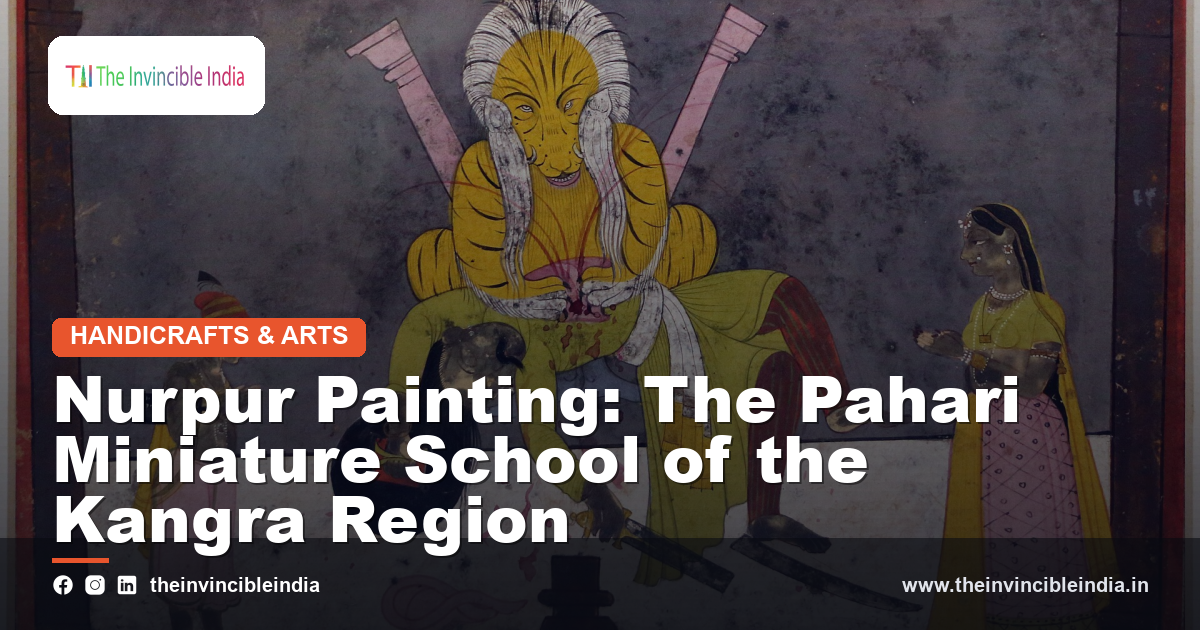
Nurpur painting, also called the Nurpur school or Nurpur kalam of Pahari miniature painting, is a hill tradition of small, jewel-like paintings that grew up at the court of the old hill state of Nurpur in the Kangra region of present-day Himachal Pradesh. The word Pahari simply means of the hills, and the Pahari schools together form one of the great chapters of Indian art, alongside Mughal, Rajput and Deccani painting. Nurpur belongs to the same family as the more famous Basohli, Guler and Kangra schools, and it shares their devotion to the story of Krishna, yet it keeps a quiet character of its own. Those who already enjoy folk and court traditions such as Madhubani painting will find in Nurpur a very different but equally rooted way of telling sacred stories. This guide explains the place, the history, the style, the method and the survival of this refined art.
Quick answer: Nurpur painting is a Pahari miniature painting school of the Kangra region of Himachal Pradesh, India, named after the former hill state of Nurpur. It is known for soft, cool colours, naturalistic landscapes and devotional scenes drawn from the life of Krishna. The school flourished under the patronage of the hill rulers and is now studied in museums and by art historians as a distinct strand of Pahari art.
Key Takeaways
- Nurpur painting is a school of Pahari miniature art associated with the former hill state of Nurpur in the Kangra region of Himachal Pradesh.
- The word Pahari means of the hills, and the Pahari schools include Basohli, Guler, Kangra, Chamba and Nurpur among others.
- Nurpur paintings are usually small works made with mineral and vegetable pigments on handmade paper.
- Typical subjects include the story of Krishna, scenes from the Ramayana, portraits of rulers and court life in a hill landscape.
- The Nurpur style is often described as calm and lyrical, with softer colour harmonies than the boldest early Pahari work.
- Many surviving examples are kept in museums, where they are studied as part of the wider Kangra tradition.
The sections below describe the place, the history, the artistic character and the living memory of the Nurpur school.
Quick Facts
| Detail | Information |
|---|---|
| Art form | Pahari miniature painting (Nurpur school) |
| Region | Kangra region, Himachal Pradesh |
| Origin | Former hill state of Nurpur, in the foothills of the western Himalaya |
| Period of flourishing | Mainly the eighteenth century, with roots and echoes before and after |
| Medium | Mineral and vegetable pigments on handmade paper |
| Main themes | Krishna legends, Ramayana scenes, portraits and court life |
| Related schools | Basohli, Guler, Kangra and Chamba |
| Significance | A distinct and gentle strand of Pahari court painting |
What Is Nurpur Painting?
Nurpur painting is a style of miniature painting created in and around the hill state of Nurpur in the Kangra region of Himachal Pradesh. It belongs to the larger Pahari tradition, in which court painters made small, finely detailed pictures for rulers and devotees of the hill kingdoms. A Nurpur painting is usually a single page that may once have belonged to an album or a series illustrating a poem or a sacred text. The pictures combine careful drawing, clear flat colour and a lyrical view of nature. They were made to be held in the hand and studied closely, not hung on a wall. Nurpur painting is therefore best understood as an intimate court art, shaped by devotion, poetry and the hill landscape in which its painters lived.
Where Is Nurpur and Why Does Its Location Matter?
Nurpur is a town in the Kangra district of Himachal Pradesh, set in the low hills near the border with Punjab and not far from the town of Pathankot. In the past it was the capital of a small hill state that sat on a busy route between the plains and the interior hills. This position mattered for art, because painters, poets, merchants and ideas moved along the same road. The state lay close to the plains, so it felt the influence of Mughal and Rajput courts, yet it was also part of the hill world of the western Himalaya. The meeting of these two worlds helped to give Nurpur painting its balanced character. The geography of the place is therefore part of the story of the art.
What Does Pahari Painting Mean?
Pahari painting is the name given to the miniature painting traditions of the hill states of the western Himalaya, including parts of present-day Himachal Pradesh, Jammu and Uttarakhand. The word Pahari means belonging to the hills, and it groups together a number of regional schools that differ in style but share a common spirit. The best known are Basohli, Guler, Kangra and Chamba, and Nurpur stands among them as a smaller but distinct centre. Pahari paintings are famous for their devotional subjects, delicate line, bright mineral colour and affectionate view of nature. Scholars treat them as one of the high points of Indian painting. Nurpur painting should therefore be read as one voice within a larger chorus of hill art.
How Did Nurpur Painting Develop?
Nurpur painting developed over time as the ruling house of Nurpur supported painters at its court, and the style matured in the period when the Pahari schools were at their height. The earliest hill painting is usually linked with Basohli, and its bold manner influenced neighbouring states, including Nurpur. Over the following decades the hill painters moved towards softer colour and a more naturalistic view of people and landscape, and Nurpur took part in this change. The exact order of events, the names of individual painters and the dating of many works are still discussed by scholars, so a cautious approach is wise. What can be said is that Nurpur was an active centre in a lively network of hill workshops. The art grew out of exchange and shared craft rather than isolation.
What Role Did Royal Patronage Play?
Royal patronage was the foundation of Nurpur painting, because the rulers of the hill state employed painters and commissioned pictures for their own use. A court painter might make portraits of the ruler, illustrations for a religious text, or scenes of ceremonies and festivals. Painters often worked in family workshops, and skills passed from father to son along with the tools and pigments of the trade. The patron chose the subject, and the painter gave it form, so each picture reflects both the taste of the court and the skill of the artist. Marriage ties between hill families also meant that painters and pictures travelled between states. Patronage thus explains why Nurpur painting is refined, devotional and closely tied to the life of the court.
What Makes the Nurpur Style Distinctive?
The Nurpur style is distinctive for its calm mood, its cool and harmonious colours and its gentle, observant treatment of figures and landscape. Compared with the boldest early Pahari work, Nurpur pictures often feel softer and more restful, with delicate shades of green, blue and pale earth tones set against touches of warmer colour. Faces are drawn in profile with clear, graceful lines, and costumes are decorated with fine patterns. Trees, hills and streams are shown with real affection, as though the painter had looked closely at the foothill country. The overall effect is lyrical rather than dramatic. These qualities make Nurpur painting easy to recognise once the eye has grown used to it, and they explain why the school is valued as a quiet and poetic strand of Pahari art.
What Subjects Do Nurpur Paintings Show?
Nurpur paintings show devotional and courtly subjects, with the story of Krishna as the most beloved theme. Scenes of Krishna as a child, as a cowherd and as the divine lover of Radha appear again and again, often set among trees, rivers and grazing cattle. Episodes from the Ramayana and other sacred stories also occur, as do portraits of rulers, nobles and holy men. Court scenes show gatherings, music, hunting and ceremonies, giving a window onto hill society. Seasonal and romantic moods, drawn from poetry, are another favourite subject. Each picture combines narrative with feeling, so that the viewer is invited to share an emotion as well as follow a story. The subjects of Nurpur painting thus join faith, poetry and the beauty of the hills.
How Is a Nurpur Miniature Painted?
A Nurpur miniature is painted in careful stages, beginning with a preparatory drawing and ending with fine finishing touches. The painter first sketches the composition lightly, often with a fine brush, and then refines the outline. Flat areas of colour are laid down one after another, with the background and large shapes first and the details of faces, jewels and clothing last. The painter builds up the surface with patient, thin layers and may add gold or silver for ornaments. When the painting is dry, the surface may be gently burnished to give a smooth finish. Because the scale is small, the work demands steady hands, good eyesight and long practice. The method is slow and exact, and the quality of the final picture depends on the patience of every stage.
What Materials and Pigments Are Used?
Traditional Nurpur painting uses handmade paper, natural pigments and very fine brushes. The paper is made of layered sheets pressed and polished to give a smooth surface that takes colour well. Pigments are ground from minerals and plants and mixed with a binder, and metals such as gold and silver are used for decoration. Brushes are made from fine animal hair and are so delicate that a single stroke can draw the finest line. These materials are chosen because they produce clear, lasting colour and allow the extremely fine detail that miniature painting requires. Modern artists who continue the tradition may use some contemporary materials, but those who follow the old methods stay close to natural ingredients. The materials are an essential part of the character and the durability of the art.
How Does Nurpur Painting Differ from Basohli and Kangra Painting?
Nurpur painting differs from Basohli painting in being generally softer, and from Kangra painting in keeping a more reserved and local flavour. Basohli, the earliest and boldest of the Pahari schools, is known for strong primary colours, strongly drawn faces and dramatic mood. Kangra, which developed later, is famous for its sweetly graceful faces, flowing line and highly polished naturalism. Nurpur lies between these poles in time and in feeling, sharing the cool harmony of the later work while keeping some of the earlier firmness of line. Scholars note that the boundaries between the Pahari schools are not sharp, because painters moved between courts. The comparison is therefore a guide to tendencies rather than a strict rule, and it helps viewers appreciate the family likeness and the individual voice of each centre.
Which Texts and Poems Inspire Nurpur Painting?
Nurpur painting draws its subjects from sacred texts and love poetry that were well known in the hill courts. The Bhagavata Purana, with its tales of the youth of Krishna, was a rich source of imagery. The Gita Govinda, a Sanskrit poem about Krishna and Radha, inspired many lyrical scenes of longing and union across the Pahari schools. The Ramayana supplied heroic and devotional episodes, and series known as Ragamala pictured musical modes as moods and seasons. Painters did not simply illustrate words, but translated their feeling into colour and landscape. A picture might show a single moment, such as a meeting beside a stream or a waiting at dusk, and let the viewer recall the whole story. The literary background gives Nurpur painting both depth and a shared language with other schools.
What Is the Link Between Nurpur Fort and the Art of the Region?
Nurpur Fort, with the Krishna temple associated with it, is the best-known heritage setting of the town, and it forms the cultural background to the painting tradition. The fort once served as the seat of the ruling family, and its ruins still speak of the court that supported artists. Within the fort stands a temple dedicated to Krishna, which is well known locally and is linked in popular tradition with the devotion of the saint Mirabai. Krishna worship at the court is mirrored in the large number of Krishna pictures produced by the school. The fort and temple do not prove any single detail of painting history, but they help visitors imagine the world in which the art was made. Heritage and painting thus belong together in the memory of Nurpur.
Where Can Nurpur Paintings Be Seen?
Nurpur paintings can be seen in museums and collections that hold Pahari miniature art, in Himachal Pradesh and elsewhere in India. Museums in the hill region, such as the Bhuri Singh Museum in Chamba and art museums in the Kangra valley, keep Pahari works that help visitors understand the regional styles. National and state museums, as well as private collections, also hold Pahari miniatures, and catalogues may identify a work as belonging to the Nurpur school. Because attribution is sometimes uncertain, labels can differ between museums, and it is helpful to read the notes beside each picture. Seeing original pages is a special experience, since the fine detail and the glow of mineral colour do not reproduce fully in print. Museum visits remain the best way to meet Nurpur painting at first hand.
How Is Nurpur Painting Preserved and Revived?
Nurpur painting is preserved through museums, conservation work, scholarship and the efforts of present-day artists who continue the Pahari tradition. Museums care for original works by controlling light, humidity and handling, because paper and pigment are fragile. Art historians study and publish the paintings, helping the public to understand them. State bodies, art institutions and workshops in Himachal Pradesh offer training to artists who wish to learn miniature painting in the traditional manner. Some contemporary painters create new works in the Pahari style, often for exhibitions and collectors. The challenge is to keep the skill alive while giving artists a fair living. Where training, patronage and public interest come together, the tradition remains vigorous, and the memory of Nurpur painting is carried forward in new hands.
How Can Collectors and Visitors Appreciate Nurpur Painting?
Collectors and visitors can appreciate Nurpur painting best by looking slowly, learning the stories and choosing honest sources. The first step is to notice the drawing of faces, the harmony of colour and the treatment of trees and water. Reading about the Krishna legends and the Ramayana helps a viewer recognise the scenes. Anyone who wishes to buy a work should deal with reputable galleries or artists, ask about materials and method, and understand the difference between an antique, a copy and a contemporary work in the traditional style. Genuine old pages are rare and legally protected in some cases, so questions about origin matter. A respectful, patient approach rewards the viewer, because the quiet beauty of the school reveals itself only to those who give it time.
Nurpur Painting Today
Nurpur painting today lives as a cherished part of Himachal Pradesh heritage, studied in museums and continued by artists who value the old methods. It reminds the modern world that the hill kingdoms of the western Himalaya were centres of poetry, devotion and fine craft. The school shows how a small state could contribute a distinctive voice to Indian art without loud display. For students, it offers a lesson in patience and observation, and for travellers, it adds meaning to a visit to the foothills of Kangra. Its gentle colours and lyrical scenes speak across the centuries to anyone who stops to look. Nurpur painting endures as a living link between the past and the present, and as a reminder of the quiet strength of regional art in India.
Sources & Further Reading
- Ministry of Culture, Government of India (indiaculture.gov.in).
- Department of Language and Culture, Government of Himachal Pradesh.
Frequently Asked Questions
What is Nurpur painting?
Nurpur painting is a school of Pahari miniature painting that developed at the former hill state of Nurpur in the Kangra region of Himachal Pradesh. It is known for soft colours, lyrical landscapes and devotional scenes, especially from the story of Krishna. The paintings are small and were made for the court and for devotion.
Where did Nurpur painting originate?
Nurpur painting originated in and around Nurpur, a town in Kangra district, Himachal Pradesh, which was once the capital of a hill state. The art grew at the court of the ruling family. It formed part of the wider Pahari painting world of the western Himalaya.
How is Nurpur painting different from Kangra painting?
Nurpur painting is generally more reserved and local in flavour, while Kangra painting is famed for its extremely graceful faces and polished naturalism. Both belong to the Pahari family and share many subjects, especially Krishna legends. The boundaries between the schools are not sharp, so the difference is one of tendency.
What themes do Nurpur paintings usually show?
Nurpur paintings usually show the life of Krishna, scenes from the Ramayana, portraits of rulers and scenes of court life. Poetic moods and seasons are also common. Each picture combines a story with a feeling drawn from hill nature.
What materials are used in Nurpur miniature painting?
Nurpur miniature painting traditionally uses handmade paper, natural mineral and plant pigments, fine brushes and sometimes gold or silver. These materials give clear, lasting colour and allow very fine detail. Some modern artists also use contemporary supplies.
Where can Nurpur paintings be seen?
Nurpur paintings can be seen in museums and collections of Pahari art, including institutions in Himachal Pradesh such as the museum at Chamba and art museums in the Kangra valley. National and private collections also hold Pahari works. Labels may vary because the attribution of some pages is still discussed.


