

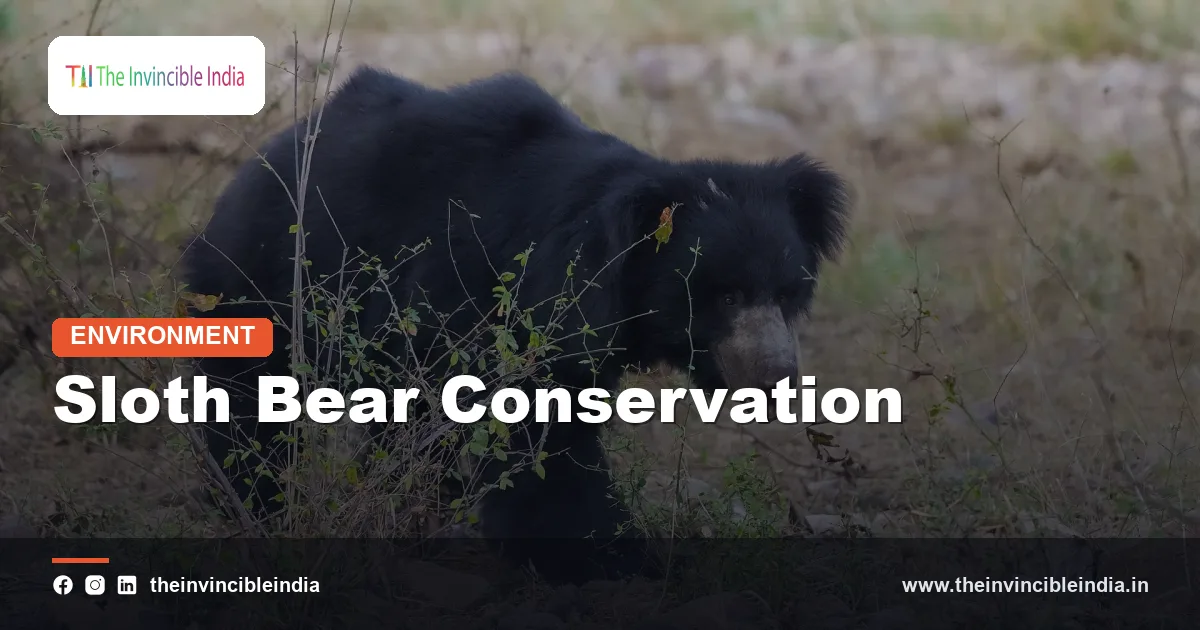
The sloth bear (Melursus ursinus) is a shaggy, long-snouted, insect-eating bear found almost entirely in the Indian subcontinent, and India holds the largest share of its world population. Unlike most bears, the sloth bear specialises in termites, ants and fruit, using a set of unusual anatomical adaptations to vacuum insects out of their nests.
Conservation of the sloth bear in India has a distinctive history: the animal was once a street performer, the so-called “dancing bear”, before rescue and rehabilitation programmes ended that trade. Today the species is classed as Vulnerable by the International Union for Conservation of Nature (IUCN), is listed in Schedule I of the Wildlife (Protection) Act, 1972, and faces pressure from habitat loss and conflict with people. Last updated: 15 October 2026.
| Attribute | Detail |
|---|---|
| Scientific name | Melursus ursinus (the only species in the genus Melursus) |
| Family | Ursidae (bears) |
| Range | India, Nepal, Sri Lanka, Bhutan; possibly extinct in Bangladesh |
| Habitat | Dry and moist tropical forest, scrub, savannah and rocky grassland |
| Main diet | Termites, ants, fruit, flowers and honey |
| IUCN status | Vulnerable |
| Legal protection in India | Schedule I, Wildlife (Protection) Act, 1972 |
| International trade control | CITES Appendix I |
| Notable protected areas | Daroji (Karnataka) and Ratanmahal (Gujarat) sloth bear sanctuaries |
Key Takeaways
- The sloth bear (Melursus ursinus) is endemic to the Indian subcontinent, and India is home to the largest part of the species’ global population.
- The sloth bear has a long, mobile snout, lacks the upper inner incisors and can close its nostrils, allowing it to suck termites and ants out of their nests.
- The IUCN lists the sloth bear as Vulnerable, and Indian law gives it the highest protection through Schedule I of the Wildlife (Protection) Act, 1972.
- The “dancing bear” trade, run mainly by the Kalandar community, was ended in India through rescue operations, bear sanctuaries and livelihood programmes for former handlers.
- Daroji Sloth Bear Sanctuary in Karnataka and Ratanmahal Sloth Bear Sanctuary in Gujarat are among the few protected areas created specifically for the species.
- Human-sloth bear conflict, caused by poor eyesight, surprise encounters and overlap with villages, is among the most serious threats to the sloth bear’s long-term survival.
What is the sloth bear and what does it look like?
The sloth bear is a medium-sized, mostly nocturnal bear with a long, shaggy black coat, a pale snout and a cream, V-shaped or Y-shaped patch on its chest. Its name comes from early European naturalists, who thought its shaggy fur and long curved claws resembled those of a tree sloth, although the two animals are unrelated.
An adult sloth bear typically weighs between roughly 55 and 145 kilograms, with males heavier than females. The claws are pale, strongly curved and several centimetres long, and they are used for digging into termite mounds and ant nests rather than for hunting large prey. The bear has a strong sense of smell but relatively poor eyesight and hearing, a trait that matters greatly for human-bear conflict. In Hindi the animal is commonly called bhalu or reech, and it is one of the four bear species recorded in India, alongside the Asiatic black bear, the Himalayan brown bear and the sun bear.
Where does the sloth bear live in India?
The sloth bear lives in a broad arc of forests and scrublands across peninsular, central and eastern India, as well as parts of the Terai region at the foot of the Himalaya. It prefers dry deciduous forest, moist deciduous forest, thorn scrub and rocky hills with boulders and caves, and it avoids the high Himalaya and the driest western deserts.
Strongholds include the Western Ghats and Eastern Ghats, the Deccan plateau, the forests of Madhya Pradesh, Chhattisgarh, Odisha, Maharashtra, Karnataka and Gujarat, and the Aravalli hills of Rajasthan. Tiger reserves such as Kanha, Bandhavgarh, Satpura, Pench, Nagarhole and Bandipur also shelter sloth bears. Outside India, smaller populations survive in Nepal, Bhutan and Sri Lanka. The Sri Lankan animal is often treated as a separate subspecies, Melursus ursinus inornatus, while the Indian animal is the nominate subspecies.
How is the sloth bear adapted to eat termites and ants?
The sloth bear is adapted to eat termites and ants through a combination of strong claws, a long snout, extendable lips and a gap in its upper teeth. The bear tears open a termite mound or ant nest with its claws, then places its snout against the opening and sucks the insects out.
Several features make this possible:
- Missing upper inner incisors: the gap in the front of the upper jaw lets air and insects pass inward as suction.
- Mobile, protrusible lips: the bear can shape its lips into a tube that works like a vacuum nozzle.
- Closable nostrils: the bear can shut its nostrils to keep dust and soil out while it feeds.
- Long, curved claws: these break into hard mounds and dig out colonies.
- A long, thin tongue and a bare-lipped snout: these help collect insects from narrow tunnels.
The suction is loud, and the sound of a sloth bear feeding can be heard from some distance. Because the bear blows dust away before sucking, the sound combines puffing and slurping.
What else does the sloth bear eat?
The sloth bear is an omnivore that relies on insects for much of the year but eats a wide range of fruits, flowers and honey when they are in season. Termites and ants are the dominant food, yet the bear’s diet shifts markedly with the calendar.
During summer, the fruits and flowers of forest trees become important. The mahua tree, whose fleshy flowers are also collected by villagers, draws bears into the same patches that people visit. Other foods include the fruits of jamun, ber, tendu and wild figs, along with honey raided from bee colonies, which the bear reaches by climbing. A sloth bear occasionally eats carrion and, rarely, small animals, but it is not an active predator of large mammals.
Breeding takes place during the year in India, and cubs, usually one or two, are born in a den. A notable behaviour is that the mother carries her cubs on her back for several months, a habit that is rare among bears. Cubs stay with their mother for about two years.
Why were sloth bears called “dancing bears”?
Sloth bears were called “dancing bears” because handlers trained captured animals to rise, shuffle and sway to the beat of a drum and a tug on a rope for the amusement of crowds. The practice was associated mainly with the Kalandar community, a traditionally nomadic group who performed with bears, monkeys and other animals at fairs and on roadsides.
The bears used for this were taken from the wild as cubs, often after poachers killed the mother. The animals were commonly restrained with a rope through the muzzle, and many had their teeth and claws removed or damaged so that they could not injure handlers or audiences. The “dance” was not natural behaviour but a conditioned response to pain and pressure. For decades the dancing bear was a familiar sight on Indian roads and at tourist spots, even though capturing and exhibiting the species was illegal under Indian wildlife law.
How was the dancing bear trade ended in India?
The dancing bear trade was ended in India through a combination of legal enforcement, the rescue of captive animals by non-governmental organisations working with state forest departments, and livelihood programmes for the Kalandar families who depended on the bears. Rescue operations began in the 1990s, and the work is widely reported to have removed the last known performing bears from the roads by about 2009.
The key elements of the effort were:
- Legal backing: the Wildlife (Protection) Act, 1972 and the Prevention of Cruelty to Animals Act, 1960 made capturing, trading or exhibiting sloth bears an offence.
- Rescue and rehabilitation: several hundred bears, reported as over 600, were taken from handlers and moved to rescue centres, including those at Agra in Uttar Pradesh, Bannerghatta in Karnataka, Bhopal in Madhya Pradesh and Purulia in West Bengal.
- Alternative livelihoods: former handlers were offered training, small businesses and schooling for children, so that families would not return to bear capture.
- Sanctuary care: many rescued bears are too habituated to humans and too impaired to be released, so they live in protected facilities for life.
The programme is often cited as a model in which animal welfare and community welfare were addressed together rather than as competing goals.
Why does conflict between people and sloth bears occur?
Conflict between people and sloth bears occurs because the species lives in forests and farmland edges where villagers collect forest produce, graze livestock and grow crops, and because the bear’s poor eyesight makes sudden, close encounters likely. A startled sloth bear tends to defend itself by charging and mauling, often aiming at the face and head.
Several patterns repeat across the range:
- Seasonal collection of forest produce such as mahua flowers and tendu leaves puts people in the bear’s feeding areas, often at dawn or dusk.
- Crop use: bears raid sugarcane, maize and groundnut fields near forest edges.
- Retaliation: injuries and fear can lead to killing of bears, including by poisoning or snares.
- Shrinking habitat: mining, roads, plantations and fragmentation push bears closer to settlements.
Mitigation measures include public awareness, moving in groups and making noise in bear areas, torches at night, community early-warning, prompt compensation for injury, and habitat measures that keep natural foods available inside forests.
Which sanctuaries protect the sloth bear?
The best-known protected areas created for the sloth bear are Daroji Sloth Bear Sanctuary in Karnataka and Ratanmahal Sloth Bear Sanctuary in Gujarat. The species also occurs in many national parks, wildlife sanctuaries and tiger reserves that were set up for other animals.
| Protected area | State | Landscape and significance |
|---|---|---|
| Daroji Sloth Bear Sanctuary | Karnataka | Rocky hills of boulders and scrub in the Ballari region, notified in the 1990s as a sanctuary dedicated to sloth bears; bears shelter in caves and crevices among granite outcrops. |
| Ratanmahal Sloth Bear Sanctuary | Gujarat | Dry deciduous forest in the Dahod and Panchmahal region, notified in the early 1980s; known for mahua trees and a long-standing bear population. |
| Jessore-Balaram Ambaji Sanctuaries | Gujarat | Hilly forests in the north of the state that form part of the Aravalli landscape and hold sloth bears. |
| Kumbhalgarh and Mount Abu area | Rajasthan | Aravalli forest with rocky terrain, important for bear populations in the west of the range. |
| Kanha, Bandhavgarh, Satpura and Pench | Madhya Pradesh and Maharashtra | Central Indian tiger reserves where sloth bears are regularly seen alongside large cats. |
Daroji illustrates how a landscape of granite hills and thorn scrub can support bears when conflict is managed, and the sanctuary is widely known for sightings of bears among the boulders. Ratanmahal is valued for its mahua trees and for community involvement in managing forest produce collection.
What is the conservation status of the sloth bear?
The sloth bear is classified as Vulnerable on the IUCN Red List, which means that it faces a high risk of extinction in the wild over the medium term. Estimates of the global population are uncertain but are generally given as fewer than around 20,000 animals, with India holding most of them.
In India the sloth bear is listed in Schedule I of the Wildlife (Protection) Act, 1972, which gives it the same top-tier protection as the tiger and the Indian elephant; hunting, capture, trade and possession of body parts are punishable offences. Internationally, the sloth bear is listed in Appendix I of the Convention on International Trade in Endangered Species of Wild Fauna and Flora (CITES), which prohibits international commercial trade. The Ministry of Environment, Forest and Climate Change (MoEFCC), state forest departments and the Wildlife Institute of India are the principal bodies responsible for policy, protected areas and research.
What threats does the sloth bear face and how can they be reduced?
The main threats to the sloth bear are loss and fragmentation of habitat, conflict with people, poaching for body parts and the legacy of cub capture. Habitat is lost to farming, mining, plantations, roads and development, which breaks forests into patches too small to support viable populations.
Reducing these threats depends on a mix of measures. Protecting corridors between forest patches allows bears to move and find mates. Compensation and quick medical help for injured villagers reduces hostility toward the species. Community-based management of mahua and other produce can reduce dangerous encounters. Continued enforcement against poaching, and surveillance of illegal trade in claws and bile-linked products, keeps pressure off wild populations. Research on population size is also needed, because the sloth bear is secretive and hard to count, and reliable monitoring supports better planning.
Bottom Line
The sloth bear is a specialised, largely India-based species whose survival depends on forest habitat, safe coexistence with villagers and strict enforcement of wildlife law. India has already ended the dancing bear trade, which shows that rescue and rehabilitation can succeed, and the next challenge is to keep forests connected and conflict low.
Frequently Asked Questions
What is the sloth bear?
The sloth bear is a shaggy, insect-eating bear native to the Indian subcontinent, with India holding most of its global population. It has a long snout, curved claws and a pale chest mark, and it feeds mainly on termites, ants and fruit.
Is the sloth bear endangered in India?
The sloth bear is classed as Vulnerable by the IUCN rather than Endangered, meaning it faces a high risk of extinction in the wild over time. In India it is legally protected under Schedule I of the Wildlife (Protection) Act, 1972, the highest level of protection.
How does the sloth bear eat termites?
The sloth bear digs open termite mounds with its claws and then sucks the insects out through its tube-like lips. It has no upper inner incisors, which creates a gap for suction, and it can close its nostrils to keep dust out.
What were the dancing bears of India?
Dancing bears were sloth bears captured from the wild and trained to perform in streets and fairs, mainly by the Kalandar community. The practice was illegal and cruel, and it was ended through rescue operations, rehabilitation centres and livelihood programmes for former handlers.
Where can sloth bears be seen in India?
Sloth bears can be seen in forests and rocky hills across central, southern, eastern and western India, including Daroji in Karnataka and Ratanmahal in Gujarat. They are also regularly recorded in tiger reserves such as Kanha, Bandhavgarh, Satpura and Nagarhole.
Are sloth bears dangerous to humans?
Sloth bears can be dangerous when startled at close range, because their eyesight is poor and they respond to surprise by charging and mauling. Most attacks happen when people enter forests to collect produce, so making noise and avoiding bear areas at dawn and dusk lowers the risk.
{“@context”:”https://schema.org”,”@graph”:[{“@type”:”FAQPage”,”mainEntity”:[{“@type”:”Question”,”name”:”What is the sloth bear?”,”acceptedAnswer”:{“@type”:”Answer”,”text”:”The sloth bear is a shaggy, insect-eating bear native to the Indian subcontinent, with India holding most of its global population. It has a long snout, curved claws and a pale chest mark, and it feeds mainly on termites, ants and fruit.”}},{“@type”:”Question”,”name”:”Is the sloth bear endangered in India?”,”acceptedAnswer”:{“@type”:”Answer”,”text”:”The sloth bear is classed as Vulnerable by the IUCN rather than Endangered, meaning it faces a high risk of extinction in the wild over time. In India it is legally protected under Schedule I of the Wildlife (Protection) Act, 1972, the highest level of protection.”}},{“@type”:”Question”,”name”:”How does the sloth bear eat termites?”,”acceptedAnswer”:{“@type”:”Answer”,”text”:”The sloth bear digs open termite mounds with its claws and then sucks the insects out through its tube-like lips. It has no upper inner incisors, which creates a gap for suction, and it can close its nostrils to keep dust out.”}},{“@type”:”Question”,”name”:”What were the dancing bears of India?”,”acceptedAnswer”:{“@type”:”Answer”,”text”:”Dancing bears were sloth bears captured from the wild and trained to perform in streets and fairs, mainly by the Kalandar community. The practice was illegal and cruel, and it was ended through rescue operations, rehabilitation centres and livelihood programmes for former handlers.”}},{“@type”:”Question”,”name”:”Where can sloth bears be seen in India?”,”acceptedAnswer”:{“@type”:”Answer”,”text”:”Sloth bears can be seen in forests and rocky hills across central, southern, eastern and western India, including Daroji in Karnataka and Ratanmahal in Gujarat. They are also regularly recorded in tiger reserves such as Kanha, Bandhavgarh, Satpura and Nagarhole.”}},{“@type”:”Question”,”name”:”Are sloth bears dangerous to humans?”,”acceptedAnswer”:{“@type”:”Answer”,”text”:”Sloth bears can be dangerous when startled at close range, because their eyesight is poor and they respond to surprise by charging and mauling. Most attacks happen when people enter forests to collect produce, so making noise and avoiding bear areas at dawn and dusk lowers the risk.”}}]}]}


