

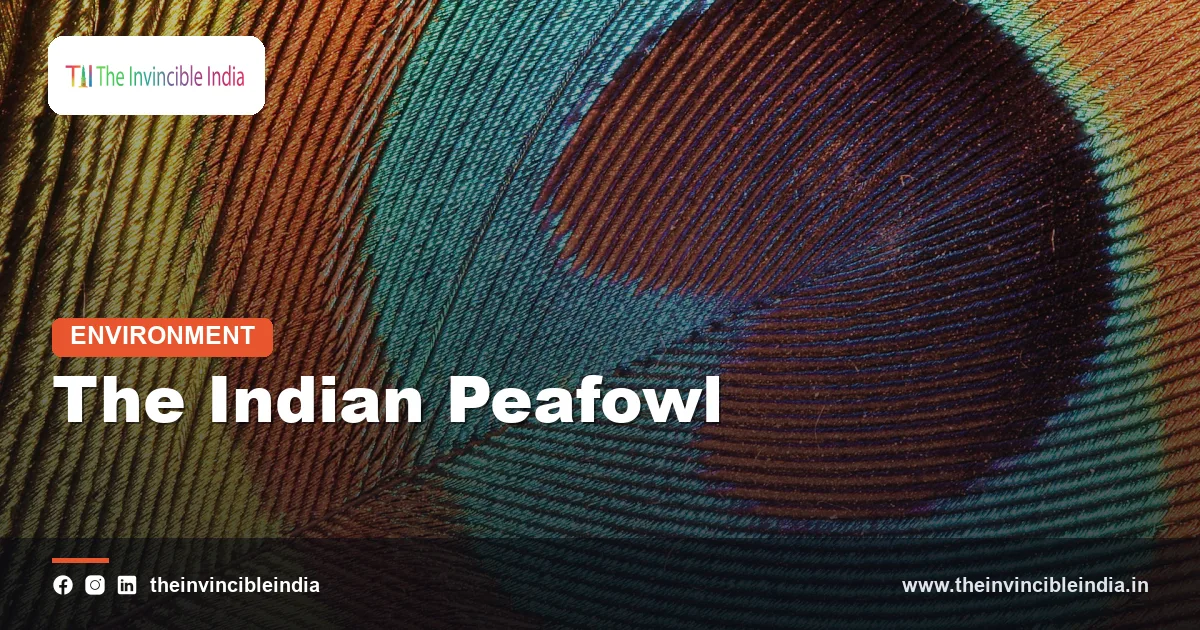
The Indian peafowl (Pavo cristatus) is a large, colourful pheasant native to the Indian subcontinent, and it was declared the national bird of India in 1963. The male, called the peacock, is known for its iridescent blue neck and its enormous fan of train feathers, while the female, called the peahen, is browner and more modest.
The Indian peafowl is found across most of India, from forests and farmland to village edges and temple grounds, and it carries deep cultural and religious meaning. It is protected under Schedule I of the Wildlife (Protection) Act, 1972, and Indian rules allow trade only in feathers that fall off naturally, not in feathers taken from killed birds. Last updated: 15 October 2026.
| Attribute | Detail |
|---|---|
| Scientific name | Pavo cristatus |
| Common names | Indian peafowl, blue peafowl, common peafowl; mor (Hindi); mayura (Sanskrit) |
| Family | Phasianidae (pheasants and allies) |
| National bird of India since | 1963 |
| Male, female and young | Peacock, peahen and peachick |
| Native range | India, Nepal, Sri Lanka, Pakistan and Bangladesh |
| IUCN status | Least Concern |
| Protection in India | Schedule I, Wildlife (Protection) Act, 1972 |
| Associated deity | Kartikeya (Murugan), whose mount is the peacock |
Key Takeaways
- The Indian peafowl (Pavo cristatus) was declared the national bird of India in 1963, chosen for its wide distribution and its place in the country’s art and tradition.
- The peacock’s iridescent colour comes largely from the microscopic structure of its feathers rather than from pigment, which is why the colours shift with the angle of light.
- The long “tail” of the peacock is actually a train of elongated upper tail coverts, which the bird fans out in a courtship display and then moults every year after the breeding season.
- The Indian peafowl is listed as Least Concern by the IUCN, yet it is fully protected in India under Schedule I of the Wildlife (Protection) Act, 1972.
- Indian law treats naturally shed peacock feathers differently from feathers obtained by killing the bird, so only the former can be collected and used for handicrafts.
- The peacock is the mount of Kartikeya, a motif in Krishna’s crown and a recurring subject in Indian temple art, miniature painting, dance and poetry.
What is the Indian peafowl?
The Indian peafowl is a large, ground-feeding bird of the pheasant family that is native to the Indian subcontinent and is best known for the male’s spectacular train. Both sexes are referred to together as peafowl, while the male is the peacock, the female the peahen and the chick the peachick.
An adult peacock is about a metre long without the train and can measure close to two metres or more including it, with a body weight of roughly four to six kilograms. The peahen is smaller, generally weighing under four kilograms, with a brown back and a pale throat. The head of both sexes carries a small crest of feathers shaped like a fan. Two other peafowl species exist: the green peafowl of South-East Asia and the Congo peafowl of Africa. In India, the blue colouring of the male has given the bird the alternative name blue peafowl.
When and why was the Indian peafowl declared the national bird?
The Indian peafowl was declared the national bird of India in 1963 after it was selected from among several candidate species. It was favoured because it occurs across almost the entire country, is easily recognised and holds a long-standing place in Indian culture.
The choice reflected a desire to name a bird that ordinary people could see in their own surroundings, and the peacock met that test better than rarer species. The Government of India recognises the peacock alongside other national symbols, such as the tiger as national animal and the lotus as national flower. The National Bird designation is symbolic; actual legal protection comes from wildlife legislation, not from the symbol itself.
How does the male peacock display, and why?
The male peacock displays by raising and fanning his train into a large, shimmering circle, vibrating the feathers and turning to face a female. This courtship display attracts peahens and is a form of sexual selection, in which females choose among males.
Key facts about the display include:
- The fan is made of roughly two hundred elongated feathers, many tipped with an eye-shaped marking called an ocellus.
- The male shakes the train so that it rustles, and he can also make loud, far-carrying calls.
- Males gather at display sites where several compete in the same area, a system known as a lek in some populations.
- The display is most active in the breeding season, which often coincides with the monsoon in much of India.
The sight of peacocks dancing before the rains has long inspired poets and painters, and it is the origin of the popular image of the “dancing peacock”.
Why are the peacock’s feathers so colourful?
The peacock’s feathers are so colourful because their colours are structural, produced by microscopic layers in the feather barbules that reflect and interfere with light. This is why the blues, greens and bronzes seem to change as the angle of view changes.
Pigments contribute mainly the brown tones, whereas the bright blues and greens come from the nano-scale arrangement of keratin and air. Researchers have used the peacock as a classic example of structural colour, and the same principle appears in butterflies’ wings and some beetles. The eye-spots on the train are made of several coloured rings, each from a slightly different feather structure.
A white form of the Indian peafowl is also known. It is leucistic rather than albino, which means pigment is reduced but the bird has normal dark eyes. It is a colour variant and not a separate species.
Do peacocks shed their feathers every year?
Yes, adult peacocks moult and lose the long train feathers once a year, usually after the breeding season, and they grow a new train over the following months. The shedding is a natural process, and the train feathers drop off without harming the bird.
In most of India, shedding takes place in the later part of the year, often from late summer into autumn, and the full train is regrown in time for the next breeding season. People who collect feathers from the ground, such as villagers and temple staff, are picking up these naturally shed feathers. This distinction is central to Indian law, because naturally shed feathers can be collected and used for handicrafts, fans and religious items, whereas killing a peacock for its feathers is a serious offence.
Where does the Indian peafowl live?
The Indian peafowl lives across most of India below roughly 2,000 metres, in dry and moist deciduous forest, scrub, farmland and even villages. The bird is a ground-dweller that feeds by day and roosts in tall trees at night to avoid predators such as leopards and tigers.
Peafowl are especially common in Rajasthan, Gujarat, Haryana, Punjab, Maharashtra and parts of the south, and they are often seen in temple compounds, school yards and on farm boundaries. In some communities, such as the Bishnoi villages of Rajasthan, peafowl and other wildlife are protected as part of local belief. The bird eats seeds, grains, fruits, insects, small reptiles and sometimes snakes, which makes it both a farm visitor and a natural pest controller. Its adaptability to human habitation is the reason the species is secure compared to many other birds.
What is the cultural and religious significance of the peacock?
The peacock has deep cultural and religious significance in India, appearing in Hindu, Jain and secular traditions as a symbol of beauty, grace, monsoon and protection. It is the vahana, or vehicle, of Kartikeya, the god of war also known as Murugan, Skanda or Subramanya, and it is closely associated with Krishna, who is shown wearing a peacock feather in his crown.
Other examples of the peacock’s cultural weight include:
- Temple and miniature art: peacocks appear in sculpture, murals, textiles, Pichwai paintings and Mughal and Rajput miniatures.
- Dance and music: classical and folk dances, including Kathak and Odissi, feature peacock movements, and the bird appears in many ragas and monsoon songs.
- History and royalty: the Maurya dynasty is traditionally linked with the word for peacock, and the Peacock Throne of the Mughal emperor Shah Jahan took the bird’s name.
- Jain practice: Jain monks traditionally carry a soft broom of naturally shed peacock feathers to sweep the ground and avoid harming insects.
- Folk belief: the peacock’s call is associated with the arrival of rain in much of north India.
What legal protection does the Indian peafowl have?
The Indian peafowl is protected under Schedule I of the Wildlife (Protection) Act, 1972, which prohibits hunting, killing, capture and trade in the bird or its body parts. The Act applies across India and is enforced by state forest departments and wildlife crime authorities.
Schedule I is the highest tier of protection, which the law shares with species such as the tiger and the elephant. The Ministry of Environment, Forest and Climate Change (MoEFCC) oversees the legislation at the national level. The IUCN rates the species as Least Concern because it is numerous and widespread, but Indian law still protects it fully because of its status as the national bird and its cultural standing. Peafowl are still harmed in some places by poisoned grain, electrocution on power lines, road accidents, stray dogs and occasional poaching for meat and feathers.
Is it legal to trade or use peacock feathers in India?
It is legal in India to collect, use and sell handicrafts made from peacock feathers that have shed naturally, but it is illegal to kill a peacock to obtain feathers or to trade in feathers taken from killed birds. Rules also restrict the commercial trade in the live bird and in other body parts.
The practical rules can be summarised as follows:
| Item | General position under Indian wildlife law |
|---|---|
| Live peafowl | Capture, keeping and sale are prohibited without permission |
| Killing a peacock or peahen | Prohibited; punishable as a Schedule I offence |
| Naturally shed tail feathers | May be collected and used for handicrafts and religious items |
| Feathers or products from killed birds | Prohibited to possess or trade |
| Export of feather products | Regulated; subject to trade rules and documentation |
Traders and artisans who work with peacock feathers are expected to be able to show that the feathers were collected after natural moulting. For specific legal advice, a person should check the current text of the Act and trade rules, since regulations can be revised.
What is the future of the Indian peafowl?
The future of the Indian peafowl appears secure at the species level, because it is abundant, widespread and tolerant of human surroundings. The main challenges are local rather than national: poisoning by treated seed, electrocution, poaching, roads and conflict with farmers over crop damage.
Conservation efforts focus on enforcing existing law, raising awareness among farmers, safer handling of pesticide-treated seed and monitoring local populations. Because the peafowl is a visible bird in everyday landscapes, it also serves as an entry point for wider biodiversity education. Its status as the national bird helps the public support conservation measures for other, rarer species that share its forests and grasslands.
Bottom Line
The Indian peafowl is both a biological marvel and a national symbol, valued for its structural colour, courtship display and place in Indian faith and art. It is secure as a species but protected by law at the highest level, and the key rule to remember is that only naturally shed feathers may be collected and used.
Frequently Asked Questions
Which bird is the national bird of India?
The Indian peafowl (Pavo cristatus), commonly called the peacock, is the national bird of India. It was declared the national bird in 1963 because of its wide distribution and its deep place in Indian culture.
Why is the peacock called the national bird of India?
The peacock was chosen because it occurs across most of India, is easily recognised and features in the country’s art, mythology and tradition. It is associated with Kartikeya and Krishna and appears in temple art, dance and poetry.
Is killing a peacock illegal in India?
Yes, killing a peacock is illegal in India because the bird is listed in Schedule I of the Wildlife (Protection) Act, 1972. Offenders can face imprisonment and fines under the Act.
Do peacocks lose their feathers?
Yes, adult peacocks moult their long train feathers once a year, usually after the breeding season, and grow them back before the next one. The feathers fall off naturally and without harm to the bird.
Can I sell or keep peacock feathers in India?
Naturally shed peacock feathers can be collected and used for handicrafts and religious items, but feathers obtained by killing a bird cannot be kept or traded. Anyone dealing in feathers should be able to show that they were collected after natural moulting.
What is the difference between a peacock and a peahen?
A peacock is the male Indian peafowl, with a bright blue neck and a long train of display feathers, whereas a peahen is the female, which is smaller and mostly brown. Only the male performs the courtship display, and both together are called peafowl.
{“@context”:”https://schema.org”,”@graph”:[{“@type”:”FAQPage”,”mainEntity”:[{“@type”:”Question”,”name”:”Which bird is the national bird of India?”,”acceptedAnswer”:{“@type”:”Answer”,”text”:”The Indian peafowl (Pavo cristatus), commonly called the peacock, is the national bird of India. It was declared the national bird in 1963 because of its wide distribution and its deep place in Indian culture.”}},{“@type”:”Question”,”name”:”Why is the peacock called the national bird of India?”,”acceptedAnswer”:{“@type”:”Answer”,”text”:”The peacock was chosen because it occurs across most of India, is easily recognised and features in the country’s art, mythology and tradition. It is associated with Kartikeya and Krishna and appears in temple art, dance and poetry.”}},{“@type”:”Question”,”name”:”Is killing a peacock illegal in India?”,”acceptedAnswer”:{“@type”:”Answer”,”text”:”Yes, killing a peacock is illegal in India because the bird is listed in Schedule I of the Wildlife (Protection) Act, 1972. Offenders can face imprisonment and fines under the Act.”}},{“@type”:”Question”,”name”:”Do peacocks lose their feathers?”,”acceptedAnswer”:{“@type”:”Answer”,”text”:”Yes, adult peacocks moult their long train feathers once a year, usually after the breeding season, and grow them back before the next one. The feathers fall off naturally and without harm to the bird.”}},{“@type”:”Question”,”name”:”Can I sell or keep peacock feathers in India?”,”acceptedAnswer”:{“@type”:”Answer”,”text”:”Naturally shed peacock feathers can be collected and used for handicrafts and religious items, but feathers obtained by killing a bird cannot be kept or traded. Anyone dealing in feathers should be able to show that they were collected after natural moulting.”}},{“@type”:”Question”,”name”:”What is the difference between a peacock and a peahen?”,”acceptedAnswer”:{“@type”:”Answer”,”text”:”A peacock is the male Indian peafowl, with a bright blue neck and a long train of display feathers, whereas a peahen is the female, which is smaller and mostly brown. Only the male performs the courtship display, and both together are called peafowl.”}}]}]}


