

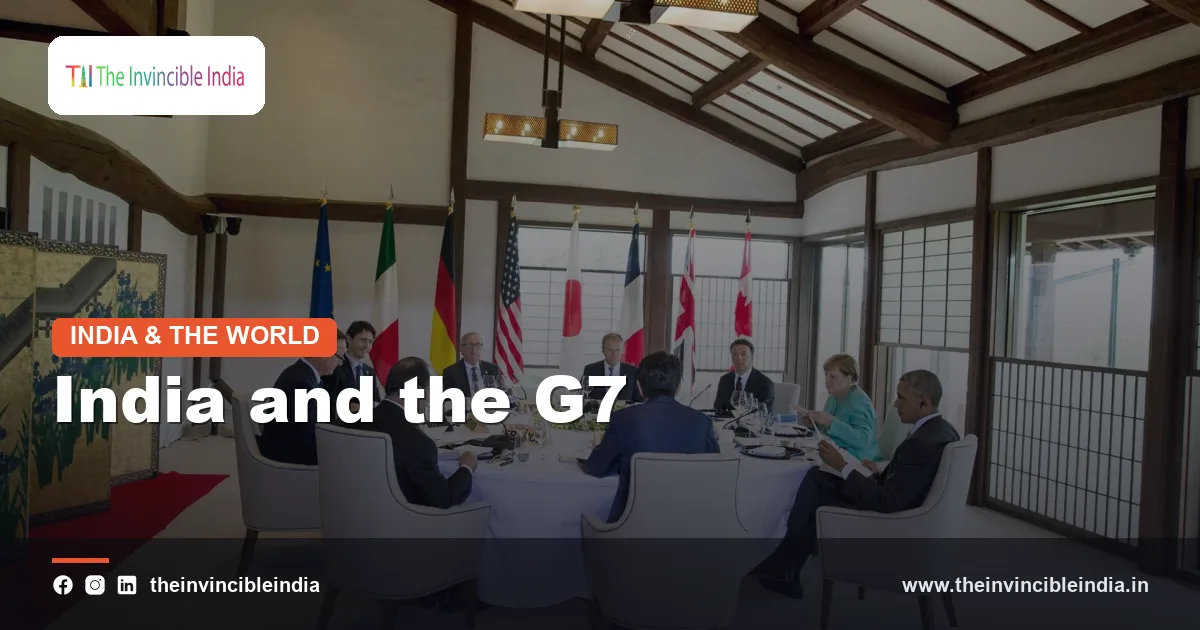
India and the G7 describes the relationship between India and the Group of Seven, an informal club of advanced democracies in which India is not a member but to which it has been invited repeatedly as an outreach or guest partner. The G7 consists of the United States, the United Kingdom, France, Germany, Italy, Canada and Japan, with the European Union taking part in its work, and the host country each year chooses which other leaders to invite.
India’s invitations reflect its weight as one of the world’s largest economies and its role as a voice for developing countries. They are separate from India’s status as a full member of the G20, a larger forum that India chaired and hosted at the leaders’ level in New Delhi in 2023. 15 October 2026
| Attribute | Detail |
|---|---|
| Group | Group of Seven (G7) |
| Members | United States, United Kingdom, France, Germany, Italy, Canada, Japan; the European Union participates |
| Origins | Began in 1975 as a group of six; Canada joined in 1976 |
| Is India a member? | No; India attends as an invited outreach or guest partner |
| Presidency | Rotates annually among members; the host sets the agenda and the guest list |
| Secretariat | None; the host country organises the year’s meetings |
| India’s full-member forum | G20 (India hosted the leaders’ summit in New Delhi in 2023) |
| Nature of decisions | Consensus-based, non-binding political commitments |
Key Takeaways
- India is not a member of the G7, which is made up of the United States, the United Kingdom, France, Germany, Italy, Canada and Japan, with the European Union participating.
- The G7 has no fixed outreach list, so India attends only when the host country invites it, and India has been invited on many occasions over more than two decades.
- India is a full member of the G20, and in 2023 it hosted the G20 leaders’ summit in New Delhi, during which the African Union was admitted as a permanent member.
- The issues India typically raises at the G7 include the priorities of the Global South, climate finance, digital public infrastructure, food and energy security and resilient supply chains.
- G7 decisions are political commitments reached by consensus rather than legally binding treaties, and the group has no permanent secretariat.
- The G7 and India sometimes differ in their approach to subjects such as sanctions on Russia, though both sides emphasise cooperation on economic and technological questions.
What is the G7?
The G7, or Group of Seven, is an informal grouping of seven major advanced economies that meet every year to coordinate views on the world economy, security and global challenges. It is not an international organisation created by treaty, and it has no headquarters, charter or permanent staff.
The group began in 1975, when the leaders of six countries met in France in response to the oil shock and economic turmoil of the early 1970s. Canada joined the next year, creating the G7. Russia was admitted in the late 1990s, producing the G8, but its participation was suspended in 2014, and the format reverted to seven members. The European Union is not counted as a member but takes part in meetings through its leaders.
Each member takes a turn as presiding country, which sets priorities, hosts the annual leaders’ summit and invites other countries and international organisations as guests.
Is India a member of the G7?
India is not a member of the G7. India has never held a formal seat in the group, and no standing process exists through which a country can apply for membership.
Changing the membership would require the agreement of all existing members, and the group has not shown interest in enlargement. Instead, it has built a flexible practice of inviting selected non-members to meetings. India has been among the most frequent of these invitees, as have other large emerging economies and leaders from Africa, Latin America and Asia.
Whether India is a member matters less to its day-to-day diplomacy than it might appear. The country is a member of several larger forums, including the G20, BRICS and the Shanghai Cooperation Organisation, and it participates in the Quad with the United States, Japan and Australia.
How often has India been invited to the G7?
India has been invited to the G7 or its earlier G8 format on many occasions since the early 2000s. The country first took part in the outreach sessions in 2003, when the summit was held in France, and Indian prime ministers attended further meetings in the following years as part of an outreach group of emerging economies.
In the 2010s the practice became less regular, but it resumed strongly from 2019. India was invited to the 2019 summit in Biarritz, France, and later to the 2021 summit in the United Kingdom, in which the Indian leader took part virtually. Invitations followed for the summits in Germany in 2022, Japan in 2023, Italy in 2024 and Canada in 2025.
| Period | India’s participation |
|---|---|
| 2003 onwards | First outreach invitations in the G8 era, as part of a group of major emerging economies |
| 2019 | Invited to the Biarritz summit hosted by France |
| 2021 | Invited to the summit hosted by the United Kingdom; participated virtually |
| 2022-2025 | Invited to summits hosted by Germany, Japan, Italy and Canada |
The pattern shows that an invitation depends on the host’s priorities each year, rather than on a standing entitlement. Hosts with strong ties to India, or with an interest in the Indo-Pacific, development finance or technology, have tended to include it.
Why is India invited to the G7?
India is invited to the G7 because it is a large, fast-growing economy, the world’s most populous country and a democracy with significant influence among developing nations. Its participation allows the G7 to hear a perspective that the seven members alone cannot supply.
- Economic weight: India’s economy is among the largest in the world, and it is larger than several G7 members by nominal output and by purchasing power.
- Global South leadership: India has presented itself as a spokesperson for developing countries, including by convening a Voice of Global South Summit in 2023.
- Technology and digital public goods: Systems such as the Unified Payments Interface (UPI) and the Aadhaar identity platform are studied and adopted in other countries.
- Strategic position: India sits at the centre of the Indian Ocean region and has partnerships with the US, Japan and European countries on security and supply chains.
Invitations also serve the host countries’ interests. The G7 members want partners for climate action, secure supply chains, infrastructure financing and rules for emerging technologies such as artificial intelligence, and India is central to all of these.
What issues does India bring to the G7?
India brings to the G7 a set of issues centred on the development needs of the Global South, including climate finance, digital public infrastructure, food and energy security and fair access to technology. The Indian delegation typically uses outreach sessions to press for support for developing economies that face high borrowing costs and climate risks.
Climate finance and energy transition
India argues that developed countries should honour their commitments to provide climate finance and technology transfer to developing nations. It also promotes initiatives such as the International Solar Alliance, launched with France in 2015, and the Mission LiFE concept of sustainable lifestyles.
Digital public infrastructure
Digital public infrastructure, or DPI, refers to open, interoperable digital systems for identity, payments and data exchange. India offers its experience with Aadhaar, UPI and related platforms as a model that other countries can adapt, and this theme found wider support in the G20 process in 2023.
Supply chains and critical technologies
India supports diversified and resilient supply chains, and it has taken part in initiatives with Japan, Australia and other partners on this subject. The G7 and India share an interest in reducing over-dependence on single suppliers for critical minerals, semiconductors and pharmaceutical ingredients.
Food, fertiliser and energy security
India also uses outreach meetings to raise the effects of conflicts and price shocks on food, fertiliser and fuel markets, which hit lower-income countries hardest. It has called for dialogue and diplomacy in current conflicts.
How is the G7 different from the G20?
The G7 differs from the G20 in being a small club of seven advanced economies, while the G20 is a broader forum of the world’s major economies, including developing and emerging countries such as India, Brazil, China and South Africa. India is a full member of the G20 but only a guest at the G7.
| Feature | G7 | G20 |
|---|---|---|
| Membership | Seven advanced economies, plus the European Union as a participant | Nineteen countries, the European Union and, since 2023, the African Union |
| Origin | 1975 (as G6), Canada joined in 1976 | 1999 at finance minister level; leaders’ summits since 2008 |
| India’s status | Invited guest | Full member |
| Character | Like-minded advanced democracies | Mixed group of advanced and emerging economies |
| Secretariat | None | None (rotating presidency supported by a troika) |
| Output | Leaders’ communiqué and statements | Leaders’ declaration and ministerial outcomes |
The G20 was created after the financial crises of the late 1990s to bring emerging economies into global economic management, and its leaders’ format was launched in 2008 after the global financial crisis. The G7 remains a smaller and more politically aligned grouping, and it often uses its meetings to coordinate positions on security and economic policy before wider forums.
What did India do as G20 host in 2023?
India held the G20 presidency from December 2022 to November 2023 and hosted the leaders’ summit in New Delhi on 9 and 10 September 2023. The summit adopted a leaders’ declaration by consensus, which was notable because the members differed on how to describe conflicts and geopolitics.
Two outcomes are widely cited. The African Union was admitted as a permanent member of the G20, which gave the African continent a seat comparable to that of the European Union. The summit also endorsed a framework on digital public infrastructure and announced a proposed India-Middle East-Europe Economic Corridor, involving India, Gulf countries and European partners.
India’s presidency was presented as an effort to place development concerns of the Global South at the centre of the agenda. It also made India’s role in global forums more visible and strengthened its case for greater representation in bodies such as the United Nations Security Council.
Where do India and the G7 agree and differ?
India and the G7 agree on many economic, technological and climate priorities but differ on some foreign policy questions, most visibly the response to the war in Ukraine. India has maintained long-standing ties with Russia, continued to buy Russian energy and not joined sanctions imposed by G7 members, while calling for a negotiated settlement.
Areas of broad agreement
- Secure and diversified supply chains for critical minerals and technology.
- Responsible development of artificial intelligence and digital public goods.
- Climate action and the clean-energy transition, including solar and green hydrogen.
- Reform of multilateral institutions, including development banks.
- Maritime security and a free and open Indo-Pacific.
Areas of differing approach
- Sanctions and energy trade with Russia.
- The pace and financing of climate commitments for developing countries.
- Trade and agricultural subsidy rules at the World Trade Organization.
Both sides generally treat these differences as manageable, and India’s repeated invitations suggest that G7 hosts value its engagement even where positions diverge.
Will India ever join the G7?
India is unlikely to join the G7 as a full member in the near term, because the group has shown no sign of expanding and because India itself has not sought a seat. India’s diplomatic strategy is to take part in multiple forums at once rather than to attach itself to a single bloc.
Some analysts have suggested that the G7 could evolve into a wider format such as a “G7 plus” or a “D10” of leading democracies, which might include India, South Korea and Australia. These ideas remain proposals, and no such change has been agreed. For now, India’s relationship with the G7 is likely to remain one of regular, invitation-based engagement alongside its full membership of the G20.
Bottom Line
India and the G7 share a working relationship rather than a membership one: India is a frequent invited guest, not a member, and uses the invitations to promote Global South priorities, digital public infrastructure and resilient supply chains. India’s role as the 2023 G20 host shows that its main seat at the global table is the broader forum, with the G7 as an important complementary platform.
Frequently Asked Questions
Is India a member of the G7?
No, India is not a member of the G7. The group consists of the United States, the United Kingdom, France, Germany, Italy, Canada and Japan, with the European Union participating, and India attends only as an invited outreach partner when the host country asks it.
Why does the G7 invite India to its summits?
The G7 invites India because it is the world’s most populous country, one of its largest economies and a leading voice of developing nations. Hosts want India’s views on climate finance, technology, supply chains and food and energy security.
What is the difference between the G7 and the G20?
The G7 is a small group of seven advanced economies, while the G20 includes major developed and emerging economies together with the European Union and the African Union. India is a full member of the G20 but only a guest at the G7.
When did India host the G20 summit?
India hosted the G20 leaders’ summit in New Delhi on 9 and 10 September 2023. The African Union became a permanent member of the G20 at that summit, and leaders also endorsed a framework on digital public infrastructure.
What issues does India raise at the G7?
India raises issues such as the needs of the Global South, climate finance, digital public infrastructure, resilient supply chains and food and energy security. It also promotes initiatives such as the International Solar Alliance and sustainable lifestyles.
Does India agree with all G7 positions?
No, India agrees with the G7 on many economic, technology and climate questions but takes a different approach on some foreign policy issues. The most visible example is sanctions on Russia, which G7 members imposed and India did not join, while it called for dialogue and diplomacy.
{“@context”:”https://schema.org”,”@graph”:[{“@type”:”FAQPage”,”mainEntity”:[{“@type”:”Question”,”name”:”Is India a member of the G7?”,”acceptedAnswer”:{“@type”:”Answer”,”text”:”No, India is not a member of the G7. The group consists of the United States, the United Kingdom, France, Germany, Italy, Canada and Japan, with the European Union participating, and India attends only as an invited outreach partner when the host country asks it.”}},{“@type”:”Question”,”name”:”Why does the G7 invite India to its summits?”,”acceptedAnswer”:{“@type”:”Answer”,”text”:”The G7 invites India because it is the world’s most populous country, one of its largest economies and a leading voice of developing nations. Hosts want India’s views on climate finance, technology, supply chains and food and energy security.”}},{“@type”:”Question”,”name”:”What is the difference between the G7 and the G20?”,”acceptedAnswer”:{“@type”:”Answer”,”text”:”The G7 is a small group of seven advanced economies, while the G20 includes major developed and emerging economies together with the European Union and the African Union. India is a full member of the G20 but only a guest at the G7.”}},{“@type”:”Question”,”name”:”When did India host the G20 summit?”,”acceptedAnswer”:{“@type”:”Answer”,”text”:”India hosted the G20 leaders’ summit in New Delhi on 9 and 10 September 2023. The African Union became a permanent member of the G20 at that summit, and leaders also endorsed a framework on digital public infrastructure.”}},{“@type”:”Question”,”name”:”What issues does India raise at the G7?”,”acceptedAnswer”:{“@type”:”Answer”,”text”:”India raises issues such as the needs of the Global South, climate finance, digital public infrastructure, resilient supply chains and food and energy security. It also promotes initiatives such as the International Solar Alliance and sustainable lifestyles.”}},{“@type”:”Question”,”name”:”Does India agree with all G7 positions?”,”acceptedAnswer”:{“@type”:”Answer”,”text”:”No, India agrees with the G7 on many economic, technology and climate questions but takes a different approach on some foreign policy issues. The most visible example is sanctions on Russia, which G7 members imposed and India did not join, while it called for dialogue and diplomacy.”}}]}]}


