

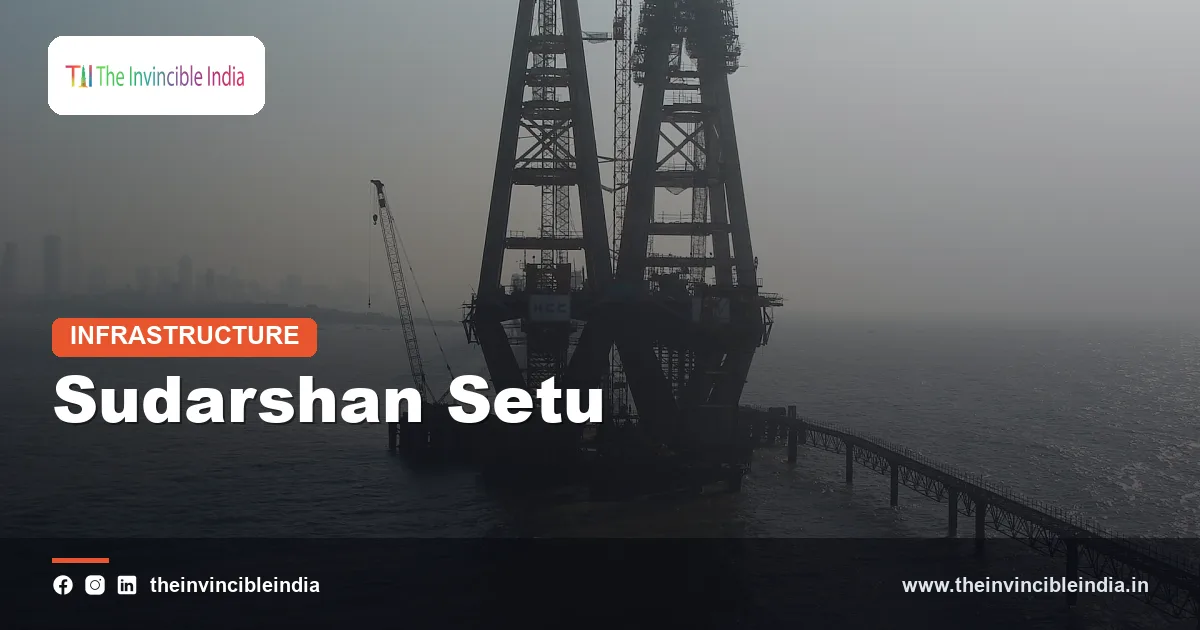
Sudarshan Setu is India’s longest cable-stayed bridge, about 2.32 km in length, which connects Okha on the Gujarat mainland to the pilgrimage island of Beyt Dwarka across a narrow sea channel in Devbhumi Dwarka district. It was inaugurated in February 2024 and was earlier known as the Okha-Beyt Dwarka Signature Bridge, before being renamed after Lord Krishna’s divine discus, the Sudarshan Chakra.
The bridge replaced a ferry crossing that islanders and pilgrims had depended on for generations. It now gives Beyt Dwarka all-weather road access and has become both a piece of engineering and a pilgrimage landmark. 15 October 2026
| Attribute | Detail |
|---|---|
| Official name | Sudarshan Setu (earlier the Okha-Beyt Dwarka Signature Bridge) |
| Location | Between Okha and Beyt Dwarka, Devbhumi Dwarka district, Gujarat |
| Type | Cable-stayed bridge over a sea channel in the Gulf of Kutch |
| Length | About 2.32 km |
| Inaugurated | February 2024 |
| Foundation stone | 2017 |
| Notable distinction | Longest cable-stayed bridge in India |
| Distinctive features | Footpaths with Bhagavad Gita verses and Krishna motifs; solar panels on the footpath top |
| Replaced | Ferry service between Okha and Beyt Dwarka |
Key Takeaways
- Sudarshan Setu is a cable-stayed bridge of about 2.32 km that links Okha on the Gujarat mainland to Beyt Dwarka island and is recognised as the longest of its type in India.
- The bridge was inaugurated in February 2024, after a foundation stone was laid in 2017, and it was formerly called the Okha-Beyt Dwarka Signature Bridge.
- Sudarshan Setu removed the need to travel to Beyt Dwarka by ferry, which had been the only way to reach the island and depended on tides and weather.
- The bridge has footpaths decorated with verses from the Bhagavad Gita and images associated with Lord Krishna, and solar panels fitted above the footpaths generate electricity.
- Beyt Dwarka is a pilgrimage island in Devbhumi Dwarka district associated with Lord Krishna, and the bridge is intended to increase safe, year-round access for pilgrims and tourists.
- The bridge crosses a marine environment in the Gulf of Kutch, so its design addresses strong winds, saline corrosion and cyclone risk.
What is Sudarshan Setu?
Sudarshan Setu is a four-lane cable-stayed road bridge in Gujarat that crosses the sea channel between Okha port on the mainland and the island of Beyt Dwarka. The word “setu” means bridge in Sanskrit and Hindi, and “Sudarshan” refers to the Sudarshan Chakra, the spinning discus associated with Lord Krishna.
The structure is about 2.32 km long in total, and its central section is a cable-stayed span, in which the deck is supported by steel cables running from tall towers. Approach spans on either side connect the cable-stayed portion to the shore. With footpaths on both sides and a wide carriageway, the bridge serves pedestrians, buses, cars and local traffic.
Before being renamed, the bridge was commonly called the Okha-Beyt Dwarka Signature Bridge, a name that reflected its intended role as a landmark structure for the region.
Where is Sudarshan Setu located?
Sudarshan Setu is located in the Devbhumi Dwarka district of Gujarat, on the western coast of India, in the Gulf of Kutch region. It stretches from Okha, a small port town on the Saurashtra peninsula’s northwestern tip, to Beyt Dwarka, an island lying a short distance offshore.
Devbhumi Dwarka district takes its name from Dwarka, the ancient city traditionally linked to Lord Krishna. The famous Dwarkadhish Temple stands in Dwarka town on the mainland, and Beyt Dwarka lies north of the mainland coast, across a strait that earlier had to be crossed by boat. The channel is shallow in places, and the sea conditions are influenced by tides, winds and seasonal storms.
Why was Sudarshan Setu built?
Sudarshan Setu was built to give Beyt Dwarka a permanent road link to the mainland and to end the dependence of residents and pilgrims on ferry boats. The island had no bridge before it, and everything from daily travel to emergency transport went through boats from Okha.
Ferry services had several limits. They were affected by tides, strong winds and monsoon weather, and the service often stopped during rough seas or cyclone warnings. Queues at the jetty were long during festivals, and carrying older pilgrims, the sick or heavy goods across by boat was difficult.
- Safety: A bridge reduces the risk associated with crowded boats in rough water.
- Reliability: Road access is available regardless of tide and most weather.
- Economic growth: Better connectivity helps local fishers, traders and tourism businesses.
- Emergency response: Ambulances, fire services and security forces can reach the island directly.
When was Sudarshan Setu built and inaugurated?
Sudarshan Setu was planned in the second half of the 2010s, had its foundation stone laid in 2017, and was inaugurated in February 2024 by the Prime Minister of India. Construction took several years and included the challenging work of building foundations in the sea.
| Milestone | Year |
|---|---|
| Proposal and planning for a bridge to Beyt Dwarka | Mid-2010s |
| Foundation stone laid | 2017 |
| Construction in a marine environment, affected by weather and cyclones | 2018 onwards |
| Inauguration and public opening | February 2024 |
The project was carried out under the Gujarat government’s road and building authorities and cost several hundred crore rupees, with the figure often stated as close to one thousand crore. Work was slowed by the Covid-19 pandemic and by cyclones in the Arabian Sea, which periodically interrupted work in the sea.
What makes Sudarshan Setu a cable-stayed bridge?
Sudarshan Setu is a cable-stayed bridge because its main deck is held up by cables that run directly from tall towers, also known as pylons, down to the deck. In a cable-stayed design, the cables take the weight of the deck and pass the load to the towers, which transfer it to the foundations.
This differs from a suspension bridge, where the deck hangs from vertical hangers attached to a main cable that is stretched between two towers and anchored at both ends. Cable-stayed bridges are well suited to medium and long spans, including crossings over water where wide spans keep piers out of shipping channels.
Why this design suits the Okha-Beyt Dwarka channel
- A central span allows boats and fishing vessels to pass beneath the bridge without obstruction.
- Fewer deep piers are needed in the sea than with a bridge made entirely of short spans.
- Steel cables and high-strength concrete can be designed to resist wind and salt-laden air.
The bridge is generally described as India’s longest cable-stayed bridge, though the length stated depends on whether one counts only the cable-stayed section or the full structure with approaches. The figure of about 2.32 km refers to the entire bridge.
What are the signature features of Sudarshan Setu?
The signature features of Sudarshan Setu are its wide footpaths decorated with Bhagavad Gita verses and Krishna imagery, and solar panels placed over the footpaths to generate electricity. These details make the bridge a cultural landmark as well as a transport link.
Footpaths with verses and motifs
Both footpaths are decorated with shlokas from the Bhagavad Gita, the scripture in which Lord Krishna counsels Arjuna, along with images and motifs drawn from the Krishna tradition and from the history of Dwarka. Visitors can walk across the bridge while reading these inscriptions, which reflect the religious character of the destination.
Solar power on the bridge
Solar panels are installed on the top of the footpaths, and they generate electricity that is used for the bridge’s lighting and other needs, with additional power potentially feeding the grid. This approach uses space that would otherwise go unused and supports the national emphasis on renewable energy.
Lighting and viewing spaces
The bridge is lit at night, and its wide footpaths provide space for pedestrians to stop and view the sea. The approach on the Beyt Dwarka side leads directly to the island’s temple area, and the design aims to blend functionality with pilgrimage tourism.
How did Sudarshan Setu change life for Beyt Dwarka residents?
Sudarshan Setu changed life for Beyt Dwarka residents by giving them a road connection that works in almost all weather, replacing a ferry service that was often disrupted. The island’s population, which depends on fishing, small trade and temple-related work, can now reach schools, hospitals and markets on the mainland more easily.
Healthcare access is among the most significant changes. In the past, urgent medical cases had to wait for a boat, and at times of rough sea they could not be moved. A road link allows ambulances to reach the mainland hospitals in much shorter time.
Local businesses may also benefit from lower transport costs and from more visitors. Fishers can move their catch to mainland markets more easily, while shopkeepers, guesthouse owners and guides can serve a larger and steadier flow of travellers.
Why is Beyt Dwarka important for pilgrims?
Beyt Dwarka is important for pilgrims because Hindu tradition regards it as the residence of Lord Krishna and the place where he met his friend Sudama. It is often visited along with the Dwarkadhish Temple in Dwarka town and the Nageshwar Jyotirlinga near Dwarka.
Dwarka is counted as one of the four Char Dham pilgrimage sites and as one of the seven sacred cities of Hinduism, known as the Sapta Puri. The island of Beyt Dwarka has temples, a long tradition of pilgrimage and a mix of communities, and it also holds shrines important to other faiths, which reflects the region’s long history as a coastal trading area.
The journey to Beyt Dwarka was earlier considered an essential but sometimes difficult part of the pilgrimage circuit. Sudarshan Setu has changed the experience by making the trip quicker and more comfortable, particularly for older pilgrims and families.
How does Sudarshan Setu boost tourism in Gujarat?
Sudarshan Setu boosts tourism in Gujarat by making Beyt Dwarka easier to reach and by adding a new attraction, the bridge itself, to the Dwarka and Okha tourism circuit. The state has promoted pilgrimage and coastal tourism as part of its wider tourism policy.
- Pilgrimage circuit: Visitors can combine Dwarkadhish Temple, Beyt Dwarka and Nageshwar in one trip.
- Coastal and marine attractions: The Gulf of Kutch has a marine national park known for corals and marine life, as well as seabird habitats.
- Heritage: Underwater archaeological work off Dwarka has attracted interest in the city’s ancient maritime past.
- Photography and sightseeing: The bridge’s long span, sea views and sunsets draw day visitors.
Planners also face the task of managing crowds, waste and the fragile coastal environment, so tourism growth is expected to need careful regulation.
What engineering challenges did the bridge present?
The engineering challenges of Sudarshan Setu came mainly from its marine setting, which exposes any structure to strong winds, tides, salty air and the risk of cyclones. Building foundations in the sea requires specialised equipment and careful scheduling around weather and tidal windows.
- Foundations: Deep piles are driven into the seabed to carry the weight of the towers and deck.
- Corrosion protection: Concrete mixes, coatings and cable protection are chosen to resist salt-laden air.
- Wind and cyclone loads: The deck and towers are designed for high wind speeds typical of the Arabian Sea coast.
- Seismic safety: Parts of Gujarat lie in an earthquake-prone zone, so the structure is designed to cope with seismic forces.
Maintenance is a continuing task. Cables, bearings and coatings need regular inspection, and the solar installation requires cleaning because dust and salt can reduce its output.
Bottom Line
Sudarshan Setu is a cable-stayed bridge of about 2.32 km that links Okha to Beyt Dwarka and ended the island’s reliance on ferries. Opened in February 2024, it combines everyday connectivity for residents with a pilgrimage-themed design, including Bhagavad Gita verses and solar-powered footpaths.
Frequently Asked Questions
What is Sudarshan Setu?
Sudarshan Setu is a cable-stayed road bridge in Gujarat that connects Okha on the mainland to the island of Beyt Dwarka. It is about 2.32 km long and is known as India’s longest cable-stayed bridge.
When was Sudarshan Setu inaugurated?
Sudarshan Setu was inaugurated in February 2024. Its foundation stone had been laid in 2017, and the bridge was earlier known as the Okha-Beyt Dwarka Signature Bridge.
Where is Sudarshan Setu located?
Sudarshan Setu is located in Devbhumi Dwarka district in the Indian state of Gujarat. It crosses the sea channel between Okha port and Beyt Dwarka island in the Gulf of Kutch region.
What is special about the footpaths of Sudarshan Setu?
The footpaths of Sudarshan Setu are decorated with verses from the Bhagavad Gita and images linked to Lord Krishna and Dwarka. Solar panels installed over the footpaths also generate electricity, which makes the bridge a renewable-energy asset as well as a cultural landmark.
Why was Sudarshan Setu needed?
Sudarshan Setu was needed because Beyt Dwarka could earlier be reached only by ferry, and the service was often disrupted by tides, wind and bad weather. The bridge gives residents and pilgrims safer, faster, all-weather access, including for medical emergencies.
Why is Beyt Dwarka important?
Beyt Dwarka is important because Hindu tradition associates the island with Lord Krishna and his meeting with Sudama. It is a major pilgrimage destination, usually visited together with the Dwarkadhish Temple and Nageshwar Jyotirlinga.
{“@context”:”https://schema.org”,”@graph”:[{“@type”:”FAQPage”,”mainEntity”:[{“@type”:”Question”,”name”:”What is Sudarshan Setu?”,”acceptedAnswer”:{“@type”:”Answer”,”text”:”Sudarshan Setu is a cable-stayed road bridge in Gujarat that connects Okha on the mainland to the island of Beyt Dwarka. It is about 2.32 km long and is known as India’s longest cable-stayed bridge.”}},{“@type”:”Question”,”name”:”When was Sudarshan Setu inaugurated?”,”acceptedAnswer”:{“@type”:”Answer”,”text”:”Sudarshan Setu was inaugurated in February 2024. Its foundation stone had been laid in 2017, and the bridge was earlier known as the Okha-Beyt Dwarka Signature Bridge.”}},{“@type”:”Question”,”name”:”Where is Sudarshan Setu located?”,”acceptedAnswer”:{“@type”:”Answer”,”text”:”Sudarshan Setu is located in Devbhumi Dwarka district in the Indian state of Gujarat. It crosses the sea channel between Okha port and Beyt Dwarka island in the Gulf of Kutch region.”}},{“@type”:”Question”,”name”:”What is special about the footpaths of Sudarshan Setu?”,”acceptedAnswer”:{“@type”:”Answer”,”text”:”The footpaths of Sudarshan Setu are decorated with verses from the Bhagavad Gita and images linked to Lord Krishna and Dwarka. Solar panels installed over the footpaths also generate electricity, which makes the bridge a renewable-energy asset as well as a cultural landmark.”}},{“@type”:”Question”,”name”:”Why was Sudarshan Setu needed?”,”acceptedAnswer”:{“@type”:”Answer”,”text”:”Sudarshan Setu was needed because Beyt Dwarka could earlier be reached only by ferry, and the service was often disrupted by tides, wind and bad weather. The bridge gives residents and pilgrims safer, faster, all-weather access, including for medical emergencies.”}},{“@type”:”Question”,”name”:”Why is Beyt Dwarka important?”,”acceptedAnswer”:{“@type”:”Answer”,”text”:”Beyt Dwarka is important because Hindu tradition associates the island with Lord Krishna and his meeting with Sudama. It is a major pilgrimage destination, usually visited together with the Dwarkadhish Temple and Nageshwar Jyotirlinga.”}}]}]}


