

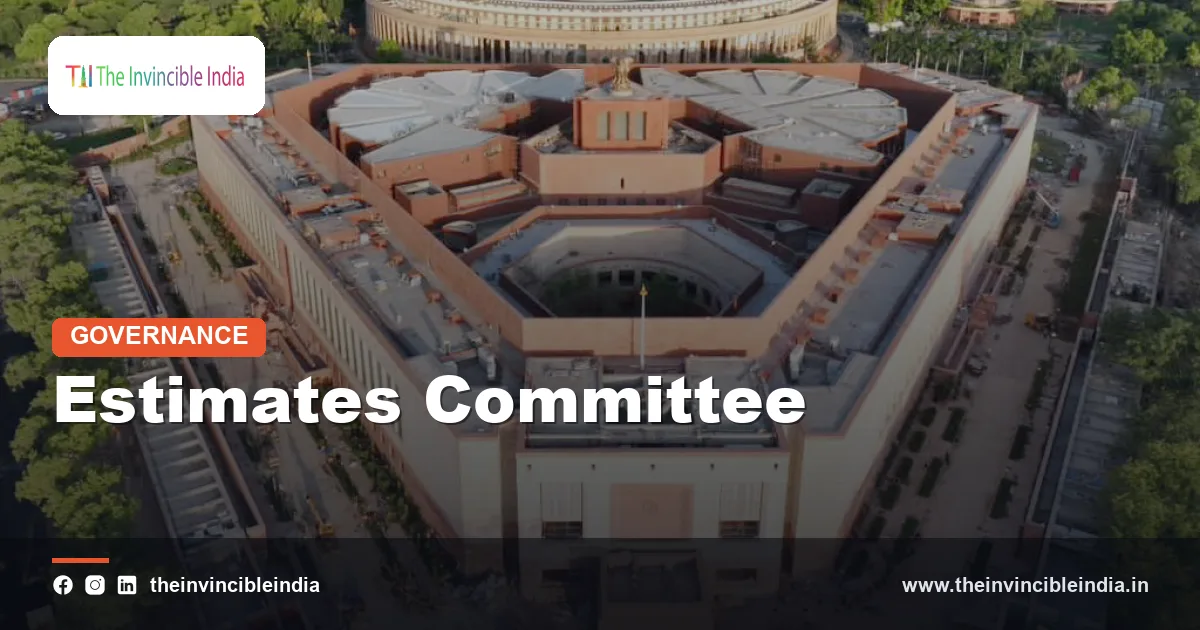
The Estimates Committee is the largest financial committee of the Indian Parliament, with 30 members drawn from the Lok Sabha alone, and it examines the Budget estimates of the Government of India in order to suggest economies and improvements in administrative efficiency. The Estimates Committee is often called the “continuous economy committee” because it works throughout the year and does not wait for the end of a financial year to begin its scrutiny.
The Estimates Committee was first constituted in 1950 and looks at how the money asked for in the Budget can be spent more wisely. Unlike the Public Accounts Committee, which examines past expenditure, the Estimates Committee looks at the estimates themselves and at the policy and organisation behind them. 15 October 2026
| Attribute | Detail |
|---|---|
| Committee | Estimates Committee |
| First constituted | 1950, following the recommendation of Finance Minister John Matthai |
| Type | Parliamentary financial committee |
| Total members | 30, all from the Lok Sabha |
| Method of selection | Elected every year by the Lok Sabha through proportional representation by the single transferable vote |
| Term | One year |
| Chairperson | Appointed by the Speaker from among the members, usually from the ruling party |
| Nickname | Continuous economy committee |
| Ministers as members | Not permitted |
Key Takeaways
- The Estimates Committee of the Indian Parliament has 30 members, all elected from the Lok Sabha, which makes it the largest of the three parliamentary financial committees.
- The Estimates Committee examines the Budget estimates and suggests economies, improvements in organisation and administrative reforms consistent with government policy.
- The Estimates Committee is called the “continuous economy committee” because it scrutinises the estimates throughout the year and is not limited to the period of the Budget session.
- The Estimates Committee was first constituted in 1950 after a recommendation by the then Finance Minister, John Matthai.
- The Estimates Committee has no members from the Rajya Sabha, and a minister cannot be a member of the committee.
- The Estimates Committee differs from the Public Accounts Committee because it looks forward at estimates and efficiency, whereas the Public Accounts Committee looks back at audited expenditure.
What is the Estimates Committee?
The Estimates Committee is a standing committee of the Lok Sabha that examines the estimates of expenditure included in the Budget and suggests how they can be made more economical and efficient. It is one of three financial committees of the Indian Parliament, along with the Public Accounts Committee and the Committee on Public Undertakings.
The committee’s purpose is to bring a systematic, non-partisan review to the way the government plans its spending. It can ask whether the money requested is well laid out within the limits of policy, whether the organisation of a department is efficient, and whether the estimates are presented in a form that is clear to the House.
The committee works on the basis of the Rules of Procedure and Conduct of Business in Lok Sabha. Its reports are presented to the House, and ministries are expected to respond to its recommendations.
When was the Estimates Committee formed and why?
The Estimates Committee was formed in 1950, when the then Finance Minister, John Matthai, suggested the creation of a committee to examine the estimates on a continuing basis. The committee was meant to make parliamentary control over expenditure more systematic and continuous.
Before independence, a Standing Finance Committee had advised the government on proposals for expenditure, but the new Constitution called for a stronger form of legislative scrutiny. The Estimates Committee was therefore constituted in 1950 as a Lok Sabha body. Its original strength was 25 members, which was raised to 30 in the mid-1950s.
The new committee fit into the broader architecture of parliamentary control that includes Article 112 on the annual financial statement, Article 113 on the procedure for estimates relating to expenditure, and Article 114 on appropriation bills. The committee extends this constitutional framework through the rules of the House.
Who are the members of the Estimates Committee?
The members of the Estimates Committee are 30 Members of the Lok Sabha, elected every year by the House from among its members according to the system of proportional representation by means of the single transferable vote. No member of the Rajya Sabha belongs to the committee, as the Lok Sabha holds primary control over financial matters.
The key rules regarding membership are as follows:
- The committee has 30 members, all from the Lok Sabha.
- Members are elected each year, and the term is one year.
- A minister cannot be a member, and a member who is appointed a minister ceases to be a member of the committee.
- The chairperson is appointed by the Speaker from among the members. If the Deputy Speaker is elected as a member of the committee, he or she automatically becomes the chair.
- The chairperson is generally from the ruling party, which is a difference from the Public Accounts Committee, which traditionally has an Opposition chair.
Because members are chosen by proportional representation, the committee reflects the strengths of the different parties in the House. This makes it a miniature version of the Lok Sabha, balanced between the government and Opposition benches.
What are the functions of the Estimates Committee?
The functions of the Estimates Committee are to report what economies, improvements in organisation, efficiency or administrative reform can be made consistent with the policy underlying the estimates, to suggest alternative policies for efficiency and economy, to examine whether money is well laid out, and to suggest the form in which estimates should be presented to Parliament. These functions are defined in the rules of the Lok Sabha.
Economy and efficiency
The committee looks for ways to reduce expenditure without harming the objectives of a programme. It may point out duplication between departments, overstaffing, wasteful procedures or opportunities for better use of existing assets.
Alternative policies
The committee may suggest alternative policies to bring about efficiency and economy in administration. This gives it more latitude than the Public Accounts Committee, which cannot question the wisdom of policy and is concerned with legality and regularity.
Whether money is well laid out
The committee checks whether the money has been laid out within the limits of the policy implied in the estimates. It asks whether the allocation fits the stated objective and whether the objective is being achieved.
Form of estimates
The committee may recommend changes in how the estimates are presented to Parliament, so that they are clearer and give better information for decision-making.
Why is the Estimates Committee called the continuous economy committee?
The Estimates Committee is called the continuous economy committee because it is not bound to wait for the Budget to be passed and can continue its examination of the estimates throughout the financial year. It does not need to complete its examination before the House votes the grants, and it may examine the estimates of any department at any time.
This continuity contrasts with the Parliament’s work on Demands for Grants, which takes place within a limited period in the Budget session. The committee, in effect, supplements that rushed schedule with careful and unhurried study. It may select specific subjects, ministries or departments for detailed examination, since the estimates are too numerous to cover in full every year.
The committee also has the power to continue its investigations beyond a single year, with new members taking up subjects begun by the previous committee, so that long-running inquiries are not lost at the end of the one-year term.
How does the Estimates Committee work?
The Estimates Committee works by selecting subjects from the estimates of ministries, collecting information through questionnaires, taking oral evidence from officials, visiting field establishments and then presenting a report to the Lok Sabha. The process is similar in form to that of other parliamentary committees but is directed at economy and efficiency.
- Selection of subjects: The committee decides which ministries or schemes to study during the year.
- Information gathering: It asks the ministries to provide written notes and answers to questions.
- Evidence: It takes oral evidence from senior officials, and sometimes from experts and non-official bodies.
- Study visits: It may visit project sites or offices to see matters at first hand.
- Report: It prepares a report with findings and recommendations and presents it to the House.
- Follow-up: The government sends Action Taken Replies, and the committee reviews them in a follow-up report.
The committee may form sub-committees and study groups to handle the workload. Since the estimates cover the entire government, it prioritises areas where spending is large or where there is room for reform.
What are the limits of the Estimates Committee?
The limits of the Estimates Committee are that its recommendations are advisory, that it cannot change the Budget itself, and that it examines only selected parts of the estimates each year. Its influence depends on the quality of its analysis and on the willingness of the government to act on its advice.
- Recommendatory power: The committee can suggest but cannot compel. The government is expected to respond, but it is not legally bound by the report.
- No effect on voted grants: The Lok Sabha votes the Demands for Grants independently, and the committee’s report does not alter an appropriation already passed.
- Selective coverage: Because of limited time and the one-year term, the committee cannot examine every item in the estimates in a year.
- Lok Sabha only: With no representation of the Rajya Sabha, the committee reflects only one House’s perspective.
- Overlap with other bodies: Since 1993, Departmentally Related Standing Committees have scrutinised the Demands for Grants of ministries, which has reduced the committee’s distinctive role in practice.
How does the Estimates Committee differ from the PAC and the Committee on Public Undertakings?
The Estimates Committee differs from the Public Accounts Committee (PAC) and the Committee on Public Undertakings (COPU) in its focus, size and chair: it examines estimates for economy, has 30 Lok Sabha members and is chaired by a member of the ruling side, while the PAC audits past expenditure and the COPU examines public sector undertakings. Together, the three committees make up the parliamentary system of financial scrutiny.
| Feature | Estimates Committee | Public Accounts Committee | Committee on Public Undertakings |
|---|---|---|---|
| Established | 1950 | 1921 | 1964 |
| Members | 30 (Lok Sabha only) | 22 (15 Lok Sabha, 7 Rajya Sabha) | 22 (15 Lok Sabha, 7 Rajya Sabha) |
| Main focus | Budget estimates, economy and efficiency | CAG audit reports and appropriation accounts | Reports and accounts of public sector undertakings |
| Direction of review | Forward-looking | Backward-looking | Backward-looking with efficiency review |
| Chair | Usually from the ruling party | By convention from the Opposition | Appointed by the Speaker, usually from the ruling party |
| Can suggest alternative policy | Yes, for efficiency and economy | No, it does not question policy | Limited, within its remit |
| Link with the CAG | Not tied to audit reports | Closely tied to CAG reports | Uses CAG reports on undertakings |
The Committee on Public Undertakings was set up in 1964 on the recommendation of a committee led by V.K. Krishna Menon. It was formed because the Public Accounts Committee and the Estimates Committee, which had both been examining public sector undertakings, could not give them enough time given their wider mandates.
Why does the Estimates Committee matter?
The Estimates Committee matters because it gives Parliament a continuing and informed way to question how the executive plans to use public money, rather than only reacting after the money is spent. This planning-stage scrutiny can reduce waste before it occurs and is one of the main ways in which Parliament encourages good administration.
The committee has produced reports on a wide range of subjects, including the organisation of ministries, the working of public programmes, defence and civil expenditure, and the structure of government departments. Many of its suggestions on simplifying procedures, reducing delays and improving the presentation of Budget documents have influenced later reforms.
It also serves as a training ground for Members of Parliament. By studying the details of departmental estimates, members learn how the government works and are better equipped to take part in Budget debates.
Bottom Line
The Estimates Committee is Parliament’s forward-looking financial watchdog. Its 30 Lok Sabha members examine the Budget estimates throughout the year to recommend economy and efficiency, and its work complements the audit-based scrutiny of the Public Accounts Committee and the sector-specific review of the Committee on Public Undertakings.
Frequently Asked Questions
What is the Estimates Committee of the Indian Parliament?
The Estimates Committee is a parliamentary financial committee that examines the Budget estimates and suggests economies and efficiency in administration. It has 30 members, all from the Lok Sabha. It was first constituted in 1950.
Why is the Estimates Committee called a continuous economy committee?
The Estimates Committee is called a continuous economy committee because it works throughout the year and not just during the Budget session. It can examine the estimates of any department at any time. This allows it to study subjects in depth and to follow up on its earlier recommendations.
How many members does the Estimates Committee have?
The Estimates Committee has 30 members, and all of them are elected by the Lok Sabha from among its own members. No member of the Rajya Sabha is on the committee. Members are elected for one year by proportional representation through the single transferable vote.
What is the difference between the Estimates Committee and the Public Accounts Committee?
The Estimates Committee examines the estimates of future expenditure to suggest economy and efficiency, while the Public Accounts Committee examines past expenditure on the basis of CAG audit reports. The Estimates Committee has 30 Lok Sabha members and may suggest alternative policies. The Public Accounts Committee has 22 members from both Houses and does not question policy.
How is the Estimates Committee different from the Committee on Public Undertakings?
The Estimates Committee examines government estimates across ministries, while the Committee on Public Undertakings examines the reports and accounts of public sector undertakings. The Committee on Public Undertakings was formed in 1964 and has 22 members from both Houses. The Estimates Committee, formed in 1950, has 30 members from the Lok Sabha only.
Are the recommendations of the Estimates Committee binding?
No, the recommendations of the Estimates Committee are not binding on the government. They are recommendatory, and the ministries are expected to reply with action taken notes. The committee’s influence rests on the quality of its analysis and on the pressure of a report presented to the House.
{“@context”:”https://schema.org”,”@graph”:[{“@type”:”FAQPage”,”mainEntity”:[{“@type”:”Question”,”name”:”What is the Estimates Committee of the Indian Parliament?”,”acceptedAnswer”:{“@type”:”Answer”,”text”:”The Estimates Committee is a parliamentary financial committee that examines the Budget estimates and suggests economies and efficiency in administration. It has 30 members, all from the Lok Sabha. It was first constituted in 1950.”}},{“@type”:”Question”,”name”:”Why is the Estimates Committee called a continuous economy committee?”,”acceptedAnswer”:{“@type”:”Answer”,”text”:”The Estimates Committee is called a continuous economy committee because it works throughout the year and not just during the Budget session. It can examine the estimates of any department at any time. This allows it to study subjects in depth and to follow up on its earlier recommendations.”}},{“@type”:”Question”,”name”:”How many members does the Estimates Committee have?”,”acceptedAnswer”:{“@type”:”Answer”,”text”:”The Estimates Committee has 30 members, and all of them are elected by the Lok Sabha from among its own members. No member of the Rajya Sabha is on the committee. Members are elected for one year by proportional representation through the single transferable vote.”}},{“@type”:”Question”,”name”:”What is the difference between the Estimates Committee and the Public Accounts Committee?”,”acceptedAnswer”:{“@type”:”Answer”,”text”:”The Estimates Committee examines the estimates of future expenditure to suggest economy and efficiency, while the Public Accounts Committee examines past expenditure on the basis of CAG audit reports. The Estimates Committee has 30 Lok Sabha members and may suggest alternative policies. The Public Accounts Committee has 22 members from both Houses and does not question policy.”}},{“@type”:”Question”,”name”:”How is the Estimates Committee different from the Committee on Public Undertakings?”,”acceptedAnswer”:{“@type”:”Answer”,”text”:”The Estimates Committee examines government estimates across ministries, while the Committee on Public Undertakings examines the reports and accounts of public sector undertakings. The Committee on Public Undertakings was formed in 1964 and has 22 members from both Houses. The Estimates Committee, formed in 1950, has 30 members from the Lok Sabha only.”}},{“@type”:”Question”,”name”:”Are the recommendations of the Estimates Committee binding?”,”acceptedAnswer”:{“@type”:”Answer”,”text”:”No, the recommendations of the Estimates Committee are not binding on the government. They are recommendatory, and the ministries are expected to reply with action taken notes. The committee’s influence rests on the quality of its analysis and on the pressure of a report presented to the House.”}}]}]}


