

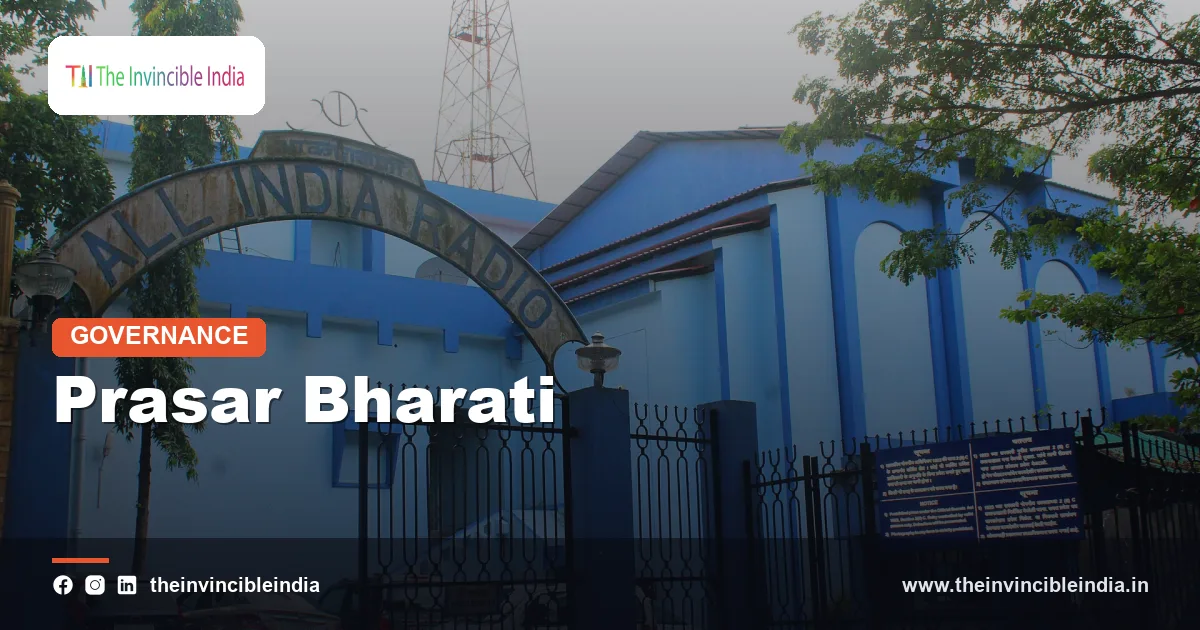
Prasar Bharati is India’s public service broadcaster, an autonomous statutory body created by the Prasar Bharati (Broadcasting Corporation of India) Act, 1990, which runs the television network Doordarshan and the radio network All India Radio (AIR), also called Akashvani. The corporation became operational on 23 November 1997 and has its headquarters in New Delhi.
Prasar Bharati was designed to separate the state broadcasters from direct government control and give them an independent public-service identity, much like the BBC in the United Kingdom. How far that autonomy works in practice, given government funding and administrative links, remains a long-running subject of debate. This explainer covers the body’s origins, structure, mandate, reach, funding and the arguments around its independence.
| Attribute | Detail |
|---|---|
| Full name | Prasar Bharati (Broadcasting Corporation of India) |
| Legal basis | Prasar Bharati (Broadcasting Corporation of India) Act, 1990 |
| Operational from | 23 November 1997 |
| Type | Autonomous statutory body and public service broadcaster |
| Administrative ministry | Ministry of Information and Broadcasting |
| Constituent services | Doordarshan (television) and All India Radio / Akashvani (radio) |
| Headquarters | New Delhi |
| Governing body | Prasar Bharati Board, headed by a Chairman |
| Public Broadcasting Day | 12 November |
Key Takeaways
- Prasar Bharati is a statutory autonomous corporation established under the Prasar Bharati Act, 1990, and it became operational on 23 November 1997.
- Prasar Bharati operates two national broadcasters, Doordarshan for television and All India Radio, also known as Akashvani, for radio.
- The Prasar Bharati Board is headed by a Chairman and appointed by the President of India on the recommendation of a Selection Committee chaired by the Vice-President.
- The statutory mandate of Prasar Bharati is to inform, educate and entertain the public and to ensure a balanced development of broadcasting on radio and television.
- Prasar Bharati is funded mainly through government grants-in-aid together with its own revenue from advertising, sponsorship and similar sources.
- The Supreme Court held in 1995 that airwaves are public property and should be used for the public good under the control of a public authority, a ruling that supports the idea of a public broadcaster.
What is Prasar Bharati?
Prasar Bharati is the statutory corporation that governs India’s public broadcasting, bringing Doordarshan and All India Radio under a single autonomous body. It was created by an Act of Parliament in 1990, after years of demand for broadcasting that was not controlled directly by a government department.
The name Prasar Bharati translates roughly as “broadcasting of India”. Before the corporation was formed, both Doordarshan and AIR were attached offices of the Ministry of Information and Broadcasting, and their staff were government employees. The 1990 Act converted them into component units of a corporation with its own Board, though the law gives the Union government certain reserved powers.
The Act was passed by Parliament in 1990 but only came into force in 1997, a gap of seven years that reflects political caution over how much autonomy the broadcaster should have. The corporation’s formal start on 23 November 1997 is the date normally cited as the beginning of Prasar Bharati’s life.
How did public broadcasting develop in India?
Public broadcasting in India began with radio in the 1920s and television in 1959, and both were run by the government before Prasar Bharati was established. The history explains why the autonomy question became so important.
| Year | Milestone |
|---|---|
| 1927 | Private Indian Broadcasting Company begins radio service in Bombay and Calcutta |
| 1930 | Government takes over and runs it as the Indian State Broadcasting Service |
| 1936 | The service is renamed All India Radio |
| 1957 | Vividh Bharati entertainment service begins, and the name Akashvani comes into wide official use in the 1950s |
| 1959 | Experimental television service starts in Delhi, the origin of Doordarshan |
| 1982 | National television network expands and colour broadcasts begin around the Asian Games |
| 1990 | Prasar Bharati Act passed by Parliament |
| 1997 | Prasar Bharati begins functioning on 23 November |
A major influence on the move towards autonomy was the work of committees, including the B. G. Verghese Committee of 1978, which proposed a National Broadcasting Trust, and the Working Group of the 1980s headed by P. C. Joshi, which examined the software needs of Doordarshan. Both argued for greater independence from direct ministerial control.
Who runs Prasar Bharati?
Prasar Bharati is run by its Board, headed by a Chairman, with an Executive Member who functions as chief executive officer, and with separate members for finance and personnel. The Board is the main decision-making body of the corporation.
The Act describes a Board made up of the following categories of members:
- A Chairman, who heads the Board.
- An Executive Member, a Member for Finance and a Member for Personnel.
- Six part-time members drawn from different fields.
- The Director-General of Doordarshan and the Director-General of All India Radio, serving ex officio.
- A representative of the Ministry of Information and Broadcasting.
- Two representatives elected by the employees of the corporation.
The Chairman and other appointed members are named by the President on the recommendation of a Selection Committee. The committee is chaired by the Vice-President of India and includes the Chairman of the Press Council of India and a nominee of the President. This process was meant to remove the appointments from direct ministerial discretion. Members hold office for a fixed term, and they can be removed only on specified grounds, such as proved misbehaviour or incapacity, following an inquiry.
What is the mandate of Prasar Bharati?
The mandate of Prasar Bharati is to function as a public service broadcaster that informs, educates and entertains the public while ensuring a balanced development of radio and television. This is set out in Section 12 of the Prasar Bharati Act.
The Act lists several specific objectives for the corporation:
- Upholding the unity and integrity of the country and the values enshrined in the Constitution.
- Safeguarding the citizen’s right to be informed freely, truthfully and objectively on matters of public interest, with a fair and balanced flow of information.
- Providing adequate coverage to the diverse cultures, languages and regions of India.
- Promoting social justice and the interests of minorities, tribal communities, children and persons with disabilities.
- Promoting education, health, family welfare and scientific temper.
- Providing suitable programmes for the entertainment and cultural enrichment of the public.
This public-service mandate is different from the commercial aims of private channels, which depend heavily on advertising and ratings. Prasar Bharati’s content therefore includes rural, agricultural, educational and regional programming that private broadcasters often find less profitable.
What does Doordarshan do?
Doordarshan is India’s national public television broadcaster, started in 1959 and now operated as a unit of Prasar Bharati. It is among the largest television networks in the world in terms of the number of transmitters and the geographic coverage of its terrestrial service.
Doordarshan runs a bouquet of channels, including DD National, DD News, DD India, DD Sports, DD Kisan and a number of regional language channels operated through regional kendras. It also offers a free-to-air direct-to-home service known as DD Free Dish, which reaches households without a monthly subscription fee. The name Doordarshan means “distant vision” in Hindi, and its logo and signature tune are among the most recognisable symbols of Indian broadcasting.
The Sports Broadcasting Signals (Mandatory Sharing with Prasar Bharati) Act, 2007 requires private rights-holders to share the live feed of events of national importance with Prasar Bharati. This allows Doordarshan and AIR to broadcast such events to the wider public.
What does All India Radio do?
All India Radio, also called Akashvani, is India’s national public radio broadcaster and one of the largest radio networks in the world. It broadcasts through a large network of stations and transmitters in numerous languages and dialects, and it covers nearly the whole of the country’s population.
AIR operates multiple services. These include the national and regional channels of the Home Service, the Vividh Bharati entertainment channel, the FM services such as FM Rainbow and FM Gold, and an External Services Division that broadcasts to audiences abroad. Its news service is among the oldest and most widely heard in the country, and it carries news bulletins in a large number of languages. AIR’s motto is “Bahujan Hitaya Bahujan Sukhaya”, which means for the welfare and happiness of the many.
Radio remains an important medium in rural areas, in remote regions and for emergencies, as it can run on batteries and does not need internet connectivity. AIR also provides content through digital platforms and a mobile application.
How is Prasar Bharati funded?
Prasar Bharati is funded through grants-in-aid from the Government of India together with revenue the corporation earns itself. The balance between the two has been central to debates over its financial independence.
- Government grants: A large share of the corporation’s budget comes from annual grants, which cover operating costs and capital expenditure.
- Advertising and sponsorship: Doordarshan and AIR earn money by selling airtime for commercials and sponsored programmes.
- Other income: Receipts also come from leasing space on the DD Free Dish platform, from licensing of content and from other commercial activities.
The Act envisages that the corporation will have a fund of its own and that its accounts will be audited by the Comptroller and Auditor General of India. An annual report must also be laid before Parliament. Because a substantial part of the money still comes from the government, critics argue that financial dependence limits real autonomy. Defenders of the model say that public broadcasters around the world, including the BBC, rely on public funding to preserve their public-service role.
What is the debate over Prasar Bharati’s autonomy?
The debate over Prasar Bharati’s autonomy is whether a broadcaster funded and administratively linked to the government can be editorially independent. Arguments exist on both sides, and the question has been raised repeatedly by committees, scholars and Parliament.
Arguments for greater autonomy
Supporters of fuller autonomy say a public broadcaster should answer to the public rather than to the government of the day. They point out that the Act was intended to create independence, but that dependence on the government for money, the continued role of officials from the Ministry of Information and Broadcasting, and the status of employees have limited this in practice. Several reviews, including an expert committee set up in 2013, recommended reforms to strengthen the corporation.
Arguments for the present arrangement
Supporters of the present arrangement point to the fact that Prasar Bharati is publicly funded and accountable to Parliament, which, they say, justifies a degree of government oversight. They also note that the Act itself contains safeguards for independence, such as the Selection Committee and the protection of members’ tenure, and that the corporation has editorial guidelines and a code for broadcasting.
The Supreme Court’s 1995 decision in the Cricket Association of Bengal case is often cited in this context. The Court held that airwaves are public property and should be used to promote public good, and that they should be controlled by a public authority free from government and private monopolies. This ruling is used by both sides to support their positions.
Why does Prasar Bharati matter?
Prasar Bharati matters because it is the only broadcaster in India with a statutory public-service mandate and a national reach that includes remote and underserved areas. Private media is concentrated in cities and in markets that can be monetised, while public broadcasting is meant to serve everyone.
The corporation plays a role in disaster communication, public education, the preservation of regional languages and the national archive of audio and video material. It also carries live proceedings and national events that are of public interest. Prasar Bharati’s performance, and the arguments over its independence, illustrate a broader question for democracies: how a public institution can serve citizens without becoming an instrument of the government of the day.
Bottom Line
Prasar Bharati is India’s statutory public service broadcaster, running Doordarshan and All India Radio under an Act passed in 1990 and operational since 1997. It has a broad public-service mandate and a Board appointed through a Selection Committee, but its funding links and administrative ties keep the question of true editorial autonomy open.
Frequently Asked Questions
What is Prasar Bharati?
Prasar Bharati is India’s public service broadcaster, a statutory autonomous body created by the Prasar Bharati Act, 1990. It manages Doordarshan and All India Radio and has operated since 23 November 1997.
When was Prasar Bharati established?
Prasar Bharati was established under an Act passed by Parliament in 1990, and it became operational on 23 November 1997. The delay of seven years between the passing of the Act and its implementation reflected political debate over the broadcaster’s degree of independence.
Who appoints the Chairman of Prasar Bharati?
The President of India appoints the Chairman of Prasar Bharati on the recommendation of a Selection Committee. The committee is headed by the Vice-President of India and includes the Chairman of the Press Council of India and a nominee of the President.
What is the difference between Prasar Bharati, Doordarshan and All India Radio?
Prasar Bharati is the parent corporation, while Doordarshan and All India Radio are its two operating broadcasters. Doordarshan handles television and DD Free Dish, and All India Radio, also known as Akashvani, handles radio services.
How is Prasar Bharati funded?
Prasar Bharati is funded by grants-in-aid from the Government of India along with its own earnings from advertising, sponsorship and other commercial activities. Its accounts are audited by the Comptroller and Auditor General of India.
Is Prasar Bharati independent of the government?
Prasar Bharati is legally an autonomous statutory body, but its independence is debated because it relies on government funding and has administrative links to the Ministry of Information and Broadcasting. Supporters of the current system note the Act’s safeguards, while critics call for further financial and editorial autonomy.
{“@context”:”https://schema.org”,”@graph”:[{“@type”:”FAQPage”,”mainEntity”:[{“@type”:”Question”,”name”:”What is Prasar Bharati?”,”acceptedAnswer”:{“@type”:”Answer”,”text”:”Prasar Bharati is India’s public service broadcaster, a statutory autonomous body created by the Prasar Bharati Act, 1990. It manages Doordarshan and All India Radio and has operated since 23 November 1997.”}},{“@type”:”Question”,”name”:”When was Prasar Bharati established?”,”acceptedAnswer”:{“@type”:”Answer”,”text”:”Prasar Bharati was established under an Act passed by Parliament in 1990, and it became operational on 23 November 1997. The delay of seven years between the passing of the Act and its implementation reflected political debate over the broadcaster’s degree of independence.”}},{“@type”:”Question”,”name”:”Who appoints the Chairman of Prasar Bharati?”,”acceptedAnswer”:{“@type”:”Answer”,”text”:”The President of India appoints the Chairman of Prasar Bharati on the recommendation of a Selection Committee. The committee is headed by the Vice-President of India and includes the Chairman of the Press Council of India and a nominee of the President.”}},{“@type”:”Question”,”name”:”What is the difference between Prasar Bharati, Doordarshan and All India Radio?”,”acceptedAnswer”:{“@type”:”Answer”,”text”:”Prasar Bharati is the parent corporation, while Doordarshan and All India Radio are its two operating broadcasters. Doordarshan handles television and DD Free Dish, and All India Radio, also known as Akashvani, handles radio services.”}},{“@type”:”Question”,”name”:”How is Prasar Bharati funded?”,”acceptedAnswer”:{“@type”:”Answer”,”text”:”Prasar Bharati is funded by grants-in-aid from the Government of India along with its own earnings from advertising, sponsorship and other commercial activities. Its accounts are audited by the Comptroller and Auditor General of India.”}},{“@type”:”Question”,”name”:”Is Prasar Bharati independent of the government?”,”acceptedAnswer”:{“@type”:”Answer”,”text”:”Prasar Bharati is legally an autonomous statutory body, but its independence is debated because it relies on government funding and has administrative links to the Ministry of Information and Broadcasting. Supporters of the current system note the Act’s safeguards, while critics call for further financial and editorial autonomy.”}}]}]}


