

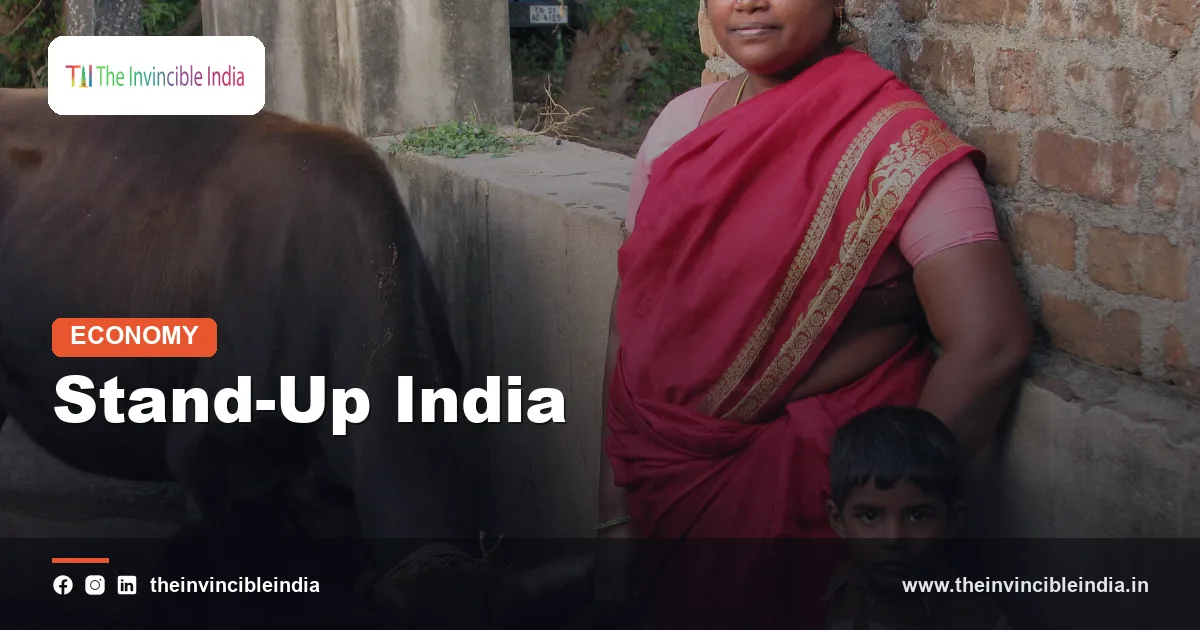
Stand-Up India is a Government of India scheme, launched in 2016, that facilitates bank loans between 10 lakh and 1 crore rupees to at least one Scheduled Caste (SC) or Scheduled Tribe (ST) borrower and at least one woman borrower per bank branch for setting up a new, or greenfield, enterprise. The scheme is meant to support first-time entrepreneurs from groups that have historically had weaker access to institutional credit.
Stand-Up India was announced in the Union Budget of 2015-16 and launched in April 2016 by the Department of Financial Services of the Ministry of Finance, with the Small Industries Development Bank of India (SIDBI) acting as the main support institution. Besides the loan, the scheme offers handholding support, a credit guarantee and an online portal, so that a borrower gets help in planning and running the business as well as in raising funds.
| Attribute | Detail |
|---|---|
| Full name | Stand-Up India Scheme |
| Launched | 5 April 2016, from Noida in Uttar Pradesh |
| Nodal department | Department of Financial Services, Ministry of Finance |
| Support institution | Small Industries Development Bank of India (SIDBI) |
| Loan size | Between 10 lakh and 1 crore rupees |
| Target borrowers | At least one SC/ST borrower and one woman borrower per bank branch |
| Type of enterprise | Greenfield (first-time) ventures in manufacturing, services, agri-allied activities or trading |
| Lenders | Scheduled commercial bank branches |
| Credit guarantee | Credit Guarantee Fund for Stand-Up India Loans (CGFSIL) |
Key Takeaways
- Stand-Up India was launched on 5 April 2016 to facilitate bank loans between 10 lakh and 1 crore rupees for SC/ST and women entrepreneurs.
- Stand-Up India expects every scheduled commercial bank branch to lend to at least one SC/ST borrower and at least one woman borrower for a greenfield enterprise.
- A greenfield enterprise under Stand-Up India means a first-time venture in manufacturing, services, agri-allied activities or the trading sector.
- Stand-Up India loans are composite loans covering both term needs and working capital, and they carry a repayment period of up to seven years with an initial moratorium.
- Stand-Up India offers handholding support through SIDBI and a dedicated online portal, and loans are backed by the Credit Guarantee Fund for Stand-Up India Loans.
- Stand-Up India differs from MUDRA loans because it lends larger amounts to first-time SC/ST and women entrepreneurs, whereas MUDRA lends up to 10 lakh rupees to any non-corporate small business.
What is the Stand-Up India scheme?
The Stand-Up India scheme is a bank-credit facilitation programme that aims to create a new generation of entrepreneurs among women and among the Scheduled Castes and Scheduled Tribes. It does not lend money directly. Instead, it requires bank branches to extend loans to eligible borrowers and supports them with guarantees, information and handholding.
The idea behind the scheme is that while India has many credit programmes for micro-enterprises, there was a gap for aspiring entrepreneurs who needed more than a micro loan but lacked the collateral, networks or experience to approach banks successfully. By setting a benchmark of at least two such loans per branch, the scheme tried to create a steady flow of new first-generation business owners across the country.
The campaign slogan “Start-Up India, Stand-Up India” linked the scheme with the Start-Up India initiative, which targets technology and innovation-led firms. Stand-Up India, by contrast, covers a broader range of ordinary businesses such as small manufacturing units, service providers, food processing and agri-allied ventures.
Who is eligible for Stand-Up India?
An applicant for Stand-Up India must be an SC or ST person or a woman entrepreneur, at least 18 years old, who is seeking a loan to set up a greenfield enterprise and who is not in default to any bank or financial institution. The main conditions are listed below.
- The borrower must belong to the Scheduled Castes, the Scheduled Tribes or be a woman, with no requirement that women also belong to a particular social category.
- The enterprise must be a first-time or greenfield venture in the manufacturing, services, agri-allied or trading sector.
- For businesses that are not individually owned, at least 51 per cent of the shareholding and controlling stake must be held by an SC/ST or woman entrepreneur.
- The borrower must not be in default to any bank or financial institution.
- The loan must be in the range of 10 lakh to 1 crore rupees, covering term loan and working capital.
What does greenfield enterprise mean?
A greenfield enterprise means a new business that is being set up for the first time, in the manufacturing, services, agri-allied or trading sector, by a person who is a first-time entrepreneur in the venture. The term excludes loans taken to expand, take over or refinance an existing running business.
The scheme’s definition of eligible activities is intentionally broad:
- Manufacturing: small units producing goods such as garments, packaged food, furniture or components.
- Services: businesses such as salons, clinics, repair shops, coaching, logistics and hospitality.
- Agri-allied activities: ventures such as dairy, poultry, fisheries, apiculture and agro-processing, excluding crop loans.
- Trading: retail and wholesale businesses, which were included after the initial design focused on manufacturing and services.
How does the Stand-Up India loan work?
A Stand-Up India loan works as a composite loan that combines a term loan for fixed assets with working capital finance, sanctioned by a scheduled commercial bank branch, within the range of 10 lakh to 1 crore rupees. The borrower prepares a business plan and applies through the bank branch, the Stand-Up India portal or a Lead District Manager.
| Feature | Details |
|---|---|
| Loan range | 10 lakh to 1 crore rupees |
| Loan structure | Composite loan covering term loan and working capital |
| Repayment period | Up to seven years |
| Moratorium | Initial moratorium period of up to eighteen months |
| Working capital | Provided through an overdraft or cash credit facility, with a RuPay debit card for withdrawals |
| Interest rate | Set by the bank within a ceiling linked to the lender’s base rate, plus a spread |
| Collateral | Primary security of the asset financed, with collateral security or a credit guarantee as per rules |
The steps for a borrower are generally to register on the portal, prepare a project report, apply to a branch, undergo appraisal and then receive sanction and disbursement. The scheme encourages banks to process applications in a timely manner, since branch performance is monitored against the target of two loans per branch.
What is margin money under Stand-Up India?
Margin money under Stand-Up India is the part of the project cost that the borrower must contribute, which is generally 25 per cent of the total project cost, and the scheme allows this to be combined with subsidies and support from other central or state programmes. The borrower must contribute at least 10 per cent of the project cost from their own funds, while the rest of the margin can come from convergence with eligible schemes.
This convergence feature is useful, because a first-time entrepreneur often finds it hard to arrange the full margin. By permitting the use of state subsidies or other support schemes, Stand-Up India lowers the up-front equity that a borrower must bring and widens access for people with limited savings.
What handholding support does Stand-Up India offer?
Stand-Up India offers handholding support that includes pre-loan training, help with preparing project reports, guidance on market linkages and assistance through a dedicated online portal and helpline. The support is coordinated by SIDBI along with the Lead District Managers of banks and state-level agencies.
- Online portal: a single window where borrowers can register, find information, locate nearby bank branches and track their applications.
- Training and skill support: pre-loan counselling and training on topics such as financial literacy, business planning and compliance.
- Credit guarantee: loans are covered by the Credit Guarantee Fund for Stand-Up India Loans, managed by the National Credit Guarantee Trustee Company (NCGTC), which reduces risk to banks and encourages lending.
- Facilitation centres: support centres and field officers who help borrowers with documentation and follow-up.
Handholding is considered as important as the loan itself, because many first-time entrepreneurs fail not for lack of funds but because of weak planning, limited market knowledge or compliance difficulties.
How is Stand-Up India different from MUDRA and other schemes?
Stand-Up India differs from the Pradhan Mantri MUDRA Yojana (PMMY) mainly in loan size, target group and business stage, because MUDRA lends smaller amounts to any non-corporate small business while Stand-Up India lends larger amounts to first-time SC/ST and women entrepreneurs. The two schemes are complementary and cover different points on the credit ladder.
| Feature | Stand-Up India | PM MUDRA Yojana |
|---|---|---|
| Loan size | 10 lakh to 1 crore rupees | Up to 10 lakh rupees in the main categories |
| Target borrower | SC/ST and women entrepreneurs | Any non-corporate, non-farm small business |
| Business stage | Greenfield (new) enterprises only | New and existing businesses |
| Delivery | Scheduled commercial bank branches | Banks, microfinance institutions and NBFCs |
| Credit guarantee | Credit Guarantee Fund for Stand-Up India Loans | Credit Guarantee Fund for Micro Units |
| Special feature | Branch-level benchmark of two borrowers per branch | Shishu, Kishor and Tarun categories by loan size |
A person who starts small with a MUDRA loan may later grow and seek larger funding, while a person with a larger greenfield project may apply to Stand-Up India directly. Stand-Up India is also different from Start-Up India, which focuses on innovation-driven startups and offers recognition, tax benefits and fund-of-funds support.
Why does Stand-Up India matter?
Stand-Up India matters because access to formal credit is a key obstacle to entrepreneurship for women and for SC/ST communities, and the scheme targets this gap with a measurable benchmark for every bank branch. By building a pipeline of first-generation business owners, the scheme supports job creation and wider participation in economic growth.
The points often highlighted include:
- Women entrepreneurs frequently face challenges with collateral because property is often not registered in their names.
- SC/ST entrepreneurs have faced social and historical barriers to access networks and credit.
- A business owner can create employment for others, and these enterprises often hire from their own communities.
- The branch-level target spreads credit across the country rather than concentrating it in a few cities.
What are the challenges and limitations of Stand-Up India?
The main challenges of Stand-Up India are uneven participation by bank branches, difficulty in meeting collateral and margin requirements, limited awareness among potential borrowers and the high failure risk of first-time ventures. Audits and commentary by development analysts have noted several points.
- Women borrowers have made up a large share of sanctions, while SC/ST participation has been comparatively lower.
- Bank officials sometimes hesitate to lend to untested ventures, and many applications are routed to smaller loans under other schemes.
- Working capital needs after the initial sanction can strain new businesses, especially in the first two years.
- Borrowers in rural areas may lack easy access to mentors, markets and digital tools.
Stronger handholding, better data on sanctions by caste and gender, and closer coordination between banks and state agencies are frequently suggested as ways to improve outcomes.
Bottom Line
Stand-Up India links first-time SC/ST and women entrepreneurs with bank credit between 10 lakh and 1 crore rupees, adding margin-money flexibility, a credit guarantee and handholding support. It complements MUDRA and Start-Up India by filling the middle of the credit ladder, though its impact depends on the willingness of bank branches to lend and on quality mentoring. This article is for general information and is not financial advice; terms and tenure of the scheme are updated by the government from time to time. Last reviewed: 15 October 2026.
Frequently Asked Questions
What is the Stand-Up India scheme?
Stand-Up India is a government scheme launched in 2016 to facilitate bank loans of 10 lakh to 1 crore rupees for SC/ST and women entrepreneurs. Each scheduled commercial bank branch is expected to lend to at least one SC/ST borrower and one woman borrower. The loans are for greenfield enterprises.
Who can apply for a Stand-Up India loan?
Any SC or ST person or woman entrepreneur aged 18 or above who plans to set up a new enterprise can apply, provided they are not in default to any bank. For non-individual businesses, at least 51 per cent of shareholding and control must be with an SC/ST or woman entrepreneur. The application is made at a bank branch or through the Stand-Up India portal.
What is the loan amount and repayment period under Stand-Up India?
The loan amount ranges from 10 lakh to 1 crore rupees as a composite loan covering term and working capital needs. The repayment period is up to seven years, including an initial moratorium of up to eighteen months. The interest rate is set by the lending bank within the ceiling prescribed for the scheme.
What does greenfield mean in Stand-Up India?
Greenfield means a brand-new enterprise being set up for the first time, in manufacturing, services, agri-allied activities or trading. Loans to expand, buy or refinance an existing business do not qualify. The first-time requirement is central to the purpose of the scheme.
Is margin money required under Stand-Up India?
Yes, the borrower must contribute margin money of up to 25 per cent of the project cost, of which at least 10 per cent must come from the borrower’s own funds. The remainder can be combined with subsidies or support from other central or state schemes. This reduces the upfront burden on first-time entrepreneurs.
How is Stand-Up India different from MUDRA?
Stand-Up India is for larger loans of 10 lakh to 1 crore rupees to first-time SC/ST and women borrowers, while MUDRA lends smaller amounts, generally up to 10 lakh rupees, to any non-corporate small business. MUDRA covers both new and existing businesses, but Stand-Up India covers only greenfield ventures. The two schemes complement each other.
{“@context”:”https://schema.org”,”@graph”:[{“@type”:”FAQPage”,”mainEntity”:[{“@type”:”Question”,”name”:”What is the Stand-Up India scheme?”,”acceptedAnswer”:{“@type”:”Answer”,”text”:”Stand-Up India is a government scheme launched in 2016 to facilitate bank loans of 10 lakh to 1 crore rupees for SC/ST and women entrepreneurs. Each scheduled commercial bank branch is expected to lend to at least one SC/ST borrower and one woman borrower. The loans are for greenfield enterprises.”}},{“@type”:”Question”,”name”:”Who can apply for a Stand-Up India loan?”,”acceptedAnswer”:{“@type”:”Answer”,”text”:”Any SC or ST person or woman entrepreneur aged 18 or above who plans to set up a new enterprise can apply, provided they are not in default to any bank. For non-individual businesses, at least 51 per cent of shareholding and control must be with an SC/ST or woman entrepreneur. The application is made at a bank branch or through the Stand-Up India portal.”}},{“@type”:”Question”,”name”:”What is the loan amount and repayment period under Stand-Up India?”,”acceptedAnswer”:{“@type”:”Answer”,”text”:”The loan amount ranges from 10 lakh to 1 crore rupees as a composite loan covering term and working capital needs. The repayment period is up to seven years, including an initial moratorium of up to eighteen months. The interest rate is set by the lending bank within the ceiling prescribed for the scheme.”}},{“@type”:”Question”,”name”:”What does greenfield mean in Stand-Up India?”,”acceptedAnswer”:{“@type”:”Answer”,”text”:”Greenfield means a brand-new enterprise being set up for the first time, in manufacturing, services, agri-allied activities or trading. Loans to expand, buy or refinance an existing business do not qualify. The first-time requirement is central to the purpose of the scheme.”}},{“@type”:”Question”,”name”:”Is margin money required under Stand-Up India?”,”acceptedAnswer”:{“@type”:”Answer”,”text”:”Yes, the borrower must contribute margin money of up to 25 per cent of the project cost, of which at least 10 per cent must come from the borrower’s own funds. The remainder can be combined with subsidies or support from other central or state schemes. This reduces the upfront burden on first-time entrepreneurs.”}},{“@type”:”Question”,”name”:”How is Stand-Up India different from MUDRA?”,”acceptedAnswer”:{“@type”:”Answer”,”text”:”Stand-Up India is for larger loans of 10 lakh to 1 crore rupees to first-time SC/ST and women borrowers, while MUDRA lends smaller amounts, generally up to 10 lakh rupees, to any non-corporate small business. MUDRA covers both new and existing businesses, but Stand-Up India covers only greenfield ventures. The two schemes complement each other.”}}]}]}


