

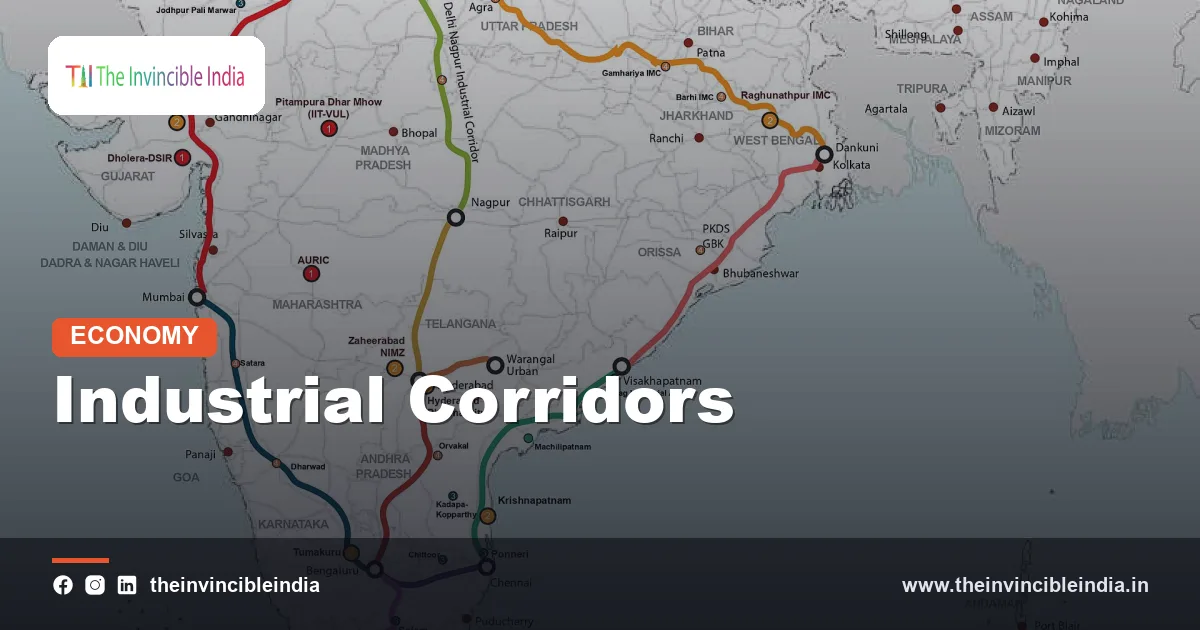
The industrial corridors of India are planned, long-distance belts of manufacturing, logistics and urban development built around major transport spines such as freight railways, highways and ports, and developed under the National Industrial Corridor Development Programme (NICDP). The idea is to concentrate factories, warehouses, power, water, skilled workers and new townships along a connected route so that producers can reach markets and ports quickly and at lower cost. The flagship project is the Delhi-Mumbai Industrial Corridor (DMIC), and several other corridors now link the northern, southern, eastern and western parts of the country.
Industrial corridors of India are administered by the Department for Promotion of Industry and Internal Trade (DPIIT) under the Ministry of Commerce and Industry. They are meant to raise the share of manufacturing in the economy, create non-farm jobs and make Indian goods more competitive in export markets. This explainer covers how the corridors are structured, which ones exist, what a node or smart city is, how plug-and-play industrial parks work, and what has been achieved and debated so far.
Quick Facts: Industrial Corridors of India
| Attribute | Detail |
|---|---|
| Programme | National Industrial Corridor Development Programme (NICDP) |
| Nodal ministry and department | Ministry of Commerce and Industry; Department for Promotion of Industry and Internal Trade (DPIIT) |
| Apex body | National Industrial Corridor Development and Implementation Trust (NICDIT) |
| Implementing agency | National Industrial Corridor Development Corporation Limited (NICDC), originally the DMIC Development Corporation |
| First and flagship corridor | Delhi-Mumbai Industrial Corridor (DMIC), about 1,500 km long |
| Origin of the DMIC idea | India-Japan cooperation announced in 2006, with the DMIC Development Corporation set up in 2007 |
| Other major corridors | Amritsar-Kolkata, Chennai-Bengaluru, Bengaluru-Mumbai and Visakhapatnam-Chennai industrial corridors |
| Core concept | Greenfield industrial nodes and smart cities with plug-and-play infrastructure along a transport spine |
| Linked planning platform | PM Gati Shakti National Master Plan for multimodal connectivity |
Key Takeaways
- The industrial corridors of India are transport-led belts of factories, logistics hubs and planned townships developed under the National Industrial Corridor Development Programme.
- The Delhi-Mumbai Industrial Corridor, launched through India-Japan cooperation in the mid-2000s, is the oldest and largest corridor and runs roughly alongside the Western Dedicated Freight Corridor.
- Besides the DMIC, the programme includes the Amritsar-Kolkata, Chennai-Bengaluru, Bengaluru-Mumbai and Visakhapatnam-Chennai corridors, with more corridors proposed in several regions.
- Each corridor is broken into nodes, which are greenfield industrial cities or clusters with ready roads, power, water, sewage treatment and digital networks.
- The National Industrial Corridor Development Corporation is the central agency that develops the trunk infrastructure and supports state governments in building the nodes.
- Industrial corridors in India aim to lower logistics costs, attract domestic and foreign manufacturers and create large numbers of jobs outside farming.
What are industrial corridors in India?
Industrial corridors in India are geographically defined belts, often hundreds or even over a thousand kilometres long, in which industry, infrastructure and urban settlements are planned together along a major freight or highway route. Unlike a single industrial estate, a corridor is a regional development plan that connects many industrial clusters, ports, airports, inland container depots and cities.
The model borrows from East Asian experience, particularly Japan and South Korea, where industrial belts along coastal and rail routes supported rapid growth in manufacturing and exports. In India the approach was adopted because the country’s factories have historically faced high logistics costs, scattered small industrial estates, delays in land allotment and uneven infrastructure. By developing land, utilities and transport as a package, the corridors try to give investors a ready-made location rather than a multi-year set of clearances.
A corridor generally has three layers. The first is the backbone, which is the rail or road spine such as a dedicated freight corridor or expressway. The second is the set of nodes, meaning the industrial cities and parks. The third is the supporting ecosystem of ports, airports, power plants, water supply, skill centres and housing.
How did the industrial corridor programme begin?
The industrial corridor programme began with the Delhi-Mumbai Industrial Corridor, which grew out of an India-Japan agreement announced in December 2006 and was institutionalised through the DMIC Development Corporation in 2007. The project was conceived as the industrial counterpart to the Western Dedicated Freight Corridor, a high-capacity railway line planned between the Dadri area near Delhi and Jawaharlal Nehru Port near Mumbai.
Japan’s government and its development agencies provided early technical and financial support, including project studies and a project development fund. The DMIC Development Corporation was later renamed the National Industrial Corridor Development Corporation (NICDC) as its mandate widened beyond the Delhi-Mumbai route.
In 2016 the Union Cabinet approved the National Industrial Corridor Development and Implementation Trust (NICDIT) as an apex body to bring all corridor projects under one umbrella. The programme was then formally organised as the National Industrial Corridor Development Programme, with a pipeline of corridors and nodes to be developed in phases.
Milestones at a glance
- 2006: India and Japan agree to cooperate on a Delhi-Mumbai industrial corridor concept.
- 2007: The DMIC Development Corporation is incorporated to plan and implement the project.
- 2010s: Master plans are prepared and other corridors, including Chennai-Bengaluru and Amritsar-Kolkata, are taken up.
- 2016: NICDIT is approved as the apex body for the National Industrial Corridor Development Programme.
- 2020s: Corridor planning is linked to the PM Gati Shakti National Master Plan, and additional industrial nodes and smart cities are approved.
What is the Delhi-Mumbai Industrial Corridor?
The Delhi-Mumbai Industrial Corridor (DMIC) is a roughly 1,500 km long industrial and infrastructure belt that runs between Delhi and Mumbai and is the largest and oldest project under the National Industrial Corridor Development Programme. It passes through Uttar Pradesh, Haryana, Rajasthan, Gujarat, Madhya Pradesh and Maharashtra, along with the National Capital Region.
The corridor is organised around the Western Dedicated Freight Corridor, which carries heavy and containerised cargo between the national capital region and the western ports. The area of influence extends on both sides of the freight line, so that districts within an economic reach of the spine can host industrial activity. The DMIC plan includes industrial nodes, logistics hubs, new and upgraded ports and power projects.
Notable DMIC nodes and projects
- Dholera Special Investment Region in Gujarat, a large greenfield industrial city planned under Gujarat’s Special Investment Region law.
- Shendra-Bidkin Industrial Area near Aurangabad in Maharashtra, developed as an industrial smart city.
- Integrated Industrial Township at Greater Noida in Uttar Pradesh.
- Khushkhera-Bhiwadi-Neemrana investment region on the Haryana-Rajasthan border.
- Vikram Udyogpuri near Ujjain in Madhya Pradesh.
- Multimodal logistics hubs in the northern Haryana and Uttar Pradesh belt and a planned logistics presence near the western ports.
The DMIC is also tied to improvements in expressways, such as the Delhi-Mumbai Expressway, which serves the same region and complements freight rail.
Which other industrial corridors exist in India?
Besides the Delhi-Mumbai Industrial Corridor, the main industrial corridors of India are the Amritsar-Kolkata, Chennai-Bengaluru, Bengaluru-Mumbai and Visakhapatnam-Chennai corridors, with further corridors proposed to connect Hyderabad, Nagpur, Odisha and other regions. Each corridor is planned around a specific transport backbone and a regional industrial base.
| Corridor | Geographic spine | Main states | Notable features |
|---|---|---|---|
| Delhi-Mumbai Industrial Corridor (DMIC) | Western Dedicated Freight Corridor and expressways | Uttar Pradesh, Haryana, Rajasthan, Madhya Pradesh, Gujarat, Maharashtra | Oldest and largest; Japanese cooperation; Dholera and Shendra-Bidkin nodes |
| Amritsar-Kolkata Industrial Corridor (AKIC) | Eastern Dedicated Freight Corridor and Grand Trunk road belt | Punjab, Haryana, Uttar Pradesh, Bihar, Jharkhand, West Bengal and some northern hill states | Links the northern farm-and-industry belt to the eastern coalfields and Kolkata port |
| Chennai-Bengaluru Industrial Corridor (CBIC) | Chennai-Bengaluru highway and rail route | Tamil Nadu, Karnataka, Andhra Pradesh | Electronics, automotive, textiles and engineering; Japanese support for planning |
| Bengaluru-Mumbai Economic Corridor (BMEC) | National highway and rail route across the Deccan | Karnataka, Maharashtra | Connects the southern technology hub with the western commercial capital |
| Visakhapatnam-Chennai Industrial Corridor (VCIC) | East Coast route within the East Coast Economic Corridor | Andhra Pradesh, Tamil Nadu | Port-led development; supported by the Asian Development Bank |
Other corridors have been planned or discussed to connect Hyderabad with Nagpur, Warangal and Bengaluru, to develop an Odisha economic corridor and to extend the southern network toward Kochi. Their status can change as plans are revised, so the official NICDC and DPIIT pages are the authoritative source for the latest list.
What is a node, a smart city and a plug-and-play industrial park?
A node is a defined industrial city or park within a corridor where land, utilities and services are developed in an integrated way, and a smart city node is one that adds digital management and sustainable urban design to this plan. Nodes are the actual sites where factories are built; the corridor is the framework that connects them.
Plug-and-play industrial parks are fully serviced industrial plots on which an investor can begin construction or production quickly because roads, power, water, drainage, telecom and common facilities already exist. The phrase signals that the investor only needs to bring machinery, workers and capital rather than waiting for the basic infrastructure to be created.
Typical features of an industrial smart city node
- Master-planned zones for manufacturing, logistics, residential use, commerce and green space.
- Reliable power supply and, in several projects, renewable energy and gas distribution.
- Water supply, sewage treatment and recycling, and storm-water management.
- High-speed internet and a central command-and-control system for city services.
- A walk-to-work idea, in which housing and amenities are placed near factories to reduce commuting.
- Single-window facilitation for approvals, supported by a digital Industrial Information System for land and infrastructure data.
The approach is related to earlier experiments such as Special Economic Zones and National Investment and Manufacturing Zones, but it is more closely tied to city-scale planning and to transport links.
Who runs the industrial corridors?
The industrial corridors of India are run by a layered structure in which the National Industrial Corridor Development and Implementation Trust (NICDIT) sets policy direction, the National Industrial Corridor Development Corporation (NICDC) implements projects, and state governments or state industrial agencies develop and manage the nodes. The DPIIT acts as the administrative department for the whole programme.
NICDIT is chaired at the highest ministerial level in the Ministry of Commerce and Industry and approves projects and funding. The NICDC works as a project developer and provides trunk infrastructure, such as external roads, power and water connections to the nodes. State governments contribute land, local approvals and state-level incentives, and many have created special-purpose vehicles for individual nodes.
Funding comes from a mix of central equity, state contributions, multilateral and bilateral institutions such as the Asian Development Bank and Japanese agencies, and private developers. This shared model reflects the constitutional position that land and industry are largely state subjects, so central schemes must work through state governments.
What are the goals of the industrial corridor programme?
The main goal of the industrial corridor programme is to build globally competitive manufacturing clusters that raise industrial output, exports and employment by combining infrastructure, land and policy in one planned system. The programme is closely linked to the objective of strengthening manufacturing in the Indian economy, an aim that also appears in the National Manufacturing Policy and the Make in India initiative.
Stated objectives
- Create new, planned industrial cities that can absorb large numbers of workers who move out of agriculture.
- Reduce logistics costs by locating industry close to freight rail, highways and ports.
- Attract foreign direct investment and anchor investments in sectors such as electronics, auto components, textiles, chemicals, food processing and engineering goods.
- Promote balanced regional development by bringing investment to states and districts that were less industrialised.
- Encourage sustainable and technology-enabled urban planning, including renewable energy and water recycling.
- Integrate industry with skill development so that trained workers are available near the nodes.
How do the corridors connect with freight corridors and Gati Shakti?
The industrial corridors connect with dedicated freight corridors by locating nodes and logistics hubs along the freight lines, and they are increasingly planned through the PM Gati Shakti National Master Plan, which maps rail, road, port and utility networks on a common digital platform. The Western Dedicated Freight Corridor runs close to the Delhi-Mumbai Industrial Corridor, while the Eastern Dedicated Freight Corridor, which runs from the Ludhiana region toward Dankuni near Kolkata, aligns with the Amritsar-Kolkata corridor.
Dedicated freight lines allow faster, heavier and more predictable goods trains by separating them from passenger services. When factories sit close to such lines and to multimodal logistics parks, goods can move between plant, port and market with fewer handling steps. Gati Shakti, launched in 2021, is designed to help planners avoid duplication, for example by ensuring that a node, its access road, its power line and its rail siding are planned together.
What has been achieved so far?
The industrial corridors of India have progressed from planning to construction in several nodes, with trunk infrastructure and industrial plots developed in some locations while others remain at earlier stages. Progress has varied across corridors because of differences in land availability, state capacity and the pace of dedicated freight corridor construction.
In general terms, the programme has delivered master plans for many nodes, approvals for additional industrial cities, trunk infrastructure at selected sites and the first allotments to industrial units. In 2024 the Union Cabinet approved a new batch of industrial nodes or smart cities across multiple states under the programme, signalling continued central backing. Exact investment and employment figures change regularly, so readers should consult the latest NICDC and DPIIT releases rather than relying on any single number.
The programme has also influenced policy discussions on land pooling, logistics efficiency and the design of state industrial policies. Several states now market their nodes with integrated land, power and water offers, which is a visible shift from earlier standalone industrial estates.
What are the challenges and criticisms?
The main challenges facing the industrial corridors of India are slow land acquisition, delayed infrastructure, uneven demand from investors, financing gaps and environmental and social concerns. These issues are common to large greenfield infrastructure projects around the world.
Common issues
- Land: Acquiring large, contiguous parcels is difficult because of fragmented holdings, compensation disputes and local resistance.
- Timelines: Dependence on dedicated freight corridors and external roads means that delays in one component affect the whole node.
- Demand: Anchor investors are needed to make a node viable, and some nodes have taken years to attract their first major units.
- Water and environment: Industrial cities require large volumes of water and careful pollution control, and some sites raise concerns about farmland and ecology.
- Coordination: Central agencies, state departments and local bodies must align approvals, which is hard without strong single-window systems.
- Workforce: Skilled labour, housing and social infrastructure must be built alongside factories for a node to function well.
Supporters argue that these obstacles are expected in a long-term, multi-state programme and that integrated planning is still better than isolated industrial estates. Critics argue that outcomes should be assessed node by node and that transparency about land use, jobs and environmental impact is essential.
Why do industrial corridors matter for the Indian economy?
Industrial corridors matter because they target one of the structural problems of the Indian economy: moving workers from low-productivity farming into higher-productivity manufacturing and services while keeping logistics costs competitive. A well-functioning corridor can lower the cost of getting goods to ports, attract supply chains and create agglomeration benefits where suppliers, buyers and workers are located near one another.
They also matter for urbanisation. India expects its urban population to keep growing, and planned industrial cities offer an alternative to unplanned expansion around existing metros. For states, hosting a node can bring investment, employment and tax revenue. For businesses, a corridor reduces uncertainty about land, power and permits, which can be decisive in location decisions.
Finally, the corridors support India’s wider manufacturing strategy, which includes production-linked incentive schemes, special economic zones and trade agreements. Infrastructure on its own does not create demand, but it removes a major constraint that otherwise limits what other policies can achieve.
Bottom Line
The industrial corridors of India are an attempt to build manufacturing capacity through planned infrastructure rather than isolated factories, starting with the Delhi-Mumbai corridor and expanding to eastern, southern and western routes. Their success depends on timely freight, power and water infrastructure, state-level execution and genuine investor demand. For readers following the economy, the corridors are one of the clearest long-term indicators of how India intends to grow its manufacturing base.
Frequently Asked Questions
What are the industrial corridors of India?
The industrial corridors of India are planned belts of factories, logistics hubs and new townships built along major transport routes under the National Industrial Corridor Development Programme. The best-known examples are the Delhi-Mumbai, Amritsar-Kolkata, Chennai-Bengaluru, Bengaluru-Mumbai and Visakhapatnam-Chennai corridors. Each is divided into nodes where land, power, water and digital services are developed in advance.
Which is the largest industrial corridor in India?
The Delhi-Mumbai Industrial Corridor (DMIC) is the largest and oldest industrial corridor in India, stretching roughly 1,500 km between Delhi and Mumbai. It passes through six states and the National Capital Region and runs alongside the Western Dedicated Freight Corridor. Japan supported its early development through technical and financial cooperation.
Who manages the industrial corridors in India?
The Department for Promotion of Industry and Internal Trade (DPIIT) manages the programme, with the National Industrial Corridor Development and Implementation Trust (NICDIT) as the apex body and the National Industrial Corridor Development Corporation (NICDC) as the implementing agency. State governments and their industrial development agencies develop and operate the individual nodes. Private developers and multilateral lenders also take part in some projects.
What is a plug-and-play industrial park?
A plug-and-play industrial park is an industrial site where basic infrastructure such as roads, power, water, drainage and telecom is already built, so a company can start construction or production quickly. The investor only needs to bring land use plans, machinery and workers. This reduces the delays that traditionally come from arranging utilities and approvals.
How do industrial corridors help India’s economy?
Industrial corridors help the Indian economy by lowering logistics costs, attracting manufacturing investment and creating jobs outside agriculture. They also support planned urbanisation by building new industrial cities with housing and services. By linking factories to ports and freight lines, they improve the competitiveness of Indian goods in domestic and export markets.
What are the main challenges facing industrial corridors?
The main challenges are land acquisition, delays in supporting infrastructure such as freight lines and roads, slow arrival of anchor investors and concerns about water and the environment. Coordination between central agencies, state governments and local bodies is also demanding. Progress therefore differs from one node to another, and official updates are the best guide to the current status.
{“@context”:”https://schema.org”,”@graph”:[{“@type”:”FAQPage”,”mainEntity”:[{“@type”:”Question”,”name”:”What are the industrial corridors of India?”,”acceptedAnswer”:{“@type”:”Answer”,”text”:”The industrial corridors of India are planned belts of factories, logistics hubs and new townships built along major transport routes under the National Industrial Corridor Development Programme. The best-known examples are the Delhi-Mumbai, Amritsar-Kolkata, Chennai-Bengaluru, Bengaluru-Mumbai and Visakhapatnam-Chennai corridors. Each is divided into nodes where land, power, water and digital services are developed in advance.”}},{“@type”:”Question”,”name”:”Which is the largest industrial corridor in India?”,”acceptedAnswer”:{“@type”:”Answer”,”text”:”The Delhi-Mumbai Industrial Corridor (DMIC) is the largest and oldest industrial corridor in India, stretching roughly 1,500 km between Delhi and Mumbai. It passes through six states and the National Capital Region and runs alongside the Western Dedicated Freight Corridor. Japan supported its early development through technical and financial cooperation.”}},{“@type”:”Question”,”name”:”Who manages the industrial corridors in India?”,”acceptedAnswer”:{“@type”:”Answer”,”text”:”The Department for Promotion of Industry and Internal Trade (DPIIT) manages the programme, with the National Industrial Corridor Development and Implementation Trust (NICDIT) as the apex body and the National Industrial Corridor Development Corporation (NICDC) as the implementing agency. State governments and their industrial development agencies develop and operate the individual nodes. Private developers and multilateral lenders also take part in some projects.”}},{“@type”:”Question”,”name”:”What is a plug-and-play industrial park?”,”acceptedAnswer”:{“@type”:”Answer”,”text”:”A plug-and-play industrial park is an industrial site where basic infrastructure such as roads, power, water, drainage and telecom is already built, so a company can start construction or production quickly. The investor only needs to bring land use plans, machinery and workers. This reduces the delays that traditionally come from arranging utilities and approvals.”}},{“@type”:”Question”,”name”:”How do industrial corridors help India’s economy?”,”acceptedAnswer”:{“@type”:”Answer”,”text”:”Industrial corridors help the Indian economy by lowering logistics costs, attracting manufacturing investment and creating jobs outside agriculture. They also support planned urbanisation by building new industrial cities with housing and services. By linking factories to ports and freight lines, they improve the competitiveness of Indian goods in domestic and export markets.”}},{“@type”:”Question”,”name”:”What are the main challenges facing industrial corridors?”,”acceptedAnswer”:{“@type”:”Answer”,”text”:”The main challenges are land acquisition, delays in supporting infrastructure such as freight lines and roads, slow arrival of anchor investors and concerns about water and the environment. Coordination between central agencies, state governments and local bodies is also demanding. Progress therefore differs from one node to another, and official updates are the best guide to the current status.”}}]}]}


