

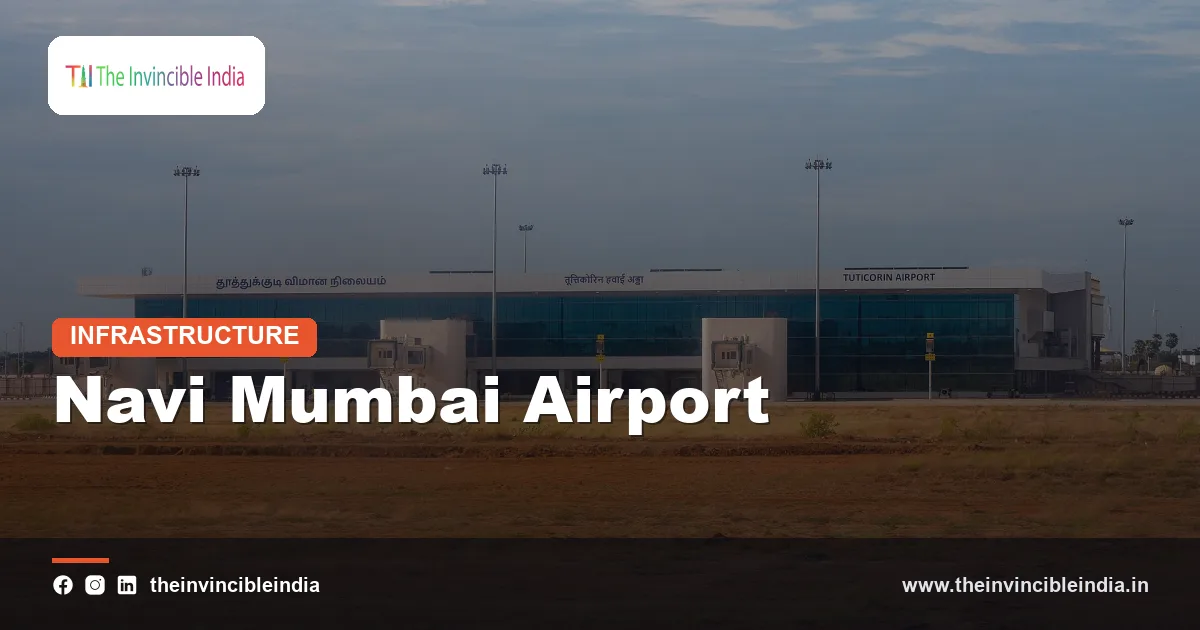
The Navi Mumbai International Airport is a greenfield airport built at Ulwe in Raigad district, Maharashtra, to relieve the overloaded Chhatrapati Shivaji Maharaj International Airport (CSMIA) in Mumbai and to serve the wider Mumbai Metropolitan Region. It was developed through a public-private partnership between the City and Industrial Development Corporation of Maharashtra (CIDCO) and Adani Airport Holdings Limited, using a special-purpose company called Navi Mumbai International Airport Limited (NMIAL).
The Navi Mumbai International Airport is planned in phases, with two parallel runways and several terminals in its ultimate form, and it needed major engineering work, including the diversion of a river and the levelling of hills. This explainer covers its purpose, ownership, phases, engineering and connectivity, and how it fits with Mumbai’s existing airport. Details were last reviewed on 15 October 2026; capacities and timelines are planning figures and may be revised.
Quick Facts
| Attribute | Detail |
|---|---|
| Official name | Navi Mumbai International Airport (NMIA) |
| Location | Ulwe, near Panvel, Raigad district, Maharashtra, across the harbour from Mumbai |
| Type | Greenfield international airport developed under a public-private partnership |
| Concessionaire | Navi Mumbai International Airport Limited (NMIAL), with Adani Airport Holdings holding the majority stake |
| Public partner | City and Industrial Development Corporation of Maharashtra (CIDCO), holding the minority stake |
| Concession period | Several decades, with a provision for extension |
| Ultimate plan | Two parallel runways, multiple terminals and capacity often cited at around 90 million passengers a year |
| Inauguration | Inaugurated in October 2025, with commercial flights following after regulatory approvals |
| Terminal design theme | Lotus flower concept, with contributions from Zaha Hadid Architects |
Key Takeaways
- The Navi Mumbai International Airport is a greenfield airport at Ulwe in Raigad district, Maharashtra, built to ease the congestion at Mumbai’s Chhatrapati Shivaji Maharaj International Airport.
- Navi Mumbai International Airport Limited is a public-private partnership in which Adani Airport Holdings holds the majority stake and CIDCO holds the minority stake.
- The airport is planned in four phases, ultimately targeting two parallel runways and a capacity often stated at around 90 million passengers a year.
- Construction involved large engineering works, including diverting the Ulwe river into a new channel and levelling hills on the site.
- Road, rail, metro and sea links, including the Atal Setu sea bridge, are meant to connect the airport to Mumbai, Navi Mumbai, Pune and the Konkan region.
- Mumbai’s CSMIA works with a single main runway in practice, which is why a second airport has long been seen as essential for the region.
What is the Navi Mumbai International Airport?
The Navi Mumbai International Airport is a new international airport located across Thane Creek from Mumbai, built to serve the Mumbai Metropolitan Region (MMR) alongside the existing airport. It is a greenfield project, built on a fresh site rather than as an expansion of an existing airfield.
The idea of a second airport for Mumbai has been discussed for decades because the existing airport is hemmed in by dense urban areas and cannot add runways or large terminals. The Navi Mumbai site was identified as the preferred location, close to the planned township of Navi Mumbai, and was cleared in principle by the Government of India in the 2000s after long studies and debate.
The airport shares a metropolitan area with CSMIA, which is among India’s busiest, and together the two are intended to form a two-airport system for Mumbai.
Where is the Navi Mumbai International Airport located?
The Navi Mumbai International Airport is located at Ulwe, near Panvel in Raigad district, on the eastern shore of Thane Creek and Mumbai Harbour. The site is about 35 to 40 kilometres from the old city of Mumbai by road, depending on the route.
The location is on the Navi Mumbai side of the harbour, close to the Mumbai Trans Harbour Link, also called the Atal Setu, a long sea bridge connecting Mumbai to Navi Mumbai. It is also near the Jawaharlal Nehru Port at Nhava Sheva, the Mumbai-Pune Expressway and the Panvel rail junction.
Because the area was previously farmland, creeks, mangrove-fringed flats and low hills, the site needed extensive preparation before any building could begin.
Who built and runs the Navi Mumbai International Airport?
The Navi Mumbai International Airport is built and run by Navi Mumbai International Airport Limited (NMIAL), a company in which Adani Airport Holdings Limited holds the majority and CIDCO holds the remaining share. CIDCO is the planning authority that developed Navi Mumbai as a satellite city of Mumbai.
The airport was first bid in the 2010s, and the concession was awarded to GVK, which later had its stake taken over by Adani Airport Holdings in the early 2020s. The new owner continued the development and construction.
Key institutional roles include:
- CIDCO: state-owned planning and development agency, the public-sector partner and nodal body for land.
- Adani Airport Holdings Limited: the private partner that finances, builds and operates the airport.
- Ministry of Civil Aviation and the Airports Authority of India (AAI): national oversight and air navigation services coordination.
- Directorate General of Civil Aviation (DGCA): safety licensing and certification.
- Airports Economic Regulatory Authority (AERA): regulation of airport charges.
Why does Mumbai need the Navi Mumbai International Airport?
Mumbai needs the Navi Mumbai International Airport because the Chhatrapati Shivaji Maharaj International Airport (CSMIA) is highly congested, has very limited land and relies largely on one main runway that handles most of its traffic. CSMIA has two runways that cross each other, but they cannot normally be used at the same time, so the airport’s hourly capacity is limited.
CSMIA is surrounded by densely populated areas, which makes expansion almost impossible. Yet demand for air travel from Mumbai, India’s commercial capital, keeps rising, and slots at peak hours are scarce.
The new airport is expected to:
- Add new runway capacity so airlines can introduce more flights.
- Reduce delays and holding patterns at CSMIA.
- Serve the growing residential and business districts of Navi Mumbai, Panvel, the Pune corridor and the Konkan.
- Provide a modern, expandable base for both domestic and international carriers.
How is the Navi Mumbai International Airport planned in phases?
The Navi Mumbai International Airport is planned in four phases, beginning with one runway and one terminal and expanding to two parallel runways and four terminals over time. The ultimate figure frequently quoted is around 90 million passengers a year, along with significant cargo capacity.
The table below shows the general phasing concept.
| Stage | Typical scope |
|---|---|
| Phase 1 | One runway of around 3.7 km and one terminal, with capacity of roughly 20 million passengers a year |
| Later phases | Additional terminals and a second runway, increasing capacity in steps |
| Ultimate build-out | Two parallel runways, four terminals and capacity of roughly 90 million passengers a year |
The phases depend on traffic growth, and the numbers are targets rather than guarantees. The airport also plans large cargo areas, so it can handle freight along with passengers.
What is the history of the Navi Mumbai International Airport?
The history of the Navi Mumbai International Airport spans several decades of planning, approvals, bidding and construction, beginning with the idea of a second airport for Mumbai in the late twentieth century. The long timeline reflects the complexity of land, environmental and financial approvals for a project of this size.
- Planning stage: CIDCO and the central government studied sites for a second Mumbai airport, and Navi Mumbai emerged as the preferred location.
- In-principle approval: the Government of India gave in-principle clearance for the greenfield airport in the 2000s.
- Bidding stage: a competitive bid in the 2010s selected a private developer to build the airport under a PPP model.
- Ownership change: Adani Airport Holdings took over the majority stake in the early 2020s and continued construction.
- Site works: river diversion, hill levelling and land preparation were carried out before terminal construction.
- Opening: the airport was inaugurated in October 2025, and commercial operations followed after licensing and trials.
The delay between concept and opening is common for large airport projects, which need coordination among central, state and local agencies.
What engineering challenges did the Navi Mumbai International Airport involve?
The Navi Mumbai International Airport involved two especially notable engineering challenges: diverting the Ulwe river and levelling a set of hills on the site. These steps were needed to create a flat, safe area large enough for the runways and terminals.
River diversion
The Ulwe river flowed through the proposed site, so engineers built a new channel to divert its path around the airport area. The new channel was designed to carry flood flows and to protect the site from flooding, since the region receives heavy monsoon rainfall. Mangrove and creek conditions in the region required careful hydrological design.
Hill levelling and land preparation
Hills at the site had to be cut down and levelled, with the earth and rock reused as fill in low-lying areas. This kind of cut-and-fill work moved very large volumes of material, and ground improvement was needed for the soft coastal soil on parts of the site.
Environmental measures
The project required environmental and coastal clearances, and it involved compensatory measures such as mangrove plantation and relocation of project-affected families. High-tension power lines crossing the site also had to be shifted.
Other design choices include a runway orientation suited to local winds and obstacle limits, and a terminal inspired by the lotus flower that uses a large central form with branching supports.
How will the Navi Mumbai International Airport connect to Mumbai?
The Navi Mumbai International Airport will connect to Mumbai through the Atal Setu sea bridge, highways, suburban rail, metro lines and planned water transport. The aim is to provide several ways to reach the airport so that passengers do not depend on a single road.
The main links are listed below.
- Atal Setu (Mumbai Trans Harbour Link): a long sea bridge that joins South Mumbai with the Navi Mumbai side, shortening travel to the airport.
- Mumbai-Pune Expressway and the Palm Beach Road: highway links to Pune and parts of Navi Mumbai.
- Suburban rail: the Harbour line and the Trans-Harbour line, with a rail corridor serving the Ulwe area.
- Navi Mumbai Metro: a metro network planned to extend toward the airport area.
- Mumbai Metro line proposals: an airport-to-airport express metro idea connecting CSMIA and the new airport.
- Water transport: water taxis across the harbour have been proposed as a supplementary link.
Some of these links are complete, while others are proposed or under construction, so access options may improve over time.
How will the two Mumbai airports work together?
The two Mumbai airports, CSMIA and the Navi Mumbai International Airport, will work together as a multi-airport system, sharing the region’s traffic rather than competing for the same passengers. Airlines will decide which routes to operate from each airport according to demand, passenger catchments and slot availability.
The Navi Mumbai airport is closer to Navi Mumbai, Panvel, Raigad, and the direction of Pune and Goa, while CSMIA is closer to South and Central Mumbai and the western suburbs. Over time, many international and long-haul services are expected to use the new airport as its capacity grows.
Policy decisions on slots, charges and airline incentives will shape how the traffic is split. Regulators also have to manage the shared airspace of the two airports so that flights can operate safely at the same time.
What is the economic and regional impact of the Navi Mumbai International Airport?
The Navi Mumbai International Airport is expected to boost the economy of Navi Mumbai and Raigad by drawing in logistics, hospitality, offices, housing and manufacturing. Large airports tend to create a ring of commercial development around them, with jobs both at the airport and in nearby sectors.
The airport is also close to the Jawaharlal Nehru Port, the Mumbai-Pune industrial belt and the proposed Vadhavan Port, making it relevant for logistics. Air cargo from the airport could serve exporters of perishable goods, pharmaceuticals and electronics.
The project has raised questions about environmental protection, mangrove loss and the effect on nearby villages. Planners cite mitigation and rehabilitation, and monitoring continues.
Bottom Line
The Navi Mumbai International Airport is a major PPP project that gives the Mumbai region a second international airport, developed by a company led by Adani Airport Holdings with CIDCO. Its phased design, river diversion and hill-levelling engineering, and sea bridge, rail and metro links make it a key part of Mumbai’s future aviation capacity.
Frequently Asked Questions
What is the Navi Mumbai International Airport?
The Navi Mumbai International Airport is a greenfield international airport at Ulwe in Raigad district, Maharashtra. It is built to ease congestion at Mumbai’s CSMIA and to serve the Mumbai Metropolitan Region. It is developed in phases by a public-private partnership.
Who owns the Navi Mumbai International Airport?
The Navi Mumbai International Airport is owned and run by Navi Mumbai International Airport Limited, in which Adani Airport Holdings holds the majority stake and CIDCO holds the minority stake. CIDCO is the Maharashtra government’s planning and development agency. The airport operates under a long-term concession.
How many runways will the Navi Mumbai International Airport have?
The Navi Mumbai International Airport is planned to have two parallel runways at full build-out. The first phase begins with one runway of about 3.7 kilometres. The second runway is added in later phases as traffic grows.
Why was a river diverted for the Navi Mumbai International Airport?
The Ulwe river was diverted because it flowed through the airport site and the runways and terminals needed a flat, flood-protected area. Engineers built a new channel to carry the river’s flow around the airport. The channel was designed to handle monsoon floods.
How will passengers reach the Navi Mumbai International Airport?
Passengers can reach the Navi Mumbai International Airport by road, including through the Atal Setu sea bridge, and by suburban rail and metro links that are being developed. Water transport and an airport-to-airport metro have also been proposed. Travel times depend on traffic and on which links are operational.
How many passengers will the Navi Mumbai International Airport handle?
The Navi Mumbai International Airport is planned to handle about 20 million passengers a year in its first phase and around 90 million passengers a year at full build-out. These are planning figures and depend on the pace of the phases. Actual traffic will depend on airline decisions and demand.
{“@context”:”https://schema.org”,”@graph”:[{“@type”:”FAQPage”,”mainEntity”:[{“@type”:”Question”,”name”:”What is the Navi Mumbai International Airport?”,”acceptedAnswer”:{“@type”:”Answer”,”text”:”The Navi Mumbai International Airport is a greenfield international airport at Ulwe in Raigad district, Maharashtra. It is built to ease congestion at Mumbai’s CSMIA and to serve the Mumbai Metropolitan Region. It is developed in phases by a public-private partnership.”}},{“@type”:”Question”,”name”:”Who owns the Navi Mumbai International Airport?”,”acceptedAnswer”:{“@type”:”Answer”,”text”:”The Navi Mumbai International Airport is owned and run by Navi Mumbai International Airport Limited, in which Adani Airport Holdings holds the majority stake and CIDCO holds the minority stake. CIDCO is the Maharashtra government’s planning and development agency. The airport operates under a long-term concession.”}},{“@type”:”Question”,”name”:”How many runways will the Navi Mumbai International Airport have?”,”acceptedAnswer”:{“@type”:”Answer”,”text”:”The Navi Mumbai International Airport is planned to have two parallel runways at full build-out. The first phase begins with one runway of about 3.7 kilometres. The second runway is added in later phases as traffic grows.”}},{“@type”:”Question”,”name”:”Why was a river diverted for the Navi Mumbai International Airport?”,”acceptedAnswer”:{“@type”:”Answer”,”text”:”The Ulwe river was diverted because it flowed through the airport site and the runways and terminals needed a flat, flood-protected area. Engineers built a new channel to carry the river’s flow around the airport. The channel was designed to handle monsoon floods.”}},{“@type”:”Question”,”name”:”How will passengers reach the Navi Mumbai International Airport?”,”acceptedAnswer”:{“@type”:”Answer”,”text”:”Passengers can reach the Navi Mumbai International Airport by road, including through the Atal Setu sea bridge, and by suburban rail and metro links that are being developed. Water transport and an airport-to-airport metro have also been proposed. Travel times depend on traffic and on which links are operational.”}},{“@type”:”Question”,”name”:”How many passengers will the Navi Mumbai International Airport handle?”,”acceptedAnswer”:{“@type”:”Answer”,”text”:”The Navi Mumbai International Airport is planned to handle about 20 million passengers a year in its first phase and around 90 million passengers a year at full build-out. These are planning figures and depend on the pace of the phases. Actual traffic will depend on airline decisions and demand.”}}]}]}


