

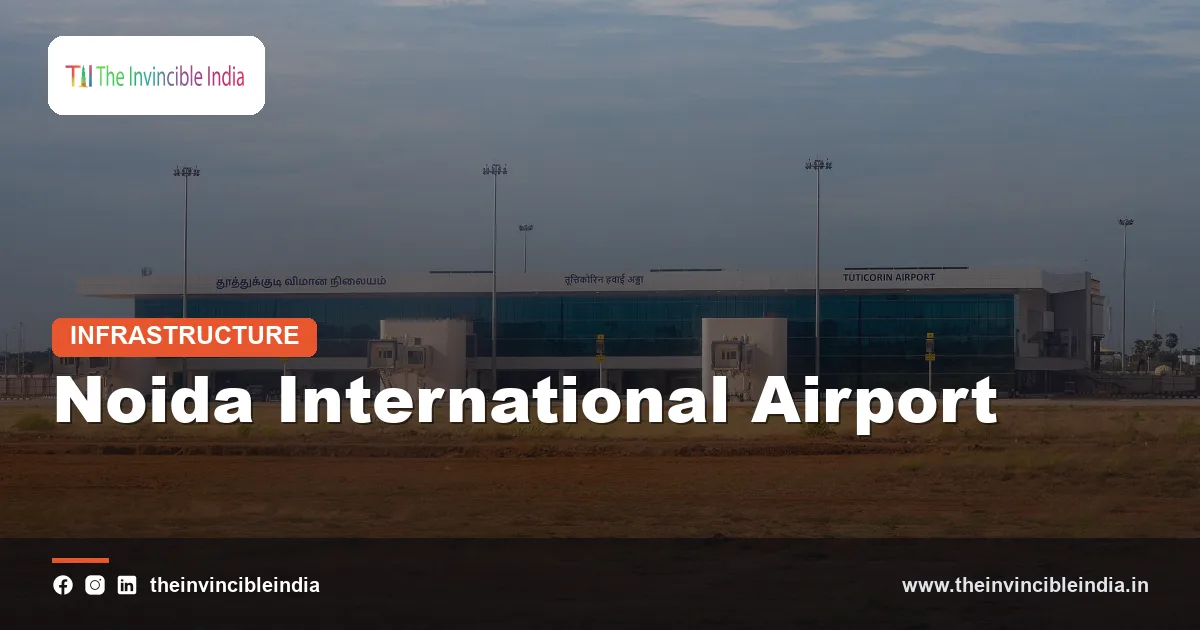
The Noida International Airport is a greenfield airport at Jewar in Gautam Buddha Nagar district, Uttar Pradesh, planned to become one of the largest airports in India and a second major aviation gateway for the Delhi National Capital Region (NCR). It is being developed on a public-private partnership basis, with Yamuna International Airport Private Limited (YIAPL), a subsidiary of Zurich Airport International AG, as the concessionaire, and the Yamuna Expressway Industrial Development Authority (YEIDA) as the nodal agency.
The Noida International Airport, also widely called Jewar Airport, is designed to be built in phases, starting with a single runway and growing to a multi-runway airport that can handle a very large passenger and cargo load. This explainer covers its purpose, ownership, phases, design, cargo and maintenance ambitions, road and rail links, and its expected effect on Delhi’s Indira Gandhi International Airport. Details were last reviewed on 15 October 2026; opening dates and capacities are planning-stage values and may change.
Quick Facts
| Attribute | Detail |
|---|---|
| Official name | Noida International Airport (also called Jewar Airport) |
| Location | Jewar, Gautam Buddha Nagar district, Uttar Pradesh, in the Delhi NCR |
| Type | Greenfield international airport, built in phases under a public-private partnership |
| Concessionaire | Yamuna International Airport Private Limited (YIAPL), wholly owned by Zurich Airport International AG |
| Nodal agency | Yamuna Expressway Industrial Development Authority (YEIDA), Government of Uttar Pradesh |
| Concession period | Multi-decade concession (about 40 years) with provisions for extension |
| Ultimate plan | Multiple runways and a very large capacity, often cited as up to about 70 million passengers a year |
| Foundation stone | Laid in November 2021 |
| Key focus areas | Passenger traffic, air cargo, and maintenance, repair and overhaul (MRO) |
Key Takeaways
- The Noida International Airport is a greenfield airport at Jewar in Gautam Buddha Nagar, Uttar Pradesh, intended to serve the Delhi National Capital Region alongside Delhi’s existing airport.
- Yamuna International Airport Private Limited, a wholly owned subsidiary of Zurich Airport International AG of Switzerland, holds the concession to build and operate the Noida International Airport.
- The Yamuna Expressway Industrial Development Authority (YEIDA) acts as the Uttar Pradesh government’s nodal agency and handles land and approvals for the airport.
- The airport is planned in phases, beginning with one runway and growing to a multi-runway layout with an ultimate capacity often stated as around 70 million passengers a year.
- Air cargo, logistics and maintenance, repair and overhaul (MRO) facilities are central to the plan, not only passenger services.
- The airport is expected to ease pressure on Indira Gandhi International Airport in Delhi and to anchor industrial and real-estate growth along the Yamuna Expressway.
What is the Noida International Airport?
The Noida International Airport is a new international airport being built at Jewar, around 70 kilometres from central Delhi, to serve the National Capital Region. It is a greenfield project, meaning it is built on fresh land rather than by upgrading an existing facility.
The airport is commonly referred to as Jewar Airport, after the town of Jewar in Gautam Buddha Nagar district. Despite the name, the airport is some distance from the city of Noida itself, and the name reflects the district and the regional branding of the Noida area as a major urban and industrial centre.
The project belongs to a wider group of new airports in India built under public-private partnership (PPP) models, including the Navi Mumbai International Airport, and it is intended to give the NCR a second airport capable of handling both domestic and international flights.
Where is the Noida International Airport located?
The Noida International Airport is located at Jewar in Gautam Buddha Nagar district of Uttar Pradesh, on the southern side of the NCR near the Yamuna Expressway. The site lies roughly 70 kilometres from central Delhi and some distance south-east of Noida and Greater Noida.
The location offers large contiguous land that is difficult to find near Delhi, which is why the area was selected for a big airport. The Yamuna Expressway, a six-lane access-controlled highway linking Greater Noida with Agra, runs close to the site and supplies the main road link.
Nearby cities that benefit include Greater Noida, Noida, Ghaziabad, Faridabad, Aligarh, Mathura and Agra, so the catchment extends well beyond Delhi. The airport is also positioned as a gateway for western Uttar Pradesh and for tourist circuits such as Mathura-Vrindavan and Agra.
Who is building and operating the Noida International Airport?
The Noida International Airport is being built and operated by Yamuna International Airport Private Limited (YIAPL), a special-purpose company wholly owned by Zurich Airport International AG, the international arm of the operator of Zurich Airport in Switzerland. YIAPL won the right through a competitive bidding process held by the Uttar Pradesh government in the years around 2020.
The concession is based on a design, build, finance, operate and transfer approach, in which the private concessionaire invests in the airport, operates it for the concession period and pays a fee to the state. The concession term is long, around four decades, with provisions for extension.
The state-side roles are split as follows:
- YEIDA: the nodal agency that acquired land, coordinates approvals and holds the state’s interests.
- Government of Uttar Pradesh: the project sponsor and a promoter of the greater Jewar area development.
- Ministry of Civil Aviation and the Airports Authority of India (AAI): regulatory and technical oversight, including clearances and air traffic services coordination.
- Directorate General of Civil Aviation (DGCA): licensing and safety certification before commercial flights begin.
Construction contractors and design consultants have been appointed for the terminal, airside and associated works, with international architects involved in the terminal concept.
Why is the Noida International Airport needed?
The Noida International Airport is needed because Delhi’s Indira Gandhi International Airport (IGIA) is one of the busiest in India and cannot expand indefinitely, and the NCR’s population and economy keep growing. A second airport spreads traffic, adds resilience and reduces congestion in the air and on the ground.
The main reasons include:
- High demand from the NCR, one of the largest urban agglomerations in the world.
- Airspace constraints around Delhi, which has multiple civil and military flight paths.
- The need for dedicated cargo capacity close to a major consumption and manufacturing region.
- The importance of a backup airport when weather, such as winter fog, disrupts operations at the main airport.
- Regional development, because large airports tend to stimulate industry, tourism and real estate.
Many large metropolitan regions worldwide use a multi-airport system, such as London, New York and Tokyo, and the NCR is following that model.
How big will the Noida International Airport be?
The Noida International Airport is planned to be among India’s largest airports, with an ultimate capacity often stated at around 70 million passengers a year and a layout of up to five runways. The first phase is far smaller, with a single runway and a passenger capacity of around 12 million a year.
The airport is intended to grow in stages as demand increases. The table below summarises the general phasing concept.
| Stage | Typical scope |
|---|---|
| Phase 1 | One runway, one terminal building and initial cargo facilities, with capacity in the order of 12 million passengers a year |
| Later phases | Additional runways and terminals, with capacity increasing in steps as traffic grows |
| Ultimate build-out | Several runways and a very large passenger terminal complex, with capacity of roughly 70 million passengers a year |
The land set aside for the airport and its associated development is large, running into thousands of hectares for the full plan. Capacity figures are planning targets and depend on future demand and approvals.
What is the Zurich Airport International concession?
The Zurich Airport International concession is the agreement under which Zurich Airport International AG, through YIAPL, develops and runs the Noida International Airport. Zurich Airport International AG is a Swiss company that holds operating and investment interests in several airports around the world.
In India, the airport sector has several private operators such as GMR, Adani and Tata-linked groups. The Jewar concession is notable for bringing in a foreign airport operator with a long operating record at European airports, in addition to its planned role as an international gateway.
The concession involves:
- A long operating period, with a fee payable to the state based on passenger numbers.
- Land provided on a lease basis through the state’s nodal agency.
- Regulated airport charges approved by the Airports Economic Regulatory Authority (AERA).
- Handover of the airport to the state or its nominee at the end of the concession term.
Such terms are common in Indian airport PPPs, though each concession has its own specific financial and regulatory provisions.
How will the Noida International Airport handle cargo and MRO?
The Noida International Airport is planned to be a major air cargo and logistics hub and to host maintenance, repair and overhaul (MRO) facilities, in addition to passenger flights. Planners see cargo as an important revenue stream and a way to serve the large manufacturing and e-commerce base of north India.
The cargo plans include:
- Large cargo terminals with temperature-controlled space for pharmaceuticals and perishable goods.
- Dedicated freighter aprons so cargo aircraft do not compete with passenger aircraft for space.
- Integration with road transport to the Yamuna Expressway and the Eastern Peripheral Expressway.
- Industrial and logistics parks near the airport for electronics, medical devices and other manufacturing.
MRO involves servicing, repairing and inspecting aircraft. India has a growing fleet but sends much of its heavy maintenance abroad, so a large MRO cluster at Jewar is intended to bring that work home. The airport plan includes dedicated land for hangars and maintenance operators, and airlines and service providers have shown interest in using it.
How will the Noida International Airport connect to Delhi and the NCR?
The Noida International Airport will connect to Delhi and the NCR mainly through the Yamuna Expressway, the Eastern Peripheral Expressway and planned metro and rapid transit links. Road access is the main mode for early operations, with rail-based services planned to follow.
The key connections include:
- Yamuna Expressway: the main access road, linking Greater Noida, Agra and the Delhi region.
- Eastern Peripheral Expressway: a ring road around Delhi that helps traffic bypass the city centre.
- Delhi-Mumbai Expressway and other corridors: long-distance links connecting the NCR to western and southern India.
- Metro extension: a proposed link from the Noida and Greater Noida metro network toward the airport.
- Regional rapid transit and high-speed rail proposals: longer-term plans to connect the airport with Delhi and other cities.
As with other large airports, travel time from the city centre depends on traffic, and dedicated rail connections are usually seen as essential to the airport’s long-term success.
How will the Noida International Airport relieve Delhi’s airport?
The Noida International Airport will relieve Delhi’s airport by taking a share of domestic and international flights, especially from the eastern and southern parts of the NCR and from western Uttar Pradesh. Passengers living near Noida, Greater Noida, Ghaziabad or further east are likely to find Jewar closer than the main Delhi airport.
Delhi’s Indira Gandhi International Airport has been expanded with additional runways and terminals, yet it still works with limited land and shared airspace. Having two major airports in the region helps airlines add flights without overloading one location, and it gives the system resilience.
The effect on Delhi will depend on how quickly airlines move services to Jewar and on the airport’s connectivity. Airlines usually follow demand, so incentives, slot policies and surface access all play a part.
How will the Noida International Airport shape regional growth?
The Noida International Airport is expected to shape regional growth by attracting manufacturing, logistics, hotels, offices and housing to western Uttar Pradesh. The state government has planned industrial and commercial development around the airport, including parks for electronics, medical devices and film production.
Expected economic benefits include job creation during construction and operation, improved access for exporters and increased tourism to destinations such as Agra and Mathura. Airport-linked development is sometimes described as an aerotropolis, in which businesses and residences cluster around the airport.
The project also raises challenges, such as land acquisition, resettlement of affected villagers, water and power supply, and environmental management. Phased development and careful planning are meant to address these concerns as the region grows.
Bottom Line
The Noida International Airport at Jewar is a large greenfield PPP project that aims to give the Delhi NCR a second major airport, run by a Zurich Airport International AG subsidiary with YEIDA as the state nodal agency. Its phased design, cargo and MRO focus and expressway links make it central to the region’s future, though timelines and capacities should be checked against official updates.
Frequently Asked Questions
What is the Noida International Airport?
The Noida International Airport is a greenfield international airport at Jewar in Gautam Buddha Nagar, Uttar Pradesh. It is planned to be among the largest in India and to serve the Delhi NCR as a second major airport. It is being developed in phases under a public-private partnership.
Who operates the Noida International Airport?
The Noida International Airport is operated by Yamuna International Airport Private Limited (YIAPL), a wholly owned subsidiary of Zurich Airport International AG. The Yamuna Expressway Industrial Development Authority (YEIDA) is the state’s nodal agency. The airport is regulated by the Ministry of Civil Aviation, the DGCA and AERA.
How far is the Noida International Airport from Delhi?
The Noida International Airport is about 70 kilometres from central Delhi by road. The journey depends on traffic and uses the Yamuna Expressway and other connecting roads. Metro and rapid transit links are planned to improve access over time.
How many passengers can the Noida International Airport handle?
The Noida International Airport is planned to handle around 12 million passengers a year in its first phase and about 70 million passengers a year at full build-out. These figures are planning targets. Actual capacity depends on how many phases are built and how fast demand grows.
Will the Noida International Airport handle cargo?
Yes, the Noida International Airport is planned as a major cargo and logistics hub. Its plan includes cargo terminals, freighter aprons and logistics parks. Maintenance, repair and overhaul (MRO) facilities are also planned.
Will the Noida International Airport replace Delhi’s airport?
No, the Noida International Airport will not replace Delhi’s Indira Gandhi International Airport but will operate alongside it. The two airports together are meant to share traffic and improve resilience for the NCR. Airlines will decide how to split their services between them based on demand.
{“@context”:”https://schema.org”,”@graph”:[{“@type”:”FAQPage”,”mainEntity”:[{“@type”:”Question”,”name”:”What is the Noida International Airport?”,”acceptedAnswer”:{“@type”:”Answer”,”text”:”The Noida International Airport is a greenfield international airport at Jewar in Gautam Buddha Nagar, Uttar Pradesh. It is planned to be among the largest in India and to serve the Delhi NCR as a second major airport. It is being developed in phases under a public-private partnership.”}},{“@type”:”Question”,”name”:”Who operates the Noida International Airport?”,”acceptedAnswer”:{“@type”:”Answer”,”text”:”The Noida International Airport is operated by Yamuna International Airport Private Limited (YIAPL), a wholly owned subsidiary of Zurich Airport International AG. The Yamuna Expressway Industrial Development Authority (YEIDA) is the state’s nodal agency. The airport is regulated by the Ministry of Civil Aviation, the DGCA and AERA.”}},{“@type”:”Question”,”name”:”How far is the Noida International Airport from Delhi?”,”acceptedAnswer”:{“@type”:”Answer”,”text”:”The Noida International Airport is about 70 kilometres from central Delhi by road. The journey depends on traffic and uses the Yamuna Expressway and other connecting roads. Metro and rapid transit links are planned to improve access over time.”}},{“@type”:”Question”,”name”:”How many passengers can the Noida International Airport handle?”,”acceptedAnswer”:{“@type”:”Answer”,”text”:”The Noida International Airport is planned to handle around 12 million passengers a year in its first phase and about 70 million passengers a year at full build-out. These figures are planning targets. Actual capacity depends on how many phases are built and how fast demand grows.”}},{“@type”:”Question”,”name”:”Will the Noida International Airport handle cargo?”,”acceptedAnswer”:{“@type”:”Answer”,”text”:”Yes, the Noida International Airport is planned as a major cargo and logistics hub. Its plan includes cargo terminals, freighter aprons and logistics parks. Maintenance, repair and overhaul (MRO) facilities are also planned.”}},{“@type”:”Question”,”name”:”Will the Noida International Airport replace Delhi’s airport?”,”acceptedAnswer”:{“@type”:”Answer”,”text”:”No, the Noida International Airport will not replace Delhi’s Indira Gandhi International Airport but will operate alongside it. The two airports together are meant to share traffic and improve resilience for the NCR. Airlines will decide how to split their services between them based on demand.”}}]}]}


