

The Kullu shawl, also called the Kullu pattu or the Kulluvi shawl, is a handwoven woollen wrap made in the Kullu valley of Himachal Pradesh, in the western Himalaya. The valley lies along the River Beas and has long been known as the Valley of the Gods, and its weavers have turned the wool of mountain sheep into warm clothing for generations. A Kullu shawl is easy to recognise by its plain or softly checked body and its broad, brightly coloured geometric borders. Readers who already know the soft luxury of the pashmina shawl will find the Kullu shawl a sturdier and more everyday relative, woven for mountain life rather than for the royal court. This guide explains the place, the wool, the loom, the patterns, the weavers and the care of this much-loved craft of Himachal Pradesh.
Quick answer: The Kullu shawl is a handwoven woollen shawl from the Kullu valley of Himachal Pradesh, India, known for its geometric border patterns, bright colour bands and warm, dense weave. It is traditionally made from sheep wool, and sometimes finer fibres, on a handloom by local weavers. The shawl is part of everyday hill dress and a celebrated craft of the region.
Key Takeaways
- The Kullu shawl is a handloom woollen shawl made in the Kullu valley of Himachal Pradesh.
- Its most recognisable feature is a broad border of geometric patterns in contrasting colours against a plain or checked body.
- The shawl is traditionally woven from the wool of mountain sheep and is valued for warmth, durability and a soft hand.
- Kullu weaving belongs to the wider woollen tradition of the western Himalaya, which also includes the shawls of Kinnaur and Lahaul.
- The shawl is worn in daily life, at festivals and as a gift, and it is closely linked with the Kullu cap and local dress.
- Buyers should look for the handwoven texture, wool content and a clear source to tell an authentic piece from a machine-made copy.
The sections below describe the place, the wool, the loom, the patterns and the people behind the Kullu shawl.
Quick Facts
| Detail | Information |
|---|---|
| Craft | Handwoven woollen shawl |
| Place of origin | Kullu valley, Himachal Pradesh |
| Also known as | Kullu pattu, Kulluvi shawl |
| Main material | Sheep wool, with finer fibres in some pieces |
| Technique | Handloom weaving with woven border patterns |
| Signature feature | Bold geometric borders in contrasting colours |
| Related crafts | Kullu cap, Kinnauri shawl, Lahaul woollens |
| Significance | A warm, durable symbol of Himachal hill culture |
What Is the Kullu Shawl?
The Kullu shawl is a handwoven woollen wrap that originates from the Kullu valley of Himachal Pradesh. It is made as a rectangular length of cloth that can be draped over the shoulders, wrapped around the body or used as a light blanket. The body of the shawl is often plain, softly checked or striped, while the ends carry bands of woven pattern in strong colours. Weavers have long made these shawls for their own families and for neighbours, and the craft later reached visitors and markets far beyond the hills. A Kullu shawl is valued because it is warm in cold mountain air, tough enough for daily use and attractive enough for festivals. The shawl is therefore both a practical garment and a recognised emblem of the valley.
Where Is the Kullu Valley and Why Does It Shape the Shawl?
The Kullu valley is a river valley in the Kullu district of Himachal Pradesh, running along the River Beas between high Himalayan ranges. Towns such as Kullu, Bhuntar and Manali sit along its length, and many weaving villages lie on the slopes above. The climate is cool for much of the year and bitterly cold in winter, which explains why warm woollen clothing became so important. Sheep grazing on high mountain pastures supplied the raw material, and the valley was also a route of trade with neighbouring hill regions. Weavers therefore had wool, demand and travelling customers close at hand. The geography of Kullu is thus the foundation of its shawl craft, shaping the fibre, the design and the market.
What Is the History of Kullu Shawl Weaving?
The history of Kullu shawl weaving is the history of hill people turning local wool into protective cloth. Woollen weaving has been practised across the western Himalaya for a very long time, and each valley developed its own habits of pattern and colour. In Kullu the craft grew within village households, where weaving was done alongside farming and herding. Over time the shawls gained a reputation among travellers and pilgrims who visited the valley, and demand from outside the hills encouraged weavers to refine their work. Later, cooperative societies and government schemes helped organise weavers and bring their shawls to wider markets. Exact beginnings are difficult to date, but the continuity is clear, since the craft has passed from one generation to the next as a living household skill.
What Wool Is Used to Make a Kullu Shawl?
A Kullu shawl is made mainly from sheep wool, which is cleaned, carded and spun into yarn before weaving. The sheep that graze on the high pastures of Himachal Pradesh grow a thick fleece suited to cold weather, and this wool gives the shawl its warmth and body. Some pieces use finer fibres, such as angora or wool blended with softer yarn, to produce a lighter and smoother feel. Pashmina yarn is also used in a few costly pieces, although such shawls then belong to a more luxurious category. The grade of wool affects softness, weight and price, so two shawls that look alike may feel very different in the hand. Good wool is therefore the first sign of a good Kullu shawl, and a careful weaver chooses it with attention.
How Is a Kullu Shawl Woven?
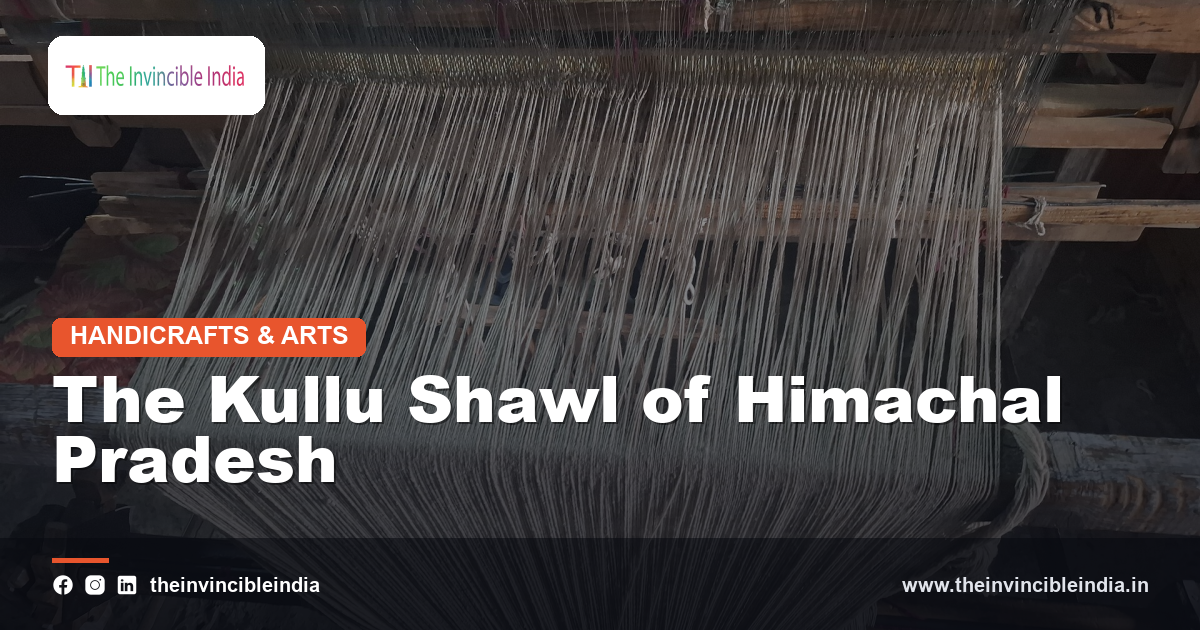
A Kullu shawl is woven by hand on a loom, with the weaver passing the weft thread through the warp threads again and again to build the cloth. The yarn is first spun, often dyed, and then arranged on the loom as a long set of parallel warp threads. The weaver works the shuttle and the treadles with steady rhythm, beating each pass of thread firmly into place. The border patterns are made by introducing extra coloured threads in the weft, so that the design grows as part of the cloth and is not printed on top of it. Weaving a single shawl may take many hours of patient work, and the pace depends on the complexity of the border. The handloom method gives the shawl its distinctive texture and its individual character.
What Patterns Define a Kullu Shawl?
The patterns of a Kullu shawl are mostly geometric, built from lines, diamonds, steps, zigzags and repeating bands. These motifs are usually concentrated in the borders at the two ends, where they form a broad decorative strip against the quieter body of the cloth. Some shawls also carry narrow pattern lines along the sides or a checked field in the centre. The designs are woven rather than embroidered, so their sharp, angular outlines come from the structure of the weave itself. Weavers combine the same basic shapes in countless ways, and a trained eye can often tell villages and families apart by their favourite arrangements. The pattern language of the Kullu shawl is therefore simple in its parts but rich in variety, and it is the main reason the shawl is recognised at a glance.
Which Colours and Dyes Are Used?
Kullu shawls are known for strong, cheerful colours set against calmer backgrounds. Traditional palettes include deep reds, greens, blues, yellows and oranges, placed in the border bands to catch the eye, while the body may be natural cream, grey, brown or black from the undyed wool. In the past many dyes came from plants and other natural sources, and some makers still use them for special pieces. Today most shawls use modern dyes that are bright and colourfast, which helps the shawl keep its colour through years of wear. The art lies in balancing the contrast, so that the border stands out without overwhelming the body. A well chosen colour scheme is a mark of the weaver’s skill, and it gives each Kullu shawl a lively personality of its own.
What Types of Kullu Shawl Exist?
Kullu weavers make several kinds of shawl and related woollen goods for different uses. The everyday pattu is a simple, sturdy wrap for the shoulders, and a heavier double-width wrap, often called a dohru, gives extra warmth in winter. Lighter stoles and mufflers suit visitors and city wear, and finer wool or blended yarns are used for softer pieces. Some shawls have plain bodies with decorated ends, while others have checks or stripes across the whole cloth. Woollen blankets, scarves and caps come from the same weaving tradition and share its border designs. The range of types shows how the craft adapts to different needs and budgets, and it explains why the Kullu shawl appears in homes, shops and festivals alike across Himachal Pradesh.
How Is the Kullu Shawl Linked to the Kullu Cap and Local Dress?
The Kullu shawl is closely linked with the Kullu cap and the traditional dress of the valley. The Kullu cap is a round, brimmed woollen cap with a decorated band, and it is worn with pride by many men of the region. The woven band uses patterns that echo the shawl borders, so cap and shawl look like members of one family. Women of the valley traditionally wear a wrapped woollen garment with a shawl or a decorated head covering, and the shawl often provides the main touch of colour. Together these items form a recognisable local costume that appears at weddings, fairs and festivals. The shawl is therefore not an isolated product but a central part of a wider hill dress tradition.
Who Are the Weavers of Kullu?
The weavers of Kullu are mostly local families, including many women, who practise weaving in their homes and in small workshops. For many households the loom is a second source of income beside farming, and skills pass from parents to children through practice rather than formal schooling. In several villages weavers have formed cooperative societies, which collect shawls, arrange fair prices and help with marketing. Government schemes and handloom bodies have also supported training, design development and exhibitions. Weaving is demanding work that requires patience, a good eye for colour and strong hands. The people behind the Kullu shawl deserve as much recognition as the cloth itself, because their daily labour keeps a hill tradition alive and gives communities a dignified livelihood close to home.
What Role Does the Shawl Play in Festivals and Daily Life?
The Kullu shawl plays a role in both ordinary days and special occasions in Himachal Pradesh. In daily life it shields people from cold winds, serves as a blanket and is carried by shepherds and farmers on the hills. At festivals, the shawl is worn as part of festive dress, and the valley is especially famous for the Kullu Dussehra, a large gathering in which local deities are carried in procession. Visitors at such events often notice the colourful shawls and caps that fill the crowds. The shawl is also a common gift, given to guests and relatives as a mark of respect and warm wishes. In this way the Kullu shawl travels through life as a practical garment and as a gesture of hospitality.
How Does the Kullu Shawl Differ from Pashmina and Kinnauri Shawls?
The Kullu shawl differs from the pashmina in fibre and from the Kinnauri shawl in pattern and local style. Pashmina is made from the very fine undercoat of certain mountain goats and is prized for extreme softness, while the Kullu shawl is usually made from sheep wool and is firmer and more rugged. The Kinnauri shawl comes from the Kinnaur region of the same state and is known for its own border designs and colour traditions. Kullu borders are typically bold and geometric, and the cloth is often plainer in the body. These regional styles share a Himalayan weaving heritage, but each carries a recognisable identity. Knowing the differences helps buyers appreciate every tradition on its own terms, and avoids treating all hill shawls as one product.
How Can You Identify an Authentic Kullu Shawl?
An authentic Kullu shawl can be identified by its handwoven texture, its wool feel and a reliable source. A genuine piece shows slight irregularities in the weave and in the border, which come from the human hand and not from a machine. The wool should feel warm and natural, and the pattern should be woven into the cloth, so that the design appears on both faces and not as a flat print. Buying from cooperatives, handloom emporiums and trusted dealers helps ensure honest information about fibre and origin. Labels or tags that name the producer and the handloom method add confidence. A thoughtful buyer asks questions about the wool and the weaving, because informed buying protects both the customer and the weavers whose work is copied by cheaper imitations.
How Should a Kullu Shawl Be Cared For?
A Kullu shawl should be cared for gently, with minimal washing, soft handling and dry storage. Woollen cloth is best cleaned by careful dry cleaning or a light hand wash in cool water with a mild detergent, followed by drying flat in the shade. Hot water, wringing and direct sun can shrink the wool and fade the colours. When the shawl is not in use, it should be folded and kept in a breathable cotton cloth with natural repellents such as dried neem leaves to keep moths away. Airing the shawl from time to time helps to keep it fresh. With such attention a good shawl can last for many years, and its colours and softness will stay pleasant, which makes careful maintenance a simple way of honouring the craft.
What Challenges Does Kullu Shawl Weaving Face and How Is It Supported?
Kullu shawl weaving faces competition from cheaper machine-made copies, rising costs and the shifting interests of younger people. Imitations that borrow the look of the borders can be sold at low prices, which makes it hard for hand weavers to earn fair rewards. At the same time, many young people prefer other careers, and the loom risks losing apprentices. Support comes through handloom cooperatives, government training, exhibitions and efforts to protect the identity of the Kullu shawl as a regional product. Fresh designs, such as lighter stoles and modern colour palettes, help the craft reach new buyers without abandoning its roots. The future of the shawl depends on fair markets and informed customers, since these allow tradition and livelihood to continue together.
The Kullu Shawl Today
The Kullu shawl today remains a cherished product of Himachal Pradesh and one of the best known woollen crafts of the western Himalaya. It is woven by hand, worn with pride in the valley and bought by visitors who wish to take home a piece of the mountains. Its bold geometric borders, warm wool and honest craftsmanship give it a character that machines cannot easily match. For the traveller it is a useful and beautiful keepsake, and for the weaver it is a livelihood and a source of pride. The shawl also shows how a regional craft can adapt to changing tastes while keeping its heart intact. The Kullu shawl endures as a living thread that links the valley’s past with its future.
Sources & Further Reading
- Ministry of Textiles, Government of India, Office of the Development Commissioner (Handlooms) (handlooms.nic.in).
- Ministry of Culture, Government of India (indiaculture.gov.in).
Frequently Asked Questions
What is a Kullu shawl?
A Kullu shawl is a handwoven woollen shawl from the Kullu valley of Himachal Pradesh, known for its geometric borders and warm wool. It is woven on a handloom by local weavers. The shawl is part of everyday hill dress and a famous regional craft.
What is the Kullu shawl made of?
A Kullu shawl is made mainly of sheep wool, and some pieces use finer fibres such as angora or blended yarns. The wool is spun into yarn and woven by hand. Costlier pieces may include softer fibres for a lighter feel.
What makes a Kullu shawl different from other shawls?
A Kullu shawl is different because of its bold geometric border patterns woven in contrasting colours against a plainer body. It is firmer and more rugged than a pashmina, which is made from a finer fibre. Its style is also distinct from the shawls of neighbouring Kinnaur.
Where does the Kullu shawl come from?
The Kullu shawl comes from the Kullu valley in Himachal Pradesh, a river valley along the Beas in the western Himalaya. Weaving takes place in villages and small workshops across the valley. Towns such as Kullu, Bhuntar and Manali are well known markets for the shawls.
How can I tell if a Kullu shawl is handwoven?
A handwoven Kullu shawl shows small natural irregularities in the weave and has patterns that are woven into the cloth, appearing on both sides. A machine-made copy usually looks perfectly uniform or carries a printed design. Buying from cooperatives and trusted handloom outlets also helps confirm authenticity.
How do you wash a Kullu shawl?
A Kullu shawl is best dry cleaned or washed gently by hand in cool water with a mild detergent. It should be dried flat in the shade and never wrung or hung in strong sun. Folding it with natural moth repellents keeps it in good condition during storage.


