

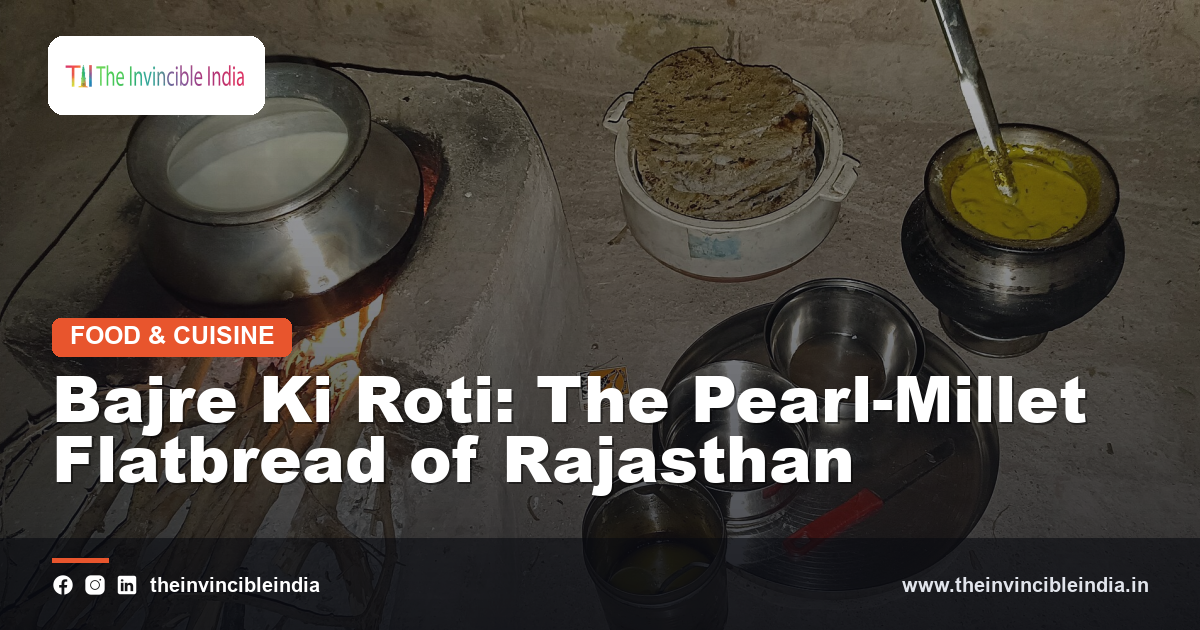
Bajre ki roti, also called bajra roti, bajri no rotlo in Gujarati or bajra bhakri in Marathi, is the traditional pearl-millet flatbread of Rajasthan and a daily staple of rural kitchens across the arid north-west of India. It is made from bajra flour and water, shaped by hand without a rolling pin and cooked on a hot griddle, and it is eaten with ghee, jaggery, chutneys and spiced vegetable or lentil dishes. The bread belongs to a farming culture that grows hardy grains in dry land. Among the many breads described in the Indian thali tradition, it is one of the most rustic and the most closely tied to the soil. This guide explains what the roti is, how it is made and how it is eaten.
Quick answer: Bajre ki roti is a traditional unleavened flatbread of Rajasthan made from pearl millet (bajra) flour and water and cooked on a griddle. It is gluten-free, hearty and especially popular in winter, when it is eaten with ghee, jaggery, garlic chutney, kadhi or dal. Similar breads are made in Gujarat, Haryana, Punjab, Maharashtra and Uttar Pradesh.
Key Takeaways
- Bajre ki roti is a Rajasthani flatbread made from pearl millet flour, known in Hindi as bajra, and it contains no wheat.
- The dough is shaped by patting with wet hands rather than rolling, because millet flour has no gluten to make it elastic.
- It is cooked on a hot griddle called a tawa and is often finished directly over embers or a flame so that it puffs slightly.
- Ghee, white butter, jaggery, garlic chutney, kadhi and buttermilk are the classic accompaniments.
- Pearl millet thrives in dry, hot regions, which is why bajra became a staple grain of Rajasthan.
- Related millet breads include jowar bhakri of Maharashtra and bajri no rotlo of Gujarat.
The sections below describe the bread, the grain it comes from, the way it is shaped and cooked, and the foods it is traditionally eaten with.
Quick Facts
| Detail | Information |
|---|---|
| Dish type | Traditional unleavened millet flatbread |
| Region | Rajasthan, with versions across north-western and western India |
| Main ingredient | Pearl millet (bajra) flour and water |
| Shaping method | Patted by hand without a rolling pin |
| Cooking style | Cooked on a tawa and often finished over a flame or embers |
| Usually served with | Ghee, jaggery, garlic chutney, kadhi and dal |
What is bajre ki roti?
Bajre ki roti is a flatbread made from pearl millet flour, known in Hindi as bajra, and it is one of the most characteristic breads of Rajasthan. The dough is mixed from flour, water and a little salt, shaped into thick rounds by hand and cooked on a griddle until it develops brown speckles. The bread has an earthy, slightly nutty flavour and a dense, grainy texture that is quite different from a soft wheat roti. It is traditionally eaten fresh and hot, topped with a generous spoonful of ghee. The roti is vegetarian, free of gluten and simple in its ingredients, which makes it both a village staple and a point of pride in Rajasthani cooking. It is best understood as the everyday bread of a dry land, plain in its making and rich in its associations.
Where does bajre ki roti come from?
Bajre ki roti comes from the arid regions of Rajasthan, where pearl millet has long been a principal crop and food grain. Millets were cultivated in the Indian subcontinent for a very long time, and bajra became especially important in areas with sandy soil and scanty rainfall where wheat and rice grow poorly. The bread therefore developed as a practical response to the land rather than as a court or restaurant creation. Similar rotis are made in neighbouring Gujarat, Haryana, Punjab and parts of Uttar Pradesh and Maharashtra, each with its own name and small differences. Exact dates for the origin of the bread are not documented, so it is best described as an ancient farming tradition that has continued in rural households up to the present. Its story is closely tied to that of the grain itself.
What is pearl millet, or bajra?
Pearl millet, called bajra in Hindi, is a hardy cereal grain that grows well in hot, dry conditions and poor soils. It is one of the most widely grown millets in India, and Rajasthan is among the leading states for its cultivation. The plant tolerates heat and limited water better than many other cereals, which is why it became the dependable grain of desert farming communities. The small, round grains are ground into flour that is greyish in colour and has a distinctive earthy flavour. Besides flatbreads, bajra is used for porridges, khichdi and fermented drinks in different regions. Because it needs few inputs and survives difficult seasons, pearl millet has long served as a food-security crop for rural families. Its resilience explains much of the importance of bajre ki roti in Rajasthani life.
Why does Rajasthan eat so much bajra?
Rajasthan eats so much bajra because the state’s dry climate suits millet far better than wheat or rice. Large parts of Rajasthan receive little rain, and bajra can be sown in the monsoon and harvested even when water is scarce. Over generations, farming families built their diets around what the land could reliably produce, and pearl millet, along with lentils, dried vegetables and dairy products, became the foundation of the traditional diet. Bajra also stores well, which matters in a region where fresh produce is seasonal. The grain became part of local identity, appearing in everyday meals, in festival offerings and in village hospitality. In this way, the popularity of the roti reflects the practical wisdom of an agricultural society adapting to its environment, and it remains a clear example of cuisine shaped by geography.
How is the dough for bajre ki roti prepared?
The dough for bajre ki roti is prepared by mixing bajra flour with warm or hot water and kneading it until it holds together as a smooth, pliable mass. Because pearl millet has no gluten, the dough does not stretch like wheat dough, and it must be handled gently and kneaded well for a good result. Many cooks use warm water to help the flour bind, and some add a pinch of salt, a little ghee or a spoonful of wheat flour for easier handling, though the traditional version is simply flour and water. The dough is covered briefly and then divided into balls. Careful kneading is considered the key skill, since poorly kneaded dough cracks at the edges. The simplicity of the preparation demonstrates how much depends on technique rather than on a long ingredient list.
How is bajre ki roti shaped without a rolling pin?
Bajre ki roti is shaped by patting the dough with the hands, because the gluten-free dough tears easily under a rolling pin. A ball of dough is flattened between the palms or pressed on a flat surface, often with wet fingers, and then patted outward into a thick circle. In many Rajasthani homes the dough is shaped on a wooden board or a plate dusted with dry flour, and the roti is then lifted carefully onto the griddle. The patting action is called thapna in some regions, and skilled cooks produce evenly round rotis with a steady rhythm. Dipping the hands in water keeps the dough from sticking and helps smooth the surface. The technique takes practice, and it is a good example of hand skills passed from mother to daughter in village kitchens.
How is bajre ki roti cooked?
Bajre ki roti is cooked on a hot griddle called a tawa, usually over a wood, dung-cake or gas fire. The patted roti is placed on the hot surface and cooked on one side, turned over, and then cooked on the other until brown spots appear. In many kitchens it is then lifted from the tawa and held briefly over an open flame or embers, where it may puff slightly and take on a smoky aroma. Because the roti is thick, it cooks more slowly than wheat bread and needs steady, moderate heat to cook through without burning. Once ready, it is brushed generously with ghee. A well-cooked bajra roti has a lightly crisp surface, a soft crumb and a toasty fragrance that is difficult to reproduce with other methods, which is why traditional fire-cooked versions are especially prized.
What is bajre ki roti served with?
Bajre ki roti is served with ghee, jaggery, white butter, garlic chutney, kadhi, dal and a variety of vegetable dishes. The simplest and perhaps best-loved pairing is hot roti crumbled with ghee and jaggery, which makes a rich, sweet and filling meal. A savoury meal may include ker sangri, a traditional desert dish of dried berries and beans, or a lentil preparation such as panchmel dal. Spicy red garlic chutney, raw onion and green chillies provide sharp contrast, while thick buttermilk or kadhi cools the palate. In some homes, the roti is eaten with a bowl of curd or fresh white butter. The strong, earthy flavour of the bread suits bold, spiced accompaniments, and these pairings have been refined over generations. Together they show how a plain bread becomes a complete and satisfying meal.
Why is bajre ki roti a winter food?
Bajre ki roti is considered a winter food because pearl millet is traditionally believed to generate warmth in the body. In Rajasthan and neighbouring states, bajra is eaten far more often in the cold months, when the nights are chilly and hearty meals are welcome. The roti is paired with ghee, jaggery and other warming foods such as sesame, which are also associated with winter eating in Indian households. The belief about warmth belongs to traditional food wisdom and Ayurvedic ideas rather than to a laboratory finding, so it is best described as a cultural understanding. In summer, many families turn to wheat or lighter grains instead. Whatever the explanation, the seasonal pattern of eating bajra is deeply established and gives the roti a place in the annual rhythm of Rajasthani food.
What is the nutritional value of bajre ki roti?
Bajre ki roti is valued as a nourishing food because pearl millet is a source of dietary fibre, protein, iron and several minerals. The bread is gluten-free, which makes it a useful choice for people who avoid wheat, and its fibre content makes it filling and slow to digest. Millets in general are often described as nutrient-dense grains, and public health discussions in India have highlighted them as a way to diversify diets. The nutritional profile varies with the variety of grain and the way the roti is made, and the addition of ghee and jaggery adds energy as well as flavour. Anyone with a medical condition or special dietary needs should seek advice from a qualified professional rather than rely on general statements. Broadly, however, bajra is regarded as a wholesome traditional grain.
How does bajre ki roti compare with other millet breads?
Bajre ki roti is one of several regional millet breads of India, and each differs slightly in grain, shape and name. Jowar bhakri, made from sorghum, is the staple bread of much of Maharashtra and Karnataka and is generally thinner and paler. Bajri no rotlo in Gujarat is very similar to the Rajasthani roti and is often eaten with ghee, jaggery and a spiced garlic mixture. Ragi mudde and ragi roti, from finger millet, belong to Karnataka and parts of the south. Makki ki roti, made from maize, is the winter partner of sarson ka saag in Punjab. Compared with these, bajre ki roti is typically thick, earthy and slightly sweet in taste. The family resemblance among these breads shows how widely millets and other coarse grains shaped the Indian table.
How is it eaten in a Rajasthani village meal?
In a Rajasthani village meal, bajre ki roti is usually the centrepiece, eaten hot and torn by hand into pieces to scoop up accompanying dishes. A common rural meal might include roti, a bowl of kadhi or dal, a dry vegetable, a spoonful of red chilli and garlic chutney, an onion and a large glass of buttermilk. Farmers often carry roti to the fields, wrapped in cloth, because it stays edible for hours without refrigeration. The meal is eaten with the right hand, and offering a second hot roti to a guest is an important gesture of hospitality. Families often eat together, seated on the floor. The custom shows how food, work and hospitality are bound together in village life, and how a humble flatbread carries the values of generosity and community.
What dishes are made from bajra besides roti?
Bajra is used for several dishes besides roti, and they show the versatility of the grain in Rajasthani and Gujarati cooking. Bajra khichdi combines millet with lentils, often cooked with ghee and eaten with kadhi or curd. Bajra porridge is made by cooking the flour or crushed grain with water or buttermilk, and it is a common breakfast in some villages. Bajra churma, made by crumbling roti with ghee and jaggery, is a sweet dish eaten at home and offered at festivals. Bajra khichu and dhokla-like preparations also appear in western India, and bajra flour is used in laddus, crisp thepla and savoury pancakes. Because it is both filling and inexpensive, the grain supports a wide repertoire of preparations. This range helps explain why bajra has stayed central to the food of the region.
Why are millets in the news today?
Millets are in the news today because they are promoted as sustainable, climate-resilient and nutritious grains. The United Nations declared 2023 the International Year of Millets at the initiative of India, and the Indian government has encouraged millets under the name shree anna. The campaign has drawn new attention to traditional foods such as bajre ki roti, which were once thought of as food of the rural poor. Restaurants, packaged food brands and urban households have begun to include bajra in menus, snacks and baked goods. The renewed interest connects old farming knowledge with modern concerns about health and environment. It also raises the profile of the farmers who have kept these crops alive, and it offers bajre ki roti a wider audience than at any time in recent memory.
Can bajre ki roti be made at home easily?
Bajre ki roti can be made at home with practice, and the main challenge is handling the gluten-free dough. Fresh bajra flour, warm water and a gentle hand are the essentials, and beginners often find it easier to pat the dough between two sheets of greased paper or on a lightly floured plate. The dough should be soft enough not to crack, and the tawa should be hot but not smoking. Many people add a little wheat flour or boiled potato at first to make shaping simpler, although purists prefer the plain version. Serving the roti with ghee and jaggery is the most forgiving way to enjoy a first attempt. With a few trials, most cooks learn to judge the dough, and the reward is a bread that tastes far better than any packaged substitute.
Bajre Ki Roti Today
Bajre ki roti today remains a staple of rural Rajasthan while also gaining a place on urban tables and restaurant menus. Village households continue to make it daily, particularly in winter, and tourists in Rajasthan often meet it as part of a traditional thali served with ker sangri, kadhi and sweet churma. At the same time, interest in millets has encouraged chefs and home cooks across India to experiment with bajra in new forms. The bread has survived because it suits the land, nourishes the body and carries a deep sense of place. Its flavour is simple but distinctive, and it recalls the farming life of the desert regions. As a food of resilience and tradition, bajre ki roti continues to represent the best of Rajasthan’s rustic culinary heritage.
Sources & Further Reading
- Ministry of Culture, Government of India (indiaculture.gov.in).
- Ministry of Agriculture and Farmers Welfare, Government of India (agriwelfare.gov.in).
Frequently Asked Questions
What is bajre ki roti?
Bajre ki roti is a traditional Rajasthani flatbread made from pearl millet flour and water and cooked on a griddle. It is gluten-free, earthy in taste and usually served hot with ghee and jaggery.
Is bajre ki roti the same as bajra roti?
Yes, bajre ki roti and bajra roti are two names for the same pearl-millet flatbread. Bajre is the grammatical form used in the phrase, while bajra is the name of the grain.
Is bajre ki roti gluten-free?
Yes, bajre ki roti is naturally gluten-free because pearl millet does not contain wheat gluten. Home cooks who add wheat flour to ease shaping, however, make a version that is no longer gluten-free.
Why is bajre ki roti shaped by hand?
It is shaped by hand because millet dough lacks gluten and tears under a rolling pin. Patting with wet fingers lets the dough spread gently without cracking.
What do you eat with bajre ki roti?
Bajre ki roti is eaten with ghee, jaggery, white butter, garlic chutney, kadhi, dal and vegetable dishes such as ker sangri. Buttermilk and raw onion are common side items.
Why is bajre ki roti popular in winter?
It is popular in winter because pearl millet is traditionally believed to be warming for the body. It is also hearty and is paired with ghee and jaggery, which are favoured in the cold months.


