

The Kadwaha temples, also written Kadwaya or Kadvaha, are a group of ruined medieval stone temples near the village of Kadwaha in the Ashoknagar district of Madhya Pradesh, India. The monuments stand in the Bundelkhand and Malwa borderland of central India, a region of rocky hills, scattered villages and a long record of temple building. They are generally attributed to the Kachchhapaghata dynasty, a ruling family of the early medieval age that is also remembered for temples at other sites in the region. Although time and neglect have damaged the buildings, they preserve doorways, pillars and sculptures of real quality. They form one more chapter in the story of Indian temple architecture, and a lesser-known one that repays careful attention. This article explains where the temples are, who built them and what they show.
Quick answer: The Kadwaha temples are a group of ruined medieval Hindu temples near Kadwaha village in Ashoknagar district, Madhya Pradesh, India. They are generally attributed to the Kachchhapaghata dynasty and dated to the early medieval period, roughly the tenth to twelfth centuries, though exact dating is debated. The temples are built of local stone in the northern Nagara tradition and are valued for their carved doorways and sculptures.
Key Takeaways
- The Kadwaha temples are a group of ruined medieval stone temples in Ashoknagar district, Madhya Pradesh.
- They are generally attributed to the Kachchhapaghata dynasty, a ruling family of the early medieval age.
- The temples follow the northern Nagara tradition, with a sanctum, a hall and a curved tower in the larger shrines.
- Their surviving carvings include figures of gods and goddesses, ornamental doorframes and decorated pillars.
- The group lies in a region that also contains Chanderi and Tumain, both known for their own heritage.
- The temples are in a ruined state and are protected as monuments of historical importance.
The sections below describe the setting, patrons, architecture and conservation of the Kadwaha temples.
Quick Facts
| Detail | Information |
|---|---|
| Location | Kadwaha, Ashoknagar district, Madhya Pradesh |
| Region | Borderland of Malwa and Bundelkhand, central India |
| Type | Group of ruined medieval Hindu temples |
| Dynasty | Kachchhapaghata, generally attributed |
| Era | Early medieval period; dating debated |
| Architectural style | Nagara, northern temple tradition |
| Material | Local stone with carved details |
| Condition | Ruined, with surviving sculpture and doorframes |
What Are the Kadwaha Temples?
The Kadwaha temples are a cluster of ruined stone temples of the early medieval period that stand near a village in central India. They include shrines of different sizes, some with their sanctums and parts of their towers still visible and others reduced to platforms and scattered fragments. The group is typical of the temple building carried out by regional dynasties in the centuries after the Gupta age, when new kingdoms rose across northern and central India. The temples are not as famous as those of Khajuraho, but they are valuable for the evidence they provide about regional variation in style. Many carved stones have survived, and they speak of the patronage and skill that created the monuments. The Kadwaha temples are therefore a modest but real treasure of Indian heritage.
Where Are the Kadwaha Temples Located?
The Kadwaha temples are located near the village of Kadwaha in the Ashoknagar district of Madhya Pradesh. The district lies in the north-western part of the state, in the transitional zone between the Malwa plateau and the hill country of Bundelkhand. Chanderi, famous for its fort and its fine woven cloth, and Tumain, known for its old temples and sculpture, lie in the same district. The countryside is a mixture of low hills, farmland and small villages, and the temples stand in a quiet rural setting. Because the area is off the main tourist routes, visitors usually find the site peaceful. The location places the temples in a region with a dense and ancient pattern of settlement and worship.
Who Built the Kadwaha Temples?
The Kadwaha temples are generally attributed to the Kachchhapaghata dynasty, a ruling family of the early medieval period. The Kachchhapaghatas held power in parts of central India, including the area around Gwalior, and are associated with temple building at several sites in the region. Attributions of individual monuments are based chiefly on style, location and the record of the dynasty rather than on explicit statements at each temple. Exact patrons and building dates are therefore matters on which scholars speak with caution. It is safest to describe the temples as belonging to the early medieval period and to the artistic world of the Kachchhapaghata kingdoms. The builders of Kadwaha are thus best understood as a regional dynasty working within a shared northern tradition.
Who Were the Kachchhapaghatas?
The Kachchhapaghatas were a ruling dynasty of early medieval central and northern India, remembered for their rule in the Gwalior region and for the monuments they patronised. Their name is connected in tradition with a tortoise, since kachchhapa means a tortoise, though the origin of the name is explained in different ways. The dynasty is commonly described as having several branches that ruled from different centres, and its history is known from inscriptions and from surviving buildings. Its members stood in a political world of larger powers such as the Pratiharas and the Chandellas, and they built temples in a recognisable regional style. The Kachchhapaghatas are therefore important as makers of temples in the heart of the country.
What Is the Architectural Style of the Temples?
The temples of Kadwaha belong to the northern Nagara tradition of Indian temple architecture. In the larger shrines the plan includes a sanctum for the deity, a pillared hall for worshippers and a porch at the entrance, while the sanctum was crowned by a curved tower called a shikhara. The temples stand on raised platforms, and their walls are divided into projecting and recessed parts that create bands of light and shade. Decoration is concentrated on the doorways, pillars and wall niches. The stone is local and was cut with skill, allowing the carver to produce both bold forms and delicate details. The style of Kadwaha shows how a common northern tradition could be varied by a regional workshop.
What Do the Doorways and Pillars Show?
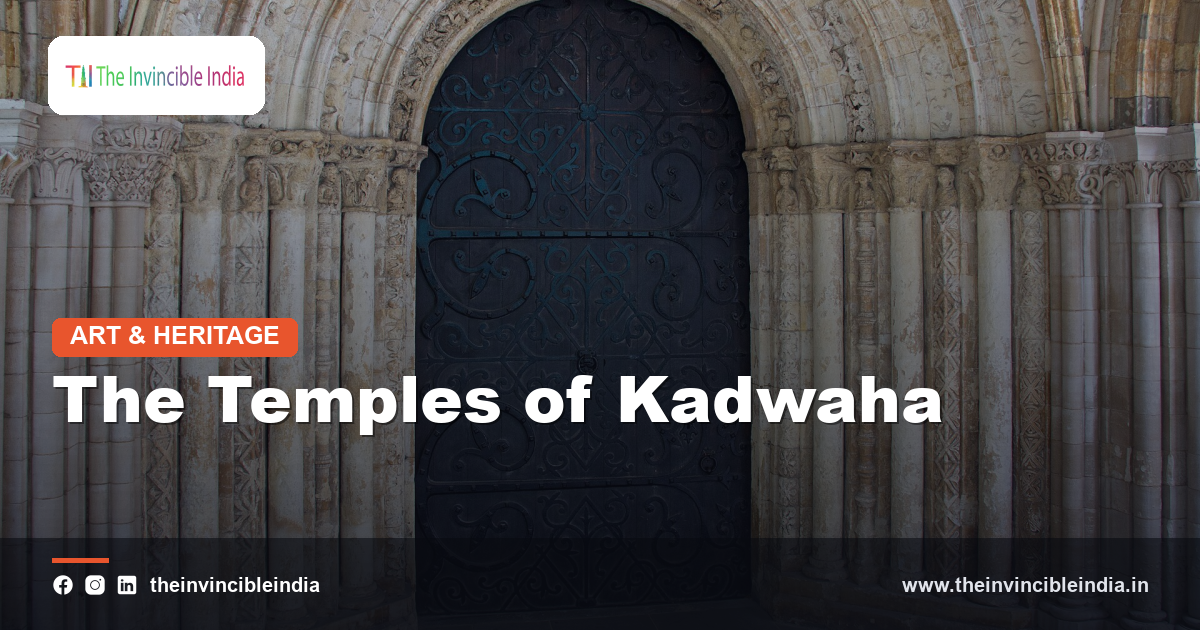
The doorways and pillars at Kadwaha are among the best-preserved and most expressive features of the temples. Temple doorframes of this period were framed by several carved bands, often bearing floral scrolls, couples, river goddesses and small figures of divinities, and the surviving frames at Kadwaha follow this scheme. The pillars carry carved shafts and decorated capitals that supported the halls and porches. The carving is crisp and confident, and its details can still be read clearly in many places. Doorways were especially important because they marked the passage from the outer world into the sacred interior. The carved doors and pillars of Kadwaha therefore carry much of the artistic interest of the site.
What Sculptures Survive at Kadwaha?
The sculptures that survive at Kadwaha include images of Hindu gods and goddesses, guardian figures and decorative reliefs on the walls and fragments of the temples. Shiva, Vishnu and the goddess are the deities most commonly honoured in temples of this age, and their forms appear in niches and on doorframes. Celestial figures, musicians and animals appear in the decorative bands, adding life and movement to the stone. Some pieces remain at the temples, while others have been moved to museums, a practice meant to protect them from damage. The sculptures show the confident handling of form typical of early medieval central India. These carvings give the temples much of their lasting value and their power to teach.
What Religious Traditions Are Linked with the Temples?
The Kadwaha temples belong to the Hindu tradition and were used for the worship of deities such as Shiva and Vishnu. In the early medieval period temple worship was central to religious life, and rulers expressed devotion and authority by building and endowing temples. Priests, musicians, dancers and craftsmen were supported by temple gifts, which made the temple an economic and cultural centre as well as a place of prayer. Although the Kadwaha temples are now largely in ruins and are no longer a major centre of worship, local villagers still regard the site with respect. The religious life of the temples is therefore preserved in memory and in the carved images that remain.
How Do the Kadwaha Temples Compare with Khajuraho?
The Kadwaha temples are smaller and less intact than the temples of Khajuraho, but they belong to a related world of northern temple art. Khajuraho was built by the Chandella dynasty at the height of its power and is celebrated for its large temples and rich sculpture. Kadwaha shows the same general principles of plan and decoration on a modest scale and under a different dynasty. The comparison helps scholars see how widely the Nagara style was shared and how local workshops gave it their own character. It also reminds us that the history of temple art includes many smaller centres alongside the famous ones. Kadwaha therefore adds depth and variety to the picture of central Indian temple building.
How Do the Temples Relate to Gwalior and Other Kachchhapaghata Sites?
The Kadwaha temples can be understood alongside other monuments connected with the Kachchhapaghata dynasty, which are found in the wider Gwalior region of central India. Temples such as the Sas-Bahu temples of Gwalior fort and the shrines of Sihonia in the Morena district are associated with the same ruling family and show comparable features. Seen together, these monuments suggest a distinct regional style marked by well-proportioned plans and carefully executed carving. Kadwaha extends the geography of that tradition southward into Ashoknagar district. Scholars use such comparisons to trace the movement of ideas and craftsmen across the region. The Kadwaha temples thus belong to a network of monuments that together illuminate a whole dynasty.
What Is Nearby: Chanderi and Tumain?
The Ashoknagar district contains several other heritage places that are often visited together with Kadwaha. Chanderi is a historic town with a fort, old gateways, tombs and a well-known tradition of hand-woven textiles, and it reflects the many periods of the region’s past. Tumain, also written Tuman, is known for its ancient temples and sculptures and for its connection with early historical rulers. Both places add important chapters to the story of the district, from Gupta-age remains to medieval and later monuments. A visit to Kadwaha is easily combined with these sites in a single journey. The neighbouring sites show that Kadwaha lies in one of the richer heritage districts of central India.
How Do Visitors Experience the Temples?
Visitors to Kadwaha find a quiet and unhurried site with ruined temples set in rural surroundings. There are few facilities, so it helps to plan the visit in advance and to carry water and basic supplies. The cooler months from October to March are the most comfortable, and morning or late afternoon light brings out the carved details. Visitors are asked to avoid climbing on fragile walls or removing stones, which are part of the monument. Local villagers can often point out the main structures and share stories about the site. A visit to Kadwaha offers an intimate encounter with an unfrequented piece of India’s temple heritage.
What Conservation Challenges Do the Temples Face?
The Kadwaha temples face challenges typical of ruined and rural heritage sites, including weathering, plant growth, structural collapse and the loss of carved fragments. Many stones lie scattered, and some have been moved or reused over the centuries. The temples are protected under heritage law and attended by the relevant archaeological authorities, who carry out clearance, repair and documentation. Recording of loose sculptures and architectural pieces is especially valuable, since it may allow future scholars to reconstruct parts of the buildings. Local awareness and visitor care also contribute to protection. The conservation of the Kadwaha temples is therefore a shared responsibility of the state, scholars and the surrounding community.
Why Are the Kadwaha Temples Important?
The Kadwaha temples are important because they preserve evidence of regional temple art that is otherwise poorly documented. They show how a ruling dynasty expressed itself in stone and how the Nagara style was adapted outside the major centres. The carved doorways, pillars and figures are valuable for the study of iconography, ornament and workshop practice. The temples also illustrate the density of religious building in early medieval central India, where even small settlements might contain several shrines. For students of Indian art and history, the site is a reminder of how much remains to be studied beyond the famous monuments. The Kadwaha temples are thus a significant, if modest, part of the national heritage.
The Temples of Kadwaha Today
The temples of Kadwaha today stand as protected ruins that attract few but dedicated visitors, including scholars, photographers and heritage enthusiasts. Their carved stones continue to tell of the skill of the craftsmen and the devotion of the patrons who raised them. Conservation work and growing public interest in lesser-known monuments are helping to secure the future of the site. The temples invite visitors to look beyond the best-known names of Indian heritage and to value the many smaller places that make up the whole. In their quiet rural setting they remain a source of learning and reflection. The Kadwaha temples endure as a reminder that Indian heritage is rich in places that deserve to be better known.
Sources & Further Reading
- Archaeological Survey of India (asi.nic.in).
- Ministry of Culture, Government of India (indiaculture.gov.in).
Frequently Asked Questions
Where are the Kadwaha temples located?
The Kadwaha temples are located near Kadwaha village in Ashoknagar district of Madhya Pradesh, India. The district lies between the Malwa plateau and Bundelkhand and also contains Chanderi and Tumain.
Who built the Kadwaha temples?
The Kadwaha temples are generally attributed to the Kachchhapaghata dynasty of the early medieval period. The attribution rests mainly on style and regional context, so exact patrons and dates are discussed with caution.
Which architectural style are the Kadwaha temples built in?
The Kadwaha temples are built in the northern Nagara style, with a sanctum, a pillared hall and, in larger shrines, a curved tower. Their decoration is concentrated on doorways, pillars and wall niches.
Are the Kadwaha temples still in use for worship?
The Kadwaha temples are largely ruined and are no longer a major centre of worship, though local villagers still regard the site with respect. They are protected as monuments of historical importance.
What other heritage sites are near Kadwaha?
Chanderi and Tumain, both in Ashoknagar district, are the best-known nearby heritage sites. Chanderi is known for its fort and hand-woven textiles, and Tumain for its old temples and sculpture.
What is the best time to visit the Kadwaha temples?
The cooler months from October to March are generally the best time to visit the Kadwaha temples. Morning and late afternoon give comfortable weather and good light for seeing the carvings.


