

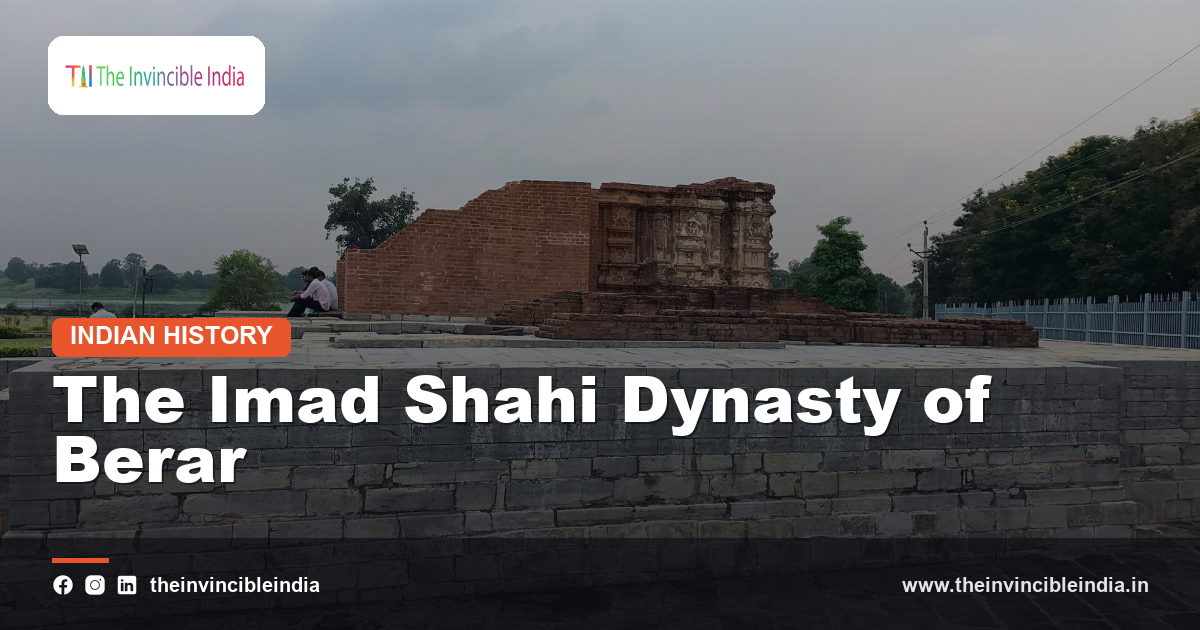
The Imad Shahi dynasty, also called the Sultanate of Berar or the Imad Shahis of Elichpur, was one of the five successor states that emerged when the Bahmani Sultanate broke apart in the late fifteenth century. Founded by Fathullah Imad-ul-Mulk, a governor of the Berar province, it ruled the region of Vidarbha from its capital at Elichpur until the Nizam Shahi sultanate of Ahmednagar absorbed it in the sixteenth century. Berar was the smallest and shortest-lived of the five, yet it left forts, tombs and a record of Deccan diplomacy. It later came under the Mughal Empire. This guide gives a general account and flags uncertain chronology.
Quick answer: The Imad Shahi dynasty was a Muslim ruling house that governed Berar, a region of the northern Deccan corresponding to Vidarbha, as an independent sultanate from the late fifteenth century until Ahmednagar annexed it in the sixteenth. Founded by Fathullah Imad-ul-Mulk, it was the smallest of the five Deccan sultanates that arose from the Bahmani Sultanate, with its capital at Elichpur and its forts at Gawilghur and Narnala.
Key Takeaways
- The Imad Shahi dynasty, also called the Sultanate of Berar, was one of five Deccan states that arose from the Bahmani Sultanate.
- Fathullah Imad-ul-Mulk, a Bahmani governor of Berar, founded the dynasty in the late fifteenth century.
- Elichpur, now Achalpur, was the Imad Shahi capital in the Vidarbha region of Maharashtra.
- Gawilghur and Narnala were the principal hill forts guarding Berar’s northern frontier.
- Berar was the smallest and shortest-lived of the five Deccan sultanates.
- Ahmednagar annexed Berar in the 1570s, after which the region passed to the Mughals.
Quick Facts
| Detail | Information |
|---|---|
| Name | Imad Shahi dynasty (Sultanate of Berar, Imad Shahis of Elichpur) |
| Region | Berar, historical Vidarbha, in present eastern Maharashtra |
| Founder | Fathullah Imad-ul-Mulk, a Bahmani governor of Berar |
| Capital | Elichpur, today Achalpur |
| Main forts | Gawilghur and Narnala in the Satpura hills |
| End of the dynasty | Absorbed by the Nizam Shahi sultanate of Ahmednagar in the sixteenth century |
What was the Imad Shahi dynasty of Berar?
The Imad Shahi dynasty was a Muslim ruling house that governed the province of Berar in the Deccan as an independent sultanate from the late fifteenth century until the sixteenth. It was one of the five states that arose from the fragmentation of the Bahmani Sultanate, alongside Ahmednagar, Bijapur, Golconda and Bidar. Berar occupied the northern part of the old Bahmani domain, in what is now eastern Maharashtra, and its capital was Elichpur. Compared with its neighbours, it was small and had fewer resources, and it lasted for a shorter time. Even so, its rulers built forts and mosques, took part in the diplomatic and military life of the Deccan, and left a record that shows how the region was divided after Bahmani power ended.
Where was Berar and why does it matter?
Berar was a historical region in the north-east of the Deccan plateau, corresponding roughly to the Vidarbha country around the Purna and Wardha rivers in present-day Maharashtra. It matters because it lay between the Deccan sultanates to the south and the powers of Malwa and Khandesh to the north. The black soil of the region made it rich in cotton and grain, giving it wealth beyond its political weight. The Satpura hills on its northern edge offered natural defences, and the forts of Gawilghur and Narnala guarded the approaches. Berar thus combined agricultural strength with strategic position. Because of this combination, it attracted the attention of every neighbouring power in turn, from the Bahmanis to the Nizam Shahis and later the Mughals.
How did the Bahmani Sultanate break up?
The Bahmani Sultanate broke up in the late fifteenth century as provincial governors grew powerful and rivalries at court weakened the central rulers. Founded in the fourteenth century, the Bahmani state had long been the main Muslim power in the Deccan, governing through provincial units called tarafs. Rivalry between older nobles and newer arrivals, often described as the conflict between Deccanis and foreigners, undermined unity. As the kings lost control, governors of the provinces began to rule independently. Five successor states emerged: Berar, Ahmednagar, Bijapur, Golconda and Bidar. The exact order and dates of independence differ in different sources, so historians treat the process as a gradual unwinding rather than a single event, and the Imad Shahi state was among the earliest of the new kingdoms.
Who was Fathullah Imad-ul-Mulk?
Fathullah Imad-ul-Mulk was the founder of the Imad Shahi dynasty, a nobleman who rose to the governorship of Berar under the Bahmani rulers and then declared independence. According to later chronicles, he was of Hindu origin from the southern part of the peninsula, was taken in his youth and converted to Islam, and rose through service at the Bahmani court. These details come from traditional accounts and are not fully confirmed. He held the title Imad-ul-Mulk, which means pillar of the realm, and the dynasty took its name from it. As the Bahmani state declined, he acted as an independent sovereign in the later fifteenth century. His rise shows how ability and royal favour could carry a person from modest beginnings to the head of a state.
Why was Elichpur the capital?
Elichpur, now called Achalpur, was the capital because it was already the main administrative centre of Berar under the Bahmanis and stood in a fertile, central position. The city lay near the Satpura hills and the passes to the north, with forts within easy reach for refuge. It had an established population of merchants, officials and religious figures, along with markets and local shrines. The Imad Shahi rulers built or restored mosques and tombs there and developed it as a royal seat. Sufi dargahs also made the city an important place of pilgrimage. Elichpur retained its importance after the dynasty ended, serving the Mughals and later the Nizam of Hyderabad as a key town of the Berar region.
Who were the rulers after Fathullah?
The rulers after Fathullah included Alauddin Imad Shah, Darya Imad Shah and Burhan Imad Shah, who governed in turn across the late fifteenth and sixteenth centuries. Alauddin continued the work of consolidating the state. Darya, who reigned for a long period, is generally regarded as the most significant of his successors, and during his time Berar faced pressure from stronger neighbours. Burhan, his young son, became ruler under the guidance of a powerful minister named Tufal Khan. The exact reign lengths vary across sources, and chronology is not settled, so historians offer only approximate sequences. The line thus numbered only a handful of rulers, which reflects both the brief life of the sultanate and the uncertain, crowded politics of the Deccan.
How did Berar deal with Ahmednagar, Bijapur and Golconda?
Berar dealt with Ahmednagar, Bijapur and Golconda through a shifting mixture of alliance, rivalry and sometimes open conflict. As the smallest of the five states, it was often in a weaker position and tended to seek partners against its most threatening neighbour. At times it sided with Bijapur or Ahmednagar, and at times it was caught between them. The Deccan sultanates also formed temporary coalitions, such as the alliance against Vijayanagara in the 1560s, in which Ahmednagar, Bijapur, Golconda and Bidar joined. Berar is generally not counted among that group. These relations show that the Deccan was a complex, multi-state system rather than a simple north-south divide, and Berar’s difficulty lay in having fewer resources than any of its partners or rivals.
What role did Gawilghur and Narnala play?
Gawilghur and Narnala were the principal hill forts of Berar, guarding its northern frontier in the Satpura range. Narnala is an older and larger complex, with multiple gates, tanks and ruined buildings spread across a high plateau, and it is closely linked with the Berar sultans. Gawilghur is a strong fortress near Chikhaldara, with a steep escarpment and walls that follow the cliffs. Both served as refuges, treasuries and military posts. They were later used by successive powers, including the Mughals and the Marathas. In the early nineteenth century Gawilghur was the scene of a British assault during the Second Anglo-Maratha War. The forts demonstrate the defensive logic of the Berar frontier and survive as important monuments.
How was the Imad Shahi state governed?
The Imad Shahi state was governed along the lines of the older Bahmani system, with a sultan at the centre and provincial officers managing districts and forts. Revenue from land, particularly the rich cotton and grain fields of the Berar plain, supported the court and army. Fort commanders held key positions, and nobles received assignments of revenue in return for military service. Persian served as the language of the court, while local languages such as Marathi were used in everyday dealings. The court included officers of diverse backgrounds, from Deccani Muslims to Hindu administrators and accountants. This structure kept a small state functioning efficiently. It illustrates how the Deccan sultanates built on shared administrative traditions even as they competed with one another.
What was the role of culture and religion in Berar?
Culture and religion in Berar blended Islamic court traditions with the older Hindu and local culture of Vidarbha. Sufi shrines, such as those at Elichpur, attracted devotees of various communities, while temples and Hindu festivals continued in the countryside. Persian was the language of courtly culture, and Marathi and other local languages thrived in popular life. Architecture combined Deccani mosque design with local building methods and materials. The region’s history before the sultanate, including the ancient Vidarbha kingdom known from classical literature, formed part of the cultural background. The mixing of these traditions is a hallmark of Deccan culture generally and makes Berar a modest but instructive example of how different communities lived together under a Persianate court.
Why did the Imad Shahi dynasty come to an end?
The Imad Shahi dynasty came to an end because Berar was too small to resist the growing power of Ahmednagar and because of troubles within the ruling circle. After the death of Darya Imad Shah, the minister Tufal Khan took control of the government and eventually seized the throne, setting aside the young heir. Murtaza Nizam Shah of Ahmednagar then used the disorder as a reason to invade, and his forces annexed Berar in the 1570s. Tufal Khan and the former royal family met unhappy fates, according to later chronicles, though details vary. The annexation shows how internal divisions could invite external conquest, and the end of Berar’s independence left Ahmednagar the sole master of the northern Deccan until Mughal pressure intensified.
What happened to Berar after the sultanate?
After the sultanate Berar passed first to Ahmednagar, then to the Mughals, who made it a province, and later to the rulers of the Deccan who succeeded them. The Mughals gained control around the turn of the seventeenth century as they pushed south, and Berar became one of their Deccan provinces. In the eighteenth century the Marathas of Nagpur and the Nizam of Hyderabad contended for the region. Eventually, most of Berar fell under the Nizam, and in the early twentieth century it was administered together with the Central Provinces. After independence, it became part of the new state of Maharashtra, in the Vidarbha region. The area’s fertile cotton lands continued to define its economy throughout these political changes.
How do the Imad Shahis compare with other Deccan sultanates?
The Imad Shahis compare with other Deccan sultanates as the smallest and least enduring of the group, with fewer monuments and a shorter record. Bijapur, Golconda and Ahmednagar are known for large cities, grand mosques, tombs, art and literature, while Berar is known mainly for its forts and the town of Elichpur. All five shared roots in the Bahmani system and a mix of Persian and local culture. Differences lay in size, wealth and political success. The Imad Shahis lacked the resources to match their neighbours, and their fall was therefore earlier. A comparison nonetheless shows that Berar belonged fully to the Deccan political world and followed the same patterns of rise, rivalry and absorption seen across the region.
What can visitors see of Imad Shahi heritage?
Visitors can see Imad Shahi heritage mainly at Elichpur and in the forts of Narnala and Gawilghur. Elichpur has mosques, tombs and shrines of the Deccan period, along with older and later monuments. Narnala presents extensive ruins on a high plateau, including gateways, water tanks and fortified walls. Gawilghur offers dramatic views over the Satpura slopes and the plains below, and its ramparts remain well defined. Both forts are protected, and the surrounding hills, including the Melghat area, add scenic interest. Travellers interested in medieval history will find the sites quiet and little visited. The monuments serve as accessible reminders of the Berar sultanate and offer a tangible connection to the largely forgotten story of the Imad Shahis.
The Imad Shahi Dynasty of Berar Today
The Imad Shahi dynasty of Berar today is remembered chiefly through its forts, its capital at Elichpur and its place within the larger story of the Deccan sultanates. Scholars continue to examine chronicles, inscriptions and coins to improve the chronology and to learn more about its rulers. Local historians and heritage groups in Vidarbha help keep the monuments in view. The dynasty’s brief history carries a useful lesson, which is that the political map of medieval India was crowded with regional states, each with its own character. Berar’s story, though short, belongs to that larger pattern, and it adds to our understanding of how the Deccan developed after the Bahmani Sultanate and before the Mughal advance.
Sources & Further Reading
- Archaeological Survey of India (asi.nic.in).
- Ministry of Culture, Government of India (indiaculture.gov.in).
Frequently Asked Questions
Who were the Imad Shahis of Berar?
The Imad Shahis were a Muslim ruling dynasty that governed Berar in the Deccan from the late fifteenth century until Ahmednagar annexed the region in the sixteenth. They were one of the five successor states of the Bahmani Sultanate.
Who founded the Imad Shahi dynasty?
The dynasty was founded by Fathullah Imad-ul-Mulk, a governor of Berar under the Bahmani rulers who declared independence as Bahmani power declined. Traditional accounts give details of his origins, but these are not fully confirmed.
What was the capital of the Imad Shahi sultanate?
The capital was Elichpur, which is now called Achalpur, in the Amravati region of Maharashtra. It had been the main administrative centre of Berar under the Bahmanis and remained an important town afterwards.
Which were the five Deccan sultanates?
The five Deccan sultanates were Ahmednagar, Bijapur, Golconda, Bidar and Berar. All emerged from the breakup of the Bahmani Sultanate in the late fifteenth century, and Berar was the smallest and shortest-lived.
How did the Imad Shahi dynasty end?
The dynasty ended when Ahmednagar annexed Berar in the 1570s after the minister Tufal Khan had seized power from the young ruler. Historians describe the end in general terms because chronicles differ on details.
What are Gawilghur and Narnala?
Gawilghur and Narnala are hill forts in the Satpura range on the northern edge of Berar. They guarded the region’s frontier under the Imad Shahis and were used later by the Mughals and Marathas.


