

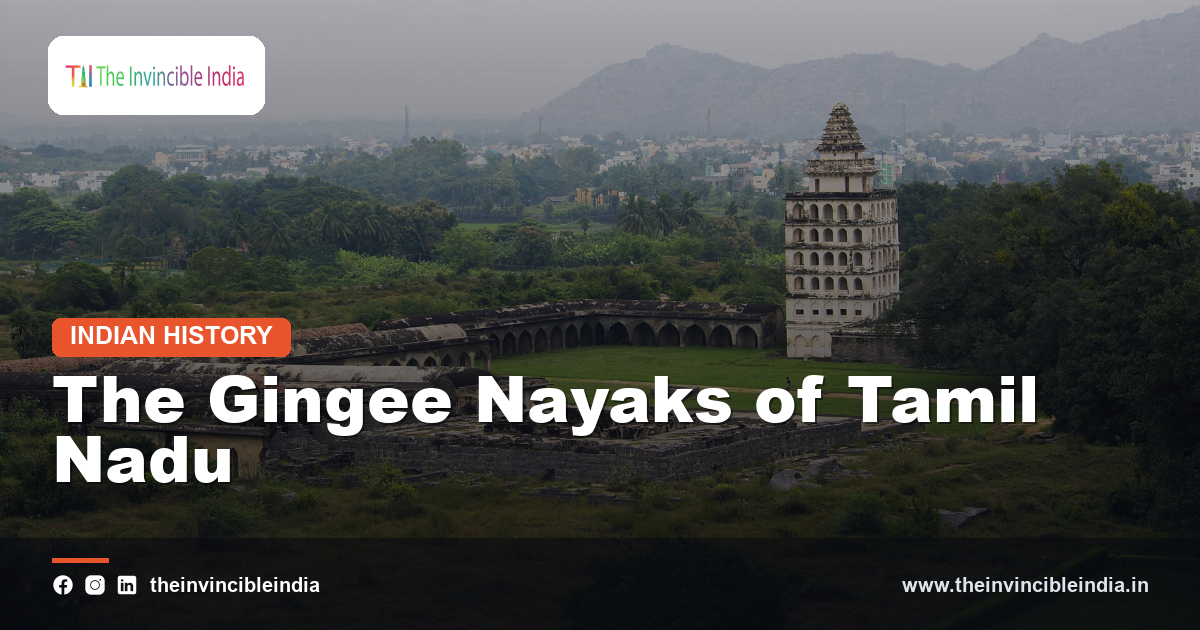
The Gingee Nayaks, also called the Nayaks of Senji or the Nayakas of Gingee, were a line of governors who ruled the northern Tamil country from the great hill fortress of Gingee, also spelled Senji or Chenji. They began as deputies of the Vijayanagara Empire, which appointed military commanders called nayakas to hold its southern provinces, and they gradually built a regional state of their own. Their rule overlapped with that of the better-known Nayaks of Madurai and Thanjavur. This guide describes the Gingee line in general terms, links its story to the wider Vijayanagara Empire, and notes where the dates of rulers are uncertain.
Quick answer: The Gingee Nayaks were a line of military governors who ruled the northern Tamil country from Gingee Fort, also spelled Senji, first as deputies of the Vijayanagara Empire and later as nearly independent chiefs in the sixteenth and seventeenth centuries. They are counted with the Madurai and Thanjavur Nayaks, and their fortress later passed to Bijapur, the Marathas, the Mughals and the Nawabs of Arcot.
Key Takeaways
- The Gingee Nayaks, also called the Nayaks of Senji, were Vijayanagara governors who became regional rulers in northern Tamil Nadu.
- Their stronghold, Gingee Fort, stands across the three hills of Rajagiri, Krishnagiri and Chandrayandurg.
- The Gingee Nayaks are counted with the Madurai and Thanjavur Nayaks as one of three main Nayak states of the Tamil country.
- After the Nayaks, Gingee was held by Bijapur forces, the Marathas, the Mughals and the Nawabs of Arcot.
- Gingee Fort is part of the Maratha Military Landscape of India on the UNESCO World Heritage List.
- The dates of individual Nayak rulers are approximate, and historians continue to refine the sequence.
Quick Facts
| Detail | Information |
|---|---|
| Name | Gingee Nayaks (Nayaks of Senji or Chenji) |
| Region | Northern Tamil Nadu, around Gingee in Villupuram district |
| Origin | Military governors appointed by the Vijayanagara Empire |
| Era | Mainly the sixteenth and seventeenth centuries, in general terms |
| Stronghold | Gingee Fort, on the Rajagiri, Krishnagiri and Chandrayandurg hills |
| Later rulers | Bijapur forces, Marathas, Mughals and the Nawabs of Arcot |
Who were the Gingee Nayaks?
The Gingee Nayaks were a family of military governors who ruled the region around Gingee in northern Tamil Nadu, first as agents of the Vijayanagara Empire and later as increasingly independent chiefs. The word nayaka means leader or commander, and Vijayanagara used such officers to control distant provinces, collect revenue and keep armies ready for the emperor. The Gingee line is counted with the three principal Nayak states of the Tamil country, alongside Madurai and Thanjavur. Their power rested on the fort of Gingee and on the fertile lands of the Palar and Ponnaiyar plains. Details of individual rulers survive in inscriptions and later chronicles, but many dates are approximate. The dynasty is best seen as a bridge between the imperial order of Vijayanagara and the more fragmented politics of the seventeenth century.
What does the word Nayak mean in South Indian history?
The word Nayak, also written Nayaka, means a leader or captain, and in South Indian history it came to denote a provincial military governor. Under Vijayanagara the nayaka system worked through land assignments called amaram. A commander received the right to collect revenue from a territory and in return had to maintain a fixed number of soldiers and send tribute to the court. Over time many nayakas turned this arrangement into hereditary rule. The system was flexible and allowed the empire to govern a vast area without a rigid bureaucracy, but it also created chiefs with their own armies and loyalties. When imperial power weakened, the nayakas were in a position to act independently, which is exactly how the Gingee, Madurai and Thanjavur lines became regional kingdoms.
How did the Gingee Nayaks begin?
The Gingee Nayaks began when the Vijayanagara rulers placed a trusted commander in charge of the Gingee region in the sixteenth century. Tradition names Krishnappa Nayaka as the first of the line, though the exact timing of his appointment is uncertain and sources differ. The posting made sense strategically, because Gingee commanded the routes between the Tamil plains and the Carnatic coast and guarded the empire’s southern flank. The new governor reorganised the fort, repaired the defences and settled administrators in the district. His successors inherited both the office and the fortress, and the family steadily gained local standing. Historians usually treat the early decades as a period of loyal service followed by growing autonomy, a pattern that repeated across the nayaka territories whenever the capital at Vijayanagara faced pressure elsewhere.
Why was Gingee Fort so important?
Gingee Fort was important because it is one of the strongest hill fortresses in South India, built across three rocky peaks that dominate the plain. The three hills are called Rajagiri, Krishnagiri and Chandrayandurg, and they are linked by massive walls, gateways and ramparts that enclose a large area. Natural cliffs form much of the defence, making assault difficult and siege long. Whoever held Gingee controlled a wide region of the Tamil country and the road towards the coast. Earlier rulers had fortified the place, and tradition connects its origins to local chiefs before Vijayanagara times, although the details are debated. The Nayaks strengthened and extended it into the form that visitors see today, which is why the fort and the dynasty are so closely identified.
What can be seen inside Gingee Fort?
Inside Gingee Fort a visitor can see a citadel on Rajagiri, a royal enclosure at its foot and a series of civil buildings that show the Nayak style of design. Notable structures include the Kalyana Mahal, a tall tower with a pyramidal roof and cells around a courtyard, and large granaries used to store grain for sieges. Temples such as the Venkataramana shrine and an Anjaneya shrine stand within the walls, and there are tanks, wells and watchtowers. A mosque and other later buildings reflect the fort’s long use under different rulers. The mix of fortification, palace, temple and store shows that Gingee worked as both a military post and a small city. Its layout is a useful guide to how Nayak rulers planned defence and daily life together.
How did the Gingee Nayaks govern?
The Gingee Nayaks governed through a mix of military command, revenue assignment and local partnership with temples and village leaders. The ruler stood at the top and appointed commanders and officials who managed districts and collected taxes. Land revenue formed the backbone of the economy, supplemented by trade duties on goods passing along regional routes. The Nayaks kept armies of infantry and cavalry and held forts across their territory. At the village level, assemblies and temple trusts continued to manage irrigation tanks and local disputes, as they had for centuries. This arrangement kept the state practical and rooted in local society. Inscriptions record gifts and orders that show how the rulers used patronage to keep loyalty, which is a familiar feature of the broader Vijayanagara administrative tradition.
What happened after the fall of Vijayanagara power?
After the fall of centralised Vijayanagara power in the later sixteenth century, the Gingee Nayaks became effectively independent rulers of their territory. The defeat of Vijayanagara at the battle of Talikota in the 1560s weakened the capital, and the court later relocated to the south, first to Penukonda and then to Chandragiri. The nayakas of the Tamil country, including Gingee, still professed loyalty to the emperor in name but acted with growing freedom. Rivalries among them, particularly with Thanjavur and Madurai, became more frequent. The empire’s final decades are complicated and the sources are not always consistent. What can be said is that Gingee emerged as a regional power that outlived the central authority that created it, at least for a time.
Why did Bijapur and others attack Gingee?
Bijapur and other powers attacked Gingee because the fortress and the rich plains around it were a prize for any ambitious ruler. The Adil Shahi sultanate of Bijapur, one of the Deccan sultanates, expanded into the Carnatic in the seventeenth century and its forces eventually captured Gingee from the Nayaks. The Deccan sultanates and the Nayak states were not simple opponents, because shifting alliances sometimes linked a sultanate with one Nayak against another. The campaigns were driven by control of land revenue, trade routes and strategic forts rather than by any single motive. The fall of the Gingee Nayaks to Bijapur ended their line as rulers, although the fortress itself kept its military value under each new master that followed.
How did the Marathas take Gingee?
The Marathas took Gingee in the late seventeenth century when Shivaji led a southern expedition into the Carnatic and captured the fortress from its Bijapur-appointed garrison. Gingee became a key southern base for the Maratha state, and its three-hill defences were improved. The fort’s importance grew when later Maratha leaders used it as a refuge during the long struggle with the Mughal Empire. Because Gingee lay far from the Maratha homeland on the western ghats, holding it extended Maratha influence deep into the south. Historians often note that the fort’s rugged position made it a strong asset for a mobile power that could not rely on a single capital. This phase added a new layer to the fort’s history alongside the earlier Nayak period.
What was the Mughal siege of Gingee?
The Mughal siege of Gingee was a long campaign at the close of the seventeenth century in which imperial forces blockaded the fortress for years. After the Marathas lost their homeland strongholds, the Maratha ruler Rajaram took refuge at Gingee and used it as his headquarters. Mughal commanders surrounded the three hills and tried to cut supplies, while defenders sallied out and the garrison endured shortages. The siege is often seen as an example of how a strong hill fortress could tie down a large army. Eventually the Mughals captured the fort, though exact details of the final surrender vary between accounts. The episode left Gingee as a Mughal possession and brought the fortress into the history of the larger struggle between the Mughals and Marathas.
Who was Raja Desingh of Gingee?
Raja Desingh, also called Tej Singh or Desing Raja, is a figure of popular tradition, remembered as a young Bundela Rajput ruler of Gingee in the early eighteenth century. After the Mughals took the fort, it was placed under a governor, and Desingh is said to have ruled the region on behalf of the empire. According to widely told accounts he refused to pay tribute to the Nawab of Arcot and died in battle against him while still young. Folk songs and ballads in Tamil and other languages keep his memory alive. Historians caution that much of the story comes from later retelling, and details such as his age and the cause of the conflict are debated. His legend nevertheless shows how deeply Gingee shaped regional memory.
How did the Nawabs of Arcot and the British use Gingee?
The Nawabs of Arcot, who governed the Carnatic as officers of the Mughal Empire and later as semi-independent rulers, took control of Gingee in the early eighteenth century. They kept it as a military post, but its importance declined as warfare shifted to the coast and to fortified towns. Later the fort changed hands among the French, the British and Mysore forces during the wars of the eighteenth century. By then, new artillery and different tactics had reduced the value of hill forts. The British eventually held the region and the fortress fell into disuse and decay. The British called Gingee the Troy of the East, a remark that reflects its reputation for strength. Its long record of conquest shows how a single fortress could matter to many different powers.
What was the cultural legacy of the Gingee Nayaks?
The cultural legacy of the Gingee Nayaks lies in their architecture, their temple patronage and their role in sustaining Tamil and Telugu court traditions. Nayak rulers across the Tamil country used Telugu as a court language alongside Tamil, and Gingee shared in this bilingual culture. Their buildings, such as the Kalyana Mahal and the temples within the fort, follow the Vijayanagara and Nayak style of tall towers, pillared halls and detailed carving. The region also holds older Pallava cave temples and Jain sites, which reflect the long layers of religion and art around Gingee. The Nayaks added to this heritage rather than replacing it, and their patronage supported festivals, craftsmen and learning. Their era contributed to the distinctive character of northern Tamil Nadu that visitors still recognise.
How do the Gingee Nayaks compare with the Madurai and Thanjavur Nayaks?
The Gingee Nayaks compare with the Madurai and Thanjavur Nayaks as the least famous of the three, although they shared the same origins in Vijayanagara service. Madurai is renowned for its great temple and the building programme of its rulers, and Thanjavur is celebrated for music, dance and literature. Gingee is remembered mainly for its fortress and its strategic position rather than for a large body of cultural patronage. Its line also ended earlier, when Bijapur forces took the fort. Historians treat the three states as variations on one political system in which imperial governors became regional kings. Comparing them shows how geography shaped their paths, with Gingee as a frontier fortress state, Madurai as a temple city and Thanjavur as an irrigated centre of the arts.
Why is Gingee Fort recognised as a heritage site?
Gingee Fort is recognised as a heritage site because it is an outstanding example of hill fortification with layers of history from several dynasties. It is protected as a monument of national importance by the Archaeological Survey of India, and it has been included among the forts of the Maratha Military Landscape of India recognised on the UNESCO World Heritage List. The recognition reflects the fort’s role in Maratha military history, though its Nayak, Bijapur, Mughal and later phases are equally visible in the walls. Conservation work addresses crumbling ramparts and plant growth. The listing has drawn new attention to the site and encouraged careful tourism. It confirms that Gingee is valued not only as a ruin but as a document of how Indian rulers designed defence across several centuries.
The Gingee Nayaks Today
The Gingee Nayaks today are remembered chiefly through the fortress at Gingee, which attracts visitors, students and photographers throughout the year. The climb to Rajagiri, the walk through the Kalyana Mahal and the view over the plain offer a direct encounter with the Nayak and later periods. Local festivals and folk traditions keep alive stories of rulers such as Raja Desingh. Historians continue to study inscriptions and chronicles to refine the sequence of Nayak rulers, because the evidence remains incomplete. The story of the Gingee Nayaks shows how a provincial commander could found a regional state, and how a single fortress could shape the politics of the Tamil country for generations, which is why the site remains central to northern Tamil Nadu’s historical identity.
Sources & Further Reading
- Archaeological Survey of India (asi.nic.in).
- Ministry of Culture, Government of India (indiaculture.gov.in).
Frequently Asked Questions
Who were the Gingee Nayaks?
The Gingee Nayaks were military governors who ruled northern Tamil Nadu from Gingee Fort, first as officers of the Vijayanagara Empire and later as largely independent chiefs. They are counted with the Madurai and Thanjavur Nayaks as one of the three main Nayak states of the Tamil country.
Where is Gingee Fort located?
Gingee Fort is in the Villupuram district of northern Tamil Nadu, about midway between the Tamil plains and the coast. It stands across three hills called Rajagiri, Krishnagiri and Chandrayandurg, which together form a strong natural defence.
What is the Kalyana Mahal at Gingee?
The Kalyana Mahal is a tall tower with a pyramidal roof inside Gingee Fort, usually linked to the Nayak period. It has a central courtyard with rooms around it, and it is often described as a palace for royal ladies or for ceremonies, though its exact use is debated.
Why is Gingee called the Troy of the East?
The nickname is traditionally credited to the British, who admired the fortress for its strength and its long record of sieges. It reflects the fort’s reputation as one of the most formidable hill defences in India.
Which powers controlled Gingee after the Nayaks?
After the Nayaks, Gingee passed to forces of the Bijapur sultanate, then to the Marathas and the Mughals, and later to the Nawabs of Arcot. It also saw the French and the British during the eighteenth century.
Is Gingee Fort a UNESCO World Heritage Site?
Yes, Gingee Fort is part of the Maratha Military Landscape of India, a group of forts recognised on the UNESCO World Heritage List in recent years. The inscription recognises its place in Maratha military history, although the fort also preserves much earlier history.


