

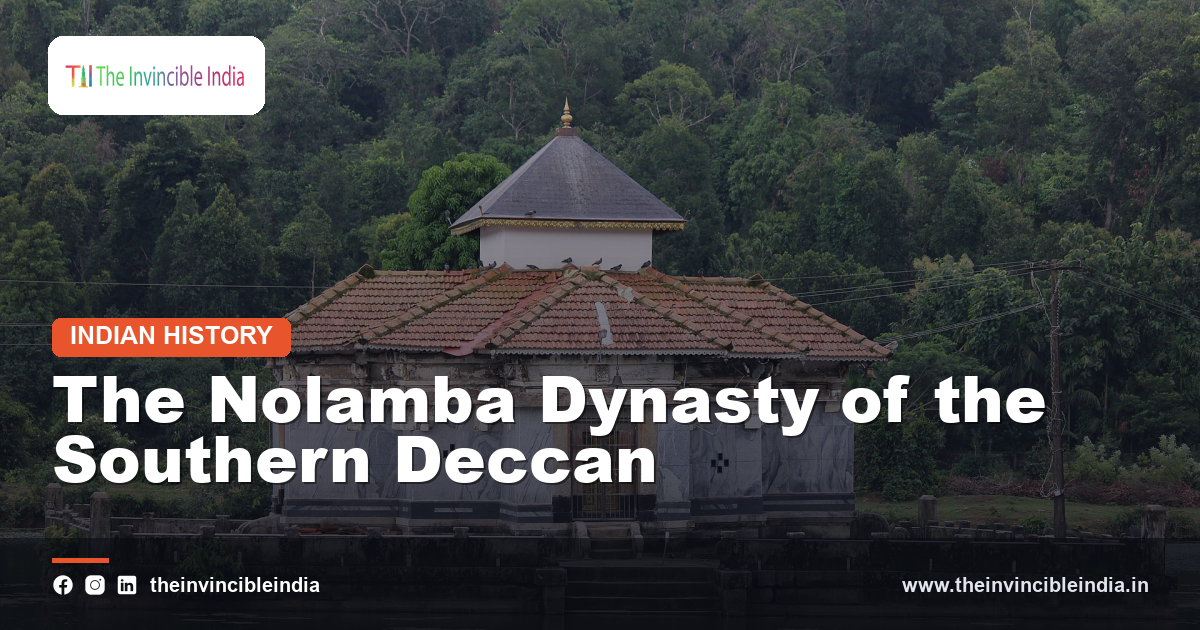
The Nolamba dynasty, also known as the Nolamba Pallavas or the Nolambas of Nolambavadi, was a regional ruling family of the southern Deccan in the early medieval period. Its territory, called Nolambavadi, covered parts of what is now southern Karnataka and the neighbouring Rayalaseema country of Andhra Pradesh. The Nolambas never built an imperial state; instead they governed as local lords who accepted the overlordship of stronger neighbours such as the Rashtrakuta dynasty. Their lasting mark lies in inscriptions written in Kannada and Sanskrit and in the temples of Hemavati. This guide explains who they were, flags where chronology is uncertain, and treats the dynasty in general terms.
Quick answer: The Nolamba dynasty was a medieval ruling family that governed Nolambavadi, a province of the southern Deccan spanning parts of present-day Karnataka and Andhra Pradesh, roughly between the ninth and early eleventh centuries. Also called the Nolamba Pallavas, the rulers served larger powers such as the Rashtrakutas, Western Chalukyas and Cholas, and are remembered for Kannada inscriptions and the stone temples of Hemavati.
Key Takeaways
- The Nolamba dynasty, also called the Nolamba Pallavas, governed the province of Nolambavadi in the southern Deccan.
- The Nolambas ruled as feudatories of larger powers, including the Rashtrakutas, the Western Chalukyas and the Cholas.
- Their main centre, Henjeru, is identified with the village of Hemavati in the Rayalaseema region of Andhra Pradesh.
- Nolamba inscriptions in Kannada and Sanskrit are the principal historical source for the dynasty.
- The claim of Pallava descent is recorded in inscriptions but remains debated among historians.
- The temples at Hemavati are leading examples of Nolamba stone architecture and sculpture.
Quick Facts
| Detail | Information |
|---|---|
| Name | Nolamba dynasty (Nolamba Pallavas, Nolambas of Nolambavadi) |
| Region | Nolambavadi, in southern Karnataka and adjoining Andhra Pradesh |
| Era | Roughly the ninth to the early eleventh century, in general terms |
| Political status | Feudatories of larger Deccan and southern powers |
| Main centre | Henjeru, today the village of Hemavati |
| Known for | Kannada inscriptions and early Dravida-style temple sculpture |
What was the Nolamba dynasty?
The Nolamba dynasty was a medieval ruling family that governed the region called Nolambavadi in the southern Deccan, roughly between the ninth and early eleventh centuries. Its rulers held the rank of regional chiefs rather than emperors, and they usually acknowledged a greater overlord. The family is often called the Nolamba Pallavas because its inscriptions claim descent from the older Pallava line of Kanchipuram. Historians treat that claim carefully, since many local dynasties of the period borrowed the prestige of famous ancestors. What can be said with confidence is that the Nolambas administered a defined territory, issued land grants, built temples and recorded their deeds on stone. The dynasty therefore offers a clear view of how smaller states functioned beneath the great empires of the Deccan, and why such states still matter to the history of Karnataka and Andhra.
Where was Nolambavadi located?
Nolambavadi lay in the southern part of the Deccan plateau, across districts now belonging to southern Karnataka and the border country of Andhra Pradesh. Inscriptions describe it as a province of thirty-two thousand villages, a conventional way of expressing its size and revenue rather than an exact count. The area includes rocky uplands, scattered hills and seasonal rivers, and its settlements clustered around tanks and temples. In later centuries the same landscape formed part of the heartland of the Hoysala and Vijayanagara states. Because the name Nolambavadi appears in records of several different powers, it is an important clue to political geography. Wherever inscriptions mention it, they signal a recognised administrative unit with its own local rulers, which is why the region is closely tied to the Nolamba name.
Why are the Nolambas called Pallavas?
The Nolambas are called Pallavas because their own records trace the family to the Pallava dynasty of Kanchipuram, which dominated the far south for centuries. Inscriptions use titles that echo Pallava royal style, and some rulers took the name Pallava alongside their Nolamba title. Modern scholars disagree about how literally to read this. One view holds that a branch of the Pallava family really migrated north and settled in the Deccan; another suggests that local chiefs adopted a famous lineage to strengthen their authority. The evidence does not settle the question. For readers, the useful point is that the name reflects a wider habit in early medieval India, where claiming descent from a celebrated line was a way of asserting legitimacy, whether or not every link in the genealogy could be proved.
How did the Nolambas rise to power?
The Nolambas rose gradually as local chiefs who benefited from the shifting balance among the Deccan’s great powers. In the ninth century the area lay in the shadow of the Ganga rulers of southern Karnataka and the Rashtrakutas to the north. A Nolamba chief who supported a stronger neighbour could win recognition, land and titles in return. Over time such arrangements turned into hereditary rule, and the family consolidated its hold on Nolambavadi. Their rise did not depend on spectacular conquests but on diplomacy, marriage ties and military service. Exact dates for the earliest rulers are uncertain, and historians estimate the sequence from inscriptions that name kings but give few firm calendar points. The pattern is nevertheless typical of the period, when capable local lords converted loyal service into durable regional authority.
Who were the main Nolamba rulers?
The main Nolamba rulers are known mostly through inscriptions that record names such as Mahendra and later chiefs bearing the title Iriva-Nolamba. These records describe victories, grants to temples and the founding of villages, but they rarely give detailed biographies. Some rulers are praised for fighting alongside overlords in campaigns, and others are remembered as patrons of religious foundations. Because genealogies were composed to flatter, scholars compare several inscriptions before accepting the order of succession. The family tree therefore remains partly provisional, and different authors propose slightly different sequences. Even so, the list of names shows continuity of rule across several generations, which is the most reliable conclusion. The Nolambas may not have produced a single famous king, but their record of steady local governance explains why they survived for generations among powerful neighbours.
What was Henjeru, the Nolamba capital?
Henjeru was the principal Nolamba centre, and it is identified with the present village of Hemavati in the Rayalaseema country. Inscriptions also mention the name Penjeru, which appears to be a variant of the same place. The settlement lay in a dry upland of low hills, and its importance came from the court, the temples and the roads that connected it with neighbouring districts. Remains at Hemavati include temples, sculptures and carved stones that suggest a busy religious and political centre. Because Nolamba rulers moved between several places at different times, historians avoid calling Henjeru a fixed capital in the modern sense. It is better described as the main seat and ceremonial heart of the dynasty, a place where royal patronage was visible in stone and where records of the family were kept.
How did the Nolambas relate to the Rashtrakutas and Gangas?
The Nolambas related to the Rashtrakutas and Gangas mainly as junior partners who owed service in return for protection. The Rashtrakutas were an imperial power centred on the northern Deccan, while the Gangas ruled much of southern Karnataka. Nolamba chiefs appear in inscriptions as vassals, sometimes fighting on behalf of one overlord and sometimes quarrelling with a neighbour. These arrangements were fluid, and a chief could change allegiance when the balance shifted. Historians therefore describe the dynasty as a feudatory family rather than an independent kingdom. The advantage of this position was survival, because the Nolambas could retain their land while greater powers rose and fell around them. The disadvantage was dependence, since their fortunes tied closely to the strength of whichever overlord they served.
What happened under the Western Chalukyas and Cholas?
Under the Western Chalukyas and the Cholas the Nolambas faced a harder and more crowded political world. After the Rashtrakutas weakened, the Western Chalukyas of Kalyani revived imperial rule in the Deccan, and Nolamba chiefs seem to have accepted them as new overlords. At almost the same time the powerful Cholas of the Tamil country pushed north and are recorded as campaigning in Nolambavadi, which their inscriptions call Nolambapadi. The region became a contested frontier between two great states. The details of each campaign are known only in outline, and chronology is debated among historians. What is clear is that the independent Nolamba line faded in this period, and the district passed under direct or closer control of larger powers, ending the dynasty’s distinct political life.
How was the Nolamba kingdom governed?
The Nolamba kingdom was governed through a hierarchy of local officials, village assemblies and temple institutions, much as other regional states of the time. The ruler stood at the top and issued orders in the form of inscribed grants, which assigned land or revenue to temples and Brahmin scholars. Below him, officers supervised districts and collected taxes in kind and coin. Village bodies managed irrigation tanks, boundaries and local disputes. Inscriptions show that tank building and maintenance mattered greatly, because the dry upland depended on stored rainwater. The state also relied on military service from allied chiefs. This administrative pattern helped small kingdoms remain stable without large standing bureaucracies, and it explains why records of grants and gifts survive in such numbers across the territory of Nolambavadi.
Why are the Hemavati temples important?
The Hemavati temples are important because they are among the best surviving examples of Nolamba architecture and sculpture. Built of local stone, they follow the Dravida tradition of the south while showing features also seen in the early Chalukyan and Ganga styles of Karnataka. Carvings include deities, guardian figures and decorative panels that display confident craftsmanship. Temples such as the Doddeshwara and Siddheshwara shrines are commonly cited when scholars discuss Nolamba art. A site museum nearby preserves loose sculptures recovered from the area. Their importance goes beyond beauty, since they show that a modest regional dynasty could sponsor sophisticated religious art. The temples remain the clearest physical evidence of the Nolamba cultural world, and they continue to draw visitors, students and researchers interested in early medieval South India.
What does Nolamba sculpture look like?
Nolamba sculpture is typically carved in stone and marked by clear outlines, rounded figures and a balanced use of ornament. Deities such as Shiva and Vishnu appear in niches, and pillars and doorways carry bands of floral and geometric work. Guardian figures flank entrances, and animals such as the bull Nandi are modelled with care. The style sits between the earlier Pallava and Ganga traditions and the more elaborate Hoysala art that followed in the same region. Experts note a certain restraint in Nolamba work, with less crowded detail than later schools. That restraint is part of its charm and helps date sculptures relative to other periods. The surviving pieces, though modest in scale, show an assured tradition that links the older southern styles with later developments.
What do Nolamba inscriptions tell us?
Nolamba inscriptions are the main source for the dynasty and they tell us about rulers, grants, wars and local society. Written in Kannada and Sanskrit on stone slabs and temple walls, they record gifts of land, the building of tanks and the deeds of chiefs. The use of Kannada is especially significant, because it shows the language already serving as a medium for official and religious records in this region. Many inscriptions also preserve the titles of kings, which helps scholars reconstruct genealogy. Their limitations are equally important. Inscriptions praise rulers, rarely mention failures, and often lack precise dating. Historians therefore read them alongside architecture and the records of neighbouring powers, building a careful and balanced picture instead of relying on any single text.
How did religion and patronage shape Nolamba culture?
Religion and patronage shaped Nolamba culture mainly through support for Shaiva temples and the communities that served them. Inscriptions record gifts that supported daily worship, festivals, lamps and the upkeep of priests. Shiva temples are prominent at Hemavati, although Vaishnava and other traditions also found space in the wider region. Patronage was not only religious, because temples also acted as local banks, schools and gathering places. Rulers who endowed them gained legitimacy and public goodwill. Jain and Buddhist communities, long established in Karnataka, also remained part of the regional landscape, and the period is generally marked by coexistence rather than sharp conflict. This religious environment helped produce the art and inscriptions that survive, and it shows how deeply faith and governance were intertwined in the early medieval Deccan.
Why does Nolamba history matter for Kannada heritage?
Nolamba history matters for Kannada heritage because it shows the language and regional identity taking firm shape in the southern Deccan. Nolamba inscriptions in Kannada form part of a long chain of records stretching from the Kadambas and Gangas to the Hoysalas and Vijayanagara. The region of Nolambavadi later became a core area of Kannada-speaking states, and its older temples and stones form part of the cultural memory of Karnataka. Scholars also value the dynasty as an example of local, non-imperial history, a reminder that India’s past was not only made by famous empires. Understanding the Nolambas helps fill the gaps between better-known dynasties and gives a more complete account of how regional culture developed across many centuries.
How does Nolamba history compare with other regional dynasties?
Nolamba history compares with other regional dynasties as a modest but typical case of a feudatory state in the medieval Deccan. Like the lesser branches of the Chalukyas and the local chiefs under the Cholas, the Nolambas ruled a limited territory, accepted an overlord and invested in temples. Unlike the great empires, they left no famous capital city or monumental complex, and their story must be assembled from scattered inscriptions. This makes them valuable to historians, who use such dynasties to study how power worked at the local level. Comparing them with larger powers such as the Chola dynasty reveals how imperial campaigns reshaped the fortunes of small states, ending some and absorbing others into new political systems.
The Nolamba Dynasty Today
The Nolamba dynasty today is remembered mainly through the temples of Hemavati, the inscriptions found across Nolambavadi and the continuing work of historians and archaeologists. The temples remain places of worship and are also protected as heritage sites, and the nearby museum helps visitors understand the sculptures. Scholars continue to refine the chronology and genealogy of the family as new inscriptions are read and older ones reinterpreted. Local interest in the dynasty is growing, because it offers a rooted story of regional culture rather than a distant imperial narrative. Studying the Nolambas teaches a broader lesson about Indian history, which is shaped as much by small kingdoms, local temples and village life as by the great empires that dominate popular memory.
Sources & Further Reading
- Archaeological Survey of India (asi.nic.in).
- Ministry of Culture, Government of India (indiaculture.gov.in).
Frequently Asked Questions
Who were the Nolambas?
The Nolambas were a medieval ruling family that governed Nolambavadi in the southern Deccan, roughly between the ninth and early eleventh centuries. They are also called the Nolamba Pallavas because their records claim Pallava descent. They generally ruled as vassals of larger powers.
Where is Hemavati and why is it famous?
Hemavati is a village in the Rayalaseema region of Andhra Pradesh that is identified with the Nolamba centre of Henjeru. It is famous for its early medieval stone temples and sculptures, which are leading examples of Nolamba art.
Were the Nolambas really descended from the Pallavas?
The claim cannot be confirmed, and historians disagree about it. Some think a Pallava branch settled in the Deccan, while others see the claim as a way of borrowing prestige. The inscriptions repeat it, but independent proof is lacking.
What language do Nolamba inscriptions use?
Nolamba inscriptions are written mainly in Kannada and Sanskrit. The use of Kannada is important because it shows the language already serving official and religious purposes in the region at that time.
How did the Nolamba dynasty end?
The dynasty faded as the Western Chalukyas and the Cholas competed for control of Nolambavadi, and the region passed under larger powers. The exact sequence and dates are debated, so historians describe the end in general terms rather than by a single event.
Is the Nolamba dynasty the same as the Pallava dynasty?
No, the Nolambas were a separate regional family, although they claimed descent from the Pallavas. The Pallavas ruled from Kanchipuram and dominated the far south, while the Nolambas governed a smaller territory in the southern Deccan.


