

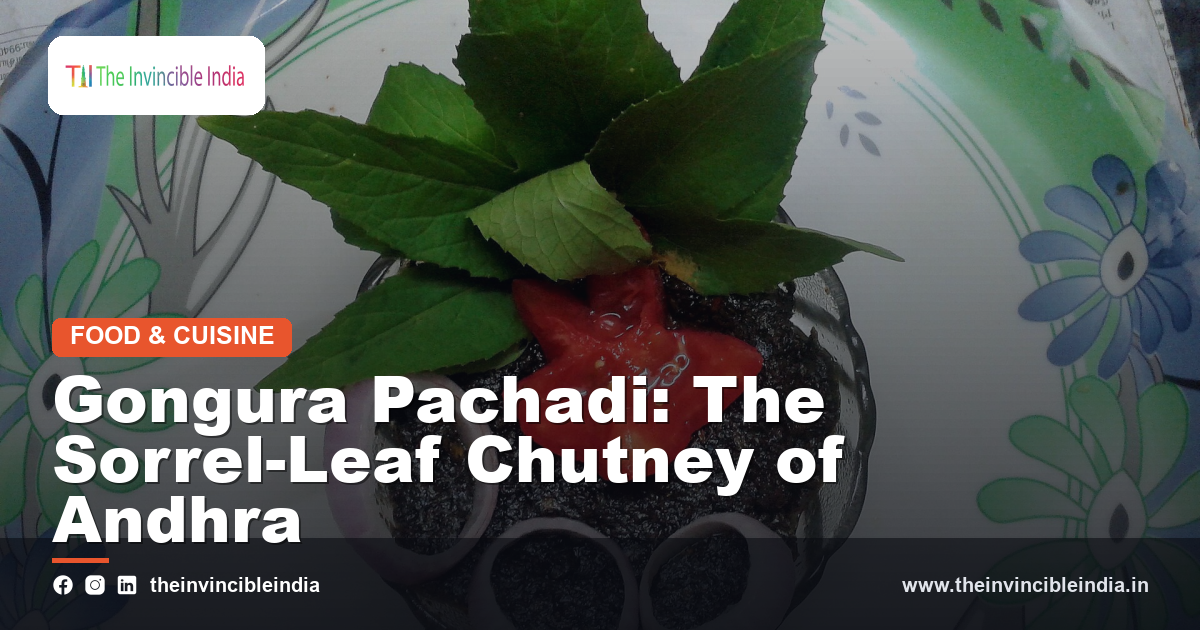
Gongura pachadi, also spelled gongura chutney and often called sorrel-leaf chutney or roselle-leaf chutney in English, is one of the most recognisable flavours of Telugu cooking. It is made from the sour leaves of the gongura plant, cooked briefly, ground with chillies and garlic, and finished with a fragrant tempering. Within the wide range described in our overview of the regional cuisines of India, few condiments are as assertive or as beloved as this one. This guide explains what the chutney is, how the leaf shapes its character, how it is prepared and eaten, and why it has become a symbol of Andhra and Telangana food.
Quick answer: Gongura pachadi is a sour, spicy chutney from Andhra Pradesh and Telangana, made from gongura leaves, a type of sorrel, cooked with green or red chillies, ground with garlic and spices, and tempered with mustard seeds and dried chillies in oil. It is traditionally eaten with hot rice and ghee. Its sharp tang and heat make it one of the best-known dishes of Telugu cuisine.
Key Takeaways
- Gongura pachadi is a Telugu chutney made from the tangy leaves of the gongura plant, a sorrel-type leafy green.
- The word pachadi in Telugu refers to a chutney or relish, and gongura is the Telugu name for the sour leaf.
- The chutney is strongly associated with Andhra Pradesh and Telangana, where gongura grows widely and appears in many dishes.
- Its flavour comes from the natural sourness of the leaf, balanced with chillies, garlic, and a mustard-and-chilli tempering.
- It is traditionally served with hot steamed rice and ghee, and also accompanies dal, millet meals, and flatbreads.
- The same leaf is used in other Telugu dishes, including gongura dal, gongura mutton, and a long-lasting gongura pickle.
Read on for the ingredients, method, serving customs, and cultural role in detail.
Quick Facts
| Detail | Information |
|---|---|
| Dish | Gongura pachadi (gongura chutney) |
| Type | Sour leaf chutney |
| Region | Andhra Pradesh and Telangana |
| Main ingredient | Gongura (sorrel) leaves |
| Flavour | Sour, spicy, pungent |
| Usually served with | Hot rice and ghee |
| Language of the name | Telugu |
| Cultural role | Everyday and festive Telugu meals |
What Is Gongura Pachadi?
Gongura pachadi is a chutney of cooked sorrel leaves that is sour, hot, and deeply savoury. The leaves of the gongura plant are sauteed in a little oil until they collapse into a dark paste, then ground with chillies, garlic, and salt, and finished with a spiced tempering. The result is a thick, glossy relish that is eaten in small amounts alongside rice rather than as a dish in its own right. Its colour ranges from olive green to a deep reddish brown, depending on the leaf used and how long it is cooked. In Telugu households the chutney is so familiar that it is often described simply as gongura, and the mention of the word is enough to suggest a plate of rice, ghee, and a spoonful of this sharp condiment. It is a clear example of how a single leaf can define a regional identity.
What Is Gongura, the Leaf Behind the Chutney?
Gongura is a leafy plant of the hibiscus family whose leaves are naturally sour, and it is commonly described in English as sorrel, roselle leaf, or red sorrel. The plant grows readily in the warm climate of the Telugu-speaking regions and is cultivated in kitchen gardens as well as fields. Its leaves are tender, slightly fuzzy, and rich in the tart acids that give the dish its signature taste. The same leafy green is known by other names in India, including pundi in Kannada, ambadi in Marathi, and pulicha keerai in Tamil, which shows how widely its sour character has been valued. In Andhra and Telangana, however, the leaf has acquired an unusually prominent place, turning from a simple green into a culinary emblem. Understanding the leaf is therefore the first step to understanding the chutney.
Where Does Gongura Pachadi Come From?
Gongura pachadi comes from the Telugu-speaking region of southern India, which today covers the states of Andhra Pradesh and Telangana. The chutney is part of a long tradition of using sour ingredients to balance the heat and richness of Telugu food, a cuisine known for its generous use of chillies. Because the leaf grows easily and is available for much of the year, it became a dependable everyday ingredient rather than a rare delicacy. No single inventor or exact date is recorded for the dish, and it is best understood as a product of village kitchens over many generations. Families in different districts prepare it with their own small variations, and each household usually considers its own version the best. This shared yet personal ownership is part of what makes the chutney a living regional tradition.
Why Does Gongura Taste So Sour?
Gongura tastes sour because its leaves contain natural plant acids that give a sharp, lemony tang without any added tamarind or vinegar. This built-in sourness is the defining feature of the chutney and the reason it stands apart from the many coconut-based and tomato-based chutneys of the south. Cooking mellows the acidity slightly but never removes it, so the finished pachadi still delivers a bright jolt on the tongue. Cooks often adjust the balance by controlling how long the leaves are sauteed and how much chilli and salt are added. A longer cook gives a deeper, rounder flavour, while a shorter cook keeps the sourness more vivid. The sour note is not an accident but the whole purpose of the dish, and it explains why the chutney pairs so well with plain rice, which carries no flavour of its own.
What Ingredients Go Into Gongura Pachadi?
Gongura pachadi is built from a short list of ingredients: gongura leaves, chillies, garlic, salt, oil, and a handful of tempering spices. Fresh leaves are washed and picked from their stems, while chillies may be green, dried red, or a mixture, depending on whether the cook wants a fresher or deeper heat. Garlic gives the chutney its earthy backbone, and some versions add roasted fenugreek seeds or coriander seeds for aroma. Sesame oil or another cooking oil is traditionally used for sauteing the leaves, because the chutney needs a generous amount of fat to carry its flavour and keep it smooth. The tempering usually includes mustard seeds, cumin, dried red chillies, and curry leaves. Because the list is so simple, the quality of the leaves and the care taken in cooking them matter more than any elaborate addition.
How Is Gongura Pachadi Made?
Gongura pachadi is made by sauteing washed leaves in oil until they wilt into a soft mass, grinding them with chillies and garlic, and adding a tempering of mustard seeds and dried chillies. Dried red chillies or green chillies are first fried briefly in oil, then set aside to be ground with salt. The leaves go into the same pan and cook down, releasing their moisture, until the raw smell disappears and the colour darkens. The cooled leaves are ground with the chillies and garlic, either on a stone grinder in the traditional way or in a mixer today, and the paste is kept slightly coarse for texture. A final tempering is poured over the chutney or mixed in. The method is short, but it depends on patience in cooking the leaves down properly.
What Is the Role of the Tempering?
The tempering, known in Telugu cooking as popu or talimpu, gives gongura pachadi its aroma and finishing flavour. Oil is heated and mustard seeds are added until they pop, followed by cumin, dried red chillies, curry leaves, and often a few crushed garlic cloves. This hot, fragrant mixture is poured over the ground chutney, where it releases a burst of scent and adds a slight crunch from the seeds. The tempering also acts as a seal, because the layer of oil on the surface helps the chutney keep for longer when stored. In many homes the final tempering is considered what separates a good pachadi from an ordinary one, since it lifts the sour leaf with a warm, nutty note. Without it the chutney would taste flat, which shows how important this small step is in Telugu cooking.
What Is the Difference Between Red and Green Gongura?
Red-stemmed gongura and green-stemmed gongura are the two types most often discussed by cooks, and they differ mainly in how sour and pungent they taste. The red-stemmed variety is generally regarded as the more sour and sharper of the two, and it is the one many people associate with the strongest, most traditional pachadi. The green-stemmed variety is usually considered milder and slightly softer in flavour, which suits those who prefer a gentler tang. Both types are used in chutneys, dals, and curries, and the choice often depends on local availability and family preference. Markets in the Telugu states commonly sell the leaves in bunches, and experienced buyers can tell the type by the colour of the stem. The existence of these two types shows how closely the cuisine pays attention to small differences in a single ingredient.
How Is Gongura Pachadi Eaten?
Gongura pachadi is eaten in small amounts, usually mixed into hot steamed rice with a spoonful of ghee or a little sesame oil. The heat of the rice softens the sharpness of the chutney, and the ghee rounds out the sourness, creating a combination that many Telugu families regard as a complete comfort meal. It also accompanies dal, vegetable curries, and flatbreads, and it is a favourite partner for millet dishes in rural kitchens. The chutney can be eaten alongside idli and dosa, although this is less traditional than serving it with rice. Because it is strong, a little goes a long way, and a small portion on the side of the plate is usual. This restrained use shows that gongura pachadi is meant to season a meal, not dominate it, even though its flavour is bold.
What Is the Place of Gongura Pachadi in an Andhra Meal?
Gongura pachadi holds a fixed place in the traditional Andhra meal as one of the sharp, flavourful side dishes served with rice. A Telugu meal typically moves through several rice courses, each paired with a different accompaniment, and a chutney such as gongura often appears early, alongside dal and ghee. It provides the sour element that the meal needs to balance sweet, bitter, and spicy tastes, a principle familiar from the broader idea of a balanced Indian thali. Guests at weddings and festival feasts often receive it as a small mound on the leaf or plate, and its presence is read as a sign of proper hospitality. In everyday households it may be served several times a week. This steady presence has made it a quiet pillar of the cuisine rather than a special occasion dish.
How Does Gongura Pickle Differ From the Fresh Chutney?
Gongura pickle is a preserved version of the same leaf, while gongura pachadi is the fresher, softer chutney that is usually eaten within days. For the pickle, the leaves are cooked down with a large quantity of oil, chilli powder, salt, and spices, and the mixture is stored in jars where the oil acts as a preservative. It keeps for a long time and is often prepared in the season when the leaf is abundant. The fresh pachadi is smoother, brighter, and made in smaller batches for immediate use. Both are known in Telugu homes, and the line between them can blur, because a well-oiled pachadi can last quite a while. The pickle travels easily, which is why jars of it are often carried by families to relatives living far from the Telugu states, spreading the taste well beyond its home.
Which Other Dishes Use Gongura?
Gongura is used in many Telugu dishes beyond the chutney, including dal, vegetable stir-fries, rice preparations, and meat curries. Gongura pappu is a dal cooked with the sour leaves, giving ordinary lentils a bright tang. Gongura mutton, in which the leaf is cooked with meat and spices, is one of the most celebrated non-vegetarian dishes of the region, and the sourness cuts through the richness of the meat. The leaf also appears in rice dishes sometimes called gongura pulihora or gongura rice, and in simple stir-fries with onions and chillies. These dishes share the same logic as the chutney, using the leaf as a natural souring agent in place of tamarind. Seeing the leaf across so many preparations makes clear that gongura is not a novelty but a basic building block of Telugu cooking.
Is Gongura Pachadi Considered Nutritious?
Gongura is traditionally regarded as a wholesome leafy green, and the chutney is valued in home kitchens as a way of bringing greens into the daily meal. Like other leafy vegetables, the leaf is part of the long Indian practice of eating seasonal greens, and families often speak of it as a food that suits the body in warm weather. These views reflect tradition and household experience rather than precise nutritional claims, and the chutney itself is cooked with oil, salt, and chillies, so it is eaten in modest portions. Anyone with dietary restrictions should treat the chutney as a condiment rather than a staple. What can be said with confidence is that the dish makes a plain bowl of rice more interesting and encourages the use of a leafy ingredient that grows easily and cheaply, which is itself a mark of practical kitchen wisdom.
Which Sorrel Chutneys Exist in Other Regions?
Sorrel-leaf chutneys and dishes appear in several other parts of India, although none has the national profile of the Andhra version. In Karnataka the same leaf is known as pundi and is cooked into chutneys and a dry stir-fry called pundi palya. In Maharashtra, where it is called ambadi, it is used in vegetable preparations and bhaji. Tamil cooks use pulicha keerai in simple kootu and chutney, and communities elsewhere in the east and north also prepare sour greens with similar methods. These parallels show that the idea of a sour leaf chutney is widely shared across the country, shaped by local chillies and spices. The Telugu version stands out for its intensity and for the way it has become tied to regional pride, something also visible in the way other regions celebrate their own signature dishes, as in the cuisine of Odisha.
How Is Gongura Pachadi Stored and Carried?
Gongura pachadi is stored in clean, dry jars with a layer of oil on top, which helps keep air away and slows spoilage. The fresh chutney is best eaten within a few days and kept in a cool place, while an oil-rich or pickled version lasts much longer. Cooks take care to use dry spoons and to avoid water entering the jar, since moisture is the main enemy of any preserved condiment. Many families make a larger batch during the season when the leaf is plentiful and keep it as a store for the months ahead. Jars also travel well, and Telugu families living in other cities or countries often ask relatives to send gongura from home. This practice has turned the chutney into a carrier of memory and belonging, linking migrants to the flavours of the place they left behind.
What Does Gongura Mean in Telugu Culture?
Gongura carries a special emotional weight in Telugu culture, and it is often treated as a symbol of regional identity in the same way that other states celebrate their signature foods. The leaf appears in conversation, film, and everyday humour as shorthand for Andhra taste, and restaurants outside the region use gongura dishes to signal authenticity. For many Telugu speakers, the taste recalls childhood meals, grandmothers, and the comfort of home cooking. The leaf is humble, cheap, and easy to grow, yet it commands real affection, which reflects a wider pattern in Indian food culture where simple ingredients become cherished emblems. Hospitality in Andhra and Telangana is also linked to generous serving of flavourful dishes, and a good gongura pachadi is a point of pride for a host. In this way the chutney speaks for a whole culinary outlook.
Gongura Pachadi Today
Gongura pachadi today remains a staple of Telugu homes and a headline attraction on the menus of Andhra restaurants across India and abroad. Packaged versions of the chutney and pickle are sold widely, making the flavour available to people who cannot find fresh leaves. Chefs have also experimented with gongura in modern dishes, from stuffed breads to sauces, while traditional cooks continue to prepare it in the old way, with a stone grinder and a hot tempering. The core of the dish has not changed, however: a sour leaf, a fierce chilli, and a spoonful of ghee over warm rice. As interest in regional Indian food grows, gongura pachadi is increasingly recognised as one of the country’s most distinctive condiments. Its enduring popularity shows how a single sour leaf can anchor the identity of an entire regional cuisine.
Sources & Further Reading
- Ministry of Culture, Government of India (indiaculture.gov.in).
- Ministry of Tourism, Government of India (incredibleindia.gov.in).
Frequently Asked Questions
What is gongura pachadi?
Gongura pachadi is a sour and spicy chutney from Andhra Pradesh and Telangana, made from cooked gongura (sorrel) leaves ground with chillies and garlic. It is finished with a tempering of mustard seeds and dried chillies. It is traditionally eaten with hot rice and ghee.
What is gongura called in English?
Gongura is commonly called sorrel, red sorrel, or roselle leaf in English. It is a sour leafy plant of the hibiscus family. Other Indian languages use names such as pundi in Kannada and ambadi in Marathi.
Why is gongura pachadi so sour?
Gongura pachadi is sour because the leaves naturally contain tart plant acids, so no tamarind or vinegar is needed. Cooking softens the sharpness slightly but does not remove it. The red-stemmed type is generally considered the more sour of the two common varieties.
How is gongura pachadi usually eaten?
Gongura pachadi is usually eaten mixed with hot steamed rice and a spoonful of ghee or sesame oil. It is also served with dal, millet dishes, and flatbreads. Because it is strong, only a small portion is taken with a meal.
What is the difference between gongura pachadi and gongura pickle?
Gongura pachadi is a fresher, softer chutney usually eaten within days, while gongura pickle is cooked with more oil and spices to last for months. Both use the same sour leaf. The pickle is the version most often sent to relatives living far from home.
Which other dishes are made with gongura?
Gongura is also used in gongura pappu (dal), gongura mutton, and rice dishes such as gongura pulihora. The leaf acts as a natural souring agent in place of tamarind. Gongura mutton is one of the most famous non-vegetarian dishes of Telugu cuisine.


