

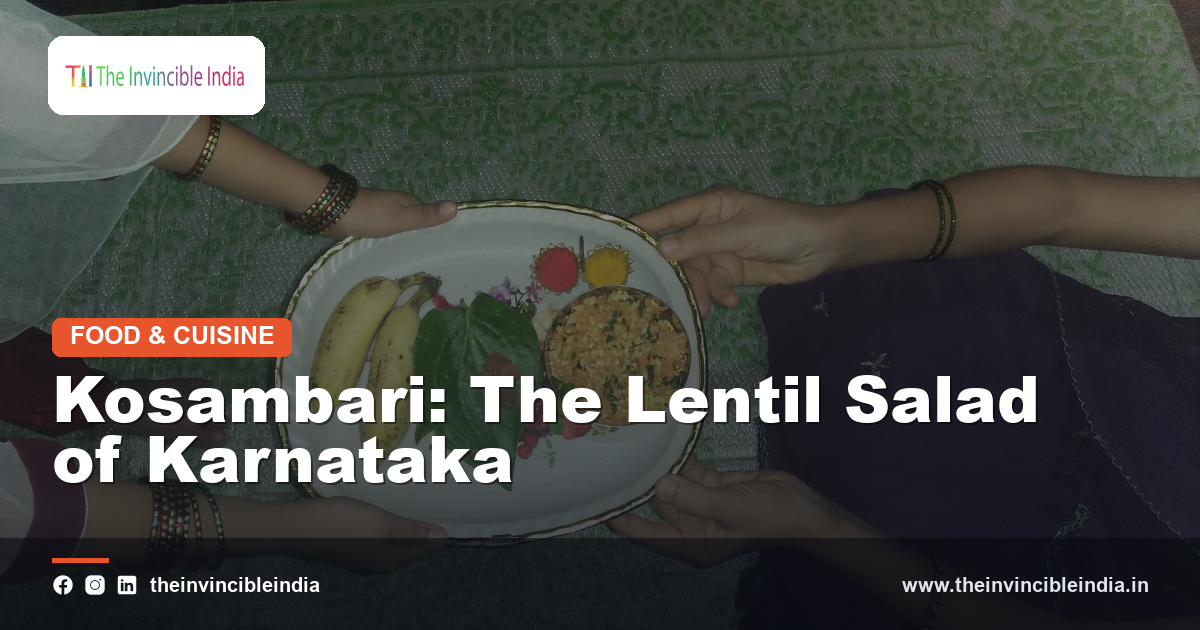
Kosambari, also spelled kosumbari or kosambri and known as kosumalli in Tamil Nadu, is a fresh salad of soaked lentils dressed with coconut, lemon, and a light tempering. It is one of the cooling, uncooked dishes that appear on festival menus and wedding feasts across Karnataka and the neighbouring southern states. In the wider landscape of South Indian food, where steamed, fried, and simmered dishes dominate, kosambari stands out as a raw preparation valued for its crunch and freshness. This guide explains what kosambari is, how it is made, when it is served, and why this humble salad carries such cultural weight.
Quick answer: Kosambari is a traditional salad from Karnataka made from soaked split lentils, usually moong dal or chana dal, mixed with grated coconut, cucumber or carrot, green chillies, lemon juice, and coriander, and finished with a mustard-seed tempering. It is eaten fresh and uncooked. Kosambari is a standard offering at Hindu festivals such as Rama Navami and Ugadi and is served at weddings and community feasts.
Key Takeaways
- Kosambari is a fresh, uncooked lentil salad from Karnataka, also spelled kosumbari and called kosumalli in Tamil Nadu.
- It is made from soaked split moong dal or chana dal, combined with coconut, vegetables, lemon juice, and herbs.
- A light tempering of mustard seeds, green chillies, and curry leaves is added to the salad for aroma.
- Kosambari is a traditional festival dish, served at Rama Navami, Ugadi, weddings, and temple feasts.
- It is commonly paired with panaka, a jaggery-and-lemon drink, and with buttermilk during warm festivals.
- Because it is uncooked and vegetarian, kosambari is valued for its fresh, cooling character.
Read on for the ingredients, method, serving customs, and cultural role in detail.
Quick Facts
| Detail | Information |
|---|---|
| Dish | Kosambari (kosumbari, kosumalli) |
| Type | Raw lentil salad |
| Region | Karnataka, also across South India |
| Main ingredient | Soaked moong dal or chana dal |
| Typical additions | Coconut, cucumber, carrot, lemon, coriander |
| Tempering | Mustard seeds, green chillies, curry leaves |
| Occasions | Rama Navami, Ugadi, weddings, temple feasts |
| Dietary note | Vegetarian and uncooked |
What Is Kosambari?
Kosambari is a salad of soaked split lentils dressed with coconut, lemon juice, and herbs, and it is one of the most characteristic fresh dishes of Karnataka. Unlike most South Indian lentil preparations, which are cooked into sambar or dal, kosambari uses the lentils raw after soaking, so they stay tender but crisp. The dish is bright with green chillies, fresh coriander, and a squeeze of lemon, and it is finished with a quick tempering of mustard seeds and curry leaves. It is served in small portions as a side, and its light texture offers a contrast to richer dishes on the same plate. In Karnataka the salad is so closely tied to festival meals that many people picture it served on a banana leaf beside payasa and rice. It shows how simple soaking, rather than cooking, can turn a pulse into a refreshing dish.
What Are the Other Names of Kosambari?
Kosambari is also written as kosumbari, kosambri, and kosamalli, and in Tamil Nadu a very similar salad is known as kosumalli. The Kannada name varies slightly by district and by the lentil used, so a version made from moong dal may be called hesaru bele kosambari, while one made from chana dal may be called kadlebele kosambari. In English the dish is often described as a lentil salad, a moong dal salad, or a South Indian dal salad. These names point to the same basic idea of soaked pulses mixed with fresh toppings and a tempering. The shared dish across states shows how food customs travel along language and religious lines, with the same festival salad appearing on many tables in slightly different forms. Knowing the alternate names helps in recognising kosambari wherever it is served.
Where Is Kosambari From?
Kosambari is from Karnataka, in southern India, where it has long been prepared for festivals, weddings, and temple feasts. The dish is also found in neighbouring Tamil Nadu, Andhra Pradesh, Telangana, and Kerala under similar names, and it is often associated with the vegetarian traditions of Brahmin and temple kitchens. No specific inventor or exact date is recorded for the salad, and it is best understood as part of a long tradition of festive, uncooked offerings served with other ritual foods. Because the ingredients are simple, locally available, and suited to a warm climate, the dish spread naturally across the region. Its home in Karnataka is seen mainly in the way it is built into the cultural calendar, appearing reliably at certain festivals every year. This steady association has made it a quiet marker of Kannada food identity.
What Ingredients Go Into Kosambari?
Kosambari is built from soaked lentils, grated coconut, a crunchy vegetable, green chillies, lemon juice, salt, and fresh coriander. The lentils are usually split moong dal, called hesaru bele, or chana dal, called kadlebele, and they are rinsed and soaked in water for a short time until softened but still firm. Cucumber and carrot are the most common vegetables, though raw mango, pomegranate seeds, and sprouts may appear in some versions. Fresh coconut adds sweetness and richness, and lemon juice supplies the sour note that ties everything together. The tempering of mustard seeds, curry leaves, and sometimes asafoetida brings aroma. Because nothing is cooked, the freshness of each ingredient matters greatly. A handful of well-chosen items, handled with care, produces a salad that tastes lively rather than plain.
How Is Kosambari Made?
Kosambari is made by soaking split lentils, draining them well, mixing them with chopped vegetables, coconut, chillies, and herbs, and finishing the salad with lemon juice and a mustard tempering. The lentils are soaked for a couple of hours, then drained thoroughly so the salad does not turn watery. They are combined with grated or finely chopped cucumber or carrot, coconut, green chillies, and coriander, and seasoned with salt. A small pan is heated with oil, and mustard seeds are added until they splutter, followed by curry leaves and sometimes a pinch of asafoetida. This tempering is poured over the salad, and lemon juice is squeezed in just before serving. The salad is mixed gently and eaten fresh. The method is quick and requires no fire except for the tempering, which suits a dish meant to be light and cooling.
Why Are the Lentils Soaked Rather Than Cooked?
The lentils in kosambari are soaked rather than cooked because the dish depends on their raw, tender crunch and fresh taste. Soaking softens the split lentils enough to be eaten comfortably while preserving a pleasant bite, and it keeps the dish light and quick to prepare. Cooking would turn the lentils into a soft mash and change the salad into something closer to a dal. The soaking time is judged by feel: too short leaves them hard, too long makes them mushy, so cooks test a few grains between their fingers. Using split moong dal is especially common because it softens quickly. This approach reflects a broader Indian habit of using soaked and sprouted pulses in fresh preparations. The choice to leave the lentils uncooked is the defining feature of kosambari and the source of its distinctive texture.
What Is the Difference Between Moong Dal and Chana Dal Kosambari?
Moong dal kosambari is softer and milder, while chana dal kosambari is firmer and nuttier, and the choice shapes the character of the salad. Split yellow moong dal softens quickly in water and has a delicate flavour that lets the coconut and lemon stand out. Chana dal, which is made from split Bengal gram, stays more crunchy and has a stronger, earthier taste. Many households prepare one or the other depending on tradition, season, or the festival, and some mix the two. Cooks who use chana dal soak it for a longer time to make it chewable. Both versions follow the same basic method and share the same dressing. The two kinds show how a single recipe can offer subtle variety depending on the pulse chosen, and neither is considered more authentic than the other.
Which Festivals Feature Kosambari?
Kosambari features prominently at Rama Navami, Ugadi, Varamahalakshmi, and many other Hindu festivals and household pujas in Karnataka. On Rama Navami, the birthday of Lord Rama, it is traditionally served along with panaka, a cooling drink of jaggery, water, and lemon, and with neer mor, a spiced buttermilk, which suit the hot weather of the season. At Ugadi, the Kannada and Telugu new year, kosambari appears on the festive menu beside the sweet-and-bitter ugadi pachadi and other dishes. It is also distributed in temples as part of prasad and served at weddings and thread ceremonies. The uncooked and vegetarian nature of the dish makes it suitable for ritual offerings. Its yearly appearance has made the salad a familiar sign that a festival is near, linking food directly to the rhythm of the religious calendar.
How Is Kosambari Served at Weddings and Feasts?
Kosambari is served at weddings and community feasts as one of the first items placed on the banana leaf, usually in a small mound near the top. The traditional South Indian feast, known as oota, follows a set order of dishes, and the placement of each item on the leaf is carefully arranged. Kosambari sits among the salads, pickles, and dry vegetables, offering a fresh contrast to richer dishes that follow, such as payasa, rice, sambar, and rasam. It is generally served in a modest portion and eaten alongside the main meal. Caterers who prepare feasts in large quantity soak the lentils in bulk and add the dressing only at the last moment to keep it crisp. The salad’s regular presence in such meals shows how it has become part of the ceremonial structure of Kannada hospitality, a detail also reflected in other regional feasts like the Indian thali.
What Is Kosambari Served With?
Kosambari is served with festival meals, rice-based dishes, and cooling drinks such as panaka and buttermilk. It makes a light accompaniment to sambar rice, curd rice, and bisi bele bath, offering a fresh crunch against soft, hot dishes. At festivals it is eaten as a stand-alone snack in small cups, often in the afternoon when the sun is high. Some people treat it as a mid-day nibble or even as a light, protein-rich salad on its own. The sour notes of lemon and the freshness of coconut balance spicy gravies and fried items well. Its modest size and lack of heat make it a good companion for richer food. Pairing kosambari with a drink and a main course illustrates the Indian principle of building meals from contrasting textures and temperatures, with the salad providing the cool and crisp element.
What Are Common Variations of Kosambari?
Common variations of kosambari change the vegetables, the lentil, or the souring agent while keeping the same basic method. Raw mango kosambari, popular in the summer mango season, adds a sharp, tangy bite. Carrot kosambari is sweeter and brighter in colour, while cucumber kosambari is the most cooling. Some cooks add pomegranate seeds for sweetness and colour, or sprouted moong for extra crunch. A few use grated raw papaya or finely chopped tomato, and others replace lemon with a little tamarind water or curd. The tempering may be kept minimal or enriched with grated ginger. These small changes allow the same dish to reflect season and household taste. Such flexibility is one reason kosambari has endured, since it can be adapted to whatever fresh produce is at hand without losing its identity.
Why Is Kosambari Considered Cooling and Light?
Kosambari is considered cooling and light because it is uncooked, rich in fresh vegetables and coconut, and flavoured with lemon rather than heavy spices. In the Indian understanding of food, dishes are often described by their effect on the body, and fresh salads, coconut, and cucumber are regarded as cooling, which is why kosambari appears at festivals held in hot months. It is also free of heavy oil and gravy, so it leaves the diner feeling refreshed rather than full. These descriptions reflect traditional ideas of balance rather than strict scientific claims. Soaked pulses are also valued as a light, filling source of plant protein in a vegetarian meal. The reputation of the dish as a cooling accompaniment explains its association with summer festivals, and it is one reason cooks choose it as a counterpoint to hot, spicy food.
How Does Kosambari Compare With Other Indian Salads?
Kosambari differs from other Indian salads in using soaked lentils as its central ingredient, while many others rely on raw vegetables or yoghurt. Kachumber from the north combines chopped onion, tomato, and cucumber with lime, and raita blends yoghurt with vegetables or fruit. Sprout chaat adds spices and chutneys to sprouted pulses, producing a sharp, snack-like dish. Kosambari is gentler and more subtle, relying on coconut, lemon, and a mild tempering rather than strong chutneys. Its closest relatives are the sundal of Tamil Nadu, which is cooked, and the sprouted-pulse salads found in several states. Among the broader family of fresh dishes found in regional cuisines, kosambari is distinctive for being both ritual and everyday. The comparison shows that the salad occupies a particular niche, combining the freshness of a salad with the symbolic weight of a festival dish.
What Tips Help Make Good Kosambari?
Good kosambari depends on draining the lentils well, using fresh vegetables, and adding lemon juice and salt just before serving. Excess water makes the salad soggy, so the soaked lentils should be strained and left to sit for a few minutes. Salt draws moisture from cucumber and carrot, so cooks add it at the last moment to keep the salad crisp. The tempering should be cooled slightly before pouring so that the herbs and vegetables are not cooked by the heat. Fresh grated coconut gives a noticeably better taste than dried. Serving the salad soon after mixing preserves the texture, since it does not keep well for long. These small habits are easy to follow and make a clear difference. The dish is simple, but careful timing in the final steps is what separates a crisp, fragrant kosambari from a tired one.
What Does Kosambari Mean in Karnataka's Food Culture?
Kosambari holds a quiet but secure place in Karnataka’s food culture as a marker of festivals, hospitality, and the vegetarian temple-kitchen tradition. It is one of those dishes that nearly every household knows how to make and that people associate strongly with family gatherings and religious occasions. The salad is rarely the star of a meal, yet its absence would be noticed at a proper festive feast. Cooks pass the method from elders to younger family members, often without written measures. The dish also reflects the region’s attention to balance, offering a fresh, uncooked note among cooked and fried items, a principle visible across the wider Kannada table described in resources on regional Indian cuisines. Its role is more cultural than culinary, binding food, festival, and family memory together.
Kosambari Today
Kosambari today continues to appear at festivals, weddings, and temple feasts across Karnataka, and it has also found a place on restaurant menus and in modern home kitchens as a healthy, protein-rich salad. Urban families prepare it for Rama Navami and Ugadi just as earlier generations did, while younger cooks add new ingredients such as sprouts, pomegranate, or microgreens. Catering services across the region offer it as a standard part of the traditional meal, and food writers increasingly highlight it as an example of South Indian plant-based eating. The method has hardly changed, and the dish remains a quick, fresh preparation built on soaked lentils, coconut, lemon, and a mustard tempering. Its lasting appeal lies in this simplicity and in the way it connects everyday cooking to ritual, offering a cool, crunchy reminder of festival days.
Sources & Further Reading
- Ministry of Culture, Government of India (indiaculture.gov.in).
- Ministry of Tourism, Government of India (incredibleindia.gov.in).
Frequently Asked Questions
What is kosambari?
Kosambari is a traditional Karnataka salad made from soaked split lentils, usually moong dal or chana dal, mixed with coconut, cucumber or carrot, green chillies, lemon juice, and coriander. It is finished with a mustard-seed tempering. The dish is served fresh and uncooked.
What is kosambari called in Tamil Nadu?
In Tamil Nadu a very similar salad is called kosumalli. The dish is also spelled kosumbari or kosambri in Karnataka. Both versions use soaked lentils, coconut, and a light tempering.
When is kosambari traditionally eaten?
Kosambari is traditionally eaten at festivals such as Rama Navami and Ugadi, and at weddings, thread ceremonies, and temple feasts. It is commonly served with panaka and buttermilk during Rama Navami. The dish is also made at home as a light snack.
Is kosambari cooked?
No, kosambari is not cooked; the lentils are only soaked in water until tender. Only the final tempering of mustard seeds and curry leaves uses heat. This is why the salad stays crunchy and fresh.
Which lentils are used in kosambari?
Kosambari uses split moong dal (hesaru bele) or split chana dal (kadlebele), and some cooks mix the two. Moong dal is softer and milder, while chana dal is firmer and nuttier. Both are soaked before use.
What does kosambari taste like?
Kosambari tastes fresh, lightly sour, and mildly spicy, with the sweetness of coconut and a crunchy texture from the lentils and vegetables. The lemon juice provides the tang, and the mustard tempering adds aroma. It is a cooling, light dish rather than a heavy one.


