

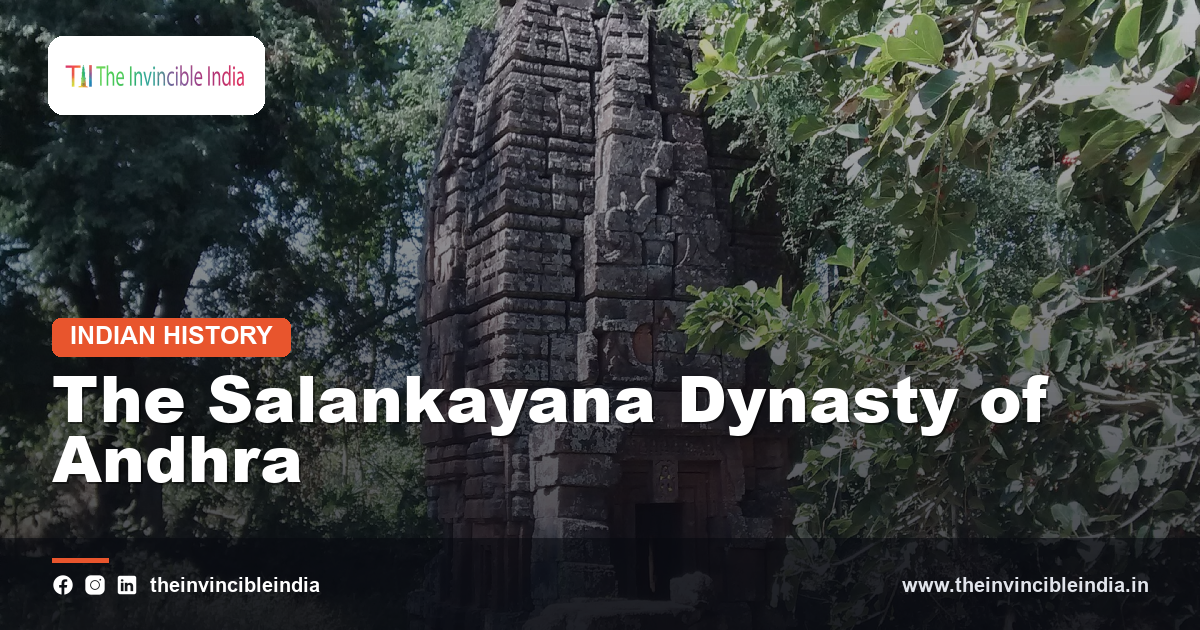
The Salankayana dynasty, also spelled Shalankayana or Salankayanas and often called the Salankayanas of Vengi, was a royal house that ruled the Krishna-Godavari delta region of Andhra in the early centuries of the first millennium. Their rule followed the age of the Ikshvakus and preceded the long Vengi story of the Eastern Chalukyas, and it is known mainly from copper-plate charters rather than from chronicles. Readers who enjoy the larger imperial story can compare it with our guide to the Gupta Empire, whose northern power touched the Andhra coast. Exact dates remain debated, so this guide keeps to broad terms.
Quick answer: The Salankayana dynasty was an early historic ruling family of coastal Andhra, whose capital Vengipura lay in the region between the Krishna and Godavari rivers. Its kings, most famously Hastivarman, are known from copper-plate grants and a mention in a Gupta-era pillar inscription. They worshipped a sun-linked form of the divine called Chitrarathasvamin, and their kingdom was later absorbed by neighbouring powers.
Key Takeaways
- The Salankayanas ruled the Vengi country, the fertile land between the Krishna and Godavari rivers in Andhra.
- Their capital, Vengipura, is generally identified by scholars with the area of Pedavegi near Eluru.
- King Hastivarman is widely identified with the Vengi ruler named in the Gupta-era Allahabad Pillar inscription.
- Most of what is known comes from copper-plate land grants, not from a surviving royal chronicle.
- The dynasty’s kings declared devotion to Chitrarathasvamin, a deity associated with solar and Vishnu worship.
- The exact chronology of the Salankayana rulers is debated among historians.
Read on for the history, culture, and legacy in detail.
Quick Facts
| Detail | Information |
|---|---|
| Dynasty | Salankayana dynasty (Salankayanas of Vengi) |
| Region | Vengi country between the Krishna and Godavari rivers, Andhra |
| Capital | Vengipura, identified with the Pedavegi area near Eluru |
| Era | Early centuries of the first millennium CE, with dates debated |
| Best-Known King | Hastivarman |
| Chief Deity | Chitrarathasvamin |
Who Were the Salankayanas?
The Salankayanas were a ruling family of coastal Andhra who governed the Vengi region after the decline of the Ikshvaku kingdom of the Krishna valley. They took their name from a gotra, or Brahmanical clan lineage, called Salankayana, and their charters proudly record that connection. Unlike the imperial houses of the north, they ruled a regional kingdom whose strength rested on the rich delta lands. Their inscriptions show a confident court that issued grants in the name of a Maharaja and invoked divine favour for its rule. Because no royal chronicle survives, the dynasty is reconstructed from stone and copper records. The Salankayanas therefore stand as a link between the older Satavahana and Ikshvaku world and the later medieval kingdoms of Andhra.
Where Was the Salankayana Kingdom Located?
The Salankayana kingdom lay in the Vengi country, the broad coastal plain between the Krishna and Godavari rivers in present-day Andhra Pradesh. This delta region is among the most fertile in the subcontinent, watered by two great rivers and by a network of channels that supported rice cultivation and dense settlement. Its position on the Bay of Bengal also gave access to coastal trade, even though the Salankayana charters speak mostly of land and villages. To the north lay the Kalinga country, to the south the Pallava and Vishnukundin zones, and to the west the interior Deccan. This setting explains why many powers sought control of Vengi for centuries. The geography of the delta shaped both the wealth and the vulnerability of the dynasty.
What and Where Was Vengipura?
Vengipura was the capital city of the Salankayana kings, and it gave its name to the wider Vengi region. Many scholars identify it with the site of Pedavegi near Eluru in the Godavari delta area, where mounds and scattered remains indicate an early settlement. The name Vengi, later attached to the Eastern Chalukya realm, preserves memory of this old centre. Charters of the dynasty were issued from Vengipura, which shows that it functioned as the seat of royal authority and record-keeping. Excavated evidence from the site remains modest compared with major urban centres of the age, so the city is understood mostly through texts. Vengipura thus survives as a name and a mound, but also as the foundation of a regional identity that endured long after the dynasty.
How Did the Salankayanas Rise After the Ikshvakus?
The Salankayanas rose in the political space left when the Ikshvaku power of the Krishna valley weakened, and they established control over the Vengi country. Their earliest rulers appear to have begun as local lords who gradually asserted the title of Maharaja. This pattern matches the wider age, when the great Satavahana order had given way to many smaller kingdoms across the Deccan. The exact moment and manner of the transition are not recorded in any surviving narrative, and scholars reconstruct it from the sequence of grants. The dynasty built its authority through land donations, alliances with learned families and careful balance among rival neighbours. In short, the Salankayanas filled a regional vacuum and turned it into a durable kingdom.
Who Was Hastivarman of Vengi?
Hastivarman is the best-known Salankayana king, widely identified with the ruler of Vengi mentioned in the Allahabad Pillar inscription of the Gupta emperor Samudragupta. That inscription lists southern kings whom the Gupta ruler is said to have defeated and then restored, and it names Hastivarman of Vengi among them. The identification is accepted by many historians because the name and the place match the Salankayana record. It gives the dynasty a rare external anchor, linking Vengi to the larger politics of the fourth century in general terms. Beyond this mention, little is recorded about Hastivarman’s personal reign, and his copper-plate grants are the main sources. His name therefore connects a regional kingdom of Andhra to the wider history of the Gupta age.
Which Kings Followed Hastivarman?
Later Salankayana rulers, among them kings named Nandivarman and Chandravarman in the grants, continued the line from Vengipura. Their inscriptions mention queens, officials and religious donations, and they preserve titles of the kind used by Deccan kings of the period. Historians disagree about the exact order of some rulers and about how many generations the dynasty counted, because the plates are not all dated in a clear era. Some grants are dated by regnal years only, which makes absolute dating difficult. What the records do show is a family that held the Vengi country through several reigns and maintained a stable pattern of rule. The succession story is thus incomplete, but the continuity of the dynasty is well supported.
What Do the Copper-Plate Grants Reveal?
The copper-plate grants are the heart of the Salankayana record, and they reveal how the kingdom was governed, funded and justified. Each charter records a gift of land or a village, often to Brahmins or religious institutions, and it names the donor, the territory and the officers charged with carrying out the order. Sanskrit and Prakrit forms appear in the surviving plates, reflecting a language shift that affected much of early India. The grants also describe boundaries by local landmarks, which gives modern scholars valuable information about place names and settlement patterns. They show a court that thought of land donation as the main instrument of piety and legitimacy. These plates are thus not only legal documents but also the principal window into Salankayana life.
Why Did the Salankayanas Worship Chitrarathasvamin?
The Salankayana kings described themselves as devotees of Chitrarathasvamin, a deity usually understood as a form of the sun god or as a manifestation linked with Vishnu. Their charters open with an invocation of this god, and the royal title claims the favour of the divine feet. Scholars note that sun worship and Vaishnava devotion often overlapped in the period, so the exact theology is not fully clear. A shrine of this deity probably stood at or near the capital and may have received royal patronage, although its remains have not been securely identified. The choice of Chitrarathasvamin shows that the dynasty linked kingship with a visible, radiant divine power. The cult remains one of the most distinctive features of Salankayana religion.
How Was the Salankayana Kingdom Administered?
The Salankayana kingdom was administered through a hierarchy of royal officers who managed territorial divisions and carried out the king’s orders. The charters mention districts, often called rashtra or ahara in the general terminology of the age, along with village headmen and local assemblies. Officials such as ministers, commanders and record keepers are named in some grants, and royal princes sometimes appear as witnesses or executors. Revenue came mainly from agriculture, supplemented by levies and trade, and land grants were exempted from many dues. This system resembled that of neighbouring Deccan kingdoms, which shared administrative vocabulary. The result was a practical, land-based government that suited a delta kingdom and kept the dynasty stable through several reigns.
Language, Script and Literature of the Salankayana Age
The Salankayana charters illustrate the movement of Andhra from Prakrit toward Sanskrit as the language of royal documents. Earlier Satavahana and Ikshvaku inscriptions used Prakrit, while many Salankayana records use Sanskrit, sometimes with Prakrit features, written in southern forms of the Brahmi script. This development mirrors the wider shift in India, where Sanskrit became the preferred language of courtly prose and inscriptions. Telugu words occasionally appear in place names and boundary descriptions, which hints at the spoken language of the countryside. No major literary work of the dynasty survives, but the quality of the charters suggests trained court scribes. The language of the plates therefore records a turning point in the written culture of Andhra.
Art, Architecture and the Krishna-Godavari Heritage
The Salankayana age sits within a rich artistic heritage of the Krishna-Godavari region, though surviving monuments securely tied to the dynasty are few. The region was already famous for the Buddhist centres of Amaravati and Nagarjunakonda, whose sculpture and stupas belonged to the earlier Satavahana and Ikshvaku age. Brahmanical temples and shrines were growing in importance during the Salankayana period, and the dynasty’s patronage of Vaishnava and sun-linked worship fits that trend. Terracotta figures, coins and small finds from coastal Andhra supplement the picture. Because many early temples were rebuilt or lost, the physical record is thin. The artistic setting of Vengi is therefore best understood as part of a continuous regional tradition rather than the product of one dynasty.
What Was the Relationship with the Guptas, Pallavas and Vishnukundins?
The Salankayanas dealt with powerful neighbours by combination of resistance, submission and alliance, as the Gupta mention of Hastivarman suggests. To the south, the Pallavas of Kanchi pressed on the Andhra plains, and records of the period describe conflicts that shifted the frontier between Vengi and the Pallava realm. Later, the Vishnukundin kings of the Deccan rose as a major regional power in the Andhra country and contributed to the decline of the older dynasties. Each of these powers valued the Vengi delta for its wealth. Historians reconstruct the diplomacy from inscriptions, but they warn that the picture is fragmentary. The Salankayanas thus lived in a crowded political world in which survival required constant adjustment.
How Did the Salankayana Rule End?
The Salankayana rule ended when stronger neighbouring powers overran or absorbed the Vengi country, though the exact sequence is uncertain. Pressure from the Pallavas in the south and the Vishnukundins in the Deccan is usually cited in general terms, together with the internal weakness that often follows a long succession of kings. No inscription records a final defeat, and no chronicle narrates the fall, so scholars rely on the disappearance of the dynasty’s grants and the appearance of new ruling houses. The Vengi country passed into other hands but kept its identity as a distinct region. Later dynasties continued to use its name and its administrative traditions. The end of the Salankayanas was therefore a change of rulers rather than a break in regional history.
Why Do Historians Debate Salankayana Chronology?
Historians debate Salankayana chronology because the surviving charters give few firm dates and often use regnal years without a fixed calendar era. Without a continuous king list, scholars compare handwriting, titles and language across the plates to arrange them in sequence. The Allahabad Pillar mention of Hastivarman provides one anchor, but some scholars question whether every inscription of that name belongs to the same king or lineage. Others debate whether the dynasty had a single line or a series of branches. These disagreements do not erase the dynasty from history, but they explain why careful writers describe its period in broad terms. The debate is a reminder of how much early Indian history depends on a small number of preserved documents.
How Did the Salankayanas Shape Later Vengi?
The Salankayanas helped establish Vengi as a recognised political and cultural unit, and later dynasties built on that legacy. The name Vengi survived for centuries and became the title of the Eastern Chalukya kingdom, whose rulers governed the Godavari and Krishna country from their own capitals. The tradition of issuing land grants on copper plates, the use of Sanskrit in royal charters and the pattern of temple patronage all continued in the same region. Telugu culture, which flowered under the later Chalukyas and Kakatiyas, grew in a landscape already shaped by early dynasties such as this one. The Salankayanas are therefore not isolated figures but early builders of Andhra’s regional identity.
The Salankayana Dynasty Today
The Salankayana dynasty is remembered today mainly through the work of epigraphists, archaeologists and historians of early Andhra, rather than through monuments or popular legend. Their copper plates are studied in universities and museums, where they help scholars map the political history of the early Deccan. Local interest in sites such as Pedavegi keeps the memory of Vengipura alive, and Andhra’s wider heritage trails include the nearby Buddhist and temple sites. For the general reader, the dynasty offers a lesson in how history is pieced together from small, durable documents. It also shows the importance of regional kingdoms, which connected the great imperial eras of ancient India. The Salankayana legacy lies in that quiet but essential role.
Sources & Further Reading
- Archaeological Survey of India (asi.nic.in).
- Ministry of Culture, Government of India (indiaculture.gov.in).
Frequently Asked Questions
Who were the Salankayanas?
The Salankayanas were a ruling dynasty of the Vengi region of coastal Andhra, between the Krishna and Godavari rivers. They governed from Vengipura in the early centuries of the first millennium and are known mainly from copper-plate grants.
Where was Vengipura located?
Vengipura is generally identified with the area of Pedavegi near Eluru in Andhra Pradesh. Mounds and remains in the Godavari delta area support the identification, though excavation has been limited.
Who was the most famous Salankayana king?
Hastivarman is the most famous Salankayana king, widely identified with the Vengi ruler named in the Allahabad Pillar inscription of Samudragupta. Details of his personal reign are limited, and his grants are the main source.
What deity did the Salankayana kings worship?
The Salankayana kings worshipped Chitrarathasvamin, a deity understood as a form of the sun god or linked with Vishnu. Their charters invoke this god at the opening of each grant.
How do we know about the Salankayanas?
We know about the Salankayanas chiefly from their copper-plate grants and from the mention of Hastivarman in a Gupta-period inscription. No royal chronicle survives, so historians reconstruct the dynasty from these records.
What happened to the Salankayana kingdom?
The Salankayana kingdom was eventually absorbed by stronger neighbours such as the Pallavas and Vishnukundins, although the exact sequence is uncertain. The name Vengi lived on and later became associated with the Eastern Chalukyas.


