

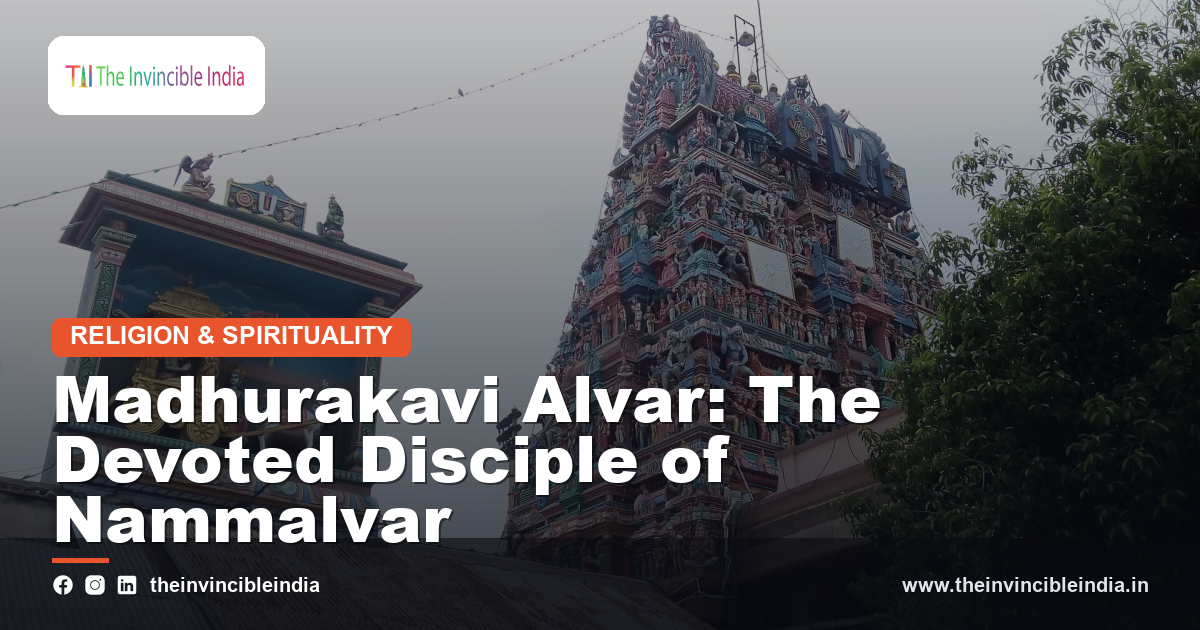
Madhurakavi Alvar, also spelled Madhurakavi Azhwar, Madhurakaviyar or Madurakavi, is one of the twelve Alvars, the Tamil saints who sang the praise of Vishnu. He is remembered as the devoted disciple of Nammalvar and is known for Kanninun Siruttambu, a short work of eleven verses that praises his teacher instead of the deity directly. By tradition he was born in Tirukkolur in the Pandya country of Tamil Nadu, and his story is part of the larger world of Vaishnavism, though many details come from tradition.
Quick answer: Madhurakavi Alvar is one of the twelve Alvars, the Tamil Vaishnava saints, and is remembered as the devoted disciple of Nammalvar, born by tradition at Tirukkolur in Tamil Nadu. His short work Kanninun Siruttambu, eleven verses in praise of his teacher, is included in the Nalayira Divya Prabandham. He is honoured for showing that devotion to a guru can be a path to the divine.
Key Takeaways
- Madhurakavi Alvar is one of the twelve Alvars, the Tamil Vaishnava saints of the early medieval period.
- He is remembered as the disciple of Nammalvar and is traditionally said to have been born at Tirukkolur in the Pandya country.
- His only surviving work, Kanninun Siruttambu, has eleven verses and praises his teacher, not the deity directly.
- The work is included in the Nalayira Divya Prabandham, the collection of four thousand verses sacred to Tamil Vaishnavas.
- His story is linked with Azhwarthirunagari, also called Tirukkurukur, the home of Nammalvar.
- Accounts of his life, including the story of the light in the south, are tradition and sacred narrative, not documented history.
The sections below explain the life, works, teachings and continuing legacy in more detail.
Quick Facts
| Detail | Information |
|---|---|
| Also known as | Madhurakavi Azhwar, Madhurakaviyar |
| Tradition | Sri Vaishnavism, one of the twelve Alvars |
| Birthplace | Tirukkolur, Tamil Nadu, by tradition |
| Teacher | Nammalvar of Azhwarthirunagari |
| Era | Early medieval period, exact dates debated |
| Language | Tamil |
| Work | Kanninun Siruttambu, eleven verses |
| Collection | Nalayira Divya Prabandham |
Who Was Madhurakavi Alvar?
Madhurakavi Alvar was a Tamil saint and poet who is counted among the twelve Alvars and who is revered above all as the devoted disciple of Nammalvar. He is remembered as a scholar who gave up everything for the sake of his teacher and who expressed his devotion in a short, heartfelt poem.
Very little about his life can be proved by documents. What survives is a brief poem and a rich tradition of stories told in the Sri Vaishnava community. For this reason, careful writers describe him as a saint of tradition and speak of his importance in general terms. His fame rests on the poem itself and on the example of loyalty that his story teaches.
What Does the Name Madhurakavi Mean?
The name Madhurakavi is made of two Sanskrit-derived words, madhura, meaning sweet, and kavi, meaning poet, and it is usually understood as the sweet poet. The word Alvar means one who is immersed in devotion, the title given to all twelve Tamil Vaishnava saints.
In writing the name appears as Madhurakavi, Madhurakavi Azhwar and Madhurakaviyar, depending on the transliteration, and the Tamil form often has the honorific ending ar. These variants help readers recognise the same saint in books and temple inscriptions. The meaning of the name suits a poet whose single work is known for its warm and tender tone.
Where Was Madhurakavi Alvar Born?
Madhurakavi Alvar is traditionally said to have been born at Tirukkolur, a village in the Pandya region of southern Tamil Nadu, near the banks of the Tamiraparani river. The town of Tirukkolur is a sacred site of Sri Vaishnavism, and its temple is counted among the Divya Desams, the holy shrines praised by the Alvars.
The Pandya country was a centre of Tamil culture and learning, and the neighbourhood of Tirukkolur is close to Azhwarthirunagari, the home of Nammalvar. This closeness gave the future disciple a natural path to his teacher. The link between birthplace and the saint’s memory is kept alive by the temple and by local devotion.
When Did He Live?
Madhurakavi Alvar is placed in the early medieval period of Tamil history, in the age of the Alvars, which is generally set between the sixth and ninth centuries, though firm dates are not accepted by all scholars. He is remembered as a contemporary or near contemporary of Nammalvar.
The Alvars are an important chapter of the Bhakti movement in South India, and the order and dates of the twelve are discussed by historians in different ways. Careful writers therefore state only the broad period. The uncertainty is common for saints whose stories were carried by memory and worship, and it does not reduce the respect given to the saint by his community.
Who Was Nammalvar?
Nammalvar is one of the greatest of the Alvars, a Tamil saint and poet of Azhwarthirunagari, also called Tirukkurukur, who composed the Tiruvaymozhi and other works that form a large part of the Nalayira Divya Prabandham. He is revered by Sri Vaishnavas as the foremost of the Alvars.
The name Nammalvar means our own Alvar, a title of affection given by the community. Tradition says that he spent his early life in silent meditation beneath a tamarind tree, and it is to him that Madhurakavi turned for guidance. The guide to the Dashavatara gives more background on the forms of Vishnu who are praised in the songs of the Alvars.
What Is the Story of the Light in the South?
Tradition says that Madhurakavi, while visiting holy places in North India such as Ayodhya, saw a bright light shining in the southern sky, and that he followed it all the way to Tirukkurukur, where he found Nammalvar seated in meditation. The light is understood as a sign of the guru’s spiritual presence.
This story is part of sacred legend and is told with variations. It should be read as tradition, not as historical fact. Its meaning is that the true teacher draws the sincere seeker from afar, and that guidance comes to those who follow the signs of devotion. The tale is one of the most beloved in the Sri Vaishnava community and is retold at festivals.
What Did Nammalvar Say When They First Met?
Tradition says that Nammalvar was silent when Madhurakavi found him, and that the disciple broke the silence by asking a deep question about the nature of the soul when it is joined with matter, to which the teacher replied with a short answer that satisfied him. This exchange is told as the beginning of their bond.
The question and answer are understood as a statement that the soul, living within the body, finds its nourishment and rest in the matter it inhabits unless it turns toward the divine. The account is part of devotional tradition and is not documented history. For the community the story marks the moment when Madhurakavi recognised his teacher and became his devoted follower.
Why Did Madhurakavi Praise His Teacher Instead of the Deity?
Madhurakavi praised his teacher instead of the deity because he regarded Nammalvar as the true source of his knowledge of Vishnu and the highest object of his reverence. In his view the one who shows the way to God deserves the first honour, and the teacher is himself a living form of grace.
This idea, called acharya bhakti, is important in Sri Vaishnavism, where devotion to the teacher is seen as the surest path to the Lord. The poem thus makes a point that the teacher is the gateway to the divine. Followers read the verses as a model of gratitude and as a reminder of the respect owed to those who guide others toward spiritual truth.
What Is Kanninun Siruttambu?
Kanninun Siruttambu is the short work of eleven verses by Madhurakavi Alvar in praise of Nammalvar, and it is the only surviving composition attributed to him. The title is taken from the opening words of the poem, which refer to a small rope, a symbol of the bond that ties the disciple to his teacher.
The verses are written in Tamil and speak of the sweetness of the name of Nammalvar, which the poet says is enough for his happiness and his path to liberation. They are included in the Nalayira Divya Prabandham and are recited in temples and homes. Their brevity and warmth make them well loved, and they hold a special place among the Alvar compositions.
What Is the Nalayira Divya Prabandham?
The Nalayira Divya Prabandham is the sacred collection of about four thousand Tamil verses composed by the twelve Alvars, and it is revered by Sri Vaishnavas as the Tamil Veda. The collection praises Vishnu and the shrines known as Divya Desams, and it is recited in temples throughout Tamil Nadu and beyond.
Madhurakavi’s eleven verses are included in the collection, although they praise the teacher rather than the deity. This shows how deeply the community values the teacher-disciple bond. The collection is arranged in sections, and its recitation forms part of daily and festival worship. Understanding it helps readers see why each Alvar, including Madhurakavi, holds an honoured place.
How Did Madhurakavi Help Preserve Nammalvar's Works?
Tradition says that Madhurakavi helped to record and spread the songs of Nammalvar, and that after the teacher attained the divine, the disciple ensured that his verses lived on in the community. In this role he acted as a guardian of the teacher’s legacy.
Later accounts also speak of the teacher Nathamuni, who is said to have recovered the verses of the Alvars through devotion and brought them into regular use. These stories belong to tradition and are told with variation, so they are best stated in general terms. The shared point is that devoted disciples ensured the survival of the songs, and Madhurakavi is honoured as the first of them.
What Is Azhwarthirunagari?
Azhwarthirunagari, also called Alwarthirunagari or Tirukkurukur, is a temple town in the Thoothukudi district of Tamil Nadu and the home of Nammalvar, and it is closely tied to the memory of Madhurakavi. The town has a famous Vishnu temple and a sacred tamarind tree that tradition links with the teacher.
Pilgrims visit the town to honour Nammalvar and his disciple, and the temple is counted among the Divya Desams. The place thus forms a living centre of the story told in this guide. Readers who wish to learn about pilgrim customs more widely can consult the guide to pilgrimage in India for the general background.
How Is Madhurakavi Alvar Honoured Today?
Madhurakavi Alvar is honoured in Vaishnava temples, especially at Azhwarthirunagari and Tirukkolur, through festivals, recitation of his verses and a special day marked in the Tamil month of Chithirai by tradition. Images of him are placed in many temples beside those of the other Alvars.
Devotees recite Kanninun Siruttambu at the start of the recitation of the Divya Prabandham in several traditions, reflecting the honour in which he is held. The details of observance vary by temple and community, and they follow long-standing local custom. His memory is thus part of daily religious life and not only of history, and it continues to inspire gratitude toward teachers.
What Is the Teaching of Devotion to the Guru?
The teaching associated with Madhurakavi is that devotion to the guru is a complete spiritual path in itself, and that gratitude toward the teacher leads to the same goal as devotion to God. His verses express the joy of finding a guide and the peace that comes from complete trust.
This message has a wide appeal beyond one tradition, since respect for teachers is a deep value in Indian culture. The poem shows that spiritual life is not lonely, because it depends on a living relationship. By choosing to honour his teacher, the poet gave a lasting example of humility, and his short work remains a gentle lesson in loyalty and love.
Why Does Madhurakavi Alvar Matter in Indian Culture?
Madhurakavi Alvar matters because he represents the teacher-disciple ideal that lies at the heart of Indian spiritual life, and because his eleven verses are a precious part of Tamil devotional literature. He shows that a single short poem can carry a message of great depth.
His story also enriches the cultural life of Tirukkolur and Azhwarthirunagari, whose temples and festivals draw pilgrims throughout the year. Scholars of Tamil and of religion study the Alvars as a major movement, and Madhurakavi’s special place within it adds a unique voice. His example of gratitude continues to speak to readers, regardless of belief.
Madhurakavi Alvar Today
Madhurakavi Alvar today is remembered in the temples of Tamil Nadu, in the recitation of Kanninun Siruttambu and in the pilgrimage to Tirukkolur and Azhwarthirunagari. His verses are chanted by devotees and taught to children as part of the Divya Prabandham tradition.
For readers, he offers a clear example of devotion expressed through respect for a teacher and of the way sacred stories are kept alive in community memory. The accounts of his life are best honoured as tradition, with respect for their sacred meaning. His short poem, sung with feeling, remains a living part of the spiritual heritage of South India.
Sources & Further Reading
- Ministry of Culture, Government of India (indiaculture.gov.in).
- Tamil Nadu Tourism, Government of Tamil Nadu (tamilnadutourism.tn.gov.in).
Frequently Asked Questions
Who was Madhurakavi Alvar?
Madhurakavi Alvar was one of the twelve Alvars, the Tamil Vaishnava saints, and the devoted disciple of Nammalvar. By tradition he was born at Tirukkolur in Tamil Nadu.
What is Kanninun Siruttambu?
Kanninun Siruttambu is a short work of eleven Tamil verses by Madhurakavi Alvar in praise of his teacher Nammalvar. It is included in the Nalayira Divya Prabandham.
Why did Madhurakavi Alvar praise Nammalvar and not Vishnu?
He regarded his teacher as the source of his knowledge of Vishnu and the highest object of reverence. This idea, called acharya bhakti, is important in Sri Vaishnavism.
Who was Nammalvar?
Nammalvar was one of the greatest Alvars, a Tamil saint of Azhwarthirunagari who composed the Tiruvaymozhi. He is revered as the foremost of the Alvars by Sri Vaishnavas.
Where is Azhwarthirunagari?
Azhwarthirunagari, also called Tirukkurukur, is a temple town in the Thoothukudi district of Tamil Nadu. It is the home of Nammalvar and a sacred centre of Sri Vaishnavism.
Is the story of the light in the south historical fact?
No, it is a tradition and sacred legend told by the Sri Vaishnava community. Respectful readers value its meaning about the pull of a true teacher and treat it as tradition.


