

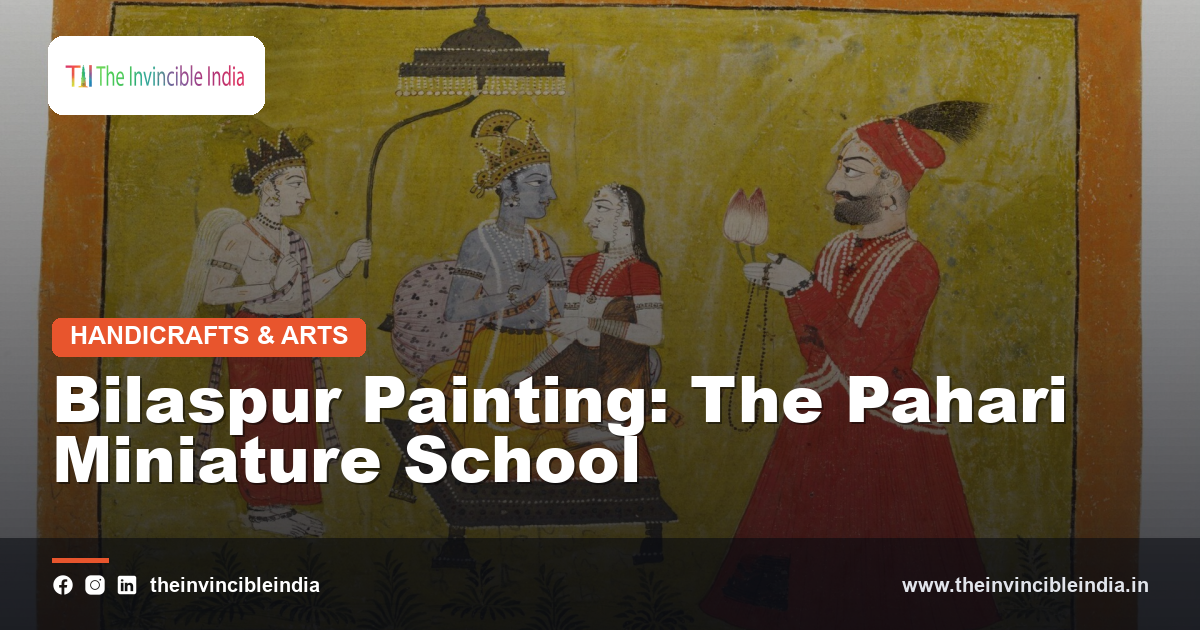
Bilaspur painting, also called Kahlur painting or the Bilaspur school of Pahari miniature art, is a refined tradition of small, opaque watercolour paintings produced at the court of the old hill kingdom of Kahlur, whose capital was Bilaspur on the River Sutlej in present-day Himachal Pradesh. It is one of the regional schools of the wider Pahari, or Punjab Hills, painting family, and it is known for early portraits that show Mughal influence and for later devotional and musical subjects. Admirers of storytelling in colour who already know the village idiom of Madhubani painting will find Bilaspur art a courtly and finely detailed counterpart. This guide describes the place, the patrons, the style, the materials and the legacy of Bilaspur painting.
Quick answer: Bilaspur painting is a school of Pahari miniature painting that flourished at the court of the Kahlur kingdom, centred on Bilaspur in the Sutlej valley of Himachal Pradesh, India. It is known for small opaque watercolour paintings on paper, including court portraits influenced by Mughal naturalism and later devotional and Ragamala scenes. The school belongs to the larger Pahari tradition of the western Himalayan foothills.
Key Takeaways
- Bilaspur painting is a regional school of Pahari miniature art from the former Kahlur kingdom, centred on Bilaspur in Himachal Pradesh.
- The school was active from about the middle of the seventeenth century into the nineteenth century, with its most distinctive work in the earlier period.
- Early Bilaspur paintings are mostly secular court portraits whose naturalism owes much to Mughal painting.
- Later work turned toward traditional subjects such as Ragamala illustrations and devotional scenes, and was strongly influenced by Guler and Kangra styles.
- Bilaspur miniatures are painted in opaque watercolour on paper, often with gold and fine linework.
- Important examples of Bilaspur painting are preserved in museums, and the school is studied as part of the Pahari tradition of India.
The sections below explain where the school arose, who supported it, how it was painted and why it still matters.
Quick Facts
| Detail | Information |
|---|---|
| Art form | Pahari miniature painting |
| Place of origin | Bilaspur, former Kahlur kingdom, Himachal Pradesh |
| Also known as | Kahlur painting, Bilaspur school |
| River region | Sutlej valley, Punjab Hills |
| Active period | Mid-seventeenth to nineteenth century |
| Medium | Opaque watercolour on handmade paper |
| Early influence | Mughal naturalism and portraiture |
| Significance | A distinct regional branch of Pahari art |
What Is Bilaspur Painting?
Bilaspur painting is a regional school of miniature painting that grew up at the court of the Kahlur kingdom in the western Himalayan foothills. Its works are small in scale, painted in opaque watercolour on paper and meant to be held in the hand or viewed in an album. The paintings include portraits of rulers, scenes of court life, Ragamala musical illustrations and episodes from devotional literature. Art historians group it with the other hill schools such as Basohli, Guler and Kangra under the name Pahari painting. Bilaspur work is valued for its careful line, its balanced composition and the way it joins courtly refinement with the colours of the hills. The school is therefore an important chapter in the story of Indian miniature art.
Where Is Bilaspur and What Was the Kahlur Kingdom?
Bilaspur is a town and district in Himachal Pradesh, lying along the River Sutlej in the lower Himalaya, and it was the capital of the old hill state of Kahlur. The kingdom was one of the many small states of the Punjab Hills, each ruled by its own hill dynasty. The old town of Bilaspur was later submerged when the Sutlej was dammed to form the Gobind Sagar reservoir, and a new town was built on higher ground. That change means much of the old courtly setting of the painters no longer stands above water. The paintings themselves therefore carry a special value as a record of a vanished court world on the Sutlej.
How Did Bilaspur Painting Begin?
Bilaspur painting began in the middle of the seventeenth century, when the rulers of Kahlur supported artists at their court. Scholars note that one early ruler, Dip Chand, who served the Mughal empire and had marital ties with other courts, is associated with the founding of a painting workshop. The first paintings were mostly portraits and court scenes, and their lifelike treatment of faces and settings reflects the naturalism of Mughal art. Artists and ideas moved between the plains and the hills, and Bilaspur absorbed what it needed while keeping a hill character. Some details of the earliest workshop remain debated, but the broad story of Mughal-influenced beginnings is widely accepted. The school thus began as a court art shaped by travelling styles.
What Is the Pahari School and Where Does Bilaspur Fit?
The Pahari school is the name given to the family of miniature painting traditions that flourished in the hill states of the western Himalaya, from the Jammu region to Garhwal. Pahari simply means of the hills. Its best known branches include Basohli, Guler, Kangra, Chamba, Mandi and Kullu, and Bilaspur sits among them as the school of the Sutlej valley. Each branch developed under its own rulers and workshops, yet all share a love of poetry, devotion and graceful line. Bilaspur is notable for its early Mughal-influenced portraits and for later borrowings from its neighbours. The school therefore belongs fully to the Pahari family while keeping a place of its own.
What Makes Bilaspur Painting Distinctive?
Bilaspur painting is distinctive for its early emphasis on secular portraiture and for its blend of Mughal naturalism with hill colour and design. Compared with the sculpture of the same region, which was largely religious, early Bilaspur paintings were mostly portraits of rulers and courtiers. The figures are drawn with attention to profile, dress and posture, and they are placed in simple, uncluttered settings. Later paintings keep the refinement of the earlier manner but move toward traditional themes. Because the school absorbed influences over time, its character is better described as a sequence of phases than as a single fixed style. That variety is part of what makes Bilaspur painting interesting to students of Indian art.
Who Supported the Painters of Bilaspur?
The painters of Bilaspur were supported mainly by the ruling family of Kahlur and by members of the court. A hill raja employed artists in the same way he kept musicians, priests and craftsmen, and he commissioned paintings as portraits, gifts and records of important events. Families of painters often worked for generations in the same service, passing skills from father to son. A museum record of one early portrait shows a Kahlur ruler listening to musicians, with an attendant holding a fan, and it carries an inscription naming him as ruler. Such works show how directly the school depended on royal interest. When courtly patronage weakened, the workshops lost their steady support.
What Subjects Did Bilaspur Artists Paint?
Bilaspur artists painted royal portraits, durbar scenes, hunting and music parties, and devotional subjects drawn from Hindu tradition. Early work favoured the ruler at ease, listening to musicians or receiving visitors. Later painters turned to Ragamala illustrations, which give visual form to musical modes, and to scenes from the life of Krishna and other divine figures. These subjects were popular across the Pahari hills because they joined poetry, music and devotion. A small painting could hold a whole narrative, with figures, architecture and landscape arranged to guide the eye. The range of subjects shows that Bilaspur painting served both the worldly and the spiritual interests of its patrons.
What Materials and Pigments Were Used?
Bilaspur miniatures were painted with natural pigments on handmade paper. Colours came from minerals, plants and other natural sources, ground fine and mixed with a binding medium to make opaque watercolour. Sheets of paper were often layered and burnished until smooth, so that the surface could take fine lines and flat colour without soaking. Thin leaf of gold or silver was used for ornaments, jewellery and highlights. Brushes were made with very fine hair so that a single stroke could draw an eyelash or a strand of a beard. These simple, natural materials explain why many old paintings still keep strong colour. The craft was therefore both an art of the eye and an art of careful preparation.
How Is a Pahari Miniature Painted Step by Step?
A Pahari miniature such as a Bilaspur painting is built up in stages. The artist first prepares the paper and sketches the composition in a light outline, often in a thin brown or black line. Large areas of flat colour are then laid in for the ground, sky, architecture and garments. After this the painter adds layers of detail, such as patterns on cloth, ornaments, faces and hands, and finally burnishes or refines the surface. Gold and silver are applied last in many works. Each stage requires patience and a steady hand, and a skilled workshop might divide tasks between a master and his assistants. The method gives the finished painting its clean outlines and jewel-like finish.
How Do Colour, Line and Composition Work in Bilaspur Painting?
Colour, line and composition in Bilaspur painting work together to create calm, readable scenes. Lines are fine and controlled, outlining faces, hands and garments with clarity. Colours are laid in clear, flat fields, with contrasting hues placed side by side so that the main figure stands out. Compositions are usually simple, with a few figures arranged against a plain or lightly decorated background, which keeps the viewer focused on the subject. In the early portraits the stress falls on character and bearing, while in later work the setting and mood become richer. The result is a measured, dignified manner that suits a court art made for private enjoyment.
Why Do Ragamala and Devotional Themes Matter?
Ragamala and devotional themes matter because they show how Bilaspur painting joined art with music and faith. Ragamala paintings illustrate the ragas of Indian classical music, giving each musical mode a human scene, mood and season. Devotional paintings illustrate stories of Krishna, Rama and other deities, often inspired by well known texts. By painting these subjects, Bilaspur artists took part in a wider hill tradition in which poetry, song and image were closely linked. The themes also allowed the painters to show landscapes, architecture and emotion in a way portraits did not. These paintings therefore reveal the cultural world in which the court of Kahlur lived.
How Did the Style Change and Decline?
The Bilaspur style changed over time as outside influences entered the workshops, and it declined in the early nineteenth century. By the end of the eighteenth century, the nearby schools of Guler and Kangra exerted a strong influence on Bilaspur painters, softening the earlier manner. In the first decades of the nineteenth century, the work showed little connection to its origins, and the school faded. Political change in the hills and the loss of royal patronage helped bring this about, as did changing tastes. The pattern is common among Pahari schools, whose fortunes rose and fell with their courts. Bilaspur painting thus had a life of roughly two centuries as a distinct tradition.
How Does Bilaspur Painting Compare with Other Pahari Schools?
Bilaspur painting differs from other Pahari schools in its history and its early character. Basohli painting is known for bold colour and strong, stylised faces, while Guler and Kangra developed a softer, more lyrical manner with delicate landscapes. Bilaspur began with Mughal-influenced portraits and only later took on traditional devotional and musical themes, absorbing Guler and Kangra influence along the way. The schools share materials, methods and a love of Krishna and Ragamala subjects, which is why they are grouped together. Comparing them helps viewers see that Pahari art is not one style but a family of related regional voices. Bilaspur contributes the voice of the Sutlej valley to that family.
Where Can You See Bilaspur Paintings?
Bilaspur paintings are preserved in museum and private collections in India and abroad. Major museums that hold Pahari art often include examples from the Kahlur school, and some have published catalogue records identifying the ruler and the subject. In Himachal Pradesh, museums and cultural institutions display Pahari miniatures and give context about the hill kingdoms. Viewers who cannot travel can often study digitised collections online. Seeing an original painting shows qualities that reproductions lose, such as the gloss of burnishing and the gleam of gold. Because miniatures are delicate, they are usually shown in controlled light. Museums are therefore the best place to meet Bilaspur painting in person.
How Is the Pahari Miniature Tradition Kept Alive?
The Pahari miniature tradition is kept alive today by artists, teachers and cultural institutions in Himachal Pradesh and elsewhere. Contemporary painters study old works, prepare natural pigments and learn the stages of miniature painting, often under senior artists. Workshops and exhibitions introduce the style to new audiences, and craft and art bodies support training. Some artists paint in the manner of a particular Pahari school, while others adapt its sense of line and colour to new work. It is important that modern copies be described honestly, so that buyers know the difference between an old painting and a recent one. Careful teaching and fair labelling help the tradition continue with integrity.
Bilaspur Painting Today
Bilaspur painting today is valued as a significant part of India’s Pahari miniature heritage and as a window on the old Kahlur court. Scholars, museums and collectors study the school for its early portraits and its blend of Mughal and hill influences. The submerged old town of Bilaspur gives the paintings an added poignancy, since they record a world now beneath the reservoir. Readers can explore the subject by visiting museums, reading about Pahari art and looking closely at the line, colour and composition of surviving works. Bilaspur painting reminds modern viewers that small hill kingdoms produced art of lasting beauty. The school remains a quiet but important voice in Indian art history.
Sources & Further Reading
- Ministry of Culture, Government of India (indiaculture.gov.in).
- National Museum, New Delhi (nationalmuseumindia.gov.in).
Frequently Asked Questions
What is Bilaspur painting?
Bilaspur painting is a regional school of Pahari miniature art from the old Kahlur kingdom, centred on Bilaspur in the Sutlej valley of Himachal Pradesh. It is painted in opaque watercolour on paper and includes court portraits, Ragamala illustrations and devotional scenes. The school is part of the wider Pahari tradition of the western Himalayan foothills.
Where does Bilaspur painting come from?
Bilaspur painting comes from Bilaspur, the former capital of the Kahlur hill state on the River Sutlej in Himachal Pradesh. The old town was later submerged by the Gobind Sagar reservoir, and a new Bilaspur was built nearby. The paintings were made at the court of the Kahlur rulers.
When was Bilaspur painting active?
Bilaspur painting was active from about the middle of the seventeenth century into the early nineteenth century. Its most distinctive work comes from the earlier period, while later painting was strongly shaped by Guler and Kangra styles. The school declined in the first decades of the nineteenth century.
How is Bilaspur painting different from Kangra painting?
Bilaspur painting is different because it began with Mughal-influenced portraits and only later took up devotional and musical themes. Kangra painting is known for a soft, lyrical manner and delicate landscapes. By the end of the eighteenth century, Kangra and Guler influence had become strong in Bilaspur itself.
What materials are used in Bilaspur miniature painting?
Bilaspur miniatures are painted with natural pigments mixed with a binder, applied on handmade paper that is often layered and burnished. Gold and silver are used for ornaments and highlights. Very fine brushes allow the delicate linework typical of Pahari miniatures.
Where can I see Bilaspur paintings?
Bilaspur paintings can be seen in museums and collections in India and abroad that hold Pahari miniatures, and many can be studied through online catalogues. Museums in Himachal Pradesh also display Pahari art. Original works are delicate, so they are usually shown in controlled light.


