

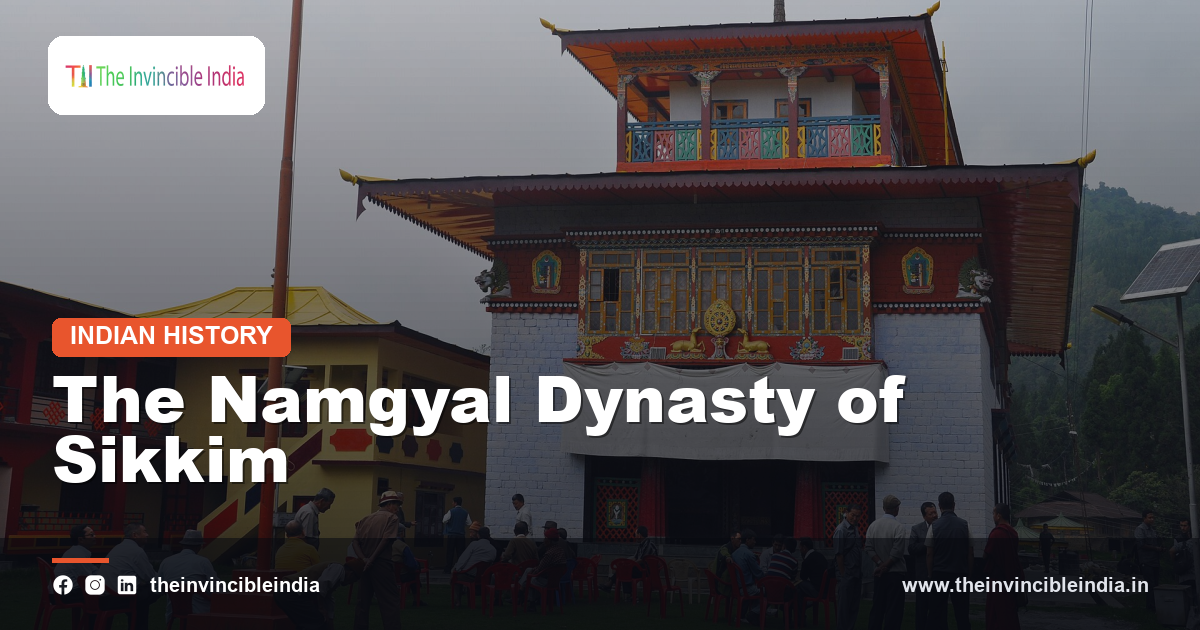
The Namgyal dynasty of Sikkim, also called the Chogyal dynasty or the royal house of Sikkim, was the Buddhist monarchy that ruled the small Himalayan kingdom of Sikkim from the seventeenth century until the twentieth. Its kings bore the title Chogyal, meaning a righteous king who rules according to the dharma, and they governed a land of Lepcha, Bhutia and later Nepali communities. The dynasty’s story is one of mountain diplomacy among Tibet, Bhutan, Nepal and British India, a world unlike the plains empires in our history of the Maratha Empire. Some early details rest on tradition, so this guide keeps to general terms.
Quick answer: The Namgyal dynasty was the royal family of Sikkim, founded in the seventeenth century when Phuntsog Namgyal was consecrated as the first Chogyal, or religious king, at Yuksom. The dynasty ruled a Buddhist Himalayan kingdom, moved its capital several times and made treaties with Tibet and the British. Its rule ended when Sikkim merged with India in the 1970s and became a state of the Indian Union.
Key Takeaways
- The Namgyal dynasty founded the kingdom of Sikkim in the seventeenth century, with Phuntsog Namgyal as the first Chogyal.
- The first coronation took place at Yuksom, which is remembered as Sikkim’s first capital.
- The title Chogyal means a king who rules in accordance with Buddhist law.
- The capital moved over time from Yuksom to Rabdentse, Tumlong and finally Gangtok.
- The dynasty ruled through treaty relations with Tibet, Bhutan, Nepal and later British India.
- The monarchy ended when Sikkim became an Indian state in the mid-1970s.
Read on for the history, culture, and legacy in detail.
Quick Facts
| Detail | Information |
|---|---|
| Dynasty | Namgyal dynasty (Chogyal dynasty) of Sikkim |
| Region | Sikkim, eastern Himalaya |
| Title of Rulers | Chogyal, meaning dharma king |
| Founder | Phuntsog Namgyal, first Chogyal |
| Capitals | Yuksom, Rabdentse, Tumlong, Gangtok |
| End of Monarchy | Merger with India in the mid-1970s |
Who Were the Namgyals of Sikkim?
The Namgyals were the hereditary rulers of Sikkim, a small Buddhist kingdom in the eastern Himalaya whose kings held the title Chogyal. Their line began in the seventeenth century with Phuntsog Namgyal, who is regarded as the founder of the Sikkimese monarchy, and it continued through a series of kings until the twentieth century. The family belonged to the Bhutia community, whose roots are linked to Tibetan migration into the hills, and it ruled over Lepcha, Bhutia and Nepali subjects. Their authority combined political leadership with religious sanction from Tibetan Buddhist teachers. Because the early chronology draws on tradition, historians use broad terms for the first generations. The Namgyals thus created and sustained a distinctive Himalayan state for roughly three centuries.
Where Is Sikkim and Why Does Its Position Matter?
Sikkim is a mountain state in north-eastern India, bordered by Nepal, Tibet and Bhutan, and its position made it a gateway between the plains of India and the Tibetan plateau. The kingdom lay in the shadow of Kangchenjunga, one of the highest peaks in the world, which Sikkimese tradition reveres as a guardian deity. Passes such as Nathu La and Jelep La connected it with Tibetan trade routes. These routes carried wool, salt, tea and textiles, and they gave the small kingdom strategic importance far beyond its size. Its rivers, forests and terraced valleys supported a varied agricultural life. The geography of Sikkim therefore shaped both its culture and its place in regional diplomacy.
Who Were the Lepchas and Bhutias in Sikkim's Story?
The Lepchas are regarded as the earliest known inhabitants of Sikkim, and the Bhutias are Tibetan-origin settlers whose leaders became its kings. Lepcha tradition speaks of a close bond with the land, its forests and Kangchenjunga, and their language and customs remain central to Sikkimese identity. The Bhutias arrived later and brought Tibetan Buddhism, which became the court religion. Tradition recalls a blood-brotherhood treaty between Lepcha and Bhutia leaders that shaped early political relations, although details are told in legend. Nepali-speaking settlers arrived in large numbers in the nineteenth century, adding a third major community. Sikkimese society is thus a layered meeting of peoples, and the monarchy was built upon that plurality.
How Was the First Chogyal Consecrated at Yuksom?
The first Chogyal was consecrated at Yuksom by three Tibetan Buddhist lamas who are remembered as the founding fathers of the kingdom. Tradition names them as Lhatsun Chenpo, Kathog Rigzin Chenpo and Ngadak Sempa Chenpo, who came to Sikkim and chose Phuntsog Namgyal as king. The ceremony gave the new ruler both religious and political legitimacy, and it set the pattern of a king who is also a protector of the faith. Yuksom, meaning meeting place of the three lamas, remains a place of pilgrimage, with a coronation throne preserved as a heritage site. Exact details of the event are handed down through tradition rather than contemporary documents. Yuksom therefore stands as the symbolic birthplace of the Sikkimese state.
What Role Did Phuntsog Namgyal Play?
Phuntsog Namgyal was the first Chogyal and the founder of the dynasty, remembered as the ruler who organised Sikkim into a unified kingdom. Tradition credits him with dividing the country into administrative units, building the first structures of governance and spreading Buddhist institutions through the land. He is also credited with establishing relations with neighbouring powers, especially Tibet, whose religious influence shaped the court. Later Sikkimese writers treat him as a model king, a protector of dharma and a unifier of Lepcha and Bhutia communities. Specific dates and reforms are preserved in traditional accounts, and historians treat them with care. His memory remains strong because he gave the dynasty its name, its title and its sacred purpose.
Why Did the Capital Move from Yuksom to Gangtok?
The capital moved several times as the kingdom changed, from Yuksom to Rabdentse, then to Tumlong and finally to Gangtok. Rabdentse, on a ridge in West Sikkim, became a major centre in the later seventeenth and eighteenth centuries, and its ruins can still be visited. Tumlong served as a capital in the nineteenth century, when the royal court looked to a more central location. Gangtok emerged as the capital in the later nineteenth century, a change linked to growing trade and British interest in the Himalayan frontier. Each move reflected military pressure, administrative convenience or shifting alliances. The sequence of capitals traces the historical journey of the Namgyal state from a Buddhist foundation to a modern frontier kingdom.
What Is Pemayangtse Monastery?
Pemayangtse Monastery is one of the oldest and most important Buddhist monasteries of Sikkim, and it has long been linked with the royal house. It follows the Nyingma tradition, the oldest school of Tibetan Buddhism, and stands on a ridge near Pelling in West Sikkim with views toward Kangchenjunga. Tradition connects its founding with Lhatsun Chenpo, and monks of the monastery historically held a special role in royal ceremonies. A famous wooden model of the heavenly palace of Guru Padmasambhava is preserved inside. The monastery is a living centre of prayer and mask dance festivals. Pemayangtse shows how the Namgyal kings tied their rule to Buddhist institutions and learning.
What Is the Importance of Rumtek and Tashiding Monasteries?
Rumtek and Tashiding are two of Sikkim’s best-known monasteries, and both express the religious heritage in which the dynasty ruled. Rumtek, near Gangtok, became the seat of the Karma Kagyu school in exile after the mid-twentieth century and is today a major pilgrimage centre with a large monastic community. An older monastery on the site is associated with an earlier Chogyal’s period. Tashiding, set on a hilltop between two rivers in West Sikkim, is regarded as one of the most sacred places in the state and is the site of the annual Bumchu festival. Both monasteries preserve ritual art, manuscripts and festival traditions. Together they show the depth of the Buddhist culture that the Namgyals protected.
How Did Sikkim Deal with Tibet, Bhutan and Nepal?
Sikkim dealt with its neighbours through alternating periods of alliance, conflict and negotiation, and it often found itself under pressure from larger powers. Close religious and family ties linked the court with Tibet, while the neighbouring kingdom of Bhutan sometimes contested the frontier valleys. In the later eighteenth century, the expanding Gorkha kingdom of Nepal overran much of Sikkim’s western territory, and the Chogyal was forced to rely on outside help to recover. These struggles left a legacy of border disputes that were later settled through British arbitration. Sikkim’s survival as an independent kingdom depended on diplomacy as much as on arms. The record shows how a small mountain state could endure among larger rivals by careful balance.
How Did the British Shape Sikkim?
The British East India Company became a decisive influence in Sikkim in the early nineteenth century, when it supported the Chogyal against Nepal. The Treaty of Titalia, made after the Anglo-Nepalese War, restored territory to Sikkim and brought the kingdom into the British sphere. Later agreements, including a grant of land at Darjeeling for a sanatorium and the Treaty of Tumlong in the mid-nineteenth century, increased British influence over trade, roads and foreign relations. Sikkim became a protectorate in which the Chogyal retained internal rule while Britain controlled external affairs. A resident officer known as the Political Officer represented British interests. This era brought both stability and loss of independent policy, and it set the stage for later negotiations with independent India.
How Did the Chogyals Govern Sikkim?
The Chogyals governed Sikkim through a court of ministers, regional officers and the great monastic and landholding families. Traditional titles such as kazi and dzongpon described local officers and landed nobles who collected revenue and kept order. The king remained the highest authority and also the protector of the monastic community, giving him a dual role as political head and religious patron. Taxes were levied in kind and in labour, and large estates were held by monastic and noble houses. Under British influence, some administrative practices were modernised, and a council and secretariat were introduced in the twentieth century. This blend of customary and modern governance defined the Namgyal state until its final decades.
What Festivals and Culture Marked the Court?
The royal court of Sikkim shaped a rich festival culture that is still celebrated in monasteries and villages. Pang Lhabsol honours Kangchenjunga as the guardian deity of the land, and it features masked dances in which the mountain deity is portrayed. Losar, the Tibetan new year, and the sacred cham dances of the monasteries involve elaborate costumes and music. Thangka painting, wood carving, carpet weaving and handmade paper are crafts that benefited from royal and monastic patronage. The Lepcha and Nepali communities add their own songs, dances and foods to the shared culture. Sikkim’s festivals therefore preserve the spiritual and artistic world of the Namgyal age in living form.
What Is the Palace and Royal Heritage at Gangtok?
The royal palace complex at Gangtok was the residence of the later Chogyals and is closely linked with the Tsuklakhang, the royal monastery. The Tsuklakhang stood beside the palace and served as the site of state and religious ceremonies, including coronations and festivals. The palace area also included gardens, offices and residences for the royal family, and it was the centre of government in the twentieth century. After the merger with India, many functions changed, but the complex remains a symbol of the monarchy. Museums and cultural institutions in Gangtok preserve collections of royal objects, manuscripts and art. Visitors thus encounter the dynasty not only in history books but also in buildings that frame the capital.
How Did the Monarchy End and Sikkim Join India?
The monarchy ended in the 1970s when Sikkim merged with India, a change that followed a period of political unrest and negotiation. After Indian independence, Sikkim became a protectorate of India under a treaty in the late 1940s and early 1950s, with the Chogyal retaining internal rule. Political movements demanded greater democratic representation, and in the mid-1970s the legislative assembly and a popular vote supported full integration. Sikkim then became the twenty-second state of the Indian Union, and the institution of the Chogyal was abolished. The events remain debated in commentary and memory, with different communities remembering them in different ways. The merger closed the Namgyal chapter while opening Sikkim’s story as an Indian state.
Why Is the Namgyal Dynasty Remembered?
The Namgyal dynasty is remembered because it created and sustained the political and cultural identity of Sikkim for about three centuries. Its kings were patrons of Buddhism, builders of monasteries and diplomats who managed the pressures of powerful neighbours. The dynasty gave Sikkim a distinctive identity among the Himalayan states, with its own title, rituals and sacred geography. Its memory is kept alive through monasteries, festivals, museums and family traditions, as well as through the history taught in the state. Scholars continue to study its relations with Tibet, Bhutan, Nepal and Britain. The Namgyal legacy is therefore both a historical record and a living cultural inheritance.
The Namgyal Dynasty Today
The Namgyal dynasty survives today as heritage rather than as a ruling house, and its legacy is visible across Sikkim. Yuksom, Pemayangtse, Tashiding and Rumtek draw pilgrims and visitors, while Rabdentse’s ruins attract students of history. Festivals such as Pang Lhabsol keep alive the ritual world in which the kings ruled, and the state promotes its Buddhist, Lepcha and Nepali traditions as shared cultural assets. Historians and local scholars preserve records and oral traditions, and descendants of the royal family remain part of Sikkim’s public memory. For readers of Indian history, Sikkim offers a different picture from the plains, one shaped by mountains, monasteries and diplomacy. The Namgyal story endures in the landscape and customs of Sikkim.
Sources & Further Reading
- Ministry of Culture, Government of India (indiaculture.gov.in).
- Government of Sikkim, Department of Information and Public Relations (sikkim.gov.in).
Frequently Asked Questions
Who founded the Namgyal dynasty of Sikkim?
Phuntsog Namgyal founded the Namgyal dynasty and became the first Chogyal of Sikkim in the seventeenth century. Tradition says he was consecrated at Yuksom by three Tibetan Buddhist lamas.
What does the title Chogyal mean?
Chogyal means a righteous king who rules according to the Buddhist dharma. The title joined political authority with religious responsibility.
Where was the first capital of Sikkim?
The first capital of Sikkim is traditionally regarded as Yuksom in West Sikkim. The capital later moved to Rabdentse, Tumlong and finally Gangtok.
How did Sikkim become part of India?
Sikkim became part of India in the mid-1970s after a political movement and a legislative and popular vote supported integration. It became the twenty-second state, and the monarchy was abolished.
Which monasteries are linked with the Namgyal dynasty?
Pemayangtse, Tashiding, Dubdi and Rumtek are among the best-known monasteries linked with the dynasty and its religious patronage. Each reflects the Tibetan Buddhist heritage in which the Chogyals ruled.
What role did the British play in Sikkim?
The British supported Sikkim against Nepal in the early nineteenth century and later made it a protectorate. The Chogyal kept internal rule while Britain managed external relations.


