

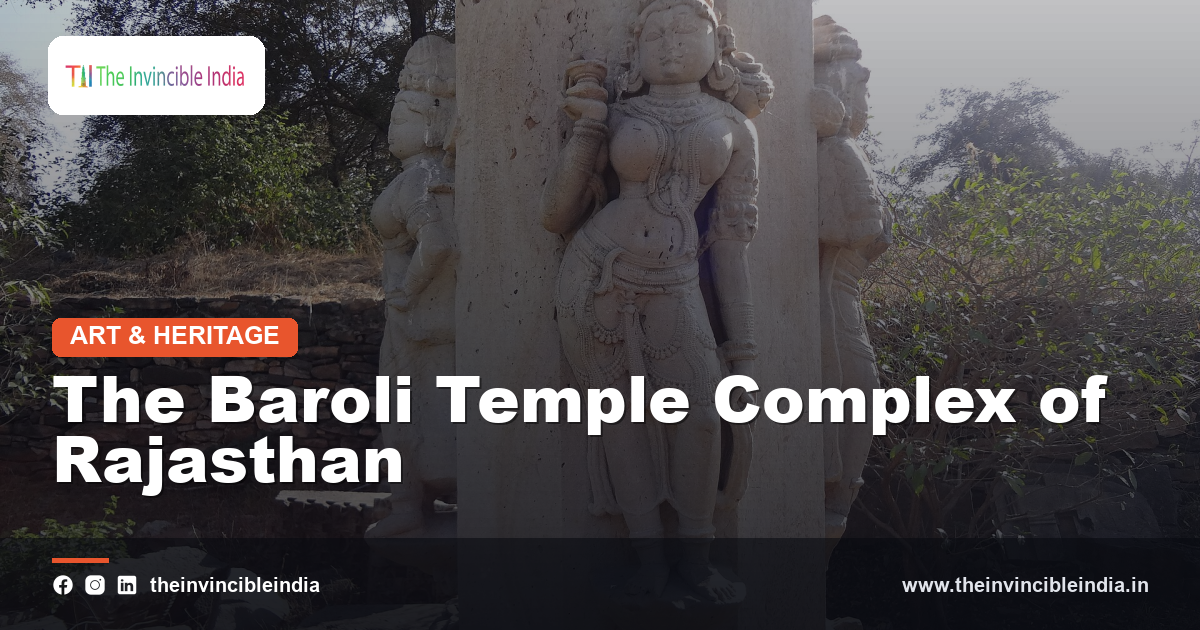
The Baroli temples, also called the Baroli temple complex or the Badoli temples in some spellings, are a group of early medieval Hindu shrines in southern Rajasthan, near the town of Rawatbhata in Chittorgarh district. Set not far from the Chambal river, the temples are admired for their northern-style towers, delicately carved walls and sculptures of Shiva, Durga and other deities. They belong to the era of the Gurjara-Pratiharas, whose patronage helped shape medieval temple art, a tradition explored in the wider guide to Indian temple architecture. This article explains the history, architecture and cultural meaning of the complex.
Quick answer: The Baroli temples (also spelled Badoli) are a group of early medieval Hindu temples near Rawatbhata in Chittorgarh district, Rajasthan, India, close to the Chambal river. They are generally attributed to the Gurjara-Pratihara period, roughly the eighth to eleventh century, and are known for their Nagara-style towers, carved walls and the Ghateshwara Shiva temple. The group is protected as a heritage site and is a major landmark of early temple art in Rajasthan.
Key Takeaways
- The Baroli temples are a group of Hindu shrines near Rawatbhata in Chittorgarh district, southern Rajasthan.
- They are generally attributed to the Gurjara-Pratihara period, roughly the eighth to eleventh century.
- The group is commonly described as eight temples standing within a walled enclosure, with the Ghateshwara Shiva temple among the best known.
- The buildings follow the Nagara style, with curved towers, pillared halls and richly carved walls.
- A famous sculpture at the site shows a three-headed form of Shiva, often called Trimurti.
- The temples were brought to the attention of scholars in the nineteenth century by the Rajput historian James Tod.
The sections below describe where the complex stands, how it was built and what visitors can see today.
Quick Facts
| Detail | Information |
|---|---|
| Location | Near Rawatbhata, Chittorgarh district, southern Rajasthan |
| Also known as | Baroli temple complex, Badoli temples |
| Dynasty | Generally Gurjara-Pratihara period |
| Approximate era | About the eighth to eleventh century |
| Type | Group of Nagara-style Hindu temples in a walled enclosure |
| Notable temple | Ghateshwara Mahadeva (Shiva) temple |
What Are the Baroli Temples?
The Baroli temples are a group of early medieval Hindu temples in southern Rajasthan, built mainly in honour of Shiva and other deities. They are commonly described as a cluster of eight shrines standing together in a walled enclosure, each with its own plan and sculpture. The buildings are made of local stone and are carved with figures, floral scrolls and geometric designs. Together they provide one of the clearest examples of Gurjara-Pratihara temple architecture, which shaped the temple styles of much of northern India. Although some structures are damaged, the group still gives a strong impression of how a temple complex of this age looked. The Baroli temples are therefore valued as both a place of devotion and an essential reference point for the study of early medieval art in Rajasthan.
Where Are the Baroli Temples Located?
The Baroli temples are located near Rawatbhata in Chittorgarh district of southern Rajasthan, in a region of rocky plateaus and river valleys. The site lies in the neighbourhood of the Chambal river, one of the major rivers of central India, and not far from the city of Kota. The surrounding landscape includes forested hills and the reservoirs created by modern dams, which give the area a green and tranquil look. Rawatbhata is the main town for visitors and is connected by road to Kota and other cities. Because the temples sit somewhat apart from the main tourist circuits of Rajasthan, they are visited by fewer people than the great forts and palaces of the state. The location of the Baroli temples gives them a quiet and rural setting that suits their contemplative character.
Who Built the Baroli Temples?
The Baroli temples are generally attributed to the Gurjara-Pratiharas, a powerful early medieval dynasty that ruled large parts of northern and western India. Local rulers and officials in the region, working within the Pratihara cultural sphere, probably supported the construction, as was common in the period. No complete written account of the exact patrons of every temple has come down, so attributions rely on style, inscriptions found in the area and comparison with other temples. This is why scholars speak of the Pratihara period rather than naming individual builders. The craftsmen themselves are anonymous, but their work shows a sophisticated tradition of stone carving. The Baroli temples therefore stand as a product of collective patronage and skill, reflecting the cultural confidence of the Gurjara-Pratihara age.
How Old Are the Baroli Temples?
The Baroli temples are generally dated from about the eighth to the eleventh century, a span that covers the heyday of the Gurjara-Pratiharas and the years that followed. The Ghateshwara temple is usually considered one of the earliest in the group, while other temples are thought to belong to later phases. Since the complex grew over time, it is better to speak of a series of building campaigns than a single moment of construction. Dating relies mainly on the study of style, including the shape of the towers, the treatment of walls and the details of sculpture. Scholars may differ about the exact sequence, and individual dates should be treated with caution. The age of the Baroli temples places them among the important early medieval monuments of western India and makes them valuable for tracing the evolution of temple design.
Who Were the Gurjara-Pratiharas?
The Gurjara-Pratiharas were an early medieval ruling dynasty that held power over much of northern India, with their influence reaching into Rajasthan, Gujarat and the Gangetic plain. They are remembered for resisting incursions from the west and for fostering trade, religion and the arts, and their capital in the north became a famous centre of power. Their patronage encouraged the building of temples in the Nagara style, characterised by curved towers and carefully ordered plans. After the dynasty declined, regional powers continued the artistic traditions it had nurtured. Historians still debate some details of the dynasty’s origins and extent, which is typical of early medieval studies. Understanding the Gurjara-Pratiharas helps explain why a remote site such as Baroli contains temples of such refinement, since it lay within a cultural world of broad influence.
What Is the Layout of the Baroli Temple Complex?
The layout of the Baroli complex centres on a walled enclosure containing several separate temples, each facing its own direction and standing a short distance from the others. Visitors move from one shrine to the next along open paths, which creates a sense of a small sacred town rather than a single building. Most temples have a sanctum, a vestibule and a pillared hall, often approached through an open porch. A tank or kund associated with the Ghateshwara temple adds a watery element that is common in Hindu sacred sites. The spacing allows each building to be seen on its own, and the walls help create a feeling of enclosure and calm. The layout of the Baroli complex thus shows how early medieval builders arranged multiple shrines into a single harmonious sacred precinct.
Why Is the Ghateshwara Temple Important?
The Ghateshwara temple is important because it is among the earliest and most admired monuments of the Baroli group and is dedicated to Shiva as Ghateshwara Mahadeva. It is known for its carved doorway, porch and sculpted pillars, and for the imposing tower that rises above the sanctum. Its position near the sacred tank gives it a special place within the complex, and it is often treated as the emblem of the whole site. Worshippers and visitors come to see its sculpture, which includes figures of deities and decorative motifs typical of the age. Parts of the building have been repaired over time, so the present appearance reflects both original work and later care. The Ghateshwara temple therefore remains the heart of the Baroli complex and a principal focus for anyone studying the site.
What Is the Three-Headed Shiva Sculpture at Baroli?
The three-headed Shiva sculpture at Baroli is one of the most famous images of the site, showing a form of the god with three faces, often described as Trimurti or Maheshamurti. In Hindu art such an image presents different aspects of Shiva at once, usually the calm, the fierce and the gentle, to suggest the fullness of the deity. The figure is carved with strong, flowing lines and is admired as a masterpiece of early medieval sculpture. Its fame has made Baroli a destination for art historians and travellers, and similar images are known from other sites in India. Because the sculpture is a sacred object as well as an artwork, it should be viewed with respect. The three-headed Shiva of Baroli thus expresses the theological depth and artistic power of the temples.
Which Other Temples Form the Baroli Group?
The Baroli group includes several temples besides the Ghateshwara temple, among them shrines dedicated to Shiva, Durga, Ganesha and other deities. Each building has its own character, and together they show how a single complex could honour a variety of divine forms. Some temples retain intact towers and porches, while others have lost parts of their structure and survive in a fragmentary state. The mixture of preserved and ruined buildings allows visitors to see both finished surfaces and the inner construction of the walls. A temple dedicated to Durga as the slayer of the buffalo demon shows the importance of goddess worship alongside Shaiva devotion. The variety of shrines at Baroli therefore illustrates the inclusive character of early medieval Hindu worship and the breadth of the artistic programme.
What Are the Features of Nagara Style at Baroli?
The Baroli temples show the Nagara style, which is the northern Indian tradition of temple building marked by a curved tower, known as a shikhara, rising above the sanctum. The tower is built of horizontal courses of stone that curve inwards as they rise and is topped by a rounded crowning element. In front of the sanctum stands a pillared hall, and the walls are divided into projecting and recessed sections that catch light and shadow. Surfaces are covered with carved bands that include figures, scrolls and architectural miniatures. This style spread across much of northern and central India and developed regional variations over time. The Nagara features at Baroli therefore make the temples a clear and accessible introduction to the architecture of the Gurjara-Pratihara age and its legacy.
What Themes Appear in the Sculpture?
The sculpture at Baroli presents themes drawn from Hindu tradition, especially the worship of Shiva and the goddess, along with guardian figures and graceful attendants. Walls and doorways display images of deities in niches, framed by delicate mouldings and flowing foliage. River goddesses are often shown at temple doorways in Pratihara art, symbolising purity and welcome, and decorative figures of dancers and musicians bring life and movement to the surfaces. The carving combines strong forms with fine detail, creating a balance between monumental presence and charm. Some sculptures are worn or removed, which is the result of age, weather and historical upheaval. The sculpture themes at Baroli thus offer a rich visual commentary on the religious ideas of the time and the skill of the artists who gave them form.
What Are the Porches, Pillars and Ceilings Like?
The porches, pillars and ceilings at Baroli are notable for their carved decoration and careful proportion. An open porch at the entrance of a temple prepares the visitor for the inner sanctum, and its pillars are often carved with bands of ornament and small figures. Ceilings may display circular or floral patterns that seem to bloom overhead, showing how builders turned structural necessity into art. The pillars rise in stages from square bases to rounded or faceted shafts and are topped by bracket capitals that support the roof. These parts are often richly worked because they were the first elements to greet worshippers. The porches, pillars and ceilings of the Baroli temples therefore reveal how every part of a temple was treated as an opportunity for sculpture and meaning.
How Was James Tod Linked to the Baroli Temples?
James Tod, a British officer and writer who documented the history of Rajasthan, is widely credited with bringing the Baroli temples to the notice of scholars in the nineteenth century. In his account of the region he described the temples and their sculpture, and his writing helped draw attention to monuments that were little known outside the area. His work is valued as a pioneering record, although modern historians read it with care, because it reflects the knowledge and assumptions of its time. Later archaeologists and art historians studied the site more systematically and corrected or expanded his observations. The attention given by Tod and others encouraged protection of the complex. The link with James Tod therefore forms part of the story of how the Baroli temples entered the wider awareness of historians and heritage workers.
What Is the Setting Near the Chambal River?
The setting near the Chambal river gives the Baroli temples a dramatic natural backdrop, with forested hills, gorges and flowing water in the surrounding area. The Chambal is one of the important rivers of central India and rises in the Vindhya region before flowing through Rajasthan, Madhya Pradesh and Uttar Pradesh. Its valley has long been a corridor of movement and settlement, and ancient sites are scattered along its length. A nearby waterfall on the river is also a popular sight in the region. Temples were often built near water for ritual reasons, and the river landscape suits that tradition. The Chambal setting therefore enhances the atmosphere of the Baroli temples, linking them to the natural and sacred geography of the region.
How Are the Baroli Temples Protected?
The Baroli temples are protected as a heritage site, and conservation of the group is carried out under the care of national archaeological authorities. Work typically includes structural stabilisation, cleaning, documentation and the management of vegetation, which can damage stone. Weathering, past neglect and the removal of sculpture over the centuries have affected the complex, and some pieces are now kept in museums. Visitors play a part in protection by avoiding climbing on walls, touching delicate carvings or leaving litter. Because arrangements and status can change, readers should check official sources for current information. Careful conservation allows the temples to remain legible as works of art and architecture. The protection of the Baroli temples thus reflects a shared responsibility to preserve an irreplaceable record of early medieval India.
How Can Visitors Plan a Trip to Baroli?
Visitors can plan a trip to Baroli most conveniently by travelling from Kota or Chittorgarh to Rawatbhata and then proceeding by road to the site. The cooler months from about October to March are the most pleasant for travel, as summers in Rajasthan are very hot. Modest clothing, comfortable footwear and a bottle of water are advisable, and visitors should allow enough time to walk among the separate temples. Photography rules should be checked at the site, and the area is best appreciated early in the day when light is soft. A local guide can add useful detail about the sculpture and history. Respectful conduct is important, because some shrines remain places of worship. A thoughtful visit allows the Baroli temples to be enjoyed in peace and with understanding.
The Baroli Temples Today
The Baroli temples today stand as one of the most significant early medieval temple groups in Rajasthan, valued for their architecture, their sculpture and their quiet setting. They attract art historians, pilgrims and travellers seeking a less crowded side of the state. Although time has taken a toll, the surviving structures still convey the grace of Gurjara-Pratihara design and the devotion of the people who built and used them. Conservation efforts and growing public interest help ensure that the complex will be remembered and studied. For those who wish to explore Rajasthan beyond its forts and palaces, Baroli offers a rewarding complement. The Baroli temples thus remain a lasting witness to the artistic achievement and spiritual life of early medieval India.
Sources & Further Reading
- Archaeological Survey of India (asi.nic.in).
- Department of Tourism, Government of Rajasthan (tourism.rajasthan.gov.in).
Frequently Asked Questions
Where are the Baroli temples located?
The Baroli temples are located near Rawatbhata in Chittorgarh district of southern Rajasthan, close to the Chambal river. The city of Kota is the usual starting point for visitors.
Who built the Baroli temples?
The Baroli temples are generally attributed to the Gurjara-Pratihara period, when local patrons worked within the cultural sphere of that dynasty. Exact patrons of individual temples are not fully recorded.
How old are the Baroli temples?
The Baroli temples are generally dated from about the eighth to the eleventh century. The Ghateshwara temple is usually regarded as one of the earliest in the group, though scholars differ on the exact sequence.
What is the Ghateshwara temple at Baroli?
The Ghateshwara temple is a Shiva temple at Baroli, dedicated to Ghateshwara Mahadeva, and is one of the best known shrines of the group. It is admired for its carved doorway, pillars and tower.
What is the Baroli temple complex famous for?
The Baroli temple complex is famous for its Gurjara-Pratihara architecture and fine sculpture, including a celebrated three-headed form of Shiva. It is a key example of early medieval Nagara-style temples in Rajasthan.
What is the best time to visit the Baroli temples?
The best time to visit the Baroli temples is the cooler season from about October to March. The summer months in Rajasthan are very hot and less comfortable for exploring open sites.


