

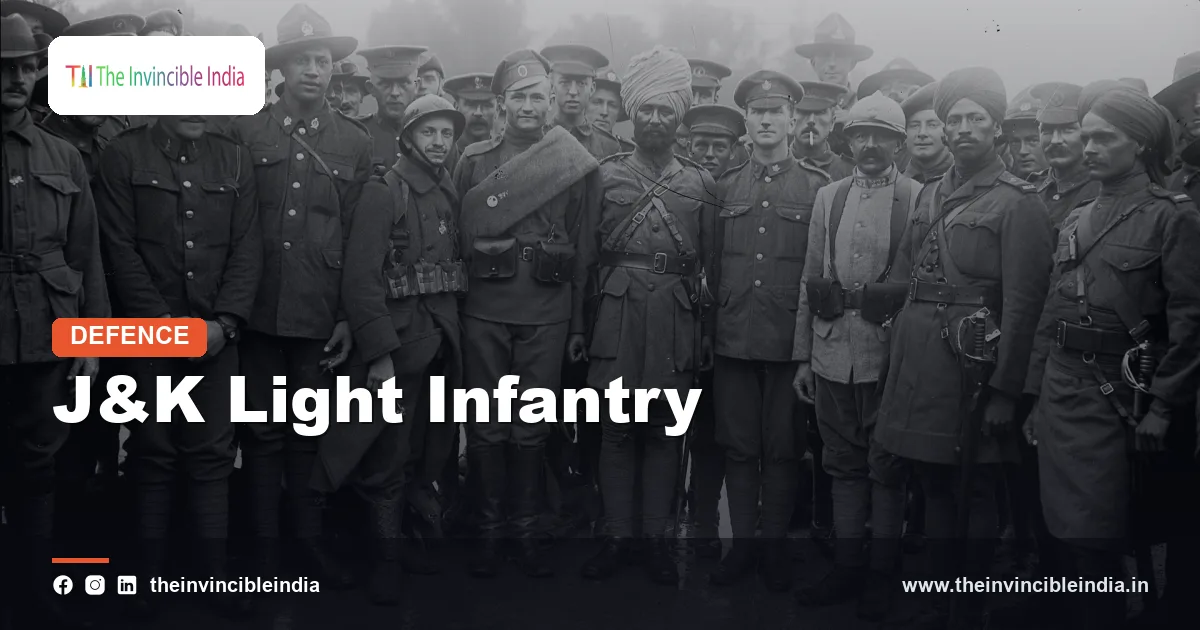
The Jammu and Kashmir Light Infantry (JAK LI) is a regular infantry regiment of the Indian Army, formed from militia and local forces of the former princely state of Jammu and Kashmir and recognised as a full regiment in the early 1970s, with its regimental centre at Avantipur in Kashmir. The regiment is known for its soldiers’ service in the mountains and for the Param Vir Chakra won by Naib Subedar Bana Singh in 1987 on the Siachen Glacier.
JAK LI is frequently confused with the Jammu and Kashmir Rifles, a separate regiment that also traces its roots to the state’s armed forces. The two regiments share a homeland and some history, but they have different battalions, centres and honours, and the confusion has produced a number of widely repeated errors.
| Attribute | Details |
|---|---|
| Full name | Jammu and Kashmir Light Infantry (JAK LI) |
| Type | Light infantry regiment of the Indian Army |
| Origins | Jammu and Kashmir Militia, raised from local forces during and after the 1947-48 war |
| Regimental status | Renamed and constituted as a regular regiment in the early 1970s (about 1972) |
| Regimental centre | Avantipur (Awantipora), Pulwama district, Jammu and Kashmir |
| Motto | “Balidanam Veer Lakshanam” (Sacrifice is the hallmark of the brave) |
| Param Vir Chakra | Naib Subedar Bana Singh, 8 JAK LI, Siachen, 1987 |
| Recruitment base | Mainly communities of Jammu and Kashmir |
| Often confused with | Jammu and Kashmir Rifles (Sanjay Kumar and Vikram Batra, Kargil 1999) |
Key Takeaways
- The Jammu and Kashmir Light Infantry is an Indian Army infantry regiment that grew out of the Jammu and Kashmir Militia and was formally constituted as a regular regiment in the early 1970s.
- The Jammu and Kashmir Light Infantry has its regimental centre at Avantipur in the Pulwama district of Jammu and Kashmir.
- Naib Subedar Bana Singh of the 8th Battalion, Jammu and Kashmir Light Infantry, won the Param Vir Chakra for capturing a post on the Siachen Glacier in June 1987, and the post was later renamed Bana Top.
- Rifleman Sanjay Kumar’s Param Vir Chakra from Kargil in 1999 belongs to the Jammu and Kashmir Rifles, not to the Jammu and Kashmir Light Infantry.
- The motto of the Jammu and Kashmir Light Infantry is “Balidanam Veer Lakshanam”, a Sanskrit phrase meaning that sacrifice marks the brave.
- Soldiers of the Jammu and Kashmir Light Infantry are drawn principally from the communities of Jammu and Kashmir, including Dogras, Muslims, Sikhs and others.
What is the Jammu and Kashmir Light Infantry?
The Jammu and Kashmir Light Infantry is an infantry regiment of the Indian Army whose battalions are raised mostly from the people of the Jammu and Kashmir region and trained for fast movement in mountainous terrain. The “light infantry” label in the Indian Army denotes a tradition of quick-marching, fast-moving infantry, a style inherited from British light infantry regiments, and it is a name rather than a separate technical category.
Like other regiments, JAK LI is an administrative parent for its battalions, which serve in brigades and divisions with units from other regiments. Its battalions have taken part in operations on the Line of Control, in high-altitude posts and in counter-insurgency grids.
How did the Jammu and Kashmir Light Infantry originate?
The Jammu and Kashmir Light Infantry originated in the Jammu and Kashmir Militia, a force assembled from local volunteers, former state personnel and reservists during the crisis that followed the tribal invasion of October 1947 and the state’s accession to India. The militia battalions were later brought under Army control and trained as regular troops.
Over the following decades, the militia was redesignated and reorganised. Around 1972, it was renamed the Jammu and Kashmir Light Infantry and received regular regimental status, with its own centre, colours and honours. Sources vary on the exact years for each stage, so this article uses “early 1970s” as the safe description.
How is JAK LI related to the former state forces?
The Jammu and Kashmir Light Infantry shares a general heritage with the former armed forces of the princely state, but it should not be treated as a direct continuation of them. The state forces of the Maharaja were integrated into the Indian Army after accession, and their principal successor was the Jammu and Kashmir Rifles, which became a regular regiment in the 1950s. JAK LI is descended from the militia instead. Popular accounts often merge the two origins into one.
Where is the Jammu and Kashmir Light Infantry’s regimental centre?
The regimental centre of the Jammu and Kashmir Light Infantry is at Avantipur, also spelt Awantipora, in the Pulwama district of Kashmir. The centre is where recruits receive basic training, where the regiment’s records are held and where regimental events take place.
The region around Avantipur is known for its ancient Avantiswami and Avantishwara temple ruins, built under the Karkota dynasty king Avantivarman in the 9th century. The cantonment sits on the road between Srinagar and Anantnag. Centre locations can change with reorganisation, so the current official notification should be checked for formal use.
Who serves in the Jammu and Kashmir Light Infantry?
The Jammu and Kashmir Light Infantry draws its soldiers largely from the communities of Jammu and Kashmir, including Dogras from the Jammu region, Muslim communities of the Kashmir Valley and the Pir Panjal area, Gujjars and Bakarwals, Sikhs and others. This gives the regiment a mixed composition by religion and region, unlike many older single-class regiments.
Some descriptions mention an all-India element alongside the Jammu and Kashmir communities, but standard sources do not confirm a formal all-India quota. The safe statement is that the regiment is recruited principally within the state’s communities, and readers should consult the Army’s recruitment notifications for the current position.
Recruitment is conducted through rallies in the region and follows Army-wide standards for age, education and fitness. Local recruitment has often been highlighted as a way of giving the region’s youth a stake in national service.
Because the regiment’s soldiers come from different faiths and sub-regions, its regimental customs are designed to be inclusive. Common messes, shared celebrations of festivals and a single parade ground for all are the ordinary features of battalion life. This composition is cited by Army writers as a practical example of the “Sarva Dharma” ethos in uniform, although the Army does not publish detailed breakdowns of religion or community by battalion.
What role did the militia and state forces play in the 1947-48 war?
Units from the Jammu and Kashmir state forces and the newly raised militia fought alongside the Indian Army in the 1947-48 war, and several actions of that war are part of the shared heritage of the state’s regiments. Brigadier Rajinder Singh, the Chief of Staff of the state forces, was killed in October 1947 while delaying the advance of raiders on the road to Srinagar near Uri, and he was honoured posthumously with the Mahavir Chakra.
State force detachments also held out at Skardu and in other outposts in the north, and local militia took part in the defence of the Kashmir Valley, Poonch and Ladakh. Historians differ over how much credit belongs to each unit. The key point is that the later JAK LI inherited the memory of local defence, which is a central part of its identity.
| Event | Approximate date | Significance |
|---|---|---|
| Tribal invasion and accession | October 1947 | State forces and local volunteers resist; state accedes to India |
| Defence near Uri | October 1947 | Brigadier Rajinder Singh delays raiders and is later honoured with the Mahavir Chakra |
| Militia raised | 1947-48 | Local volunteers organised into Army-controlled battalions |
| Redesignation as JAK LI | Early 1970s (about 1972) | Regular regimental status |
| Siachen action | June 1987 | Bana Singh wins the Param Vir Chakra |
Who won the Param Vir Chakra in the Jammu and Kashmir Light Infantry?
The Param Vir Chakra of the Jammu and Kashmir Light Infantry was won by Naib Subedar Bana Singh of the 8th Battalion, for leading a small party to capture a heavily defended Pakistani post on the Siachen Glacier in June 1987. The post stood at a height of roughly 6,500 metres and was reached by a difficult ice-wall climb.
Bana Singh later became an honorary captain. The captured position, previously known as Quaid Post, was renamed Bana Top in his honour, and it remains one of the best-known features of the Siachen conflict. The operation is generally referred to as Operation Rajiv, though accounts vary on the details.
Whose Param Vir Chakra was Kargil 1999?
Rifleman Sanjay Kumar’s Param Vir Chakra belongs to the 13th Battalion, Jammu and Kashmir Rifles, and not to the Jammu and Kashmir Light Infantry. Sanjay Kumar won it in July 1999 during the attack on Area Flat Top in the Mushkoh Valley, in the Kargil conflict. Captain Vikram Batra of the same 13 JAK RIF also received the award posthumously. These two honours are therefore correctly credited to the Jammu and Kashmir Rifles, a mix-up that appears often in popular writing.
How does the Jammu and Kashmir Light Infantry differ from the Jammu and Kashmir Rifles?
The Jammu and Kashmir Light Infantry and the Jammu and Kashmir Rifles are two separate regiments of the Indian Army, even though both are linked to the region and both are sometimes shortened to “JAK” in news reports. The main differences are in the tabulated points below.
| Feature | JAK LI | JAK Rifles |
|---|---|---|
| Origin | Jammu and Kashmir Militia | Former state forces of the princely state |
| Regular regimental status | Early 1970s | 1950s |
| Regimental centre | Avantipur, Kashmir | Jabalpur, Madhya Pradesh (as commonly reported) |
| Param Vir Chakra | Bana Singh (1987) | Vikram Batra and Sanjay Kumar (1999) |
| Composition | Mainly Jammu and Kashmir communities | All-India, all-class |
Readers should treat the table as a general guide and check official sources for the detailed position of each regiment.
What has the Jammu and Kashmir Light Infantry done since the 1970s?
The Jammu and Kashmir Light Infantry has served in high-altitude operations on the Siachen Glacier, in the Kargil sector, and in counter-insurgency along the Line of Control and inside Jammu and Kashmir. Its soldiers know the terrain and often speak the local languages, which is an advantage in grids where trust and information matter.
Battalions have received a range of gallantry and distinguished service awards, including the Mahavir Chakra, Vir Chakra, Kirti Chakra, Shaurya Chakra and Sena Medal. The number of awards is not listed here because published tallies differ. Readers should consult the regimental history for the official record.
Major forms of employment include:
- Manning forward posts on the Line of Control.
- Operating at extreme altitude, including Siachen deployments.
- Counter-terrorism and area domination patrols.
- Disaster relief during floods and avalanches.
What does the light infantry style mean in practice?
Light infantry battalions emphasise speed, endurance and independent action by small teams, which suits the ridge lines, passes and glaciers of the Himalayan region. Soldiers practise long marches with heavy loads, mountaineering skills, survival at low temperatures and navigation in poor visibility. In the Indian Army, the formal title does not change a battalion’s equipment table, but it carries a tradition of quick drill and a distinctive pace on ceremonial parades.
High-altitude service also involves medical screening, acclimatisation schedules and specialised clothing. Units posted to Siachen, for instance, follow rotation rules that limit the time any soldier spends at the highest posts, because cold, low oxygen and avalanches are major hazards.
Why does the Jammu and Kashmir Light Infantry matter?
The Jammu and Kashmir Light Infantry matters because it brings people from the region into a national institution on the frontier where the state’s security challenges are most acute. Local soldiers, many from the same districts they patrol, give the Army a recruiting base rooted in the region and a source of local knowledge.
The regiment’s history also illustrates the way the Indian Army has absorbed princely-state and militia forces into a unified structure. It connects the events of 1947 to the high-altitude conflicts of the 1980s and 1990s, and it shows that regimental identity can be created from local service as well as from colonial-era tradition.
Bottom Line
The Jammu and Kashmir Light Infantry is a regular Indian Army regiment, descended from the Jammu and Kashmir Militia, constituted in the early 1970s and based at Avantipur. Its Param Vir Chakra is that of Naib Subedar Bana Singh from Siachen in 1987. Sanjay Kumar’s Kargil award belongs to the Jammu and Kashmir Rifles, and centre locations and dates should be verified in official sources.
Frequently Asked Questions
Where is the JAK LI regimental centre?
The regimental centre of the Jammu and Kashmir Light Infantry is at Avantipur, also spelt Awantipora, in the Pulwama district. It trains recruits and keeps the regiment’s records. Centre locations can change, so official notifications should be checked.
Who won the Param Vir Chakra in JAK LI?
Naib Subedar Bana Singh of the 8th Battalion, Jammu and Kashmir Light Infantry, won the Param Vir Chakra in 1987. He led a party that captured a post on the Siachen Glacier, later renamed Bana Top. He retired as an honorary captain.
Did Sanjay Kumar belong to the Jammu and Kashmir Light Infantry?
No, Rifleman Sanjay Kumar belonged to the 13th Battalion of the Jammu and Kashmir Rifles. He won the Param Vir Chakra in July 1999 at Area Flat Top during the Kargil conflict. The Jammu and Kashmir Rifles is a separate regiment from JAK LI.
When did JAK LI become a regular regiment?
The Jammu and Kashmir Light Infantry became a regular regiment in the early 1970s, with about 1972 commonly cited. It grew out of the Jammu and Kashmir Militia raised after 1947. Sources vary on the exact steps.
What is the motto of the Jammu and Kashmir Light Infantry?
The motto of the Jammu and Kashmir Light Infantry is “Balidanam Veer Lakshanam”. It is a Sanskrit phrase meaning that sacrifice is the hallmark of the brave. The motto appears on regimental insignia.
Who is recruited into the Jammu and Kashmir Light Infantry?
The Jammu and Kashmir Light Infantry recruits mainly from communities of Jammu and Kashmir, including Dogras, Muslims, Gujjars, Bakarwals and Sikhs. Recruitment follows Army-wide standards. Candidates are selected through rallies and tests.
{“@context”:”https://schema.org”,”@graph”:[{“@type”:”FAQPage”,”mainEntity”:[{“@type”:”Question”,”name”:”Where is the JAK LI regimental centre?”,”acceptedAnswer”:{“@type”:”Answer”,”text”:”The regimental centre of the Jammu and Kashmir Light Infantry is at Avantipur, also spelt Awantipora, in the Pulwama district. It trains recruits and keeps the regiment’s records. Centre locations can change, so official notifications should be checked.”}},{“@type”:”Question”,”name”:”Who won the Param Vir Chakra in JAK LI?”,”acceptedAnswer”:{“@type”:”Answer”,”text”:”Naib Subedar Bana Singh of the 8th Battalion, Jammu and Kashmir Light Infantry, won the Param Vir Chakra in 1987. He led a party that captured a post on the Siachen Glacier, later renamed Bana Top. He retired as an honorary captain.”}},{“@type”:”Question”,”name”:”Did Sanjay Kumar belong to the Jammu and Kashmir Light Infantry?”,”acceptedAnswer”:{“@type”:”Answer”,”text”:”No, Rifleman Sanjay Kumar belonged to the 13th Battalion of the Jammu and Kashmir Rifles. He won the Param Vir Chakra in July 1999 at Area Flat Top during the Kargil conflict. The Jammu and Kashmir Rifles is a separate regiment from JAK LI.”}},{“@type”:”Question”,”name”:”When did JAK LI become a regular regiment?”,”acceptedAnswer”:{“@type”:”Answer”,”text”:”The Jammu and Kashmir Light Infantry became a regular regiment in the early 1970s, with about 1972 commonly cited. It grew out of the Jammu and Kashmir Militia raised after 1947. Sources vary on the exact steps.”}},{“@type”:”Question”,”name”:”What is the motto of the Jammu and Kashmir Light Infantry?”,”acceptedAnswer”:{“@type”:”Answer”,”text”:”The motto of the Jammu and Kashmir Light Infantry is “Balidanam Veer Lakshanam”. It is a Sanskrit phrase meaning that sacrifice is the hallmark of the brave. The motto appears on regimental insignia.”}},{“@type”:”Question”,”name”:”Who is recruited into the Jammu and Kashmir Light Infantry?”,”acceptedAnswer”:{“@type”:”Answer”,”text”:”The Jammu and Kashmir Light Infantry recruits mainly from communities of Jammu and Kashmir, including Dogras, Muslims, Gujjars, Bakarwals and Sikhs. Recruitment follows Army-wide standards. Candidates are selected through rallies and tests.”}}]}]}


