

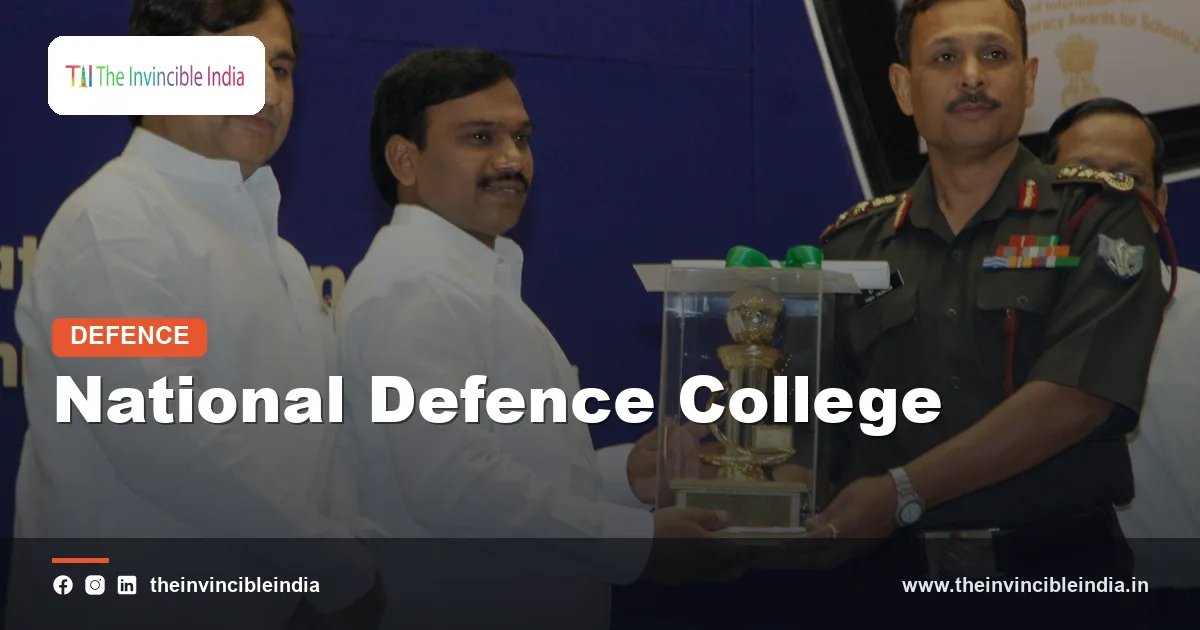
The National Defence College (NDC) is India’s premier institution for training in national security and strategy, established in 1960 in New Delhi to prepare senior armed forces officers and senior civil servants for the highest responsibilities of national security. It runs a single year-long course, bringing military leaders and civilian officials into the same classroom to study how a large country plans for peace, crisis and war.
The National Defence College sits at the top of the Indian system of professional military education, above the staff colleges that train mid-career officers. This explainer covers its purpose, its participants, the course and syllabus, its leadership and the standing it enjoys among alumni in India and abroad. Details were last reviewed on 16 October 2026.
| Attribute | Details |
|---|---|
| Full name | National Defence College (NDC) |
| Established | 1960 |
| Location | New Delhi |
| Administrative setting | Under the Ministry of Defence, as a tri-service institution |
| Type | Apex institution for national security and strategic studies |
| Head | Commandant, a three-star officer drawn in rotation from the three services |
| Course length | About one year (roughly 47 weeks) |
| Participants | Senior military officers, senior civil servants and officers from friendly foreign countries |
Key Takeaways
- The National Defence College was established in 1960 in New Delhi and is regarded as India’s highest institution for training in national security and strategy.
- The National Defence College offers a year-long course attended by Brigadier-equivalent and higher officers of the Army, Navy and Air Force, together with senior civil servants.
- The National Defence College also admits a number of officers from friendly foreign countries, which gives the course an international dimension.
- The National Defence College syllabus is broad, covering strategy, geopolitics, economics, science and technology, internal security and international relations.
- The National Defence College is headed by a Commandant, a senior three-star officer of the armed forces, and its faculty includes military and civilian experts.
- The National Defence College is prestigious because its alumni include senior military commanders, diplomats and civil servants who later shape national policy.
What is the National Defence College (NDC)?
The National Defence College (NDC) is the apex institution in India for the study of national security, defence and strategy, and it functions as a tri-service college under the Ministry of Defence. Its purpose is to prepare selected senior officers for high command and policy positions by broadening their view beyond the single service or department in which they have served.
Officers who attend the college have already spent more than two decades in service. They come to the NDC not to learn basic military skills but to examine national security as a whole: how political goals, economic strength, technology, diplomacy and military power fit together.
The college is located in New Delhi, close to the institutions of government that its students will later work with. Its position in the capital enables regular interaction with ministers, senior officials, scholars and visiting dignitaries.
When and why was the National Defence College established?
The National Defence College was established in 1960 because India’s leadership recognised, in the years after independence, that modern security problems required officers and officials trained in an integrated, strategic way. Independent India needed a body in which senior defence and civilian leaders could study national security together.
The idea reflected a wider trend. Several countries had set up similar senior colleges, such as the National War College in the United States and the Imperial (later Royal) College of Defence Studies in the United Kingdom, and India adapted the concept to its own needs. The 1962 war with China, which occurred soon after the college began, reinforced the case for better coordination between the military and the civil government.
Over the decades the college has revised its curriculum to match changes in the strategic environment, including the end of the Cold War, the growth of terrorism, the rise of cyber and space domains and the increasing importance of economic security. Its core mission, however, has remained the same: to develop strategic thinkers for the highest levels of governance.
Who attends the National Defence College?
The National Defence College is attended by senior officers of the Army, Navy and Air Force, usually of the rank of Brigadier or equivalent and above, along with senior civil servants of comparable standing and a limited number of officers from friendly foreign nations. Selection is based on service record and potential for higher responsibility.
The participants fall into three broad groups:
- Armed forces officers: Brigadiers, Commodores and Air Commodores and higher, nominated by their services.
- Civil servants: Officers of the Indian Administrative Service, Indian Foreign Service, Indian Police Service and other central services, usually of Joint Secretary level or similar, along with representatives of related departments.
- Foreign officers: Military and civilian participants from friendly countries, nominated through diplomatic channels.
This mix is intentional. Military and civilian officials rarely study together at such a senior level, and the college provides them a rare chance to understand each other’s perspectives before they work together on policy.
What is taught at the National Defence College?
The National Defence College teaches a broad syllabus on national security and strategy, covering geopolitics, international relations, economics, science and technology, internal security, defence planning and leadership. The syllabus aims at breadth rather than the technical detail of any single service.
Main areas of study
- International relations and India’s foreign policy, including relations with neighbours and major powers.
- Geopolitics and geo-economics, with attention to energy, trade and maritime issues.
- Defence economics, resource allocation and the defence industry.
- Science, technology and emerging domains such as space, cyber and artificial intelligence.
- Internal security, counter-terrorism and disaster management.
- Strategic and military planning, and the higher direction of war.
- Leadership, ethics and decision-making at senior levels.
The learning method includes lectures by experts, discussion in syndicates, case studies, research projects and individual papers. Students are encouraged to question assumptions and to draw on their varied careers while working on practical problems of national policy.
How long is the National Defence College course?
The National Defence College course lasts about one year, with a roughly 47-week programme divided into phases of lectures, group studies, projects and study tours. Because it is a residential course, participants are expected to give the programme their full attention for the entire period.
The structure usually includes several elements:
- Core lectures and seminars on the main subjects, often by senior policymakers and academics.
- Syndicate work, in which small mixed groups examine specific issues and present their findings.
- Individual research, resulting in a paper or dissertation.
- Study tours within India, in which students visit military formations, industrial centres, border areas and administrative bodies.
- Visits abroad, in which students see the security and economic arrangements of other countries.
Successful participants receive a certificate from the college, and the course has been linked to an academic degree through an affiliated university. The arrangement gives the course a formal academic recognition in addition to its professional importance.
Who heads the National Defence College?
The National Defence College is headed by a Commandant, a senior serving officer of three-star rank from the Army, the Navy or the Air Force, appointed in rotation among the services. The rotation reflects the college’s tri-service character and prevents any one service from dominating it.
The Commandant is assisted by a Deputy Commandant, senior directing staff drawn from the services and from the civil services, and a team of academic and administrative staff. The directing staff guide the syndicates, supervise research and arrange the lecture programme.
The college also draws on visiting faculty and guest speakers, including diplomats, scientists, economists and retired commanders. In this way, the NDC keeps in touch with developments in the wider world of strategy and policy rather than functioning as a closed institution.
How does the National Defence College fit into India’s military education system?
The National Defence College sits at the very top of India’s military education pyramid, as the final stage of professional training for officers who are about to reach the highest ranks. Earlier stages prepare officers for progressively wider responsibility, and the NDC takes the process to the level of national strategy.
| Stage | Typical institution | Focus |
|---|---|---|
| Pre-commission | National Defence Academy, service academies | Basic military and academic training |
| Junior and middle level | Service-specific schools and courses | Tactics, unit command and technical skills |
| Staff level | Defence Services Staff College, Wellington | Staff work and operations for mid-career officers |
| Higher command | Higher Command courses of the services | Command of larger formations |
| Defence management | College of Defence Management, Secunderabad | Management of defence resources |
| Apex level | National Defence College, New Delhi | National security and grand strategy |
The sequence shows how the NDC differs from other institutions. The Defence Services Staff College trains officers to be effective staff officers, whereas the National Defence College deals with the strategic questions that senior leaders handle.
Why is the National Defence College considered prestigious?
The National Defence College is considered prestigious because it is the highest professional college of its kind in India, selection is limited, and its alumni include many of the country’s most senior defence, diplomatic and administrative leaders. Attendance is often seen as a mark of confidence in an officer’s future prospects.
Several factors contribute to this standing:
- Its selective intake, which brings together officers recognised for exceptional records.
- Its tri-service and civil-military character, which is rare in other institutions.
- Its access to senior policymakers and experts, giving students insight not available elsewhere.
- Its network of alumni in India and friendly countries, which promotes understanding across services, ministries and borders.
Alumni include officers who went on to lead the three services, serve as ambassadors, head ministries and take up senior positions in the government. The shared experience of the NDC year helps them cooperate later in their careers.
What does the National Defence College do beyond the main course?
Beyond the main course, the National Defence College conducts research, hosts seminars and lectures, engages with foreign defence colleges and publishes work on security and strategic issues. These activities extend its influence beyond those who attend it as students.
The college organises workshops on subjects such as maritime security, energy security, defence technology and regional geopolitics. It invites scholars and officials from India and abroad to share their views, and its students are encouraged to produce research papers that engage with questions of real policy importance.
International engagement is also a feature. The college sends its students on visits to partner countries, receives delegations from foreign defence colleges and takes part in exchanges with similar institutions elsewhere. Through this work, the NDC contributes to India’s defence diplomacy and to a wider network of professional contacts among security leaders.
How can an officer attend the National Defence College?
An officer attends the National Defence College by being nominated through his or her parent service or cadre after a selection process based on service record, seniority and potential, rather than by applying directly as a member of the public. Seats are limited, and the nominating authorities choose from among the eligible senior officers.
For military officers, each service nominates a quota of officers of the required rank. For civil servants, the Government of India selects officers from the central services and relevant departments. For foreign participants, nominations come through the defence and foreign ministries of friendly countries and are subject to approval.
The college does not offer public admission, and it is not a degree-granting college for civilians in general. Its audience is small, specialised and senior, which is part of what makes the course effective: each syndicate consists of experienced people with varied backgrounds and insights.
How is the National Defence College different from a university or a staff college?
The National Defence College differs from a university and from a staff college in its audience, its purpose and its method: it trains already-senior public servants for policy responsibility, not students for a first degree or mid-career officers for staff appointments. Its teaching is built around discussion among experienced practitioners rather than around examinations.
A university generally concentrates on one discipline and teaches students at the start of their careers. A staff college, such as the Defence Services Staff College at Wellington, concentrates on the techniques of planning and operations. The National Defence College instead asks how security, economics, diplomacy and technology interact at the level of the state.
The college therefore values the experience that each participant brings. A Brigadier who has commanded a brigade on the border, a diplomat who has served in a mission abroad and an administrator who has managed a district or a ministry’s programmes can all contribute different insights to a syndicate discussion on, say, maritime security or energy dependence. The faculty guides and challenges this exchange instead of lecturing at the class.
This design explains why the course is short, intensive and residential, and why its main output is not a set of technical skills but a changed way of thinking about national interests, risks and priorities.
Bottom Line
The National Defence College is India’s apex centre for learning national security and strategy: founded in 1960, it brings senior military officers, senior civil servants and foreign participants together for a year of study on strategy, economics, technology and international relations. Its prestige comes from its selectivity, its civil-military character and the influence of its alumni.
Frequently Asked Questions
What is the National Defence College?
The National Defence College is India’s highest institution for training in national security and strategy, located in New Delhi. It runs a year-long course for senior officers of the armed forces, senior civil servants and some foreign officers. The college is a tri-service institution functioning under the Ministry of Defence.
When was the NDC established?
The NDC was established in 1960 in New Delhi. It was set up to train senior officers and officials in an integrated approach to national security. Since then it has revised its syllabus to include modern issues such as cyber security, space and economic security.
Who can attend the National Defence College?
Senior armed forces officers of Brigadier-equivalent rank and above, senior civil servants and selected officers from friendly foreign countries can attend. Participants are nominated by their services, departments or governments. Members of the public cannot apply directly.
How long is the NDC course?
The NDC course lasts about one year, running for roughly 47 weeks. It includes lectures, syndicate discussions, research projects, study tours in India and visits abroad. Participants stay at the college for the duration of the course.
What subjects does the NDC teach?
The NDC teaches national security and strategy, including geopolitics, international relations, defence economics, science and technology, internal security and leadership. The approach is interdisciplinary and focuses on policy and decision-making at the national level rather than on tactics.
Who heads the National Defence College?
The National Defence College is headed by a Commandant, who is a three-star officer of the Army, Navy or Air Force. The post rotates among the three services. The Commandant works with a Deputy Commandant and a directing staff drawn from the military and civil services.
{“@context”:”https://schema.org”,”@graph”:[{“@type”:”FAQPage”,”mainEntity”:[{“@type”:”Question”,”name”:”What is the National Defence College?”,”acceptedAnswer”:{“@type”:”Answer”,”text”:”The National Defence College is India’s highest institution for training in national security and strategy, located in New Delhi. It runs a year-long course for senior officers of the armed forces, senior civil servants and some foreign officers. The college is a tri-service institution functioning under the Ministry of Defence.”}},{“@type”:”Question”,”name”:”When was the NDC established?”,”acceptedAnswer”:{“@type”:”Answer”,”text”:”The NDC was established in 1960 in New Delhi. It was set up to train senior officers and officials in an integrated approach to national security. Since then it has revised its syllabus to include modern issues such as cyber security, space and economic security.”}},{“@type”:”Question”,”name”:”Who can attend the National Defence College?”,”acceptedAnswer”:{“@type”:”Answer”,”text”:”Senior armed forces officers of Brigadier-equivalent rank and above, senior civil servants and selected officers from friendly foreign countries can attend. Participants are nominated by their services, departments or governments. Members of the public cannot apply directly.”}},{“@type”:”Question”,”name”:”How long is the NDC course?”,”acceptedAnswer”:{“@type”:”Answer”,”text”:”The NDC course lasts about one year, running for roughly 47 weeks. It includes lectures, syndicate discussions, research projects, study tours in India and visits abroad. Participants stay at the college for the duration of the course.”}},{“@type”:”Question”,”name”:”What subjects does the NDC teach?”,”acceptedAnswer”:{“@type”:”Answer”,”text”:”The NDC teaches national security and strategy, including geopolitics, international relations, defence economics, science and technology, internal security and leadership. The approach is interdisciplinary and focuses on policy and decision-making at the national level rather than on tactics.”}},{“@type”:”Question”,”name”:”Who heads the National Defence College?”,”acceptedAnswer”:{“@type”:”Answer”,”text”:”The National Defence College is headed by a Commandant, who is a three-star officer of the Army, Navy or Air Force. The post rotates among the three services. The Commandant works with a Deputy Commandant and a directing staff drawn from the military and civil services.”}}]}]}


