

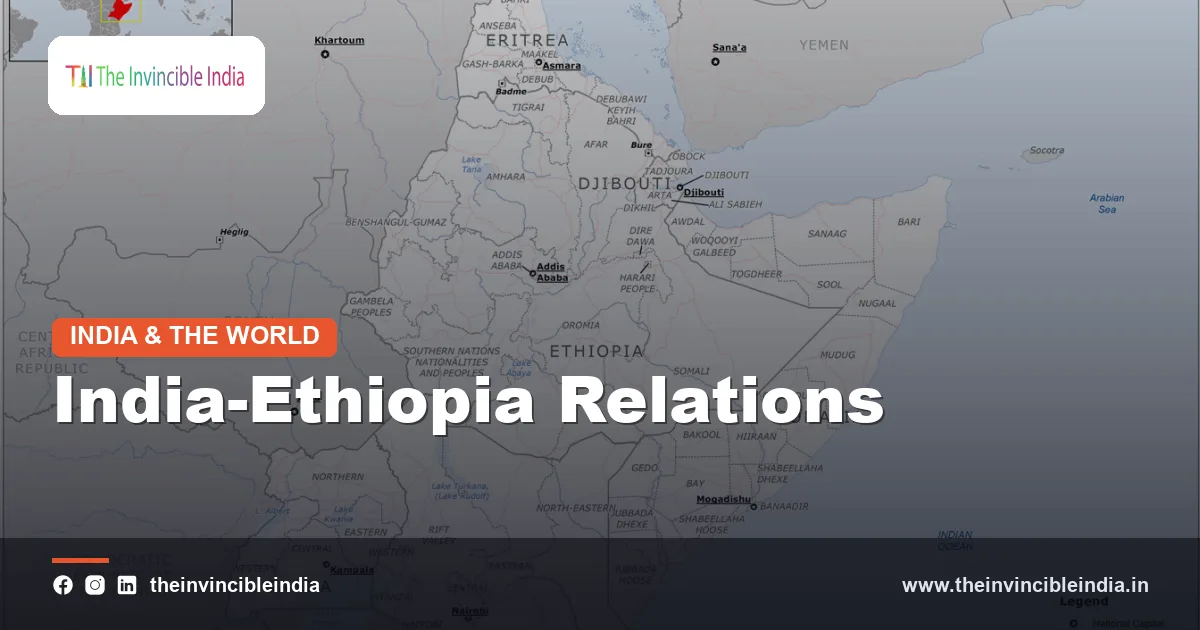
India-Ethiopia relations are the friendly bilateral ties between the Republic of India and the Federal Democratic Republic of Ethiopia, built on ancient Red Sea trade, a mid-twentieth-century educational connection in which Indian teachers worked in Ethiopian schools, and a modern partnership in trade, investment, development finance and diplomacy. Ethiopia, the second most populous country in Africa and the seat of the African Union, is among India’s most significant partners in the Horn of Africa.
The relationship has grown steadily since the late 1940s through development cooperation, Indian business investment in agriculture and manufacturing, and shared membership of forums such as the Non-Aligned Movement, the United Nations and, since 2024, BRICS. This explainer reviews the history, the main areas of cooperation, and the opportunities and difficulties that characterise the ties.
| Attribute | Detail |
|---|---|
| Countries | Republic of India and the Federal Democratic Republic of Ethiopia |
| Capital of Ethiopia | Addis Ababa, also the headquarters of the African Union |
| Early contacts | Trade between the Kingdom of Aksum and ports on India’s western coast in antiquity |
| Modern diplomatic ties | Begun in the late 1940s; India’s mission in Addis Ababa grew into a full embassy |
| Educational link | Indian teachers recruited for Ethiopian schools from the 1940s and 1950s |
| Major investment sectors | Floriculture, agriculture and agro-processing, textiles, pharmaceuticals, manufacturing |
| Development finance | Lines of credit extended through the Export-Import Bank of India, including for sugar and power projects |
| Multilateral overlap | United Nations, Non-Aligned Movement, G77 and BRICS (Ethiopia joined in 2024) |
Key Takeaways
- India-Ethiopia relations have ancient roots in trade between the Kingdom of Aksum, whose port of Adulis lay on the Red Sea, and the western coast of India.
- In the 1940s and 1950s Ethiopia recruited Indian teachers for its schools, and this educational link is remembered in both countries as a foundation of the modern relationship.
- Indian companies have invested in Ethiopia in floriculture, agriculture, textiles, pharmaceuticals and manufacturing, and India has been described as one of the larger foreign investors in the country.
- India has extended concessional lines of credit to Ethiopia through the Export-Import Bank of India for projects that include sugar factories and power transmission and electrification.
- The second India-Africa Forum Summit was held in Addis Ababa in 2011, reflecting the city’s importance as the diplomatic capital of Africa.
- Ethiopia became a member of BRICS in 2024, and India and Ethiopia now sit together in a grouping that is widely seen as expanding Global South cooperation.
How old are India-Ethiopia relations?
India-Ethiopia relations are around two thousand years old, tracing back to the maritime trade between the Kingdom of Aksum and ports on the western coast of India. The Greek-language trade manual known as the Periplus of the Erythraean Sea, written in the first century CE, mentions the Aksumite port of Adulis as a trading centre where goods from India, among others, were exchanged.
Aksum, in the northern highlands of present-day Ethiopia, exported ivory, tortoiseshell and other goods, and imported textiles, glass and metalwork. Indian cotton cloth and other products are among the goods noted by ancient writers in the Red Sea trade. Over the centuries, Indian Ocean networks also carried people, ideas and food crops between India and the Horn of Africa. Communities of African origin in India, such as the Siddis of Gujarat and Karnataka, include people whose ancestors came from the Horn of Africa, and some historical figures such as Malik Ambar of Ahmednagar are said to have been born in Ethiopia.
How did modern India-Ethiopia diplomatic relations begin?
Modern India-Ethiopia diplomatic relations began in the late 1940s, soon after India’s independence, when India opened a mission in Addis Ababa that was later raised to an embassy. Emperor Haile Selassie of Ethiopia visited India in 1956, and the two countries developed friendly ties based on a shared commitment to anti-colonialism and peaceful coexistence.
Ethiopia had resisted colonial rule more successfully than most African states, defeating Italy at the Battle of Adwa in 1896, a victory that was noted by anti-colonial thinkers elsewhere. Its status as a long-independent African state made it a respected voice when other African countries gained freedom, and India valued its role in the formation of the Organisation of African Unity in 1963, with its headquarters at Addis Ababa.
| Period | Milestone |
|---|---|
| Antiquity | Aksumite and Indian trade across the Red Sea and Indian Ocean |
| Late 1940s | India opens a diplomatic mission in Addis Ababa |
| 1940s-1950s | Indian teachers begin serving in Ethiopian schools |
| 1956 | Emperor Haile Selassie visits India |
| 1960s onwards | Both countries participate in the Non-Aligned Movement and decolonisation diplomacy |
| 2008 | First India-Africa Forum Summit in New Delhi, with Ethiopian participation |
| 2011 | Second India-Africa Forum Summit in Addis Ababa |
| 2024 | Ethiopia joins BRICS |
What was the role of Indian teachers in Ethiopia?
Indian teachers played a significant role in Ethiopia’s education system from the 1940s and 1950s, when the Ethiopian government recruited many of them to staff secondary schools and colleges as the country expanded modern education. Large numbers of Ethiopians, including individuals who later rose to senior positions in government, business and academia, were taught by Indians.
The Ethiopian government sought foreign teachers because it had too few trained local educators, and Indians were favoured for their English-language training and their qualifications in science and mathematics. Many served for years and some settled permanently. The connection is often cited by leaders of both countries as a source of goodwill, and it has given India a reputation in Ethiopia as a country associated with education and skills.
Continued educational ties
The educational partnership has continued through scholarship programmes, the Indian Technical and Economic Cooperation (ITEC) scheme, and the Indian Council for Cultural Relations (ICCR) awards. Indian faculty continue to teach in Ethiopian universities, and Ethiopian students attend Indian institutions. The Pan-African e-Network project, launched in the late 2000s, connected Ethiopian institutions with Indian universities and hospitals for tele-education and tele-medicine.
How much has India invested in Ethiopia?
India has invested several billion US dollars in Ethiopia by approved commitments over the years, and Indian companies have been among the larger foreign investors in the country, though the amount actually realised is smaller than the amount licensed. Indian investment has gone mostly into manufacturing, agriculture, floriculture, textiles, pharmaceuticals and services.
The licensed investment figures are reported by Ethiopian authorities and by the Indian embassy, and the numbers differ according to the method of counting, so no single figure is definitive. Hundreds of Indian-linked companies have been registered in Ethiopia over time, and many are small and medium enterprises, as well as larger groups.
Floriculture and agriculture
Floriculture is a notable area of Indian investment. Ethiopia’s cool highland climate, altitude and proximity to European markets made it an attractive place for the production of cut flowers, which became one of its important export products. Indian-owned firms were among the large operators, including Karuturi Global, which established rose farms near Addis Ababa and also took up large agricultural land leases. Some of these ventures later encountered financial and operational difficulties, and the experience has been used in Ethiopia to discuss land use, working conditions and contract enforcement.
Manufacturing and services
Indian firms are present in textiles and garments, edible oils, pharmaceuticals, plastics, sugar-related projects, education and information technology. Indian pharmaceutical products are widely used in Ethiopia’s health system, and several Indian companies supply generic medicines.
What lines of credit has India given Ethiopia?
India has extended concessional lines of credit to Ethiopia through the Export-Import Bank of India (Exim Bank), including for sugar factories and for power transmission and electrification, together amounting to several hundred million US dollars. These lines are financed by the Government of India and on-lent to the Ethiopian government, which uses them to contract Indian firms to execute the projects.
- Sugar sector: a major line of credit supported the construction and rehabilitation of sugar factories in Ethiopia, in line with the government’s plan to expand sugar production for domestic needs and exports.
- Power and electrification: lines of credit supported transmission lines, substations and rural electrification, helping extend electricity access.
- Other sectors: credit and grants have supported agricultural machinery, railway-related work, training and institutions.
Some projects faced delays arising from contractor performance, financing arrangements, security conditions and changes in government priorities. Both governments have acknowledged these difficulties and sought to resolve them through joint reviews.
What is the trade relationship between India and Ethiopia?
The trade relationship between India and Ethiopia is valued at around one to two billion US dollars annually in recent years, heavily in India’s favour, with India exporting more than it imports. The totals vary from year to year with commodity prices and foreign-exchange conditions in Ethiopia.
| Direction | Principal items |
|---|---|
| Indian exports to Ethiopia | Pharmaceuticals, vehicles and auto parts, machinery, iron and steel products, textiles, chemicals and electrical equipment |
| Indian imports from Ethiopia | Oilseeds such as sesame, pulses, leather, spices, coffee and some other agricultural products |
Ethiopia has faced shortages of foreign exchange and has adjusted its currency regime in recent years, which affects imports from India and the repatriation of profits by Indian investors. The scope for growth is considered large, especially in agro-processing, pharmaceuticals and textiles, and Ethiopia’s access to preferential markets has been another factor attracting manufacturers.
How do India and Ethiopia cooperate in development and capacity building?
India and Ethiopia cooperate in development and capacity building mainly through the ITEC training programme, scholarships, institution-building projects and lines of credit. Ethiopian civil servants, engineers, doctors and teachers have received training in India under ITEC, which is one of the largest sources of such training for African countries.
India has also supported Ethiopian institutions in areas such as vocational education, information technology and agriculture. Cooperation on health, including supply of medicines and vaccines and medical tourism, has been another area, and India has shared experience on digital public infrastructure, which is of interest to Ethiopia’s modernisation plans.
Africa as a priority for India
Ethiopia’s role as host of the African Union gives it special weight in India’s Africa policy. India supported the African Union’s admission as a permanent member of the G20 at the New Delhi summit in 2023, and Ethiopia, as a leading AU member, has participated in India-Africa forums since the process began.
Where do India and Ethiopia work together in multilateral forums?
India and Ethiopia work together in multilateral forums including the United Nations, the Non-Aligned Movement, the Group of 77 and BRICS. Ethiopia was invited to join BRICS, the grouping founded by Brazil, Russia, India and China and later joined by South Africa, with effect from January 2024.
The two countries often coordinate positions on development finance, climate justice, reform of international institutions and peacekeeping. India has been a leading contributor of personnel to United Nations peacekeeping, and it has served in missions in Africa, which gives it an interest in the stability of the Horn of Africa region.
What challenges affect India-Ethiopia relations?
The challenges affecting India-Ethiopia relations include security and political instability in parts of Ethiopia, foreign-exchange shortages, delays in project implementation, differences between licensed and realised investment, and competition from other international partners. These are practical issues that both governments discuss rather than disputes between them.
- Conflict and tensions in some regions of Ethiopia have affected business confidence and project timelines.
- Currency and payment restrictions have complicated imports and profit repatriation.
- Some large agricultural ventures struggled with land, finance and management issues.
- Ethiopia’s partners include China, Turkey, the Gulf states, the European Union and the United States, so Indian firms face competition.
- Trade is lopsided, and Ethiopia seeks more access for its goods in the Indian market.
What is the outlook for India-Ethiopia relations?
The outlook for India-Ethiopia relations is positive but gradual, supported by deep historical goodwill, complementary economies and the shared forums in which they now participate. Ethiopia’s large and young population, ambitions for industrialisation and strategic location offer opportunities for Indian partners, while India offers experience in digital services, pharmaceuticals, textiles and agriculture.
The areas most likely to define the next phase are agro-processing and value addition, pharmaceutical supply and local manufacturing, education and skills, energy and electrification, and cooperation on digital public infrastructure. Progress will depend on conditions within Ethiopia, the availability of finance and the speed at which stalled projects are completed.
Bottom Line
India-Ethiopia relations rest on ancient trade, the shared memory of Indian teachers in Ethiopian classrooms, and a modern mix of investment, development credit and diplomacy. The ties are friendly and balanced by realistic challenges, with considerable room for growth in trade, agriculture and manufacturing.
Frequently Asked Questions
How are India and Ethiopia connected historically?
India and Ethiopia are connected through ancient maritime trade between the Kingdom of Aksum and India’s western coast, and through the Indian teachers who worked in Ethiopian schools from the 1940s and 1950s. These links created lasting goodwill between the two peoples.
Which sectors do Indian companies invest in in Ethiopia?
Indian companies invest in Ethiopia mainly in floriculture, agriculture and agro-processing, textiles, pharmaceuticals, manufacturing and services. Several of the largest foreign investment licences in Ethiopia have gone to Indian-linked firms, although not all projects have been fully realised.
Has India given lines of credit to Ethiopia?
Yes, India has given Ethiopia concessional lines of credit through the Export-Import Bank of India. They have supported projects such as sugar factories and power transmission and electrification.
What do India and Ethiopia trade?
India mainly exports pharmaceuticals, vehicles, machinery, steel products and textiles to Ethiopia, and imports oilseeds, pulses, leather, spices and coffee. Trade is worth around one to two billion US dollars annually and has favoured India.
Are India and Ethiopia both members of BRICS?
Yes, India is a founding member of BRICS and Ethiopia joined the grouping in January 2024. Both also participate in the United Nations, the Non-Aligned Movement and the Group of 77.
Why is Ethiopia important to India?
Ethiopia is important to India because it is Africa’s second most populous country, hosts the African Union headquarters in Addis Ababa and is a gateway to the Horn of Africa. It is also a large market and a significant destination for Indian investment and development cooperation.
{“@context”:”https://schema.org”,”@graph”:[{“@type”:”FAQPage”,”mainEntity”:[{“@type”:”Question”,”name”:”How are India and Ethiopia connected historically?”,”acceptedAnswer”:{“@type”:”Answer”,”text”:”India and Ethiopia are connected through ancient maritime trade between the Kingdom of Aksum and India’s western coast, and through the Indian teachers who worked in Ethiopian schools from the 1940s and 1950s. These links created lasting goodwill between the two peoples.”}},{“@type”:”Question”,”name”:”Which sectors do Indian companies invest in in Ethiopia?”,”acceptedAnswer”:{“@type”:”Answer”,”text”:”Indian companies invest in Ethiopia mainly in floriculture, agriculture and agro-processing, textiles, pharmaceuticals, manufacturing and services. Several of the largest foreign investment licences in Ethiopia have gone to Indian-linked firms, although not all projects have been fully realised.”}},{“@type”:”Question”,”name”:”Has India given lines of credit to Ethiopia?”,”acceptedAnswer”:{“@type”:”Answer”,”text”:”Yes, India has given Ethiopia concessional lines of credit through the Export-Import Bank of India. They have supported projects such as sugar factories and power transmission and electrification.”}},{“@type”:”Question”,”name”:”What do India and Ethiopia trade?”,”acceptedAnswer”:{“@type”:”Answer”,”text”:”India mainly exports pharmaceuticals, vehicles, machinery, steel products and textiles to Ethiopia, and imports oilseeds, pulses, leather, spices and coffee. Trade is worth around one to two billion US dollars annually and has favoured India.”}},{“@type”:”Question”,”name”:”Are India and Ethiopia both members of BRICS?”,”acceptedAnswer”:{“@type”:”Answer”,”text”:”Yes, India is a founding member of BRICS and Ethiopia joined the grouping in January 2024. Both also participate in the United Nations, the Non-Aligned Movement and the Group of 77.”}},{“@type”:”Question”,”name”:”Why is Ethiopia important to India?”,”acceptedAnswer”:{“@type”:”Answer”,”text”:”Ethiopia is important to India because it is Africa’s second most populous country, hosts the African Union headquarters in Addis Ababa and is a gateway to the Horn of Africa. It is also a large market and a significant destination for Indian investment and development cooperation.”}}]}]}


